

Peppermint Frappé (1969)
Essay
Geraldine Chaplin and Carlos Saura
On the formidable collaborations of the Aragonese filmmaker and his American muse.
The Remembered Lives of G. Chaplin & C. Saura plays at Metrograph from Saturday, October 17.
Share:
When it comes to creative romantic partnerships between 20th-century filmmakers and their leading actresses—a storied lineup that includes Godard and Karina, Cassavetes and Rowlands, and Ottinger and Blumenschein—no survey of heavyweight trysts would be complete without the work of the Spanish writer-director Carlos Saura and his British-American star Geraldine Chaplin, whose collaboration extended across nine films and 12 years, from their first cinematic endeavor in 1967 to their final film together in 1979.
In Chaplin, the multilingual progeny of movie icon Charlie and theater scion Oona (daughter of playwright Eugene O’Neill), Saura found the essential vessel with which to move between both the personal and political past and present, a cinematic project that emerged from his early days as a rebel filmmaker under Franco’s regime. Perhaps they were destined to meet. Chaplin, of course, hailed from her own anti-fascist legacy, while Saura’s films brought him under the watchful eye of state censors, even as the government—in a bid to appear progressive to international onlookers—co-opted the work of other young filmmakers and presented them under the false guise of a “New Spanish Cinema.”
All cut-glass cheekbones and pale skin, Chaplin was a prismatic performer, alternately a blank slate and a living marker of cinematic history: she could embody allegory, tragedy, comedy (note the birthmarks below each eye, like two permanent clown tears), appear at once ferocious and frail. Chaplin enriched Saura’s work, expanded his perspective, tilted his cinema toward the feminine, the surreal, the sublime. He made her a star, a beloved fixture of Spanish cinema, and cultivated the talent that would attract such era-defining auteurs as Robert Altman and Jacques Rivette.

Stress is Three (1968)
Their earliest films are interrogations of corrosive male obsession, with Chaplin typically incarnating a threat to the established order. In 1967’s Peppermint Frappé—an homage to Saura’s mentor and fellow Aragonese Luis Buñuel, with whom he shared a decidedly dark sense of humor—a middle-aged provincial doctor (José Luis López Vázquez) becomes infatuated with his best friend’s (Alfredo Mayo) exotic young blonde wife (Chaplin), convinced they’ve met before. When his overtures go unheeded, he transfers his attention—in an unmistakable echo of Scottie’s misplaced affection in Vertigo (1958)—to his mousy brunette assistant (also played by Chaplin), whom he remodels in a desperate bid to possess the one he cannot have. With her coolly feminine modernity, Chaplin’s slippery presence disrupts the film’s conservative, patriarchal milieu.
In the striking black-and-white road movie Stress Is Three (1968), her character is again the fulcrum for a pair of dueling men, with Saura this time taking aim at the listless, morally vacuous bourgeoisie. Both films are drenched in the male gaze, rife with images of control. Peppermint Frappé begins with a man cutting up and collaging images of models from fashion magazines with a view to building his perfect woman, a scene that moved Chaplin senior, his daughter would later recall, to declare Saura a genius. (The scene evidently made an impression years later on another cinematic clown, Jack Nicholson’s Joker.) In Stress Is Three, Chaplin’s character is spied through door frames and telephoto lenses, alternately subject to lust and suspicion. Saura—who began an affair with the Chaplin while still married to his first wife—knew his subject matter well. He was, after a fashion, down bad for his star. “The first question [he asked] during our romance was, ‘You’ve been with lots of men, right?’” Chaplin recalled in the 2004 documentary Portrait of Carlos Saura. “I said ‘yes,’ which was a lie. I could see how fascinated he was. A foreigner! And promiscuous! His head was spinning!” Suffice it to say that neither film ends happily for anyone on screen.
The star’s growing influence on her director is evident in pivotal Honeycomb (1969), which Chaplin co-wrote alongside Saura and his regular collaborator Rafael Azcona; her only screenwriting credit. “In [Honeycomb] the woman’s problem was essential,” Saura told Spanish cinema monthly Dirigido por, in seeking Chaplin’s script contribution. “We tried to work on it the best way possible.” And where the actress is explicitly objectified in Peppermint and Stress, there is no mistaking her transformative screen presence here. Holed up in the cruel, minimal spaces of a brutalist designer home, Chaplin’s kept housewife begins to unravel when she takes possession of her family’s baroque antiques, sparking a series of troubling memories as the past begins to encroach upon the present. In response, her husband (Swedish star Per Oscarsson) indulges her increasingly infantilized state, using his wife’s trauma as a form of manipulation.

Peppermint Frappé (1967)
Whether buried in live crawfish or enacting a lurid pantomime of birth, Chaplin’s performance is exhilarating, and full of surprise; a portrait of emotional repression that turns on a dime into explosive psychosis. She is so potent, so unpredictable that we begin to wonder who is gaslighting who. Witness the film’s high-wire roleplaying climax, in which Chaplin’s acting transcends the male-female dynamic of the scenario, exposing complex layers of desire. It is the first of Saura and Chaplin’s collaborations in which the latter’s power—fueled, no doubt, by her co-authorship—into sharp focus. In foregrounding a feminine subjectivity, Chaplin’s performance also unlocked Saura’s own imagination. “She has participated in my changing perspective of women,” the filmmaker told Spanish TV’s A fondo in 1976.
If Chaplin was relegated to allegorical agent of chaos for Saura’s scathing Ana and the Wolves (1973)—in which her English au pair is subjected to the gruesome predations of the Spanish patriarchy, religion, and the military—then 1976’s Cria Cuervos, arguably the full flowering of their creative partnership, finds her moving through past, present, and future like a phantom. One of the greatest cinematic portraits of childhood, thanks to Saura’s unsentimental appraisal of the subject, the film centers the perspective of nine-year-old Ana (the remarkable Ana Torrent), a pint-sized ingénue obsessed with death and dancing to Jeanette’s bittersweet pop hit, “Porque te vas.” Inhabiting multiple roles, Chaplin plays Ana’s dead mother, manifest both as memory and surreal vision in the present, and also appears as an imagined version of the girl 20 years into the future.
Like the nation, soon to emerge from nearly 40 years of fascist rule after El Caudillo’s passing, the film’s present—and projected future—is haunted by the past, and it’s Chaplin’s performance that sustains Saura’s ambitious, shapeshifting conceit. As Ana’s mother, she is both buoyant and increasingly distant, given to periods of melancholy; as her daughter’s fantasy, and a ghost of the living present, she’s both a comfort and a terrifying reminder of history’s trespasses. Few scenes in either Chaplin or Saura’s filmographies match the chilling moment when her character, writhing on her death bed, exclaims that her life “was all a lie. There’s nothing, nothing” and fixes her daughter with a look that seems to land on the audience beyond the screen. “Ana the mother, Ana the child, and Ana 20 years later could be considered to be a single character,” Saura informed Spanish writer Vicén Campos, in a wide-ranging 1976 interview. The character, summoned in both Chaplin and Torrent’s complementary visages, was drawn in large part from Saura’s own childhood: a perfect synthesis of director and star.
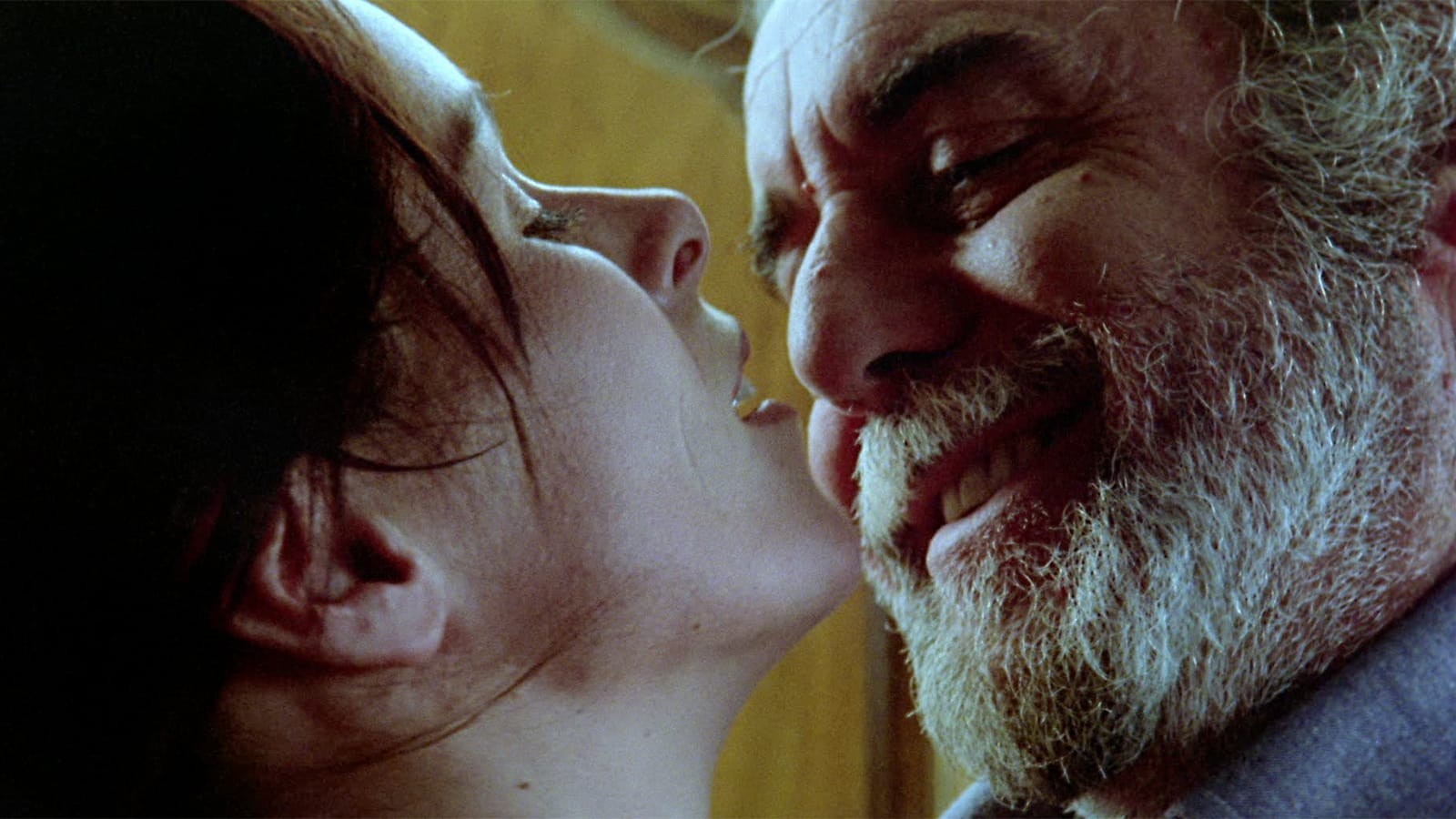
Elisa, My Life (1977)
Their follow-up, Elisa, My Life (1977)—perhaps Saura’s most moving reflection on the communion of past and present—is likewise equal parts filmmaker and performer. “Elisa is the closest I’ve come to expressing my own thoughts in film,” Saura explained to Positif. His tale of sisters reconnecting with their ailing father (the great Fernando Rey) takes inspiration from a real-life picture of Chaplin and her own sibling, which also appears on screen. The actress again plays multiple roles: a wife growing estranged from her cheating husband; her mother, depicted in flashback; and intriguingly, an unrelated woman her father has seen murdered. The film slips elegantly through Buñuelian trance (the old surrealist even remarked that he wished he’d made it), prowling the psychic spaces—half-lit hallways and rooms in which past and present collapse—that Saura and Chaplin had made their own. Still, in some ways it also augured the demise of their partnership. In the same Positif interview, Saura says the film emerged from “the desire to do something about the difficulty of sharing a life with someone.” In performing a relationship on the rocks, was Chaplin drawing from experience?
“When Carlos Saura and I broke up, it seemed like Spain broke up with me as well,” she reflected in 2015. “But it was also a time, after Franco’s death, when everyone wanted to do a film about the Civil War, and there was no place for me as a foreigner.” After two more post-Franco films together—the self-reflexive Los ojos vendados (1978) and the comedic farce Mama Turns 100 (1979)—Chaplin and Saura parted ways, following 12 years of personal and professional symbiosis. Saura was exhausted, he said in interviews of the period, and needed a change of direction—a change that apparently included leaving Chaplin for their 17-year-old babysitter, like some character he’d lampooned in one of their early film collaborations. Chaplin, meanwhile, decamped to Los Angeles to deliver an all-timer performance in Remember My Name (1978), Alan Rudolph’s thriller about a very different specter returned from the past: a woman recently released from 12 years in prison who sets out to stalk the ex-husband likely responsible for putting her there. Her romance with Saura may not have lasted, but their films together endure as singular works of Spanish cinema, testament to a moment of shared genius.

Share:
Recommended
- Geraldine Chaplin and Carlos Saura
 On the formidable collaborations of the Aragonese filmmaker and his American muse.
 - Genevieve Yue’s Trains
 On the offbeat pleasures of the train in Genevieve Yue’s new book.
 - Yuliya Solntseva
 On the actress-turned-filmmaker’s unsung authorship.