
Virgina (1991)
Essay
Virgina
On the rediscovery of a lost film, tackling the complexities and pleasures of gender expression in the Balkans.
Virgina screens at Metrograph from Friday, October 23, as part of Jenni Olson Selects: Mini Masc.
Share:
“VIRDZINA,” OR “BURRNESHA,” REFERS TO the “sworn virgins”—a practice primarily found in the Balkans, particularly in the highland areas of Albania, Kosovo, Montenegro, and to a lesser extent Bosnia, Croatia, and Serbia. Much like other cultural “third genders,” namely in Western Indigenous societies, their existence dates back centuries, and has long transfixed outsiders. They are women who present as male socially in dress, names, and sometimes pronouns, and they take on the duties and roles traditionally prescribed to men within their family units in instances when there are no living patriarchs or male heirs. They swear an irrevocable oath, gaining male privileges with the trade-off of being celibate and unable to marry.
Their stories have been covered in numerous magazines and television reports, the most recent profiles declaring that their subjects are “the last” of their kind. Virgina (1991) by Serbian filmmaker Srđan Karanović is perhaps the most notable and accomplished dramatization portraying the conditions that can lead a traditional family into supporting their female children socially transitioning into the male role of a burrnesha. The film endures as a lean and empathetic 19th century–set morality play. It enmeshes itself into this ancient culture while remaining critical of the ways patriarchal expectations and traditions can destroy a family. Its queerness is arguably incidental but also deeply consequential to the film’s plot, not unlike Barbra Streisand’s 1983 period drama Yentl.
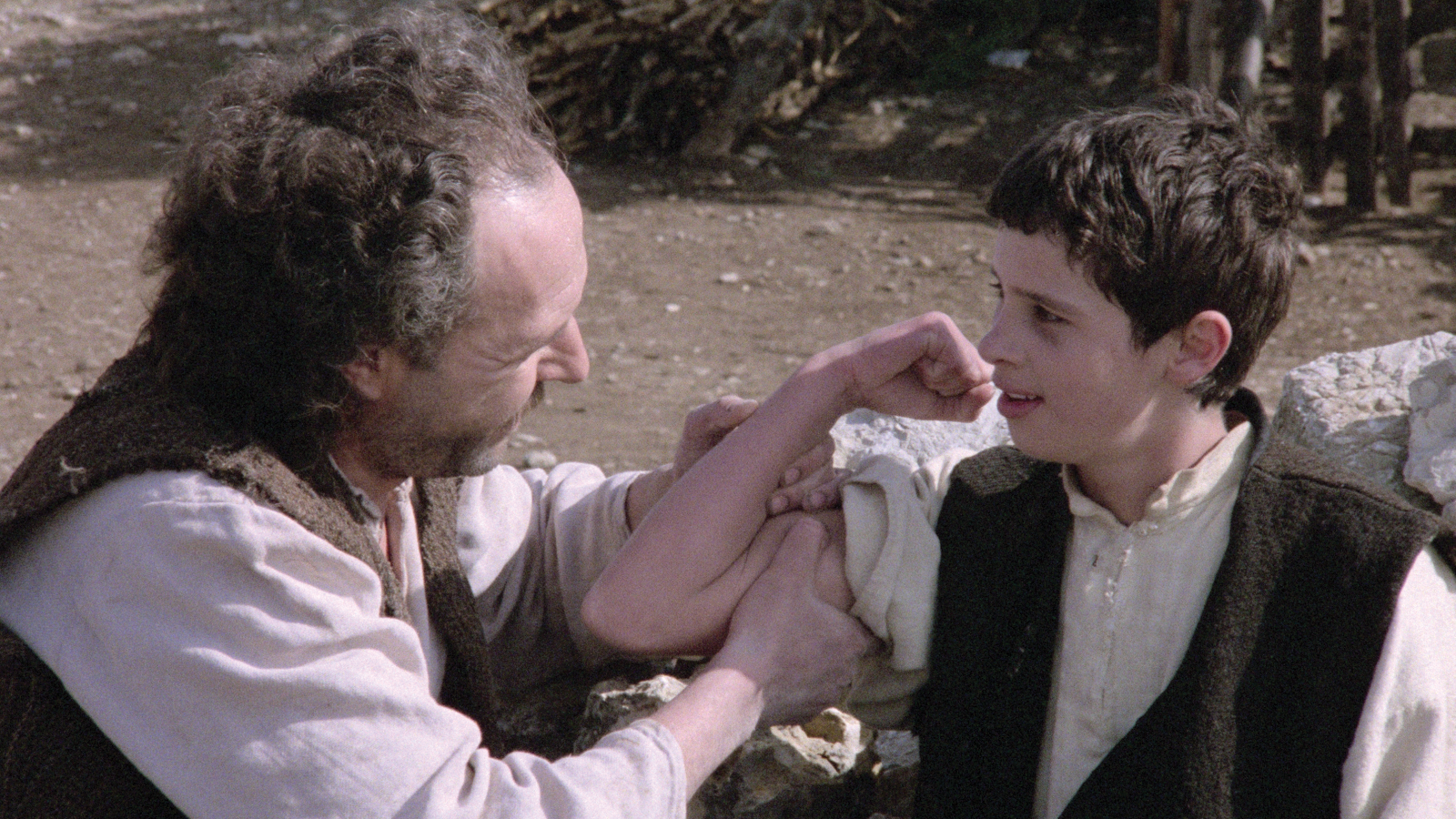
Virgina tells the story of Stevan (Marta Keler), born into a poor, agrarian household ruled by the iron fist of their abusive father, Timotije (Miodrag Krivokapić). The film is set in the mountainside village of Kninska Krajina (present-day Croatia) during the Austro-Hungarian Empire, where the highest authoritarian presence is the Eastern Orthodox Church, with its Great Martyr, St. George. There are only daughters in the family and so Stevan, the fourth child, is—after narrowly escaping being shot at birth by Timotije—presented as the virdzina. In addition to being deeply religious, Stevan’s family is also deeply superstitious. They believe that they are “cursed” for the lack of a male heir—none more so than Stevan’s mother, Dostana (Inka Gogálová). She approves Stevan’s oath, offering words of encouragement that double as a damning indictment of their culture: “Better a rooster for a day, than a hen for life. Everything is made for men.”

Virgina (1991)
Stevan experiences a startling shift in life’s station once he starts being considered a son by his father. Beyond being favored by his father over his older sisters, Stevan has freedom to walk the land and engage publicly with others beyond the home. As a teenager and in the throes of puberty, he meets another boy around his age, Mijat (Igor Bjelan), who takes a shine to him, and soon Stevan’s hormonal urges begin to overwhelm him. The romantic and sexual tension between the two is apparent as Stevan becomes all too aware of their anatomical differences. He ultimately breaks the oath to be with Mijat, who is aware of Stevan’s identity, and together, they try to leave the village. The only social order and traditions they have ever known is collapsing around them. Meanwhile, off- camera, the region was also experiencing its own societal earthquake.
Virgina was completed in June 1991 and released amid a period of tumultuous change and genocidal conflict involving the ethnic cleansing of racial and religious minorities. Starting in 1991, the Yugoslav Wars would stretch over a decade, dissolving the former Socialist Federal Republic of Yugoslavia into ultimately seven different, now independent countries, at terrible human cost. As one can imagine, artists and filmmakers were overwhelmed by the bloodshed and the uncertainty surrounding their splintering territory. In a 1998 interview, Karanović stated that at the height of these conflicts, he thought of at least three different film ideas each time he turned on the radio—but he would not make another feature film after Virgina until the 2003 refugee romance film, Loving Glances.
A Belgrade-born Serb, Karanović is most often associated with the “Prague Film School,” a group of Yugoslav filmmakers who attended the Academy of Performing Arts in Prague and went on to make narrative features and documentaries during the 1970s, the final decade of Jozip Tito’s rule. Karanović’s output prior to Virgina could be described as egalitarian, modern, and at times, experimental. His 1972 film, Social Game, begins with everyday Yugoslavs responding to a casting call in a newspaper whom he handpicks to play parts in his film, and his film prior to Virgina was the 1988 mockumentary A Film with No Name, which directly addresses the political and ethnic tensions in the region. While Virgina has a pretty standard narrative, its message against the dangers of religion and the patriarchy remains subversive.

Virgina (1991)
Though Karanović had made period piece films prior to Virgina, his anti-nostalgic modernist sentiment celebrates the liberation that Stevan finds in his assigned male role, while it also challenges the traditional practices being depicted, focusing its attentions mostly on Stevan’s father, whose brutality and rigidity proves to be not only regressive, but also counter-productive to the survival of his family. The irony of Vigzina is the fact that Stevan’s privileges as a burrnesha give way to his realizations of who he actually wishes to be. Stevan’s trajectory is anomalous to the more common media portrayals of the sworn virgin social ritual, but Karanović’s tale doesn’t dismiss the tradition.
Due to the political instability of Former Yugoslavia, and despite the fact that the film was made by a high-profile director and screened at major festivals such as the Berlin International Film Festival, Virgina nearly became a lost film. Karanović believed the negative had disappeared during the war. Luckily it has been rescued from falling through the cracks of film history due to the efforts of filmmaker, critic, and programmer Jenni Olson, whose dogged pursuit of a film print of Karanović’s work ultimately led her to locate one in a Parisian film lab, leading to the restoration of the film under the supervision of Karanović and the Yugoslav Film Archive in Belgrade, with distributor Altered Innocence assisting in bringing it back to North America theatres.
Virgina is not a queer film and yet Olson, who first saw the film in 1992, reviewing it for the San Francisco-based Bay Area Reporter, remembered it to be a unique film tackling the complexities and pleasures of gender expression that, despite being steeped in traditions and situated in a far-flung region of the past, still managed to connect with contemporary audiences. “Virgina is a stunning film, a complex and interesting narrative about gender, with unique pleasures for a queer audience,” she wrote upon revisiting the restored film. Virgina is indeed a special film and one deserving of rediscovery.

Share:
Recommended
- Virgina
 On the rediscovery of a lost film tackling the complexities and pleasures of gender expression in the Balkans.
- Farley Granger
 On the queer star who defied mid-century Hollywood archetypes.
- Geraldine Chaplin and Carlos Saura
 On the formidable collaborations of the Aragonese filmmaker and his American muse.