
Cracked Actor
Farley Granger
On the queer star who defied mid-century Hollywood archetypes.
Strangers on a Train (1951) plays at Metrograph from Friday, October 16.
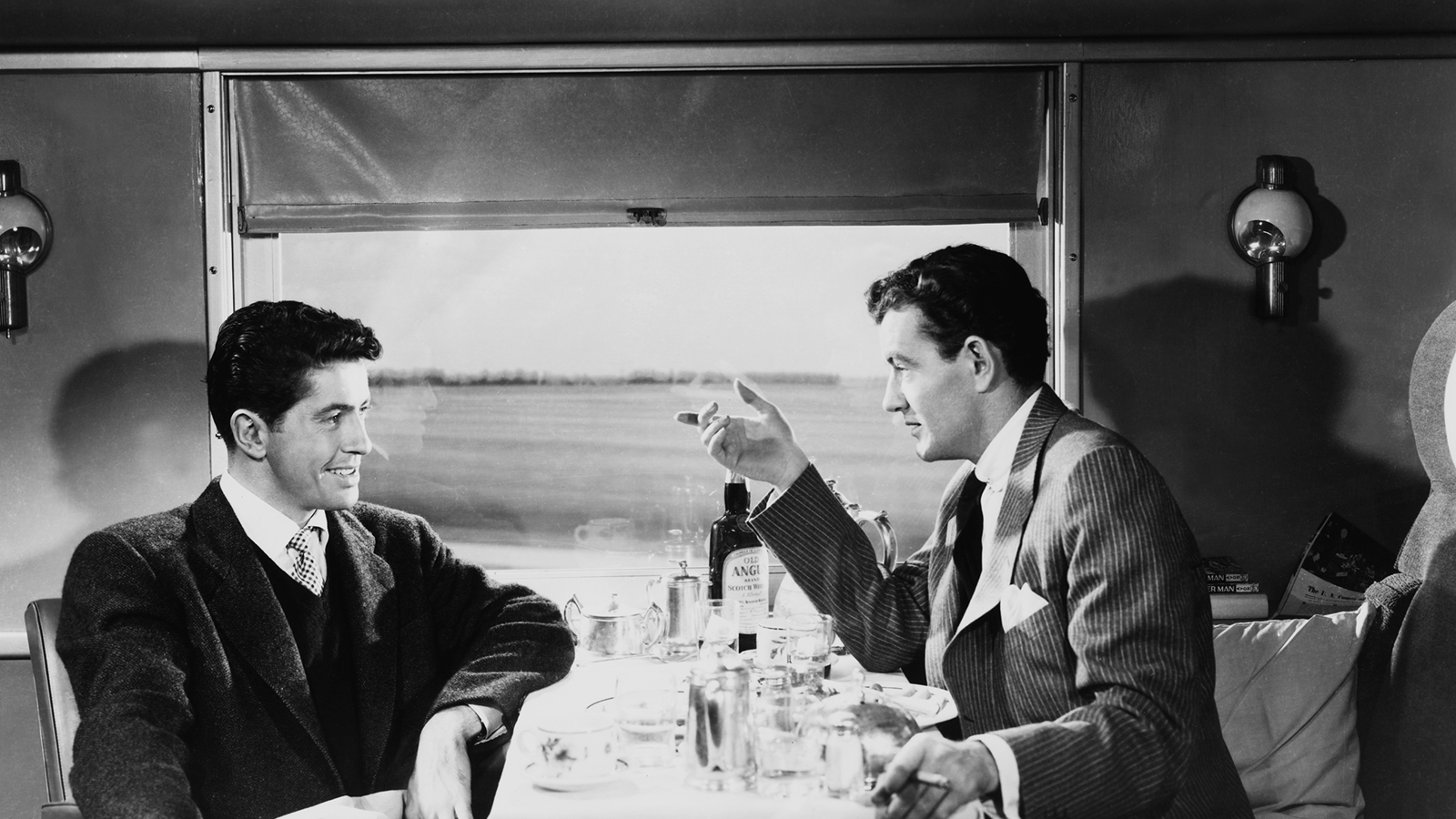
Strangers on a Train (1951)
Share:
BEFORE HE WAS A SILVER SCREEN has-been—before he left Hollywood for New York and theater (and television) in 1955; before he accepted a lead role in the sumptuous softcore giallo thriller Amuck! (1972) and a small part in the third-rate slasher The Prowler (1981); before he was an actor whose estimable early accomplishments under directors Nicholas Ray, Alfred Hitchcock, and Luchino Visconti more than made up for any disappointment inspired in viewers by his piddling latter-day cinematic output, not to mention the insipid studio fare he was compelled to participate in as a contract player under Samuel Goldwyn during his peak years—before all of this, Farley Granger was jailbait.
I am not here making discourteous reference to his “good looks—sensuous face, doe eyes, full lips, jet-black hair,” which, as the critic Richard Corliss wrote in an enlivening obituary for Granger in 2011, “could have come from a casting director’s composite sketch of the Hollywood romantic lead.” His immaculate mug would, anyway, prove most arresting in performances that complicated or denuded the stodgy Tinseltown archetype for which he seemed designed. I’m rather cribbing from the script for Ray’s directorial debut, They Live by Night (1948), a heartbreaking and influential noir about a young couple on the run. Twice in the film an imprisoned gangster’s wife looks at Granger’s indignant, boyish face and drops that word, “jailbait.” The actor was 22; his character Bowie, who’s recently escaped prison in the company of two seasoned criminals, is a year older. Neither, then, technically qualified as “jailbait” according to its common, creepy meaning. But the word has a second definition, one that applies to Bowie as well as to a bevy of the other characters Granger portrayed during his too-brief Hollywood heyday in the 1940s and ’50s. It can designate a person deemed likely to go to jail—a man who can’t properly conceal his criminality, or one whose bad luck and guilty conscience distinguish him as a fantastically attractive fall guy.
As Bowie, Granger’s face radiates a sunny guilelessness that suddenly clouds with distress and flashes with rage when the winds of ill fortune blow. This is a man who’s been incarcerated since he was a teenager, who needs still to believe in the dreams of youth and America—in fresh starts, in his ability to engineer an enviable future from the mangled machinery of his life—and who clings to the hope that he is not, like his fellow bandits, doomed to depravity and violence. Listen to how touchingly Granger says “Keechie,” his beloved’s name: as though Bowie is the sort of “Hollywood romantic lead” who could secure a happy ending despite the odds.
The paroxysms of angry alarm that burst from his otherwise winsome face are little eruptions of recognition that Bowie’s escape will not prove easy. They’re also traces of his apparent innocence: he is both young enough to remain shocked by others’ baseness and betrayals, and old enough to find his surprise disturbing. Bowie’s problem is circumstance: he is trapped by the threats and expectations of his implacable associates, as much as the lies and misapprehensions of the press, which makes out of this naïve and credulous manchild a mythic gunner in the mold of Billy the Kid, a matinee monster the state must at all costs suppress. And suppress him they do, but not before a host of thrilling close-ups framing Granger and his co-star Cathy O’Donnell as their characters fall first in love and then into trouble.

Rope (1948)
By the time of They Live by Night, Granger was already a budding star. He was discovered in 1943 by one Bob McIntyre, the casting director for Goldwyn, during a performance of a play called The Wookie. He signed a seven-year contract with Goldwyn that he would come to regret dearly and, shortly thereafter, aged just 17, secured a role in The North Star (1943), a war picture denigrated by anti-Communists for its sympathetic portrayal of Soviet Ukrainian villagers resisting the German invasion during World War II. (“What the hell is Sam doing making a commie movie?” a gossip columnist asked Granger at the time.) Another war movie, this time for 20th Century Fox, followed—The Purple Heart (1944), featuring Granger as a young American soldier in a unit captured by Japanese forces—before Granger himself shipped out to join the fight, sort of.
Granger enlisted in the Navy but suffered such debilitating seasickness on the boat to Hawaii that he was judged unfit for combat and instead wound up staying in Honolulu to help organize entertainments for troops in the Pacific Theater. While there, he made industry connections and, in a single night, lost his virginity to a local sex worker named Liana (whom he proceeded to date) at an exclusive brothel and then bedded a Navy officer at the same establishment. So began a prolific—if wisely unpublicized—career of bisexuality that saw him spend quality time with everyone from Ava Gardner to the Cocteau muse Jean Marais. “I was never ashamed, and I never felt the need to explain or apologize for my relationships to anyone,” he wrote in his memoir, Include Me Out.
Ray had completed They Live by Night in 1947, but Howard Hughes, the eccentric filmmaker, aviator, and entrepreneur who had taken ownership of RKO studios by then, meddled with the film—renaming it more than once—and withheld the US release until 1949, much to the chagrin of everyone involved in its production. Happily for Granger, Hitchcock caught a private screening of the flick before its release and decided he wanted Granger for the part of the nervous, weak-willed murderer Phillip Morgan in Rope (1948), his adaptation of Hume Cronyn’s 1929 play of the same name, which was in turn inspired by Leopold and Loeb’s much-publicized “crime of the century.” (Granger would also spend a year romantically entangled with Arthur Laurents, Rope’s screenwriter.)
Granger embodies a very different kind of jailbait in this sleek thriller. The film opens just as Granger’s Phillip and John Dall’s Brandon Shaw finish garroting their friend David and tumble his body into a wooden chest. They proceed to throw a fancy party with the deceased parents’ and his soon-to-be fiancée in attendance. The killers are well-to-do former prep schoolers and, it’s implied, homosexual lovers convinced by their sense of their own superiority that they reserve the right to extinguish the lives of inferior humans. As Phillip, Granger wears the brittle, stony look of an undead WASP waiting to be shepherded into the hellish afterlife of a prison cell. He strains to tamp down his emotions—his fear, its transformation into hysterical laughter—and struggles secondarily to conceal the visible evidence of his straining. Granger’s performance teeters between emotional containment and that containment’s failure, between tension and explosion. “That’s a lie!” he yells, boiling over when Brandon begins relating a story in which his partner strangles a chicken. Dall, bitchy, clever, and disastrously self-assured as Brandon, gets to have most of the fun here; he prods the other partygoers with vague hints about David’s demise and giggles at Granger’s character’s belated, self-interested pretensions to remorse.
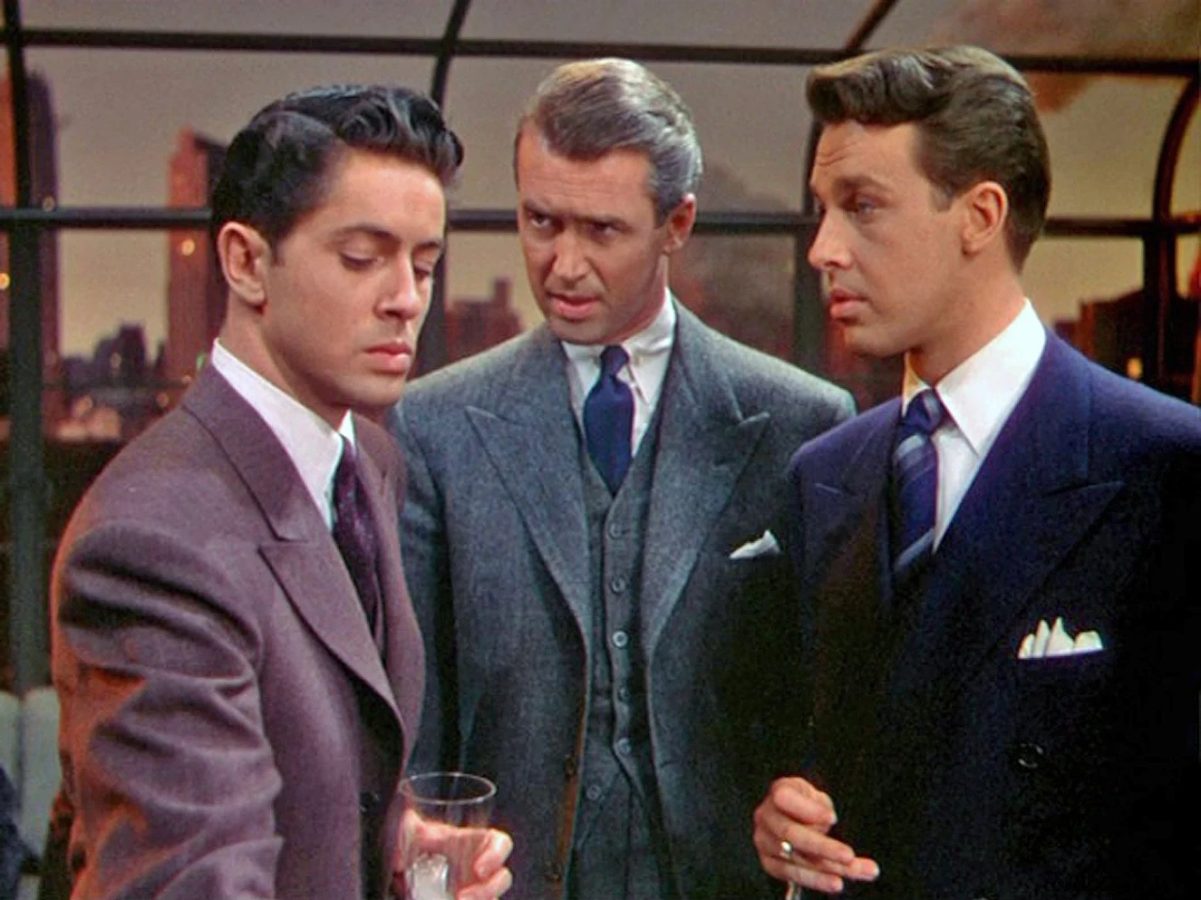
Rope (1948)
The film, shot mostly in a series of long, 10-minute takes—its cuts often hidden via careful camera maneuvering—was regarded by Granger and many contemporary critics as an “interesting technical experiment” but not “one of Hitchcock’s better films.” Furniture and walls were set on wheels so that they could be moved in and out of place as the unwieldy Technicolor camera roved about the apartment set. Critical reception has since graduated from an appreciation of the “experiment” Hitchcock undertook to a genuine appreciation of its art. Its black comedy crackles; its cat-and-mouse game delights and disconcerts; after Jimmy Stewart’s pompous mentor character uncovers his benighted former charges’ crime, his vain attempt to impress the necessity of society’s moral norms on Phillip and Brandon comes off as the film’s darkest joke.
Granger had by now proved adept at playing an adult manque whom older or more openly vicious characters intuited they could contaminate with their will. Perhaps too adept: in his memoir, he bemoans “all the sensitive young man parts I’d been stuck with under Goldwyn.” Still, it’s easy to see why Goldwyn slotted Granger into some of these parts. His youthful beauty and trusting, upright carriage were red meat for bullies looking for marks and mad men seeking accomplices. (Amuck!, the sapphic giallo picture, notably features an older Granger playing against his former type as a sleazy, Nietzsche-quoting novelist who corrupts young women in his Venetian manor.) Granger would continue in this vein in the forgettable noir Side Street (1950), again opposite O’Donnell—and the actor would be the first to admit that a number of the films Goldwyn put him in were, at best, forgettable—before landing his second and last Hitchcock masterwork, Strangers on a Train (1951).
In this adaptation of Patricia Highsmith’s first novel, Granger is not a sensitive young man but a star tennis player and would-be future senator named Guy Haines who wants to strangle his wife. He doesn’t—he grabs her, he shakes her, he yells in a phone booth that he could strangle her, for he wants out of his marriage to this calculating, two-timing woman impeding his social ascent. Instead he has the luck—good or bad for Haines, it’s hard to say—to catch the eye of a garrulous lunatic on a train. Robert Walker, fresh off a real-life crack up and months away from his own untimely death, plays Bruno Antony, the decadent, unhinged, and effete offspring of an uppercrust clan who takes a shine to Guy and proposes a deal: I’ll take care of your problem wife if you take care of my problem father.
Guy laughs him off, but Bruno executes his half of the plan anyway. Later, Granger descends like a shade from his cossetted high society life onto the darkened street to confront his foil. His face captures in stages disorientation, disbelief, and disgust as he realizes what his weird travel mate has done to Guy’s wife and, more importantly to Guy, to his own life. Here Granger, the police’s prime suspect in his wife’s murder, is jailbait, but not a morally pure varietal. In the performance that made him momentarily a superstar, he is a self-interested hero. Once again at the mercy of a charismatic kook, once again embedded in a plot rife with homosexual subtext, he finds within himself the means of producing a performance of vitalizing ambiguity.
Goldwyn and Granger butted heads for years—Goldwyn, taking himself to be a benevolent patriarch, put Granger on suspension more than once. Eventually, at great cost to his career and finances, Granger would buy his way out of his contract. When Granger returned to Los Angeles for a spell some years later, he received no film offers: Goldwyn had instructed the studios not to work with him, and Granger had earlier spurned 20th Century Fox founder Darryl F. Zanuck, one of the few power players unmoved by Goldwyn’s grudge, by turning down his offer to star The Egyptian (1954).
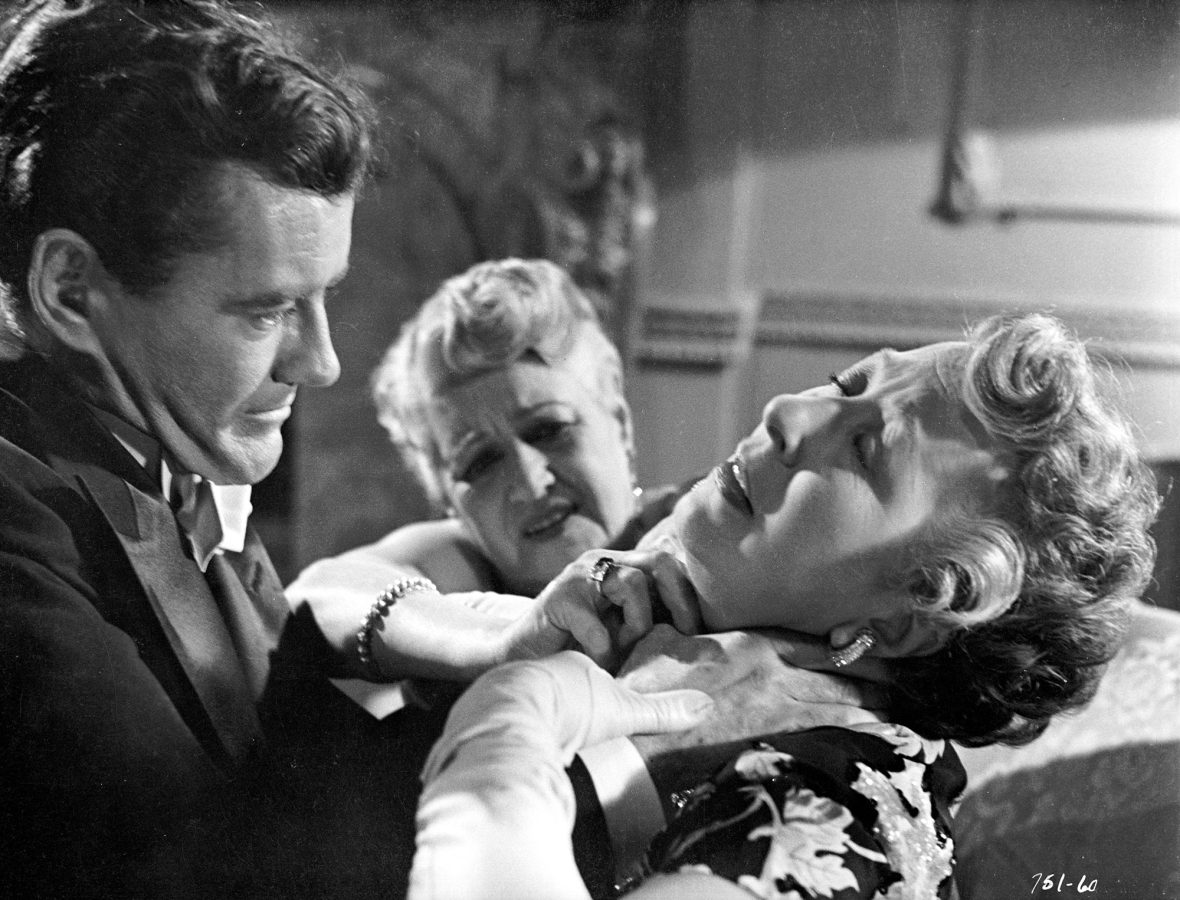
Strangers on a Train (1951)
In dire financial straits, the actor was convinced to travel to Italy for a three-month shoot that tripled to nine. Granger hadn’t heard of the director, but he was won over by mention of Tennessee Williams’s involvement and a handsome payday. At last, he would be playing a man living through a hard time, not one facing hard time. Near the end of Visconti’s lush and wrenching period melodrama Senso (1954), the Italian aristocrat Livia Serpieri, played by Alida Valli, travels a perilous road in pursuit of a former Austrian officer named Franz Mahler for whom she has betrayed the cause of her inchoate nation (as well as the friends and family members who have risked their lives to win its independence). The year is 1866 or so. War has broken out between the declining Habsburg empire and its rebellious peninsular holdings, and Serpieri is on the verge of a nervous breakdown. Overcome with longing for her lover—who resides behind Austrian lines after having secured an illicit leave from the military using money she provided him—Serpieri surrenders her comfortable future as a contessa in a sterile but manageable marriage. She hopes that this man, a striking ladykiller who has instructed her in plain terms not to come to him, will fill and fulfill her. She is a fool for love fleeing safety for ruin. And because the object of her passion is played by Granger, we can see where she’s coming from.
When Serpieri lands in his apartment, Granger’s Mahler has lost the upright elegance and cool martial nobility he channeled while courting her. Disheveled, drunk, and unstable, he wears a deep green robe with maroon stripes; he is unshaven, and strands of his unkempt brown hair, dyed from Granger’s natural black for the production, curl across his forehead. In a matter of minutes, the actor’s screen idol face cycles between joyful viciousness, inconsolable regret, and devastated vacancy. “Austria will be finished in a few years, and a whole world will vanish, one to which we both belong, you and me,” he says through tears, his right hand gripping the back of his chair for support. Moments later, as Serpieri weeps at a table, he stares at her, his face blank with shock, his eyes watery. “I am not your romantic hero!” he declares. Granger’s character means to disabuse Serpieri in cruelest terms of the fantasy she has cultivated. He is not her soulmate but a fearful and frightening cad unwilling or incapable of orienting himself in the new reality that is being born.
In retrospect, he might seem also, to be disabusing his audience of their hopes for his future on screen. “I had no interest in becoming a household name or in playing by the rules of the game to become a movie star,” he writes in his memoir. He wanted to be a great actor. The scene, which marks the high point of Granger’s film acting career, proves that he was.

Share:
Recommended
- Farley Granger
 On the queer star who defied mid-century Hollywood archetypes.
 - Geraldine Chaplin and Carlos Saura
 On the formidable collaborations of the Aragonese filmmaker and his American muse.
 - Genevieve Yue’s Trains
 On the offbeat pleasures of the train in Genevieve Yue’s new book.