
The Curse of Frankenstein (1957)
Essay
The Curse of Frankenstein: To Victor, The Spoils
The Old Dark House smash that rang in Hammer’s postwar horror new wave.
Terence Fisher: Hammer’s Master Smith is now playing at Metrograph.
Share:
FOR BELOW-THE-LINERS EMPLOYED by Hammer Film Productions, Monday, November 19, 1956, didn’t substantially differ from any prior workday morning. Arriving at the designated Hammersmith corner by tube and taxi, the crew clambered aboard a decommissioned London bus purchased a few productions back by Hammer’s penny-wise managerial brain trust for bang on schedule departure at 7:30am. The company’s motorcyclist accountant met up with the bus en route, leading the two-vehicle motorcade along the either picturesque or perilous, depending on the weather, Great West Road, arriving at Hammer’s production facility Bray Studios at 8:20am. Self-reports included Jock May, the unit sound recordist, arriving via canoe from his home upriver.
On this day, the Hammer unit was embarking on an experiment—The Curse of Frankenstein (1957)—a film destined to succeed beyond the wildest expectations of everyone involved in its making. The studio had up to this point extruded crime thrillers, comedies, costume dramas, and the odd war picture through its frugal production mechanism, and would continue to do so up to the company’s demise in the 1970s. But The Curse of Frankenstein would forever identify Hammer as the Seventh Art’s preeminent postwar purveyors of Gothic horror, and its director, Terence Fisher, as the premiere stylist of same. “Anybody who has made a horror picture since 1957 has been influenced by Terence Fisher,” attested John Carpenter. “He changed the rules and set the standards.”
From a production and distribution view, the conventions and standards of UK filmmaking were mercurial at best. Arguably, the British film industry had been in survival mode almost from its inception. By 1956 upward-spiraling costs, government-mandated censorship, potentially self-asphyxiating union strife, the benefits weighed against the burdens of native protectionist production quotas and levies, along with the still-present aftermath of World War II, all inclined old-guard UK filmmaking fiefdoms to be increasingly desperate in their scanning of the horizon for better days to come. Upstart Ealing Studios had, for instance, sold out to the BBC and J. Arthur Rank only the year before, and Rank would be driven largely out of the movies and into the photocopy business less than a decade hence.
But at Hammer, and its distribution imprint Exclusive, a postwar boom in almost indiscriminate moviegoing throughout the British Isles (and a legislated obligation to churn out native “quota quickie” B features) had thus far kept the lights on, the cameras rolling, and the paychecks clearing. The grips, sparks, wardrobe, make-up, camera, and continuity craftspeople filing off the bus that November morning were all returning from a break that had halved from two weeks’ off to just one, in order to realize Hammer’s upwardly ramping output. Thanks to the schmoozing aegis of Hammer’s chief executive James Carreras and the parallel pragmatic thrift exercised by both James’s son Michael and fellow producer Anthony Hinds, Hammer had sailed the fickle tides of the peacetime picture business with as yet nary a wreck.

The Curse of Frankenstein (1957)
Bray Studios, for instance, was a Thameside mansion, a Gothic folly originally constructed in 1750 near Maidenhead. Its initial owner—an MP for surrounding Windsor who christened it Down Place—inherited all 48 portraits of the esteemed members of his great uncle’s anti-monarchist fraternal salon, The Kit-Kat Club, which he dutifully hung in a gallery hall added to his home for that purpose. Nearly 200 years later, with the Kit-Kat portraits in the possession of the National Trust, Down Place was concluding its WWII service as a vast, increasingly dilapidated ad hoc warehouse for unused British Army winter coats. Purpose-built UK film stages had largely been shuttered or commandeered for war office use and V-J Day saw leasable UK studio space rendered virtually non-existent. To meet demand for cheaply made second features (i.e. the less prestigious half of the double bills that mid-’50’s ticket buyers were accustomed to), Hammer leased a succession of disused estates, replete with moldering ballrooms and overgrown gardens—never mind that physical conditions at such poetically named locales as Cookham Dean and Oakley Court frequently meant that camera crews and lights were placed outside, shooting in from under tarps in the rain, or that takes were sometimes interrupted by roof leaks or a passing barge horn.
An initial rental of Down Place proved sufficiently suitable that Hammer bought the property outright in 1951, despite a sellers’ stipulation that its prior owners remain living in an otherwise disused south wing. A flurry of interior gutting and the addition of a pair of exterior soundstages further transformed Down Place—rechristened Bray Studios—from a nearly derelict residential white elephant to an, if not state of the art, at least thriving studio. Through the mid-’50s, Hammer’s assembly line kept rolling, with native radio adaptations and starchy but polished crime mellers fronted by fading American stars, like Stolen Face (1952), in which Lizabeth Scott sinks her purring underbite into a plastic surgery revenge masquerade, and Four Sided Triangle (1953), featuring Barbara Peyton sleep-pouting through a kind of tweed-and-vacuum tube cloning drama.
Hammer’s essential survival tactics included distributing low-budget American films proffered by similarly entrepreneurial independents in the States. In the wake of exhibiting US producer Robert Lippert’s Rocketship XM (1950) to surprising success in UK cinemas, Hammer optioned The Quatermass Experiment (1953). The hugely popular BBC TV science fiction serial, written by Nigel Kneale and directed for live broadcast by Rudolph Cartier, dramatized the sole survivor of the first crewed flight into space returning to earth, unknowingly harboring a bloodthirsty alien agenda. Ably directed by Val Guest and fronted by toupee-clad functional alcoholic Brian Donlevy, the film version—retitled The Quatermass Xperiment (1955) to alert movie audiences to its adolescent-and-up appeal—hit big. As rapidly as possible, Hammer produced a standalone rip-off movie, X The Unknown (1955), with repeat success, and then commissioned an audience survey to better understand just why the two had done such good business. What they learned, as Wheeler Wilson Dickson observes in his estimable critical biography of Fisher (to whom we’ll return in a moment) was that “what really appealed to the audiences for these films was the ‘horror’ angle, rather than the ‘science fiction’ angle.”
In early 1956, tyro screenwriter Milton Subotsky arrived at Hammer House on Wardour St. with a self-penned script entitled Frankenstein and the Monster and a letter of introduction from a stateside colleague James Carerras had recently wooed into coproduction. Subotsky and his script survived a few rounds of notes before the young American was shown the door with a check in hand for ceding his foundational idea: a Frankenstein story foregrounding its implacably, profanely ambitious titular doctor over his star-crossed creation. The nascent project was then turned over to Jimmy Sangster, who’d lately been battlefield promoted at Bray from first AD to scriptwriter.
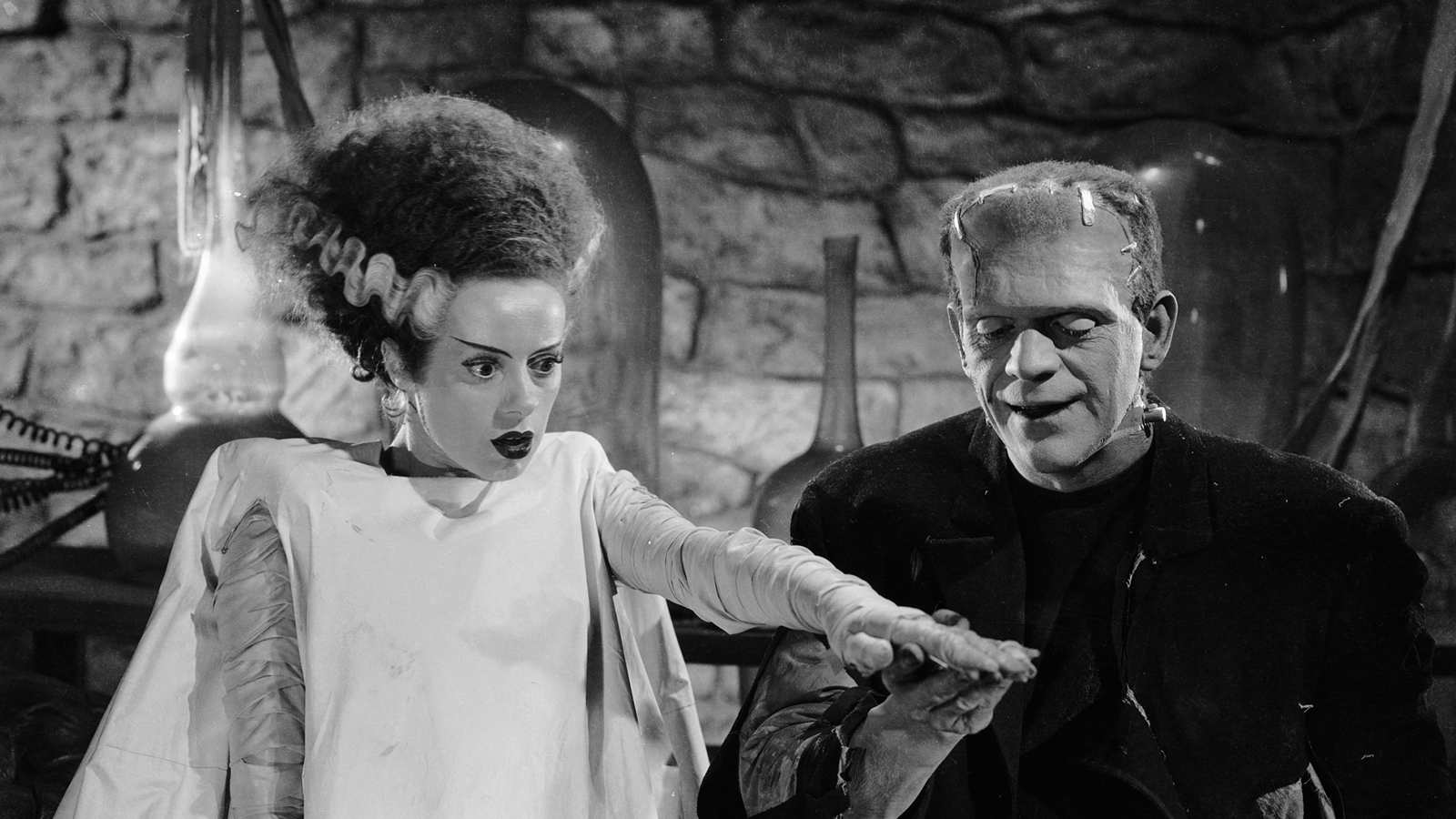
Sangster’s Frankenstein script needed to acknowledge several practical realities. While Mary Shelley’s 1831 novel itself was public domain fair game, Universal Pictures in Hollywood held absolute copyright sway over everything unique to their justifiably renowned pair of initial adaptations, Frankenstein (1931) and Bride of Frankenstein (1935)—both helmed by James Whale—as well as to their increasingly forgettable sequels, an exclusion including, but not limited to, Jack Pierce’s emblematic bolt neck-and-flattop make-up design. (Hammer’s attorneys were nearly instantaneously in receipt of first shot litigation correspondence from Universal’s legal department to prove this.) And, in truth, neither a straight adaptation of the Shelley novel nor a remake of Universal’s prized back catalog possession were possible at Bray. Hammer simply couldn’t afford to realize budget-nuking extravagances like the icefloe-set climax of the book, let alone comparatively modest tropes of Whale’s already off-limits originals.
Bride of Frankenstein (1935)
“Every other Frankenstein movie, before or since, has had a bunch of irate villagers descending on the castle,” Sangster writes in his memoir. “Villagers cost money,” he recalls hearing at a story conference, “so eighty-six the villagers. Talk about them if you like. Threaten to get their help. Hear them baying in the background. But keep them off screen.” Hammer’s high bang for the quid expectations extended in every direction. “Keep sets to a minimum,” Sangster was told, “have as few locations as possible, and certainly no more than 30 minutes’ drive from the studio. No special effects please, and not too large a cast. Oh, yes, one other thing, design the script so that the director can shoot it in four weeks maximum.”
Sangster’s final script dutifully circumvents the two cinematic urtexts that Universal were so eager to protect. Like Shelley’s novel, Sangster’s saga is bookended with confession. But unlike the book, Baron Victor Frankenstein’s confessor isn’t a sympathetic sea captain, but a wary and sanctimonious priest summoned to a death row dungeon on the eve of the baron doctor’s execution for murder. Rather than pursuing absolution or, as is often misunderstood by audiences, a reprieve, Frankenstein seeks a final soap box from which to trumpet his achievements to the unappreciative world he’s scheduled to depart at first light. “In contrast with Mary Shelley’s febrile idealist,” critic Raymond Durgnat observes, Hammer’s baron “represents both the cold cruelty, and the courage, of science.” Without stooping to spoil, Sangster’s free adaptation sheaths the doctor’s origin, his arranged marriage to his first cousin, an upstairs/downstairs pan-class romantic betrayal, multiple murders, and the creation, destruction, and re-creation of the monster that Hammer hoped audiences would pay to see in three fast acts of pulpy human malfeasance, bursting a girdle of period politesse.
Hammer’s choice of director for The Curse of Frankenstein was just fine with Sangster. “I’d worked on a half a dozen movies in one capacity or another with Terry Fisher,” he writes. “I knew exactly how long it would take him to shoot a certain sequence, I knew how much it should cost.” At 52, Fisher was a veteran of over 25 features, nearly half of those made for Hammer—including the aforementioned Scott and Peyton vehicles—though none as ambitious as the one he was about to undertake. But Fisher’s gifts were substantial, even if they were up that point frequently obscured by creative and coherence license necessarily taken in the name of inferior scripts, penurious budgets, and desiccated schedules.
Hammer’s top brass, the Carreras’ and Hinds, had each coattailed into the picture business via wealthy forebears already bit by the showbiz bug. But Fisher was a child of empire. Both of his parents were born in India to career soldiers. A few years after baby Terence’s birth in Maida Vale in 1904, his father abandoned a promising career as a bank clerk and moved the family to Sri Lanka in hopes of becoming a tea plantation owner, there to promptly succumb to tetanus. Returning to London, wee Terry’s widowed mum chose an appropriately economic destiny for both an overburdened single mother and an only child of modest means and precocious curiosity. “My mother thought that a period at sea would give some direction to my life,” Fisher recalled. His term in both a sort of floating school concern on board a Crimean War vintage former Royal Navy battleship and subsequent Merchant Marine service perhaps broadened his horizons more than Terry’s mother intended. “It put me in the way of a great many temptations. You can write my sea experience down to my sexual education. Also intellectual, because I saw places and people I’d never seen before.”
The Curse of Frankenstein (1957)
Back on dry land, young Terence made ends meet at a variety of jobs. Fisher-conceived department store window displays for Van Heusen collars and Jacob’s biscuits hint at a flair for crafting sub-proscenia within camera setups of the sort that gild his subsequent directorial career. Nights and weekends were split between the pub and the pictures, having joined a subsequently lionized screening cabal now known as the London Film Society. Other members around the same time included Carol Reed, Alfred Hitchcock, and Michael Powell, alongside a host of anonymous prewar London Rep Rats that The Daily Graphic described as “women in the most fantastically mannish clothes, and grotesque young men with bare heads and abundant cascades of hair.”
Inspired by the Film Society’s largely European bill of fare (uncensored, unlike commercial UK cinema going of the moment, due to the society’s membership-only private audience) and an ardent admiration for American mainstream directors John Ford and Frank Borzage (“the greatest genius in the history of film”), Fisher leveraged an entry-level gig at Gaumont British at the unheard-of age of 28. (Future Hammer director Roy Ward Baker was, for instance, barely 17 when he took an identical job a few years later.) The wizened ambition of maturity quickly inclined Fisher away from the camera department and into the cutting room.
From the editing bench, Fisher voraciously consumed the syntax and grammar of film, measuring the merit of performances, the meter and tempo of camera movements and cuts, and the advantages of including or omitting closeups and inserts, while working for directors as varied as Robert Flaherty, Robert Stevenson, William Beaudine, and Hitchcock himself. Fisher’s editing career climaxed late in WWII at Gainsborough Pictures where a particularly sharply dressed in-house strain of politely lubricious period melodramas had caught on with home front audiences. The success of Fisher-edited The Wicked Lady (1945) sent co-star James Mason to Hollywood, and Fisher to the director’s chair. Fisher’s 1947 directorial debut, Colonel Bogey, the Noël Coward melodrama The Astonished Heart (1950), and a particularly imaginative Victorian set-thriller So Long at the Fair (1950) became calling cards for a subsequent decade of alternately fleetfooted and perfunctory, invariably swiftly made second features and TV episodes at Gainsborough, Hammer and elsewhere.
During the accelerated prep period for The Curse of Frankenstein, Hammer assembled a cast of barely big screen names in the UK who were, to the anxiety of the studio’s cross-pond backers, uniformly unfamiliar names in the States. Though 43 at the time, Peter Cushing was nevertheless a fresh new face to British television audiences via a popular 1954 small-screen adaptation of George Orwell’s 1984. Having seen Hammer’s preliminary announcement of their Frankenstein film in the trades and an admirer of Whale’s films—an otherwise fruitless prewar trip to Hollywood coincidentally yielded a small part in Whale’s The Man in the Iron Mask (1939)—Cushing instructed his agent to contact Hinds and company on his behalf. The part of the Creature (hedge betting Universal’s legal department extended to Hammer’s choice to not designate him the “Monster”) fell to Chrisopher Lee, a veteran of J. Arthur Rank’s The Company of Youth alongside Dirk Bogarde, Petula Clark, and Patrick McGoohan, and some 41 films since. Lee was largely at a career wit’s end, fed up with a native industry ill-equipped to utilize his half-Italian features, marvelously booming baritone, and towering six-foot five-inch frame. “I had been told for years that I was too tall and too foreign looking,” Lee later remarked. “I thought, ‘Well, I haven’t been getting anywhere looking like I do, so if I cover myself in peculiar make-up and it’s a success, people will wonder what I really look like.’”
The Curse of Frankenstein “was originally scheduled as a quick inexpensive follow-up on the Hammer treadmill,” lighting cameraman Jack Asher recalled. “I don’t think it’ll amount to anything,” Asher’s operator Len Harris remembers being told. Hammer’s creative vision for the film was made abundantly clear: “Rich-looking, slow, deliberately paced, bursting with unstated sex but with nothing overt—no nudity, no dolly girls,” Hinds advised.
And when cameras rolled that Monday in November, Hinds was on hand to urge expedience above all else. “Everybody always takes it easy at first, then panics in the afternoon, trying to get the day’s schedule done,” he said. “I was there to remind them to start panicking first thing!” Hammer’s tight-knit unit would occasionally encounter Fisher’s ultimately career-hobbling alcoholism—but it had long since became just another part of the workday. “The crew liked and respected him and would do their best to cover for him on those mornings he would arrive at the studio in a cab, having been out all night, God knows where,” Sangster writes. Hungover or not, Fisher always did his homework. “I’ve had my call sheet,” Fisher later explained. “I know what scenes are to be shot—I know what they mean… I know exactly how many shots I’ve got to do, where I’m going to put the camera.”
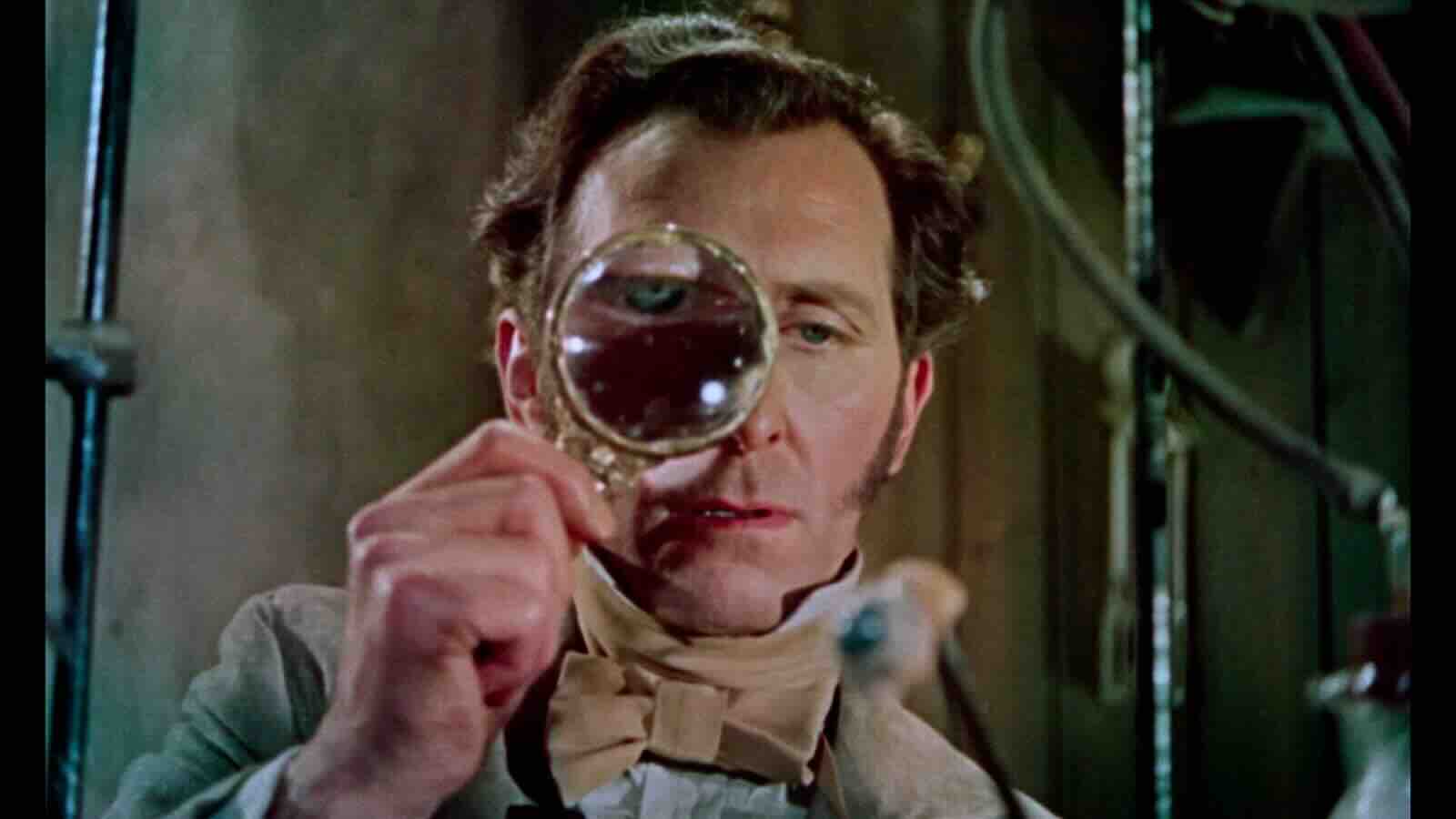
Actors were colloquially referred to as “artists” on UK sets of the era, and Fisher treated them as such. “He used to let the artists do it,” Hammer’s still photographer John Jay remembered. “He’d have a scene to do and stand there and say, ‘Well run it for me.’ He was a very good director that way and I think the artists adored him for giving them such a free hand.” Cushing and Lee quickly proved themselves particularly sympathetic hires. As the adult baron, Cushing’s cadaverous frame, lofty, near-Metalunan forehead, cantilevered high cheekbones and lipless, hard ‘r’ gargling, uptalking diction leapt off the screen and soundtrack with equal élan. Within another film or two—Hammer booked him for The Abominable Snowman (1957) before The Curse of Frankenstein even wrapped—Bray crews affectionately nicknamed Cushing “Props Peter” for the extraordinary lengths to which he went to imbue virtually anything in his character’s grasp with dramatic life. The same went for the written word. In scenes devoted to debating ebbing ethics and describing increasingly outrageous next moves, Cushing revealed a genius for dispensing exposition. “Peter is the greatest guy at speaking unbelievable dialogue,” cinematographer and director Freddy Francis observed in a 1993 interview. “I’d listen to Peter talking all this rubbish on the screen and I’d think, ‘That must be true.’”
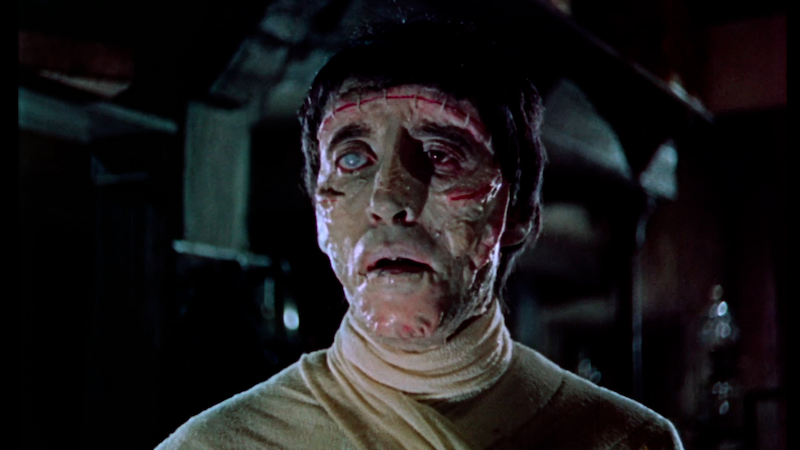
Necessarily shorn of his distinctive baritone and Rank Charm School diction by a scripted obligation to confine his delivery to shrieks and moans, and with his semi-Continental features obscured by lumps of fish belly-white makeup kit flesh, bloodshot contacts and a hairstyle that seems, in hindsight, to have predicted those of Eric Burdon & The Animals, Lee brought the Creature to life as a kind of undead marionette. “I wanted to convey the feeling that he was disconnected,” he said. “He’s been put together from bits and pieces of somebody else and the brain, which controls everything, has been damaged, so the movements, the head, the body, the hands or the legs, are not coordinated.”
The Hound of the Baskervilles (1959)
With each show of dailies (sometimes preceded by Cushing and Lee improvising a soft shoe routine while still in costume) for the assembled crew and execs, it became increasingly clear that Hammer had bet on a winner. Accordingly, the film’s schedule grew to meet heightened expectations. “I knew a third of the way through the shooting of the film that it was going to do something,” Fisher said. “Hammer, I don’t think, knew until later. There’s was a commercial assessment. Mine was a different assessment. I wasn’t interested in how much money it was going to make, I was interested in the achievement of the film itself.”
The rushes displayed a spectacularly grotty grandeur. An eleventh-hour decision to shoot the film in Eastmancolor—not, as originally planned, in black and white—paid dividends, with a lush palette and wide latitude of hued moods and options. Bold swaths of reds and greens with deep crepuscular shadows (“It’s what lights you leave off that count,” Asher once assured Harris) cocoon the severed hands, bubbling and sparking lab equipment, fetid cells, and heaving bodices that Sangster’s script itemized with a wonderfully impressionistic visual intimacy. A harrowing yet bucolic scene of a fatal encounter with Lee’s Creature in an autumnal woodland setting was shot, for convenience’s sake, immediately next door to the studio, and at Fisher’s suggestion the scenic crew applied individual daubs of red paint to leaves and berries within the frame to achieve the right bloody-minded tone on screen. “This was something that people wouldn’t notice but which subconsciously effects them,” he said.
Sets and decor were the work of yet another last-minute hire and Gainsborough vet, Bernard Robinson, who imbued the scripted proceedings with appealingly Brummagem expressionism. “Every room in the very rich Frankenstein’s house seems a bit small and/or oddly shaped,” Farran Smith Nehme writes in a 2106 appreciation of Robinson’s craft, “The whole house feels squeezed in an upward direction.” The designer’s remarkable aptitude for realizing, per Nehme, “opulence with a few strategically placed drapes,” subsequently made Robinson as vital a Hammer fixture as Fisher, Cushing, or Lee. Hammer screen excursions to pharaonic Egypt, WWII Burma jungle, turn of the century Hong Kong, India under the British Raj, a Himalayan monastery, the moors of Dartmoor and innumerable Mitteleuropa Gothic locales were all made courtesy of Robinson’s ingenuous repurposing of flats and properties from prior films and boldly redressing studio-adjacent exteriors into whatever exotica a given script required.
True to Fisher’s cutting-in-camera methodology, editing the finished film proved a mere matter of polishing, an ongoing assembly begun soon after principal photography commenced. An obligatory memo volley with the British Board of Film Censors (BBFC) generated such fine cut notes (painstakingly compiled by Hammer scholar Wayne Kinsey) as “The monster has been on fire for some little time and it would seem natural to suppose that he would scream during the earlier process of his discomfiture.” In the end, Hinds’s strategy of baiting the BBFC with more obviously objectionable material in both script and initial edit than Hammer ultimately intended to include paid off: The Curse of Frankenstein was awarded the UK “X” certificate the company sought all along.
From the day The Curse of Frankenstein premiered May 2, 1957, at the Warner Theatre on Leicester Square, it was a bone fide smash. The limited opening broke its own box office record second week. The film went wider later in the month and continued to play to packed houses straight through the summer. Hammer’s turn towards the Gothic was a fait accompli and the film hadn’t yet opened in the US yet, where it would go on to earn back 30 times its budget. “I enclose a new batch of figures which are quite fantastic,” James Carreras wrote to an American co-financier in July. “England is sweltering in a heatwave and NOTHING is taking any money but The Curse of Frankenstein.” He ends the letter: “P.S. DRACULA???”

The Brides of Dracula (1960)
Contemporary critical response to the film was nearly uniformly unkind and unappreciative and irrelevant where ticket sales were concerned. Derek Hill’s now somewhat infamous declaration in Sight & Sound that The Curse of Frankenstein was “immediately reminiscent of concentration camp atrocities” was, I don’t think, entirely inaccurate. There is more than a whiff of latent genocidal mania to Cushing’s Frankenstein and the implication that, despite the film’s definitive conclusion, his heedless zeal to bring both nature and humanity to heel would continue regardless of the body count, which it did over four filmed sequels.
“The blend of Technicolor elegance and cold savagery gives something at once frozen and libidinous,” Durgnat observed, though my personal favorite assessment comes from Derek Granger in The Financial Times’ otherwise politely dismissive review: “By the time the bits and pieces of the creature are finally assembled, the thing emerges from its zinc bath looking rather like an animated version of one of Mr. Francis Bacon’s more unnerving figure studies.” Perhaps the lowest hanging current contextual fruit would be to equate Frankenstein’s heedless passion to create an unnervingly autonomous man-made conscious entity with a certain two-letter ongoing media panic, but I can’t quite bring myself to go there.
Around the same time that Stanley Kubrick and James B. Harris licensed a clip from The Curse of Frankenstein for Lolita (1962), François Truffaut, in conversation with Hitchcock, had this to say about British cinema:
My idea, and I’m not sure if I’m right about this, is that in Britain there was and in my mind there still is, something which is difficult to define, but which is anti-cinematic in the plastic sense. There’s an incompatibility between cinema and Great Britain, which is perhaps an excessive way of formulating it. But I think on a number of levels there are British characteristics which sort of go against cinema.
I fully agree with Truffaut on one point at least: he’s not right. Let The Curse of Frankenstein itself provide one of many rebuttals. Filmmakers from Mario Bava to Kenji Misumi, the Kuchar Brothers to Tsui Hark would likely all agree—never mind the mainstream pantheon of branded auteurs like Carpenter, Dante, Polanski, Scorsese, Lucas, Coppola, Burton, Del Toro, Eggers, Biller, et al. who are on record with praise, creative co-opting, or casting tributes to what Fisher and company wrought in that damp home counties winter of ’56-’57.
With each clock tick in these narrative film grammar end times, it becomes clearer that Fisher’s influence, one in which delicately balancing ambitious preconception with on-set reality, valuing good actors’ instincts, and resisting the temptation of elevating directorial ostentation over narrative clarity as today’s wearying ranks of “oner” addicted camera choreography blowhards seem unable to do, is perhaps more worth recommitting to than, say, Jean-Luc Godard’s largely joyless cinematic onanism. Reverse ageism on my part perhaps, but as New Waves go, I prefer the one that hungover but fully prepared Fisher and a crew of production warhorses inaugurated in the name of a paycheck, a bus ride home with heads held high, and hopes of making last orders at their respective locals. With The Curse of Frankenstein, Terence Fisher inaugurated “Thee New Wave.”
Written in fond memory of Roy A. Loney and Elliott Stein.

Share:
Recommended
- The Curse of Frankenstein: To Victor, The Spoils
 The Old Dark House smash that rang in Hammer’s postwar horror new wave.
- Kogonada
 On the filmmaker’s observational portraits of time and space.
- Virgina
 On the rediscovery of a lost film tackling the complexities and pleasures of gender expression in the Balkans.