

Artist Portrait of Lorraine O’Grady, 2023. Photo by Lelanie Foster. Courtesy of the Lorraine O’Grady Trust and Mariane Ibrahim.
Interview
Zawe Ashton Honors Lorraine O’Grady
On the boundary-defying conceptual artist whose craft inspired the next generation.
Lorraine O’Grady: Rivers, First Draft Performance plays at Metrograph from Sunday, November 15.
Share:
AT 45 YEARS OLD, LORRAINE O’GRADY performed a poetic coup as Mlle Bourgeoise Noire (Miss Black Middle-Class), an alter ego she used to protest two exhibition openings at the New Museum and Just Above Midtown (JAM), a Black avant-garde gallery run by Linda Goode Bryant. This was O’Grady’s artistic debut: dressed like a pageant winner in an elaborate floor-length gown stitched with 180 pairs of debutante white gloves, she handed out a bouquet of white chrysanthemums bound with a long piece of sailing rope that mimicked a white cat with nine tails. The rope, termed “the whip-that-made-plantations-move,” referenced slave foremen on Southern plantations. She then self-flagellated repeatedly until she reached 100 lashes. This radical performance—like Howardena Pindell’s iconic Free, White, and 21 (1980)—enlists the body as a mode of intervention, critiquing institutional racism and the ways Black women creatives are still largely made invisible. Mlle Bourgeoise Noire was a declarative statement for Black and white art spaces to unlearn the abstraction that still dominated the industry; she revolted against the idea that Blackness is homogeneous.
Driven by a rebellious, category-defying philosophy and a chameleon-like ability to work across disciplines, O’Grady refused to conform or wait for folks to play catch-up. Born in Boston in 1934 to Jamaican emigres, she was raised in a highly accomplished Caribbean community. Her middle-class upbringing, which she challenged, would later inform how she approached her art and cultural criticism when interrogating questions of race, class, gender, and hybridity. Her canonical 1992 essay, “Olympia’s Maid: Reclaiming Black Female Subjectivity,” examined the Western construction of femininity, in particular through the maid figure in Édouard Manet’s oil painting Olympia, widening the lens through which art history engaged with Black women figures in 19th-century art and their contributions to Modernism.
For more than four decades, until her passing in 2024, the artist cultivated a body of work spanning performance, photography, video, and installation, which are currently on view in major institutions around the world. Most prominent among them are stills from her one-time-only performance, Rivers, First Draft, or the Woman in Red, performed in the northern section of Central Park on August 18, 1982. Considered her most autobiographical piece, its influence has transcended the small audience of friends from JAM and passersby who happened to stumble upon the performance. Never-before-seen footage of Rivers alongside the short film Meeting Lorraine O’Grady (2017), commissioned by the Tate and directed by Zawe Ashton, takes us to the site in Central Park where O’Grady first performed Rivers. Ashton, an accomplished performer and stage actress herself, has starred in Dreams of a Life (2011), Nocturnal Animals (2016), and Velvet Buzzsaw (2019). Her 2019 hybrid memoir, Character Breakdown, grapples with her experiences in the film industry, which she entered at just six years old.
Ahead of Meeting Lorraine O’Grady and Rivers, First Draft, Rehearsal Raw Cut screening at Metrograph, I spoke to the British performer and playwright about O’Grady’s creative practice, the ways she addressed Black female subjectivity by using her own body as a medium, and how the artist influenced Ashton’s life and craft. —Matene Toure
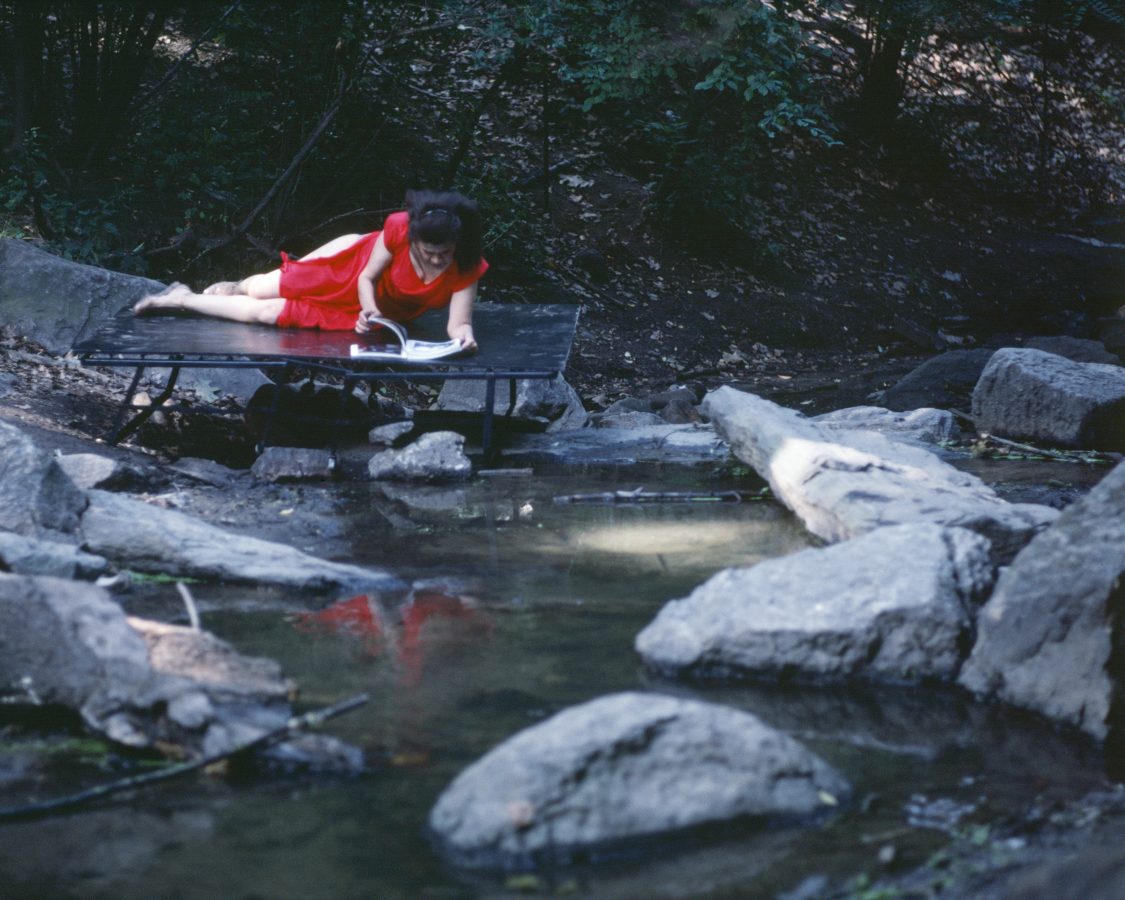
Rivers, First Draft Performance (1982)
MATENE TOURE: How did you come across Lorraine O’Grady’s work?
ZAWE ASHTON: I first heard Lorraine O’Grady’s name in the song “Hot Topic” by Le Tigre, this Riot Girl punk group. They have a song where they name all of these amazing avant-garde women, and there’s a little chorus where I heard her name.
Cut to two years later, and I’m approached to make this short film for the Tate. They gave each director a list of artists who were going to be exhibited in the Tate Modern’s Soul of a Nation: Art in the Age of Black Power exhibition, which featured the innovative work of Black artists from 1963 to 1983. As I’m scrolling through a Rolodex of artists, I get to Lorraine O’Grady, and I’m like, “That’s the woman from the song!” I wasn’t familiar with her work until the moment I got this gig with the Tate. In the weeks leading up to the shoot, I had to feast on her. I was particularly touched by Mlle Bourgeois Noire—this Black middle-class performance art where she hands out these white chrysanthemums at the New Museum and whips herself. It’s this identity-based critique of the art world, and how risk-averse and racist it was. She’s not an actor, but she uses her body as a canvas to grapple with the idea of whether to be subject or object in her own work. I do that too, and I thought that was going to be the connection.
In a very short space of time, she taught me about the power of Blackness as abstract. A narrative she encountered often in white and Black art worlds was that you weren’t supposed to be abstract as a Black artist; you were supposed to present the pain of your community in a linear, literal way, maybe most notably in a photograph. If you were daring to do something more abstract, people would dismiss it as this bourgeois style of artmaking.
MT: How did you conceive of the idea of filming in the location where O’Grady performed Rivers, First Draft?
ZA: When I got to New York to do the interview with her, I had this whole idea that we would be mirroring each other in the film: one generation of artist talking to another. But it became clear once we started that we should not be sharing the frame. She needed to be full frame. This needed to be a project that encapsulated everything that she was because she had an intoxicating, gravitational pull that also resonates in her artwork. The idea of revisiting the location of Rivers came from a conversation that we were having off-record about this transitional piece of work that she’d made that seemed to usher her into a new threshold of womanhood.
In Rivers, she cast herself as the “Woman in Red” to explore the overlapping oppressive themes of racism and sexism. I’d loved performance art before, but I hadn’t come across many Black performance artists, let alone ones who were using their body as this disruptive machine. In this project, she was interested in the ways her body was changing. She had a new relationship with her physical life, so it felt like a bridge between her earlier work and her later work. It was clear that the idea of going back to the location in Central Park was complex. I didn’t realize that she hadn’t been back in 40 years, so as soon as I had that information, I wanted to use this documentary to introduce a new audience to Lorraine’s work.

Rivers, First Draft Performance (1982)
MT: I can’t believe that you came up with the idea when you met her, because it really does seem like an extension of Rivers, which is an exploration of her life through various parts of herself, and your short further extends the piece into her older age.
ZA: It was deeply moving. It also felt like we were revisiting a sort of halcyon time of artmaking. This was a historic, one-time-only piece, and today a performance like that would be recorded and distributed widely. The fact that she did this coming-of-age story in this specific location feels like it was basically honouring a bygone era of art that felt more urgent and alive and more feminist and political. It felt like traveling back in time.
MT: It looks like she’s guiding you back into that time, but it was hard for her to remember some of the smaller details when recalling the performance.
ZA: It was like watching her gather these fragments of her past together.
MT: Her artwork also tried to grapple with this very complex relationship she had with her family and upbringing. She spoke often about using her art as a means of self-exploration as much as a form of cultural critique, but she seemed to be using art to figure out herself and her identity during her middle-aged years, and to invite the audience into that; it’s a very vulnerable way of approaching one’s craft.
ZA: You’re exactly right. There were parallels in terms of her family’s journey and her art journey. Her family emigrated from Jamaica to Boston, and tried to knock down the door of every institution to make sure that she was ready to assimilate into the West. Yet here is a woman making art in the ’80s, where there is this really sharp line in terms of the institutional gatekeepers keeping out the Black artistic vanguard, and she used her body to traverse a hostile world because the level of exclusion was real and palpable. It wasn’t under the radar. It was, “You shall not make a livelihood here.” We’ll tokenize the people that we want to tokenize, and we will ignore the rest of you.
MT: That’s why I love that you brought up one of her first performance art exhibitions, Mlle Bourgeois Noir, because it’s a brilliant example of her using her body to force her way into and critique the very institutions that were excluding her at the time.
ZA: I felt radicalized and felt myself really transitioning during my time with her. I began questioning how much longer I could go along this journey of being cast in other people’s metaphors before taking control of my own story. Making the film was so empowering because with Lorraine we decided how she wanted to be seen. She said to me, “Please make a film that a 12-year-old girl in Trinidad, or the West Indies or the Caribbean, can see and understand what it is that I’ve been trying to do.” That was my instruction. “It’s not about making a film that makes the art world that has rejected me for a great proportion of my lifetime recognize me. It’s about getting my word out to the people.”
When you’re in the acting and film world, that urgency is often sanded down. That feeling of wanting to change people at a grassroots level is interrupted by different tiers of private equity investment, and so the risks become less and the reach becomes more homogeneous. And honestly, that time with Lorraine made me want to use myself for something different. I did end up walking away from acting not long after making the film with her. I wrote a book called Character Breakdown. I wanted to take passivity out of my artistry as much as possible, in the same way that Lorraine strategically reversed her own objectification through a lot of her performance art pieces.
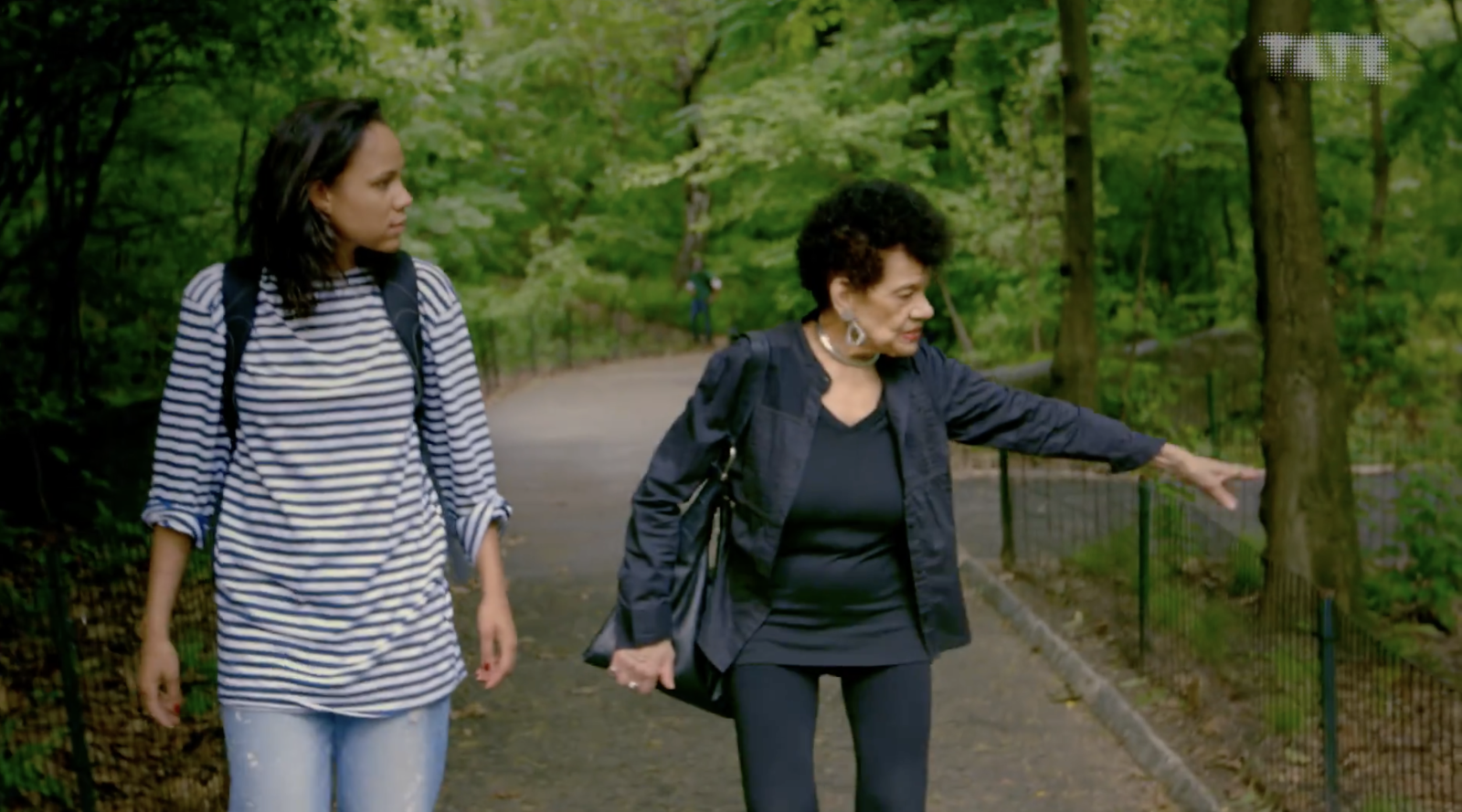
Ashton and O’Grady in Meeting Lorraine O’Grady (2017)
MT: I know you probably had a lot of material to work with. How were you able to edit it down to this 9-minute short?
ZA: The other work of hers that I was inspired by is this series of photographs of the African-American Day Parade in Harlem called Art Is…, where she brings this huge gold-gilded frame for her subjects to pose with. I think some people are holding it, and then there’s one that’s mounted on a float as well, and literally everything the float goes by becomes art.
I think she was asking me to create something where anyone could see themselves in art, in general, but in her art, specifically. So I wanted it to feel like Art Is…which is an immediate and joyous piece that she created but is animated by real people on the street. I think there was some talk early on with the Tate about heavily signposting the fact that this was two women of color talking. I was like, “I think people have eyes.” Even though Lorraine needed an introduction to a new audience, I know she would have hated the film to be explicit in that way. I thought of the song she had done with Anohni, “Marrow,” to start the piece because it’s such a beautiful music video, and we get an instant injection of Lorraine’s iconic look with her bold red lip and signature style. Once people have this punchy visual guide to who this brilliant, sparkling, interesting woman is, then there’s a little bit of hand-holding with the footage where we’re in her studio at the Westbeth. She lived and worked in her art at all times, so it was clear that’s where the traditional introduction happens. I also used some incredible soundbites that she provided.
But I also did something else: I kept the sound running on the camera when shooting in Central Park when we weren’t filming. But I was trying to be some little hotshot documentarian and capture something candid. Lorraine had already been hugely candid, but I was trying to get something off the record that felt truly unscripted, even though the whole thing is unscripted, but that would feel kind of off the beaten track. She saw. She called me that night and said, “Don’t think I didn’t see that little red light.” I have never been so scared in my life. We have an expression in the UK, “bricking it.” I bricked it. It created a real rift. It wasn’t clear whether she was going to continue to work with me on the rest of the film.
MT: Oh no, really?
ZA: Yes, because a boundary had been crossed. It was a breach of trust that had been built over the course of our first 24 hours together. I had to go back to her studio the next day and put my hands up and say, “Artistically, that was on me. Look, I have no idea what I’m doing.” I just said, “I know the subject I have in you is so powerful. I’m just trying to get every single bit of juice that I can.” Because I was instantly obsessed. I just thought she was the most interesting, groundbreaking woman I’d ever met in the art world. So I had to say to her, artist to artist, that I was wrong. I just care about this so much. I want this to resonate with people so much that I tried to do something that crossed a personal boundary. I threatened this amazing new connection that we forged instantly. I think she really responded to the fact that I completely surrendered to being wrong. She saw in that moment a younger artist—I was a much younger artist then—desperately trying to get it right. It was a re-entry point because she agreed to continue to make the film, and we ended up getting amazing footage because somehow, in my foible, I had revealed to her I’m not just here because of Tate. I had revealed my vulnerability, my love and deep passion for her work and the project itself.
I edited the film myself, but on the last day of the editing process, I had a student editor Ella Newton help me with the areas where I felt I had leaned too much into the institution’s notes. I said to her, “Look, it’s you and me. We have one day; let’s get loose and make something Lorraine would be proud of.” And we did, even though I blasted through Tate’s notes. But once they saw the finished product, I think they understood that I wanted to make something with a bit of emotionality, rather than one of your regular introducing-the-artist videos.
MT: Were you able to see her again before she passed?
ZA: We kept in really close touch. She came to see a play I had off-Broadway called for all the women who thought they were mad. It was a very avant-garde piece about Black maternal mortality. I was proud to show it to her because it felt like a continuation of her legacy and artists like her who opened the doors for us. We kept trying to meet up. But I went away, had kids. She never stopped working, so we always kept missing each other. I had got in touch with her just before she died, saying, what about the feature-length piece?
She says in the short, if you’re someone who’s grown up without a blueprint of the artist that you want to be, because of marginalization within the industry, you cobble yourself together from many different artists. I’m sad I didn’t get to see her one more time before she passed, or a bunch more times. But I’m also sad that I didn’t have her as a guiding light in my life sooner because, as she says, cobbling yourself together from different artists is hard. But all you need is that one person who ignites that fight for you to go on and be the blueprint so you can break down doors. I wish I’d known her sooner, but I’m grateful for the way that she completely overturned the trajectory of my thinking at a certain point in my artistic life.

Share:
Recommended
- Zawe Ashton Honors Lorraine O’Grady
 On the boundary-defying conceptual artist whose craft inspired the next generation.
- No Concessions!
 An excerpt from cartoonist Nathan Gelgud’s latest satirical serial.
- Virginie Efira
 An interview with the daring and in-demand international actress.