

Faat Kiné (2000)
Interview
Jollof Films
Senegalese visual artists and curators discuss the towering cinematic figures who inspire their craft.
Jollof Films Presents: Faat Kiné plays at Metrograph from Sunday, September 27.
Share:
For Alassane Sy and Ahmad Cissé, the Senegalese founders of the Pan-African cinema club Jollof Films, highlighting the pioneering work of African filmmakers is vital to their ethos. Colonialism robbed much of the continent of autonomy over its cultural production, and a lack of funding and visibility for Black imagemaking still persists, leaving crucial blind spots for contemporary audiences. Widely regarded as one of the most influential figures in cinema, Senegalese filmmaker and novelist Ousmane Sembène advocated for film to be a “democratizing force.” For four years, Jollof has assumed this mantle, curating and screening neglected productions from around the continent for young audiences: Their previous screenings in partnership with Metrograph have included Moussa Sène Absa’s Xalé: The Childhood Wounds (2022) and Souleymane Cissé’s Den Muso (1975).
In an interview with The New York Times, Sembène observed that “Africa’s society and economy are held together today by women.” In many African and diasporic families, women are the heartbeat of their communities, preserving culture and communal memory. “But how can women have these responsibilities,” Sembène mused in the same breath, “and yet be denied the same privileges as men?” From his short Borom Sarret (1963) to Black Girl (1966)—his most recognized feature—Xala (1975), and his last film, Moolaadé (2004), women play a central role in Sembène’s narratives: they are whole, imperfect, and often the lens through which he compels his audience to navigate his peculiar blend of socio-political commentary, vulgar humor, and melodrama.
His penultimate film, Faat Kiné (2001), is no different. With unsparing honesty, he reveals an authentic exploration of womanhood under the confines of patriarchy. Set in early 2000s Dakar, the film follows Kiné (Younousse Sèye, who also appears in Xala and Sembène’s 1968 Mandabi), a chic, cig-smoking, no-nonsense, sexually liberated single mother of two, who delivers a right two-punch to the patriarchal structures impeding the liberation of African women. Kiné must navigate abusive men from her past, who seek to mooch off her successful career as a gas station manager and undermine her autonomy, as well as pressures from her children to remarry. Like much of Sembène’s literary and cinematic work, Faat Kiné above all condemns bourgeois men seeking to enrich themselves in the shadow of a French occupation that only nominally ended in 1960.
Ahead of the film’s screening at Metrograph, I sat down with Sy and Cissé to discuss Faat Kiné, how they became interested in postcolonial African cinema, and why they launched a cinema club that centers the diaspora.—Matene Toure
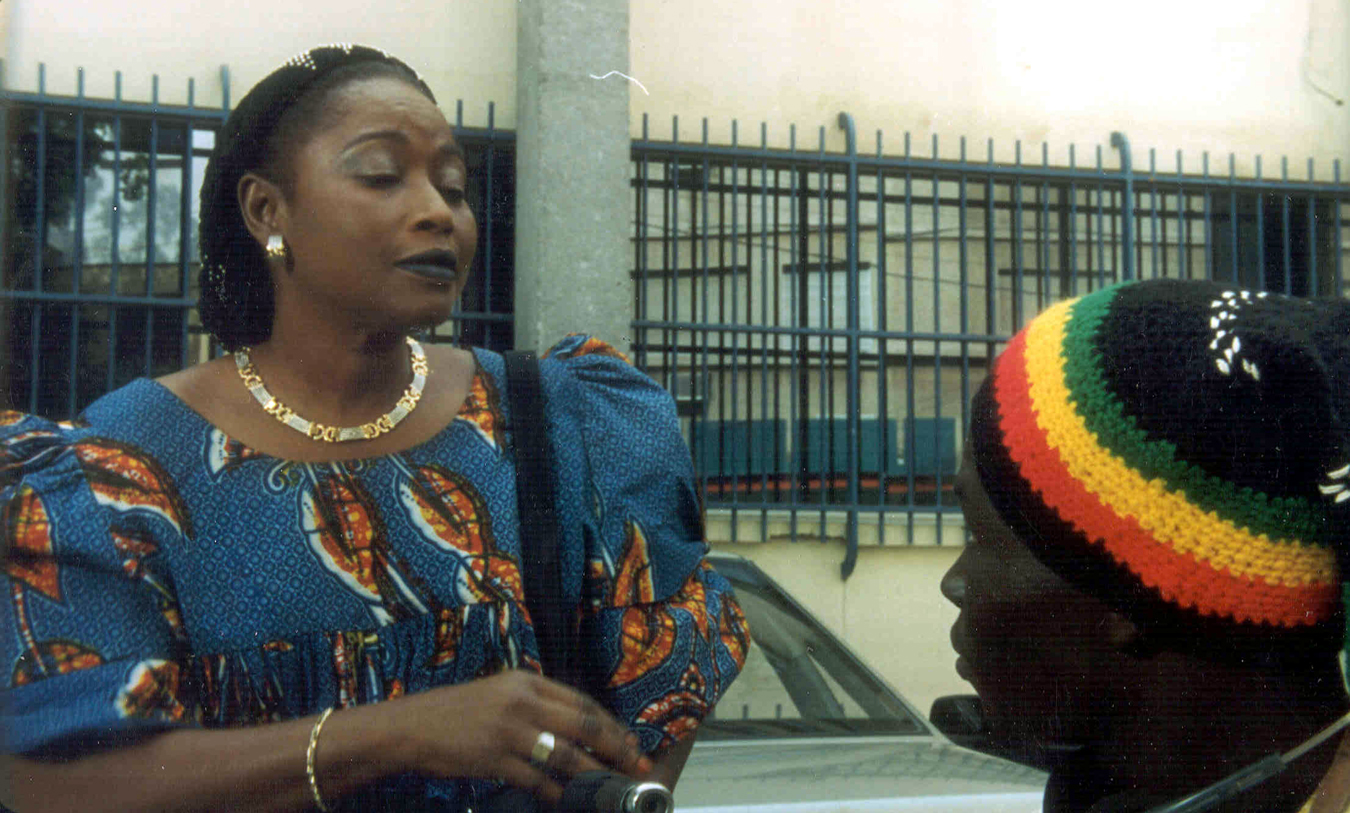
Faat Kiné (2000)
MATENE TOURE: I’d like to start with how you both got Jollof Film started. What made you want to make this collective in the first place?
ALASSANE SY: It came about when Ahmad, my cousin and co-founder of Jollof, moved to New York. We went to watch a film at the African Film Festival at Lincoln Center and we noticed the crowd was mostly older white people. There were not a lot of young people; there were not a lot of Black people. And that’s when we were like, how can we get our people, especially the younger generation, interested in African film?
We hosted the first Jollof Film in August 2022 in our living room and got some feedback from people in our generation. They all loved it.
That’s when we decided to start hosting monthly screenings.
AHMAD CISSÉ: Yes, we invited our friends for a one-off film screening of Ousmane Sembène’s Guelwaar (1992). The conversation that followed lasted about two hours. We felt the demand immediately after that screening because we were being asked, when are we doing this again? So, on a phone call that didn’t last too long, we came up with a programming schedule, which would be the last Sunday of the month, and the name of what the cinema club would be. Since then, it has opened me up to even more African cinema, and it’s opening up our audience as well. Like, a lot of them who grew up in Senegal, Nigeria, and in so many different parts of Africa did not know Sembène, or Djibril Diop Mambéty, or Gaston Kaboré, or Souleymane Cissé.
I released a film earlier this year, N’Dobine (2026), which premiered at the New York African Film Festival this year, and a lot of the cinematic language is anchored in and inspired by the works of those inspirational figures.
MT: I know you guys are both filmmakers and visual artists in your own right. What’s your background? Were you always interested in cinema and African films specifically?
AS: I’m very passionate about African film. When I was young, I watched a lot of cinema. I was more interested in the storytelling. For example, the stories built by Sembène, Mambéty, or Mansour Sora Wade really conveyed the realities of Senegal.
I’m a photographer, and most of the references in my work can be attributed to films that we screen through Jollof Film.
AC: I’m an avid student of cinema. I grew up in Senegal, but was born in the Bronx. When I was 4, I was sent to live in Senegal, and I was there until I was 16. I made my way back to the States, lived in Detroit for 8 years, and moved back to New York about four years ago. My background in cinema started with me being exposed to what we were creating on the continent as well, not necessarily the films of Ousmane Sembène and Djibril Diop Mambéty, because I did not have access to those films.
My earliest memories of watching films were Asian martial arts films in Senegal. Like, the Bruce Lees, the Jet Lees, and films like Ong-Bak (2003). If you had their films on DVD, everybody was rushing to your house to watch these films. We watched Nigerian comedies— made by Sanyeri [Nigerian comedian Olaniyi Afonja], the Centerville equivalent of what Aki and Paw Paw were from Nigeria.
After moving to the States, I began following the cinematic styles of certain directors and the way that they write their plots. Like Christopher Nolan, for example; I remember he was one of the first filmmakers who astonished me because of how he writes his plots. M. Night Shyamalan as well, because I love good plot twists. That’s really my thing. Fast forward, Alassane and I had a very passionate conversation about how, in Senegal, the current state of production is just not rooted in the reality that we share as Senegalese people, because there are a lot of series that feel controlled by the empires of the world; it doesn’t feel anchored in the realities of Senegalese society. Like, even when you’re watching these series, you know, like, a lot of French is being spoken, less Wolof is being spoken; half the time, they’re in mansions that have pools in them, and they’re eating whatever European food. It feels very European. So we had this conversation, and we questioned: why is this [content] currently dominating the airwaves in Senegal?
Starting Jollof Films was a journey into finding the answer.

Black Girl (1966)
MT: Can you delve more into the mission statement of Jollof Films and your ideological ambitions around building a Pan-Africanist cinema club? What does Pan-Africanism mean to you, and why is it important that the type of films that you show have that ideological throughline?
AS: The mission statement is to raise awareness about African filmmakers. We also seek to inspire the African diaspora to be strongly rooted in the African reality. There’s a lot of great African artists, and they’ve made a lot of work that allows us and our generation to be here in New York and do what we do. The first thing is to make sure to raise awareness of those image makers. By showcasing their work, that’s a sort of Pan-Africanism to us. Because in the past, most of these creatives weren’t given a platform for their films to be shown. For example, there are a couple of Sembène’s films that were banned for over 10 years on the continent. Our mission is to make sure their stories are known.
Our first objective is to create space where we curate African cinema for the African diaspora. Our second objective is to provide space for the people of the diaspora to openly discuss the African socio-political context of each film. Whenever we screen a film, after the film, we have a post-screening discussion to share ideas and thoughts. Our last objective is to empower the diaspora to exchange knowledge about the cultures, traditions, and societal inner workings depicted in the films we spotlight. To inspire the African diaspora to be rooted in African reality. I grew up in Senegal, and that’s a [different] experience from someone of African origin who was born and raised here.
MT: That’s a good segue into your next program at Metrograph, which is Faat Kiné. I’m a huge Sembène fan; this was really an interesting film to watch because it felt in conversation with his most best known film, Black Girl. Why this film for your next program?
AS: Faat Kiné was the second option to be screened for this collaboration with Metrograph. We wanted to screen Le Prix du Pardon (2001) by Mansour Sora Wade, but it was hard to find the rights. But Faat Kiné is another Senegalese film made in the early 2000s, and the main theme is women’s empowerment and reflects the current state of Senegalese society more than his previous works. In Faat Kiné, Sembène shows a single mom raising her kid while also managing a gas station in order to provide for her family.
MT: An unmarried Muslim woman.
AS: That part too. Sembène is great at visualizing a common reality in Senegal: independent women navigating patriarchy and [religious] conservatism.
Also, visually, the film is amazing. The colorful cultural, traditional outfits and the ambience of the car are depicted beautifully. It was shot very well.
AC: To add to what Alassane said, Faat Kiné deserves to be seen by a wider audience, and the reality of Kiné living as an independent woman is a topic that is not often discussed in [West] African households. No culture, no matter how hard we strive to make a strong unit, is immune to suffering from the vulnerabilities that [destroy the home], your community, or village.

Den Muso (1975)
MT: It’s a two-pronged critique in a greater sense, because Sembène is highlighting the hypocrisies of decolonization and how these leaders, who are predominantly men, failed to usher in this idea of a better Senegal and ultimately ended up reinforcing a lot of colonial-era oppression. But it also serves as a critique of the ideals of the nuclear family and how these conservative, patriarchal societies are very much matriarchal, and family doesn’t necessarily mean husband, wife, and kids. In the film, the grandmother also serves as a caretaker for Kiné’s two children, and I think it’s implied that she is legally their guardian because Kiné had them very young.
AC: Yes.
MT: What’s next for Jollof Films? What other programs are you guys thinking about? Are there new directors that you want to program in the future?
AC: Alassane and I had a conversation about platforming young African filmmakers in the diaspora who do align with the mission statement. A lot of us are entering the image-making space, whether it’s through photography or videography. Even if you look at the fashion industry, for instance, right, there’s a lot of folks from the African diaspora who are producing great imagery, great work, and are a part of Jollof Films, and we want to get those folks recognized.
Imagine if we were to have a proper reference of what cinema in the post-colonial period was like against the current evolutionary stage of continental or diasporic African film creation. Because for a very long time, and I think still to this day, the continent has not been looked at as the reference for great filmmaking, right? So, the next step is to platform young filmmakers who are in alignment with said trajectory while also continuously championing the pioneers of African filmmaking. When people go on our page, they may have an idea that we [only] screen films from back in the day, but we’re also very much open to the stories that feel like an evolution of what the pioneers were already doing.
AS: I think we’re definitely going to keep being consistent about our monthly screenings. We want to explore more countries; we’ve screened a lot of films in Senegal and Mali, and we want to explore East African, Nigerian films, and Central African films. Like, we want to touch all over Africa; whenever we find a film we think our audience will connect with, we make sure to screen it. But as far as the future of our collective, we’ve organized a festival before, Jollof Film Festival, and we want to do that more consistently. By organizing a weekend festival, we can screen films previously projected through our programs, so our new audience who didn’t get a chance to watch can still gather on the weekend and view them. We’re planning to do one soon.

Share:
Recommended
- Farley Granger
 On the queer star who defied mid-century Hollywood archetypes.
 - Geraldine Chaplin and Carlos Saura
 On the formidable collaborations of the Aragonese filmmaker and his American muse.
 - Genevieve Yue’s Trains
 On the offbeat pleasures of the train in Genevieve Yue’s new book.