
Cracked Actor
Winona Ryder
A Hollywood “It“ girl comes of age.
Winona Ryder, Analogue Youth plays at Metrograph from October 3.
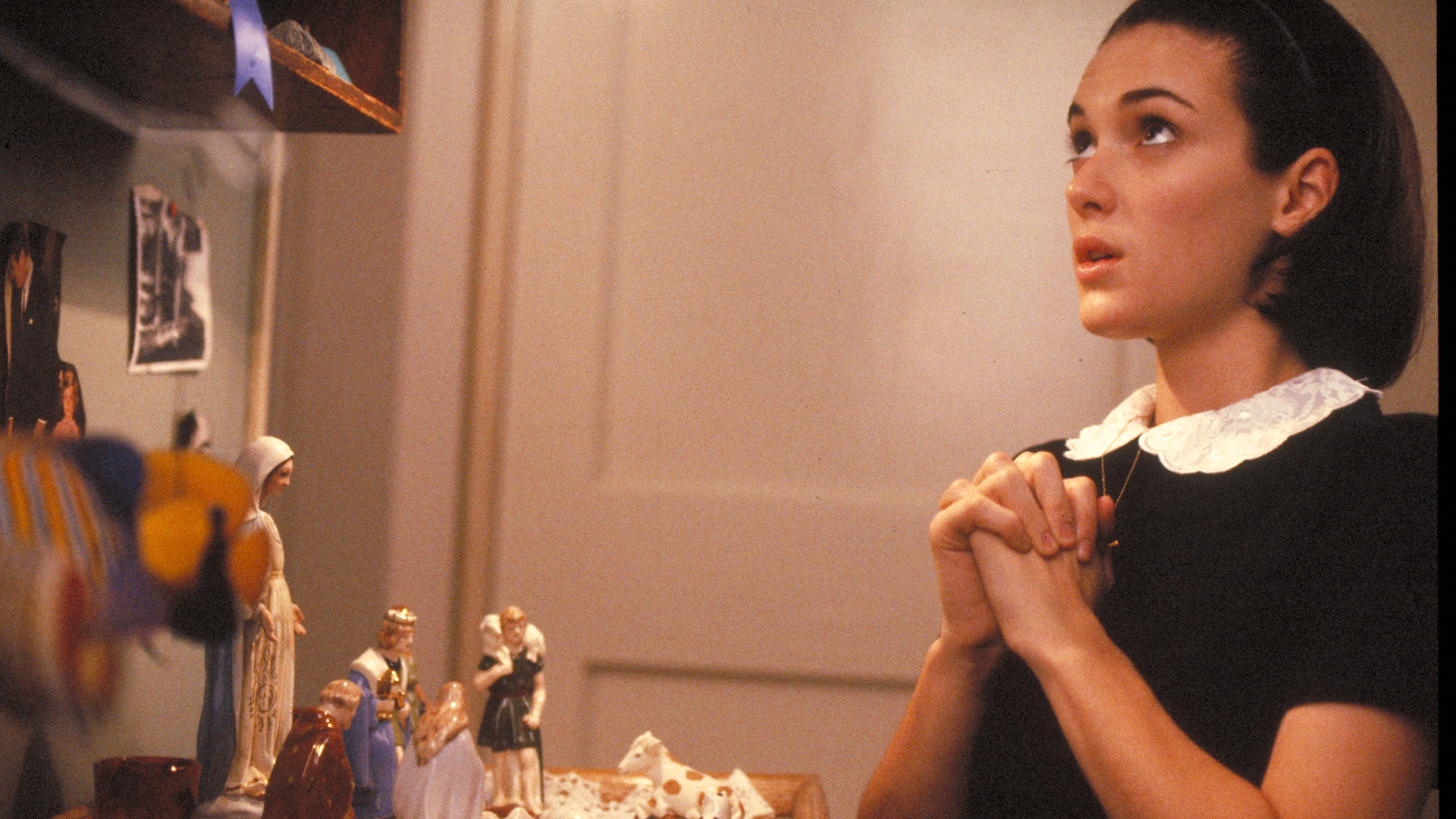
Mermaids (1990)
Share:
“MY WHOLE LIFE IS A DARKROOM,” deadpans Lydia Deetz in Beetlejuice (1988) when her father offers to build a photography studio in the basement of their newly acquired, soon-to-be-raucously haunted house. With this misanthropic retort, Winona Ryder punched her ticket to fame and sealed her place in pop culture immortality. She was 15 years old and had the pallor of a 19th-century consumptive. Behind her lace black veil, as wide as a lampshade, she looked like a Goth child bride, or a kid whose Halloween costume was “mob wife at a funeral.” The pun was obvious, but she laid it on thick, because her parents—and any old people in the audience—were surely too dumb to get the joke. “One… big… dark… room.” She savored each word, serving them with a side of vocal fry. The contrast with Catherine O’Hara’s hysterical stepmother was generation-defining. “My whole life is a darkroom” captured not only Lydia’s essence, but a new type of adolescent girl, one who, like Lydia, believed herself to be “strange and unusual”—or at least stranger and more unusual than your typical Hollywood “It” girl.
Beetlejuice was Ryder’s breakout role. She had debuted a couple years earlier in Lucas (1986) as Rina, a sad sack, thrift-costumed baby punk in love with the title nerd (played by Corey Haim)—the Juliet to his clueless Romeo, if only he’d wake up and notice her. It was a small part, but enough to win over Tim Burton, who had been considering Alyssa Milano and Jennifer Connelly for Lydia in Beetlejuice. (Hard to imagine either of them making as strong of an impression as Ryder did—neither has Ryder’s child-like quality, that slightly androgynous or tomboy fragility and lostness.) Rina wasn’t as bold as Lydia but she was just as morbid and romantic. Her most memorable lines concerned the death of the school’s band teacher, who the kids say shot himself next to a book of poetry because his love for a dental technician was unrequited. Did Morrissey write the script? “I think it’s kind of beautiful,” Rina says to her fellow misfits at the lunch table. “The poetry, I mean. It was probably Keats or Shelley.”
Some actors are chameleons with tremendous range, who can disappear into any part. Others have a genius for a type. Ryder is one of the latter. In film after film from the late 1980s through the 1990s—Beetlejuice and Heathers (1988) and Welcome Home, Roxy Carmichael! (1990) but also Edward Scissorhands (1990), Mermaids (1990), Night on Earth (1991), Bram Stoker’s Dracula (1992), Little Women (1994), Reality Bites (1994), The Crucible (1996), and more—she plays a girl (not yet a woman) who comes of age, often by discovering her sexual power. She’s sometimes an outcast, or chooses to ally herself with outcasts. She’s always the smart one and sometimes awkward, funny, or self-deprecating (or all three). She’s pretty, so she finds love—or, if love doesn’t work out, revenge.

On the set of Bram Stoker’s Dracula (1992).
Her biography was catnip. She grew up (for a while, anyway) in a commune. Her godfather was Timothy Leary, the counterculture icon infamous for advocating for psychedelic drugs. She suffered from insomnia and called Al Pacino in the middle of the night to talk. She chose “Ryder” as a stage name because her father’s Mitch Ryder and the Detroit Wheels album was playing when the producer called to ask how she should be credited; apparently “Horowitz”—her birth name—was assumed to be less than ideal. Was all the talk about Ryder being “smart” a coded way of acknowledging that she was Jewish? Or was it only a way of acknowledging that she had brown hair? (While we’re on the subject: being bookish is one thing, but did any viewer of Reality Bites really believe that Lelaina Pierce was valedictorian of the University of Texas-Houston? She was scared off astronomy because of the math, and couldn’t define irony. What, exactly, did she get good grades in?) In any case, she had a cool most mortals could only aspire to. She gave herself a pixie cut at home—not quite as extreme as Lydia’s knife-sharp, tropical fern bangs, but iconic nonetheless—and it actually looked good.
Ryder’s distinctive voice isn’t kittenish; she doesn’t sound like she’s trying to seduce you, though it might. She often sounds like a slightly bored girl in the back of the classroom who knows the right answer without trying too hard. She’s down for getting dirty on her own terms—she’s not the cheerleading Heather, or the bulimic one, but the one covered in grime, lighting her cigarette off an explosion. She’s great at indignation and exasperation, and her characters are often frustrated, thwarted, yelling at a bad boyfriend who doesn’t listen, in over their heads. Eventually she figures out that she can call the shots: she can lose her virginity, dump the loser, fake her own suicide, bring down her enemies, drive a stake through the heart of the undead. She’s never one to feel sorry for.
For women of a certain age, to revisit Ryder’s coming of age in Hollywood is to revisit one’s own youth. Yet only a few peak Ryder roles are actually set contemporaneously. Beetlejuice parodies the ’80s art world; Heathers is one long joke about yuppies; Reality Bites defined Generation X’s sputtering entry into the workforce. But Ryder didn’t continue to make movies about the times she lived in. She went for Little Women and Age of Innocence (1993), and The Crucible and Dracula—period pieces that were also literary adaptations. She was passed over for Shakespeare in Love (1998), but proved she could handle iambic pentameter as Lady Anne in Al Pacino’s Looking for Richard (1996). Whether or not the film was set in the present, she excelled in highly stylized productions—dark comedies, goth satires, dramas that touched the otherworldly and uncanny—that required her to be completely sincere in her emotions while also putting scare quotes around them. It’s notable that her most successful “realist” performance, as the demure but steely May Welland in Martin Scorsese’s Age of Innocence, which earned her an Academy Award nomination, is set in a world aestheticized to the point of mannerism, where everyone is choking on the self-consciousness of social performance. Does it need to be said that having authentic feelings that appear stagey to the point of camp while being self-conscious of social performance is a working definition of what it means to be a teenage girl?
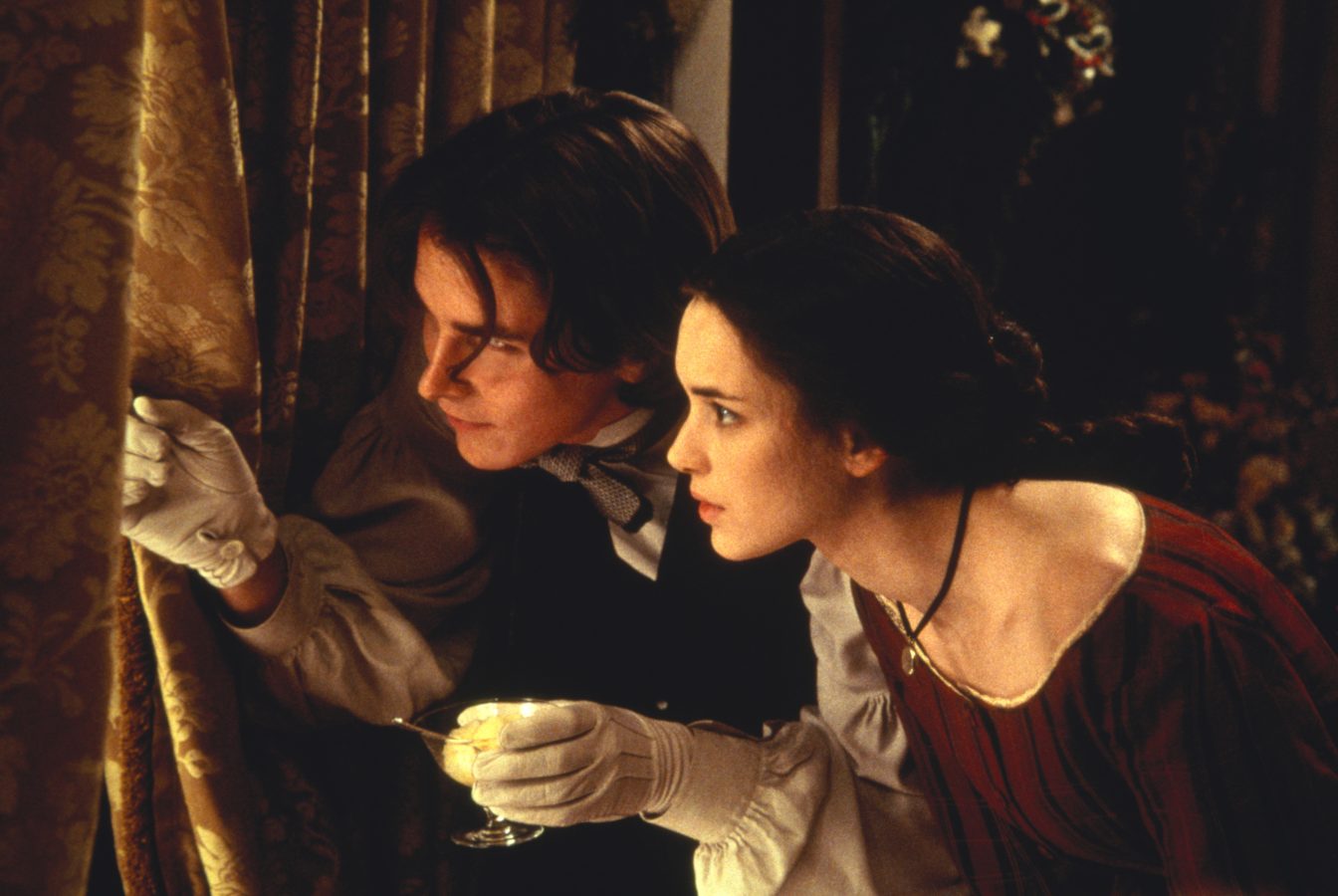
Little Women (1994)
Her most relatable—and a strong contender for her best—role was as Charlotte Flax in Mermaids, a teen girl driven to Catholicism by the wanton ways of her single mother, played pitch perfect by Cher. (Walking past her crucifix-wearing daughter, on her knees on the bedroom floor, she tosses off the unforgettable line: “Charlotte, we’re Jewish.”) Set in 1964, with one of the great soundtracks of all time, Mermaids has no ghosts, murders, witch hunts, or strange artists with scissors for hands—just the everyday horror of mother-daughter angst. Eventually Ryder, consumed with lust for the young man who works at the local monastery (and furious that her mother has betrayed her by kissing him), discards her cardigan, wiggles into Cher’s hot pink dress, and heads out into the night.
This combustive mix of female sexuality and Christian iconography recurred in Ryder’s career, next in the fever dream psychosis that is Bram Stoker’s Dracula and the melodramatic delirium of The Crucible. If Ryder is not entirely convincing as a 17th-century Puritan, she is more than persuasive as a mean girl who, through force of will and sexual fury, summons the girls around her into a vengeful and possessed army. She screams, shaking, open-mouthed: “I feel the power of hell in this room!” She rules the meeting house with a fist as iron as the Heathers ruled their high school.
A lot of the smart girls that Ryder played were suffering artists, or wanted to be. Lydia Deetz takes photographs; Lelaina is a documentary filmmaker; Jo in Little Women is a writer. These are painfully self-aware people who spend a lot of time in their own heads. But at some point, whether rocking out in a gas station to the Knack or shaking in midair to the sound of Harry Belafonte, they all eventually cut loose. Mermaids, too, ends with a dance—Cher, Ryder, and little sister Christina Ricci (!) goofily cavorting around the kitchen to Jimmy Soul’s “If You Wanna Be Happy.” They bump hips, jump around, and just generally look like the most lighthearted of fools. The real art, Ryder’s characters teach us, is not in suffering; it’s in how you make yourself. At some point you have to venture out of the darkroom.

The Age of Innocence (1993)
After Mermaids she took a left turn, showing up in the first chapter of Jim Jarmusch’s Night on Earth (1991) as a Popeye-quoting, bubblegum-snapping, would-be grease monkey cab driver who looked about 14 years old, chain-smoking and rolling her eyes when a posh Gena Rowlands in the backseat asks her to turn down Blue Cheer’s cover of “Summertime Blues”—“Sure, mom.” But this tough-nut shell was cracked wide open to reveal a tender soul hoping to find a man who loves her as she is. “I yam what I yam.” Her oversize men’s shirt blowing around, flashlight dangling from her belt loops, backwards cap jaunty, oil-stained cheek—all of it some adorable Halloween costume, a little girl playing dress-up, which is just what the character called for. When Rowlands, a casting agent, says she’d be perfect for a movie, Ryder resolutely turns down the opportunity, saying, “I’m a cab driver. This is what I do.” It’s not believable, it has nothing to do with the real lives of taxi drivers, the whole thing feels like a late-night improv session—and it’s so much fun, it doesn’t half matter.
Between Girl, Interrupted (1999) and Netflix series Stranger Things, Ryder mostly wandered in the wilderness. She had five minutes of screentime in Black Swan (2010), during which she was subjected to the indignity of stabbing herself in the face; and she provided the lovely, pebbly voice of Elsa Van Helsing, the girl next door with Lydia Deetz hair and a gentle soul, in Tim Burton’s animated masterpiece Frankenweenie (2012). But most of those middle years are best forgotten. Autumn in New York (2000)? Mr. Deeds (2002)? S1m0ne (2002)? What happened? Maybe it was the shoplifting or maybe her youthful mien was less in demand after 9/11 or maybe she had a nasty Saturn return or maybe no one was writing good parts for her anymore. Hollywood, we all know, doesn’t exactly overflow with interesting parts for women in their thirties. It didn’t help that after being twice nominated for an Academy Award and not winning, she wasted time chasing Oscar bait. (Remember 1995’s How to Make an American Quilt? Me neither.)
But it’s also the case that Ryder’s persona and gift as an actor is deeply connected to adolescence; she gets adolescence the way that Claire Danes gets crying or Tom Cruise gets doing his own stunts. It’s fitting that her mid-career renaissance in Stranger Things has her playing the mom of teens, and that Beetlejuice Beetlejuice (2024) sent her to hell and back to rescue her teenage daughter. There’s a built-in pathos to seeing Ryder on the other side of this great divide. Somewhere inside her face is still the strange and unusual Lydia Deetz, the yearning Charlotte Fox, the idealistic Lelaina Pierce. We know she remembers what it was like to be young. We do, too.

Share:
Recommended
- Genevieve Yue’s Trains
 On the offbeat pleasures of the train in Genevieve Yue’s new book.
 - Yuliya Solntseva
 On the actress-turned-filmmaker’s unsung authorship.
 - Futures and Pasts: Socrates
 Rossellini’s one-of-a-kind approach to the costume drama, and his 1970 film on the last years of the Athenian truth-seeker.