
The Illiac Passion (1967)
Essay
The Illiac Passion
On the most elaborate of Gregory Markopolous’s modern myths.
The Illiac Passion (1967) plays at Metrograph from Saturday October 10, as part of Classical Cinema.
Share:
AS SOMEONE WHO’S SPENT MORE or less their whole adult life trying to insist that however unwelcoming some movies might initially seem, however dense, obscure, or formally remote, they all can be entered—that it’s only a matter of maintaining a certain attention, a way of thinking through looking that opens onto pleasures all the more moving and profound for their reticence—it’s admittedly funny to be writing about a famously difficult film that begins and ends with the image of a wrought-iron fence. But there it is: three bars, two of them plain, flanking a decorative fleur-de-lis, in stark silhouette against a sky the last orange before day begins or ends. Ninety minutes later, we return to this composition: the footage was obviously shot at the same time, though the film’s cyclical nature obliges us to suspend that knowledge; sunlight’s arcing symmetry is all that matters—now with a hand resting atop the knuckled iron. Do you imagine I’m going to tell you this implies the fence might be opened for us? It doesn’t. There are, yes, what look to be joints, hinges, but just beyond cars pass by, a busy, indifferent world, the traffic of other stories. Let’s stay with ours.
It’s among the stranger ones the medium has given us so far. Gregory Markopoulos, Greek American son of Toledo, Ohio, was born in 1928, found his way to Hollywood’s fringes via a brief enrollment at the University of Southern California (where he landed at Josef von Sternberg’s feet), and produced a trilogy of 16mm films before his 21st birthday, collectively known as Du sang, de la volupté et de la mort (1947-48), which now look as significant as anything this side of Maya Deren in shaping the incipient American avant-garde. By the mid-60s, he was among the most revered figures of the New American Cinema, the New York scene arrayed around the Film-Makers’ Cooperative (he was, along with Jonas Mekas and others, a founding member). In a different world, he might have become as commonplace a name to film studies students as Stan Brakhage, the sort of artist who condenses and exemplifies an entire subculture.
Instead, after a couple miserable years attempting to start a film program at the School of the Art Institute of Chicago, he departed America in 1967, following the young filmmaker Robert Beavers to Europe, where the two remained until Markopoulos’s death in 1992. In 1974, he cut ties for good with the scene he’d left behind, issuing a denunciation in Variety of what by then had found its institutional basis as Anthology Film Archives and withdrawing his work from circulation. (For good measure, he insisted that P. Adams Sitney remove the chapter on him from the second edition of Visionary Film.)
Living one of the great late-bohemian romances, Markopoulos and Beavers crisscrossed the continent, trailing funding and favors, working all but privately toward the realization of what the former had come to call the Temenos, a dedicated home for the screening and study of their work, the inaugural and exemplary instance of his ideal, “film as film.” The specifics of this, articulated across hundreds of pages of often tortuous prose (his fondness for the Germanic capitalized Concept is one of Markopoulos’s more regrettable traits), are nearly impossible to summarize, but for present purposes, it’s enough to say that, in good modernist fashion, he sought to establish a tradition for his art that wouldn’t depend on the methods and means of any other.
Markopoulos’s contribution to the Temenos would be Eniaios, made between 1948 and 1990, a work so deranged in ambition and massive in scale—running to more than 80 hours—that it makes all but a few of the century’s other artistic monuments look quaint. The film, which Markopoulos never saw (he edited by hand without a Steenbeck), finally began to make its way into the world a decade after his passing thanks to the dogged efforts of Beavers; its 24-year-long premiere, occurring every two or four years in a field half an hour by foot outside Markopoulos’s ancestral village in the Peloponnese, finally concluded this June.
Eniaios comprises revisions of nearly his entire extant work alongside an almost equal volume of purpose-shot material, thousands upon thousands of brief bursts of imagery—the overwhelming majority between one and 12 frames—constellated among expanses of mainly black, and occasionally clear, leader. Within this structure, footage, whether new or old, tends to occur only once. Yet material from a single film, one of the last Markopoulos completed before leaving for Europe, appears in each of the 22 cycles: The Illiac Passion (1967).
This raises an obvious question: why? Perhaps there’s unpublished commentary in the Temenos archives that confirms he held it in particularly high esteem, but nothing in the collection of Markopoulos’s writing released as Film as Film by The Visible Press in 2014 indicates this. The Illiac Passion was, along with Twice a Man (1963) and Himself as Herself (1967), one of three films that bear out the vision he articulated for the future of the medium in the 1963 essay “Toward A New Narrative Film Form,” a mode based on “the use of short film phrases which evoke thought-images,” each of which is “composed of certain select frames that are similar to the harmonic units found in musical composition.” But if this points plainly enough toward the form of Eniaios, we might as easily expect the other two films to reappear, as well as films like Ming Green and Galaxie (both 1966) that do the same in their own ways. So again: why?
I’ve been putting off saying what The Illiac Passion is actually like because, as is often the case with Markopoulos, it really isn’t amenable to description in language. The official record lists the film as “inspired by Aeschylus’ Prometheus Bound,” which manages to both over- and undersell its relation to that source text. Played without its soundtrack, one could take The Illiac Passion as a uniquely sumptuous cousin to Ken Jacobs’s Blonde Cobra or Jack Smith’s Normal Love (both 1963), two tableaux films haunted by stories that never quite arrive even as their images and editing go on insisting they might.
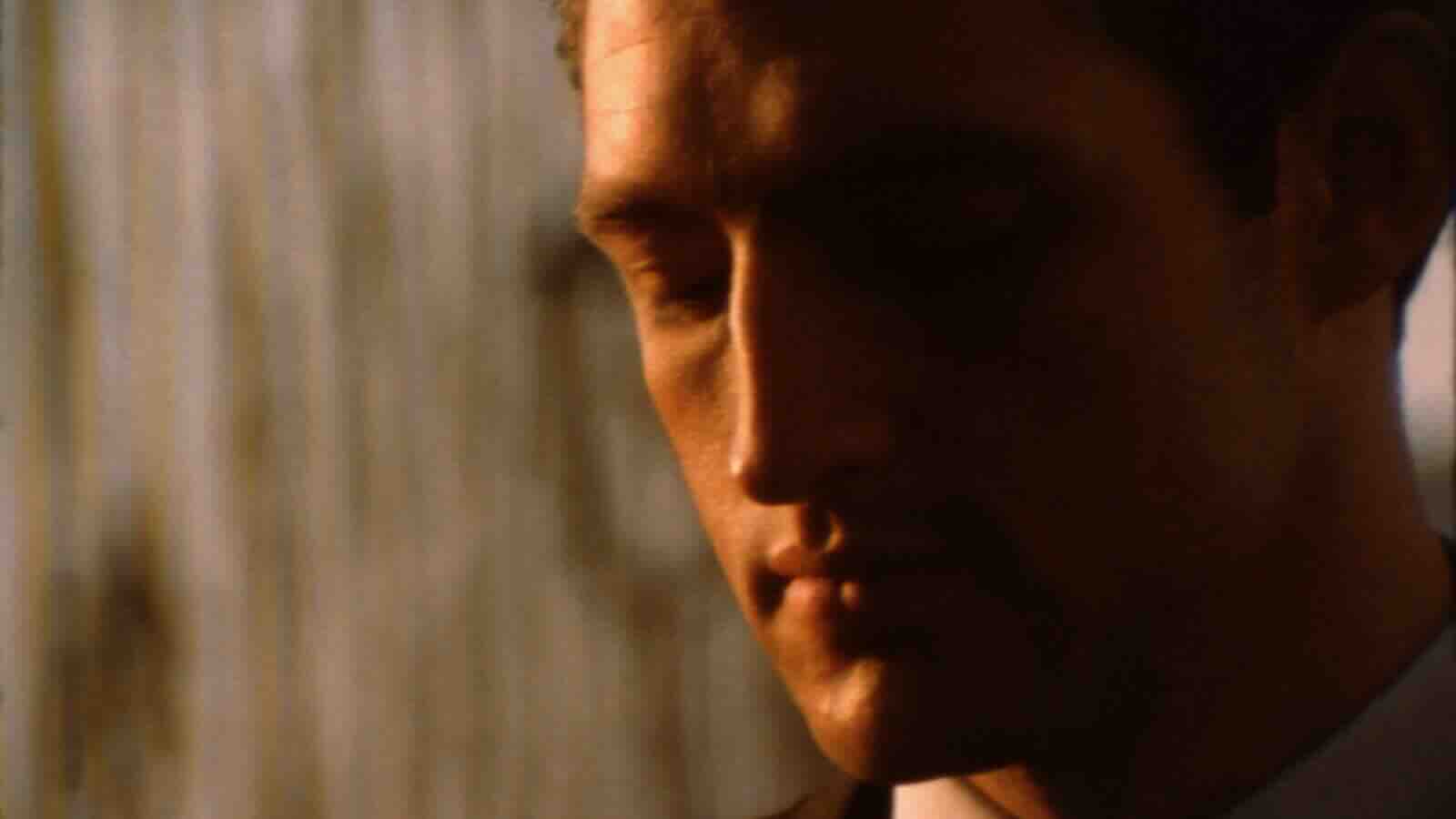
Richard Beauvais is the ostensible central figure of The Illiac Passion, Prometheus by way of Hyannis Port, a tortured American Titan alternately nude and clothed in an unremarkably handsome suit, his jaw and hairline the center of gravity around which orbit a cast of uniformly fascinating downtown faces (the stars—Andy Warhol, Taylor Mead, Gregory Battcock, Gerard Malanga, Jack Smith, Paul Swan, Tally Brown—don’t reliably outshine the ones less known to history). In its Eniaios version, the image of Beauvais writhing in a void, shackled by invisible chains, dominates to an overwhelming degree (it’s hard not to think Markopoulos found this to be his strongest image; I can’t agree), but here it’s just one mythic note among many, some more legible than others as things spin out well past the Aeschylian starting point.
On one end, there’s Smith and Jan Chipman as Orpheus and Eurydice, the film’s most overt sub-narrative, legible to anyone familiar with the story’s iconography (they take over the last 20 minutes or so in a sustained homage to Markopolous’s hero Cocteau); that Tally Brown is Venus,wandering Manhattan’s churches and lazing with her idiotically hunky mortal boy toy (i.e., Adonis) in decadent parlors, is, I imagine, apparent enough to those of, or raised on, the most refined of mid-century gay sensibilities; I rather doubt anyone could find Poseidon in the ridiculous image of Warhol in sequined trousers on an exercise bike. But then, making anything like conventional narrative sense of these situations is avowedly not the point: each one instead occasions a tone, a feeling, a sensuality—Markopoulos is, here and elsewhere, the greatest filmmaker of draped fabric. Collectively, they allow for and are inflected by his singular editing, an approach to composition that shares something with what was happening downtown in music at that time (I’ve always wondered if he ever met the composer Morton Feldman), even as it approaches the “film as film” ideal he would fully realize with Eniaios. The phrases aren’t quite so short yet—illusionist depth and realist motion haven’t yet been overcome—but his intuitive sense of how to get, quickly, from one image to another and back again affords him a seductive, oneiric counterpoint punctuated by zooms, blinks to black, sharp contrasts of shadow and allover light.
Then there’s the sound. Excised from its Eniaios edit—the whole 80 hours are silent—the audio of The Illiac Passion nonetheless points even more clearly to that future than his visual montage. Beyond a few shrieking eagles to indicate the narrative frame, and three passages from Bartok’s Cantata Profana to expand it, the rest is built from something like an erasure poem of Henry David Thoreau’s Prometheus Bound translation, with Markopoulos reconfiguring choice sections of the text. In an exact parallel to how Markopoulos would treat his films when re-editing them, he takes the 8,000 or so words of Thoreau’s English rendering as a fixed set of material to draw from, plucking out and arranging words as he later would his own images, building up repetitions and doubling back as necessary. (Notably, the only language Markopoulos himself alters is the opening: the thuggish Kratos’s “We are come to the far-bounding plain of earth” shifts to “I contemplate far-bounding earth”—the opening “I” repeated three times.)
Sound and image refuse to come together, neither is subordinate, illustration; the space of mythic, filmic feeling he was after exists somewhere in-between. Maybe The Illiac Passion appears in every cycle of Eniaios as the sign of an audiovisual relationship that Markopoulos couldn’t figure out how to improve; it’s a loss, to my mind, that in the end he settled on “silence,” on the chance sounds of insects and distant village life. But then, the other gift Prometheus gave to man, the less remembered one, was hope for the future.
Anyway, I should admit that in keeping with how myths get made, I lied a bit in the beginning. The first image that we see isn’t a fence: it’s Markopoulos alone, seated at a desk with his back to us, examining a strip of film.

Share:
Recommended
- Farley Granger
 On the queer star who defied mid-century Hollywood archetypes.
 - Geraldine Chaplin and Carlos Saura
 On the formidable collaborations of the Aragonese filmmaker and his American muse.
 - Genevieve Yue’s Trains
 On the offbeat pleasures of the train in Genevieve Yue’s new book.