
Essay
Who Makes the Nazis?
On Juraj Herz’s Czechoslovak New Wave landmark.
The Cremator (1969) plays from Saturday, November 1 as part of The Gothic Visions of Juraj Herz.
Share:
The Cremator (1969)
THE CENTRAL CHARACTER OF JURAJ Herz’s 1969 The Cremator is one Karel Kopfrkingl, a stout, staid middle-aged bourgeois father of two who, for nearly 20 years, has kept the same meek little wife and worked in the same funeral home, reverently referred to by Kopfrkingl as the “Temple of Death,” where he oversees the incineration of Prague’s departed. In the course of the film, Kopfrkingl—played by Rudolf Hrušínský, a film actor of note since the period when The Cremator is set, the late ’30s, who had just appeared in Jiří Menzel’s Capricious Summer (1968)—is drawn into the orbit of an old army buddy from the Great War, Reinke (Ilja Prachař), an ardent supporter of Adolf Hitler. When this Reinke informs him that his wife’s side of the family is tainted with Jewish blood, Kopfrkingl, who is lured into membership in the Party with the promise of improving his professional position, dispassionately sets about ridding himself of these obstacles to his advancement in the coming Reich.
The above may suggest the story of an ordinary man’s corruption by the combination of awakened aspirations and an insidious ideology of racial purity, but The Cremator is not that—not precisely. While it can be said that Kopfrkingl, as first introduced, displays no overtly homicidal tendencies, nothing about the character is presented as “ordinary,” easy, or natural. With his shrewd, piggy eyes, moon-round face—its pallid, flabby expanse accentuated by cinematographer Stanislav Milota’s use of a fisheye lens imported from France—and prissily placid grin, he is every inch the smug, satisfied burgher on the surface. But there is an imp of ambition gnawing at his breast, and more unspeakable things still within.
At once unctuous and clammy in his manner, Kopfrkingl delivers endless wan, sentimental soliloquys on domestic bliss, larded with saccharine cliché and drained of anything identifiable as spontaneous passion, to a ready audience consisting of his “beautiful and blessed” family: his wife (Vlasta Chramostová), on whose dowry their comfort is built, and their two children, pubescent Mili (Miloš Vognič) and teenaged Zina (Jana Stehnová). Another favorite subject of discourse for Kopfrkingl is music, to which he professes a passionate attachment; his spouse he has affectionately nicknamed “Lakmé,” a reference to the 1883 opera of the same name by the French Romantic Léo Delibes. Kopfrkingl has a florid vocabulary, as amply displayed in his steady stream of monologues, but its floridity has the sickly stench of rotting bouquets.
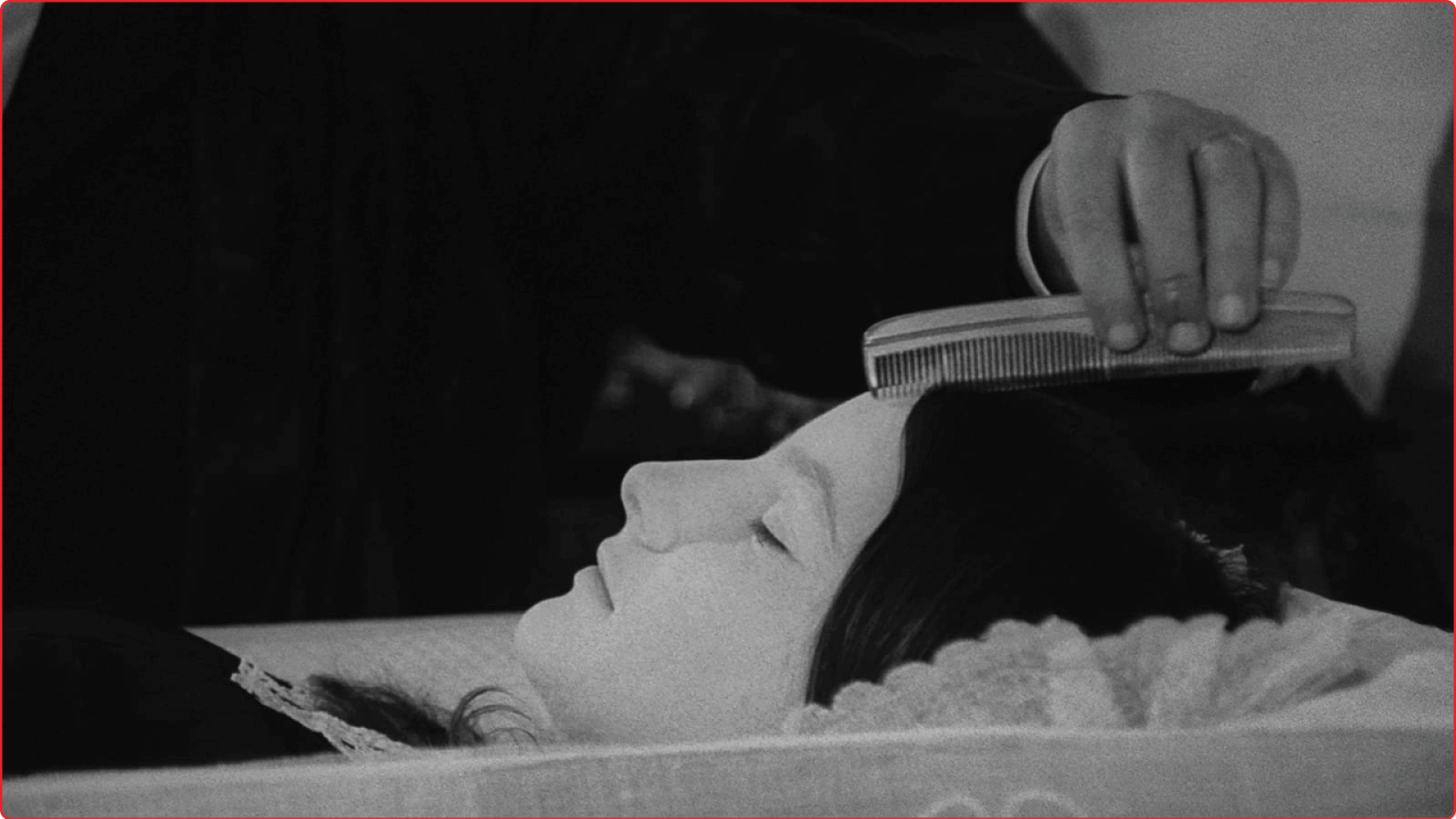
His ideal in life, as in music, is perfect harmony. He gives the same meticulous attention to maintaining the precise part of his well-oiled hair that he does to attending the coiffure of the corpses left in his care, and in fact uses the same ever-ready comb for both tasks. A teetotaler, much like der Führer, our Kopfrkingl is the image of cossetted self-possession, and leads a rigidly proscribed existence, right down to his precisely timed trips to the brothel (the first Thursday of every month), his preference for the same lady therein (played by Chramostová, in a double role), and his blood tests afterwards, for this scrupulously hygienic fellow has a positive horror of infection. The film throughout has a deadpan wit in dealing with Kopfrkingl’s character, as when the brothel’s madame greets her most predictably punctual customer by chirping, with feigned delight, “What a surprise!”

The Cremator (1969)
The Kopfrkingl family flat, with its seemingly vast and immaculately, blindingly white bathroom, reflects the paterfamilias’s mania for sanitation, as well as being an altar to the bourgeois religion of cozy hominess, a clutter of indifferently chosen lithographs in gilded frames and tacky tchotchkes that recall Nabokov’s rough definition of the untranslatable Russian phrase poshlust: “Not only the obviously trashy but mainly the falsely important, the falsely beautiful, the falsely clever, the falsely attractive.” Nothing ugly or unsettling or, to use a contemporary phrase, “problematic,” is to be permitted into this redoubt of tranquil domestic respite; this is reserved for trips to the funfair, where Kopfrkingl takes the family to a sideshow wax museum peopled with infamous murderers, and stares with ardent fascination at a display of deformed fetuses. (A comparison may here be ventured to the contemporary guardians of morality in the arts who are gluttons for ghoulish true crime streaming series.)
Herz’s film, based on a 1967 short story by Ladislav Fuks, who co-authored the script with the director, is not a work to swooningly recall the world of yesterday, the lost Mitteleuropa of coffeehouse wits, Hungarian stage farces, and sunset summer strolls beneath the swaying poplars in Letná Park. The Kopfrkingls are introduced at a zoological garden, the scene of the first meeting between Karel and Lakmé, and this opening, showing the family ogling the caged beasts, prepares the viewer for the almost entomological perspective of the film ahead—a perspective, problematically enough, explicitly aligned to that of Kopfrkingl himself, going so far as to adopt his actual point-of-view on occasion—in which human beings are coldly scrutinized as specimens.
The sense of gelid disgust towards humanity that runs through the movie, that of Kopfrkingl, is bracingly evident from the post-credits scene depicting a reception hosted by our protagonist, with its cutaways to an audience of dull-eyed dewlapped dowagers, disinterested old men with dollops of whipped cream in their moustaches, and an automaton-like girl being goosed by her frisky date. Beauty, inasmuch as it exists in the movie, is here in the form of a solemn, black-clad, raven-tressed female apparition, played by Helena Anýzová, who appears only to Kopfrkingl—these moments recall the devilish little girl haunting Terence Stamp in Federico Fellini’s 1968 Toby Dammit—and appears to be nothing less than Death personified. While the influence of German Expressionist cinema on The Cremator has been much commented on, that of Symbolist painting is no less pronounced: its Death has the melancholic tranquility of a Puvis de Chavannes or Fernand Khnopff, while the solemn mass of Kopfrkingl’s Temple feels somehow kindred to Arnold Böcklin’s Isle of the Dead.

The Cremator (1969)
In stark contrast to Kopfrkingl’s professed vision of harmony, Herz’s film, approximating his scrambled, chaotic inner life, is a work of totalizing discord, achieved with a panoply of stylistic conceits. The score, by Czech New Wave mainstay Zdeněk Liška, with whom Herz had worked on his 1965 short The Junk Shop, overlays funerary chanting onto lilting waltzes, to an effect more jaundiced than jaunty. One scene slides seamlessly into the next, bridged by the sibilant, water-torture drip of Kopfrkingl’s speechifying, and orienting establishing shots are often eschewed, as in the film’s opening, a flurried buffeting with extreme close-ups: a pacing leopard’s spots, Lakmé’s furtive eyes under a broad-brimmed hat, the craggy terrain of a crocodile’s hide. (“I wanted to gradually reveal to the viewer the environment,” Herz would say, “To find out and put it together like a puzzle in his head.”) That fragmentation, a central aesthetic conceit in The Cremator, is exemplified in the film’s stop-motion credits, in which impersonal jumbles of clipped-out photographs of women’s limbs and torsos tumble into heaps, and faces are rent asunder to reveal the names of the personnel beneath.
This brief foray into animation is an indicator of Herz’s somewhat unusual pedigree. Like a number of the leading figures of the Czechoslovak New Wave, Herz attended the Academy of Performing Arts in Prague, but unlike fellow graduates Menzel, Jaromil Jireš, and Věra Chytilová, he was enrolled in the school’s puppetry department, where he studied alongside Jan Švankmajer, with whom he shared a proclivity for fractured fairy tales, evident in later Herz films like 1972’s Morgiana and 1979’s The Ninth Heart, and already asserting itself in The Cremator. This early training in puppetry—to which one might attribute the presence of several marionette-like performances in The Cremator, including those of the mechanical men and women at the sideshow—was not the only area in which Herz was something of an outlier among his peers. He was a Slovak, born 350 miles from Prague in the eastern town of Kežmarok, into a family of assimilated Jews. He was also, singularly among his director contemporaries, a Holocaust survivor, that assimilation having done nothing to prevent the Herz’s incarceration in the Ravensbrück concentration camp.
The action of The Cremator spans a period of a little over two years—as it begins, the Kopfrkingls are celebrating their 17th wedding anniversary, and by the film’s last reel, Lakmé is referred to by Karel as his wife of 19 years. Drawing on references to current events threaded through the film—to Nazi Germany’s Anschluss of Austria, to its annexation of the Czechoslovak Sudetenland and further incursions with the establishment of the Protectorate of Bohemia and Moravia, and to Karel’s recruitment to oversee the establishment of high-capacity crematoriums in what is rather clearly framed as a preliminary run-up to the Final Solution—we can place its events, roughly, in the crucial years of 1938-40, when the threat of another all-out European war came to the brink of assurance.
In spite of this, the film does not give a marked feeling of disintegration, of a world of old certainties being turned upside down and coming to bits in the process. The Cremator is a jarring, cacophonous, dissonant work from its first moments to its last, and this consistency suggests it to be something other than a narrative of innocence seduced by evil. Herz’s film is not a character study of a serene, simplistic bourgeoisie who is led astray by the Nazi ideology; it is the study of an incipient Nazi who takes to dogma of the Reich like a duck to water precisely because he has been primed for it by years of practice playing an upstanding member of his class: parroting prevailing sentiments, valuing cleanliness and sterility to the point of obsession, and buffering himself off from the harsh realities of the world behind walls of comforting chintz and lace curtains. (It needs be remembered that, outside of certain propaganda productions dealing in the sinister glamor of will to power, the artistic products of National Socialism were corny enough to make Norman Rockwell blush.)

The Cremator (1969)
Kopfrkingl even, like his German compatriots, shows an interest in exotic religious esoterica, namely the 14th century Bardo Thodol or The Tibetan Book of the Dead, from which he devises a doctrine of cremation as a humanitarian undertaking to alleviate human suffering—the earlier undertaken, the better. As he descends deeper into messianic mania, he begins to imagine himself the reincarnation of Thubten Gyatso, the 13th Dalai Lama, who died in 1933, and has visions of the Potala Palace in Lhasa. His own Temple of Death is itself not without a certain Orientalist flair; its exteriors were shot at a celebrated crematorium in the city of Pardubice, a Byzantine-inspired Art Deco eccentricity by architect Pavel Janák.
The Cremator began production in a period of great hope for the future of the Czechoslovak state and unusual freedom for artists working inside it, the greatest since the 1930s: the period of liberalization following the election of Alexander Dubček to the position of First Secretary in January of 1968 that was dubbed the “Prague Spring.” Strange though it may be to say of a film so unremittingly grim in atmosphere, The Cremator owes its existence to the sense of possibility of the moment, the unloosing of pent-up experimental energy that had begun in the early ’60s and peaked with the thaw of the Spring, allowing for the development of the film’s relentlessly discombobulating style.
Shooting without live sound, largely handheld, often with short or zoom lenses, on a 16mm Arriflex, one senses that Milota was working fast, loose, and unfettered, sometimes capturing scores of set-ups in single scenes—Kopfrkingl’s visit to a Chevra-Seudah dinner held by the local Jewry, at which he goes into rhapsodies at the mournful singing of the cantor, or his meeting with a Nazi official, in which he stands in front of a reproduction of the “Hell” panel of Hieronymus Bosch’s The Garden of Earthly Delights—to then be fragmented into nettling stick-and-move montage by editor Jaromír Janáček. The effect of these sequences is something like the cinematic equivalent of making one’s way through the halls of distorted mirrors and across the wobbling floors of a funhouse—or, perhaps more accurately, an unfun house.
The Cremator shoot would be interrupted by the arrival of tanks and troops from four different Warsaw Pact nations in the Czechoslovak Socialist Republic in August ’68, putting a deep freeze end to the Prague Spring. Hrušínský, according to Herz, “was hiding somewhere in a factory” during this period; as a signatory of The Two Thousand Words manifesto authored by reformist writer Ludvík Vaculík that June, he feared reprisals, and rightly so—The Cremator would be the actor’s last film until 1976. Milota would suffer an even worse fate, his release from his employment with the state-owned Barrandová studios effectively putting an end to his working life in Czech cinema, while Chramostová, his wife, would go without screen credits from 1972 to 1995. In spite of its connections to such insalubrious individualists, The Cremator was completed, publicly premiered, and to all reports enjoyed a degree of popular and critical success, winning awards from the Czechoslovak Film and Television Union and being selected as the Czechoslovakian entry for Best Foreign Language Film—this, before being put under lock and key and not screened again until after the Velvet Revolution of 1989, which signaled the last gasp of one-party rule in Czechoslovakia and preceded the election of President Václav Havel, a former playwright, under whom Milota would serve as the first head of secretariat.
Herz has described filming a postscript scene which would bring the action of The Cremator to the present day, in which an elderly Kopfrkingl observes the arrival of the Soviets with a bland smile. Given that this scene was ultimately excised and presumably destroyed, it is worth asking: what would the regime’s censors find so objectionable in a movie that focused its indictment on the prewar bourgeoisie and the wartime collaborators they became, the class that surely had nothing to do with the postwar dictatorship of the proletariat?
One can only guess, though it is a fact that the total reinvention of everyday existence promised by the Russian Revolution of 1917 had been less complete than was anticipated. The initial explosion of avant-garde energy that followed it had been muffled by a slow sinking into the morass of Soviet kitsch, and the sons and daughters of the Old Bolsheviks who had once preached abolition of the traditional family—those who survived the Purges, at least—then formed a fairly stable, reproducing upper caste in the USSR, and were busy feathering their nests and in all regards conducting themselves as well-behaved bourgeoisie. This state of affairs was, presumably, not so different in Prague than it was in Moscow. The conformist has an infinite capacity to adapt to regime changes; it is with this in mind that, in a late-in-life interview on the film given in a Czech Republic that had left behind fascism and communism, Milota would say “The Kopfrkingls are still among us.” Made under one bygone authoritarian Czechoslovak administration and depicting the rise of an earlier one, The Cremator considers certain imperishable evils afflicting the body politic, not least the tendency to frame abominable cruelty under the guise of sweetest compassion.

The Cremator (1969)

Share:
Recommended
- Yuliya Solntseva
 On the actress-turned-filmmaker’s unsung authorship.
 - Futures and Pasts: Socrates
 Rossellini’s one-of-a-kind approach to the costume drama, and his 1970 film on the last years of the Athenian truth-seeker.
 - The Illiac Passion
 On the most elaborate of Gregory Markopolous’s modern myths.