
Throw Down (2004)
Essay
Throw Down
On Johnnie To’s frenetic, poetic, deeply personal homage to nightlife, friendship, stick-to-itiveness, and the Hong Kong of the heart.
Throw Down (2004) plays at Metrograph from Saturday, April 25, as part of Sukiyaki Bebop
Share:
WHAT WOULD ALEXANDER MACKENDRICK’S Sweet Smell Of Success (1957), Elia Kazan’s Panic In the Streets (1950), or Sherman A. Rose’s Target Earth (1954) each be without, respectively, the sooty gloss of pre-Disney Times Square, the courtly sleaze of New Orleans’ yet to be corporatized French Quarter, and the down-market Victoriana of pre-urban renewal Bunker Hill? And would those films still so tenaciously cling to memory had they not inadvertently documented the loss of three gloriously photogenic cityscapes subsequently legally vandalized or pounded into gentrified oblivion?
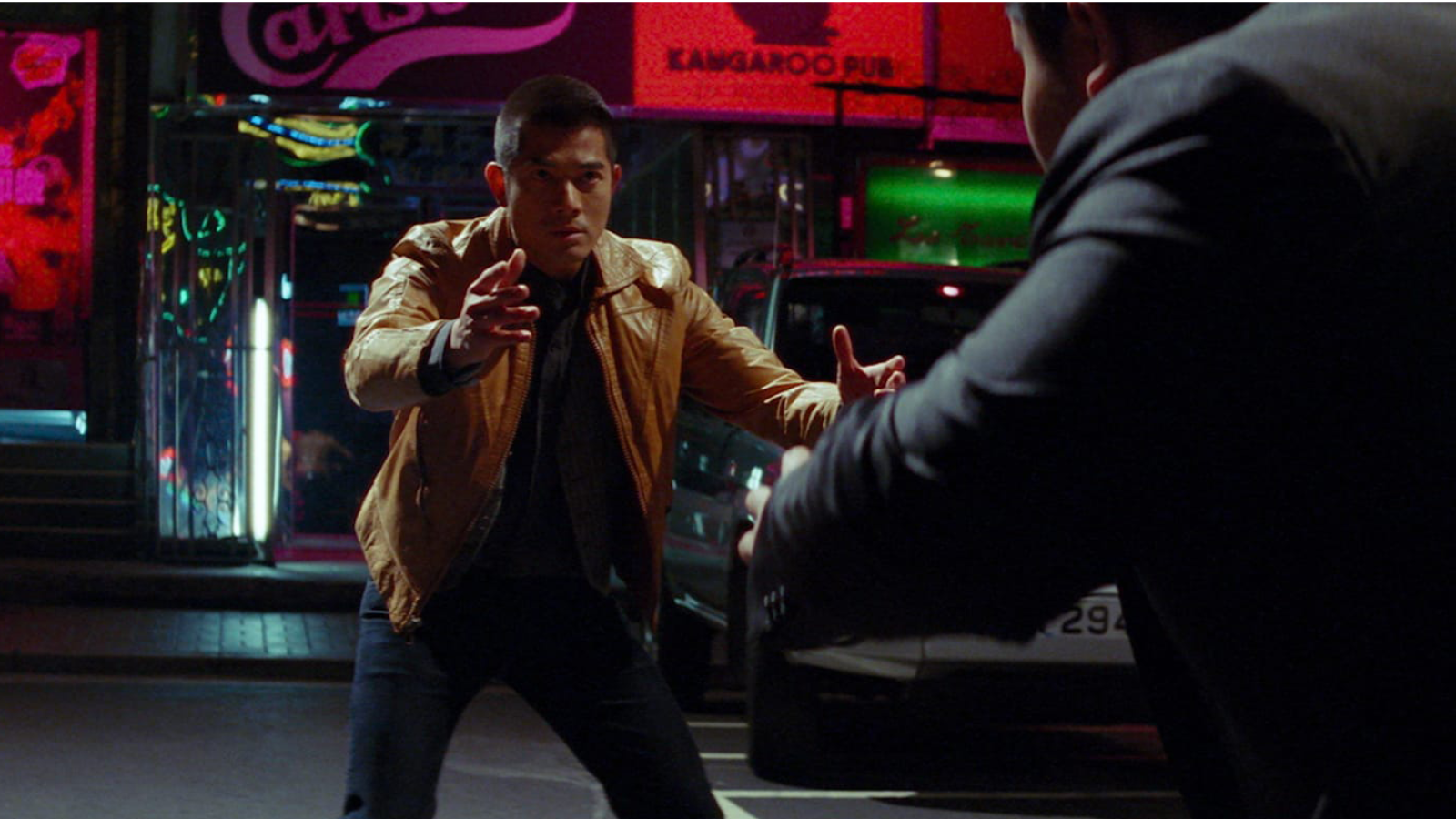
The Hong Kong of Johnnie To’s 2004 Throw Down—shot largely in the streets of Sheung Wan, Tsim Sha Tsui, and other neighborhoods on both sides of Hong Kong’s Victoria Harbour—appears to have remained, as of a visit last year anyway, largely architecturally intact. Nevertheless, Throw Down was completed and released six years before the implementation of at least one tragic act of municipal self-harm that has forever sealed To’s film in the sentimental amber of loss and regret. In 2010, 13 years after the city-state’s return to Mainland Chinese control, the Special Administrative Region government began actively licensing and regulating Hong Kong’s extraordinary street and storefront neon signs. Arguably the advent of comparatively inexpensive, lightweight, and low maintenance LED lighting around the turn of the millennium, along with a generational brain drain of dying-off artisans sufficiently versed in technology roughly as analog as the electric chair had already sounded the death knell for the spectacular gardens of light crusting over building fronts and bridging thoroughfares in nearly every corner of the “Pearl of the Orient.” But the prohibitive cost of meeting the stringent new administrative specifications definitively doomed the city’s eye-catching trademark. HK’s psychedelic washing lines of garish and gorgeous signage (estimates ran above 120,000 individual pieces prior to the still ongoing denuding) was and remains in collective memory—and in a collection of rescued displays enshrined in HK’s M+ museum—what marble is to the streets of Rome.
Throw Down (2004)
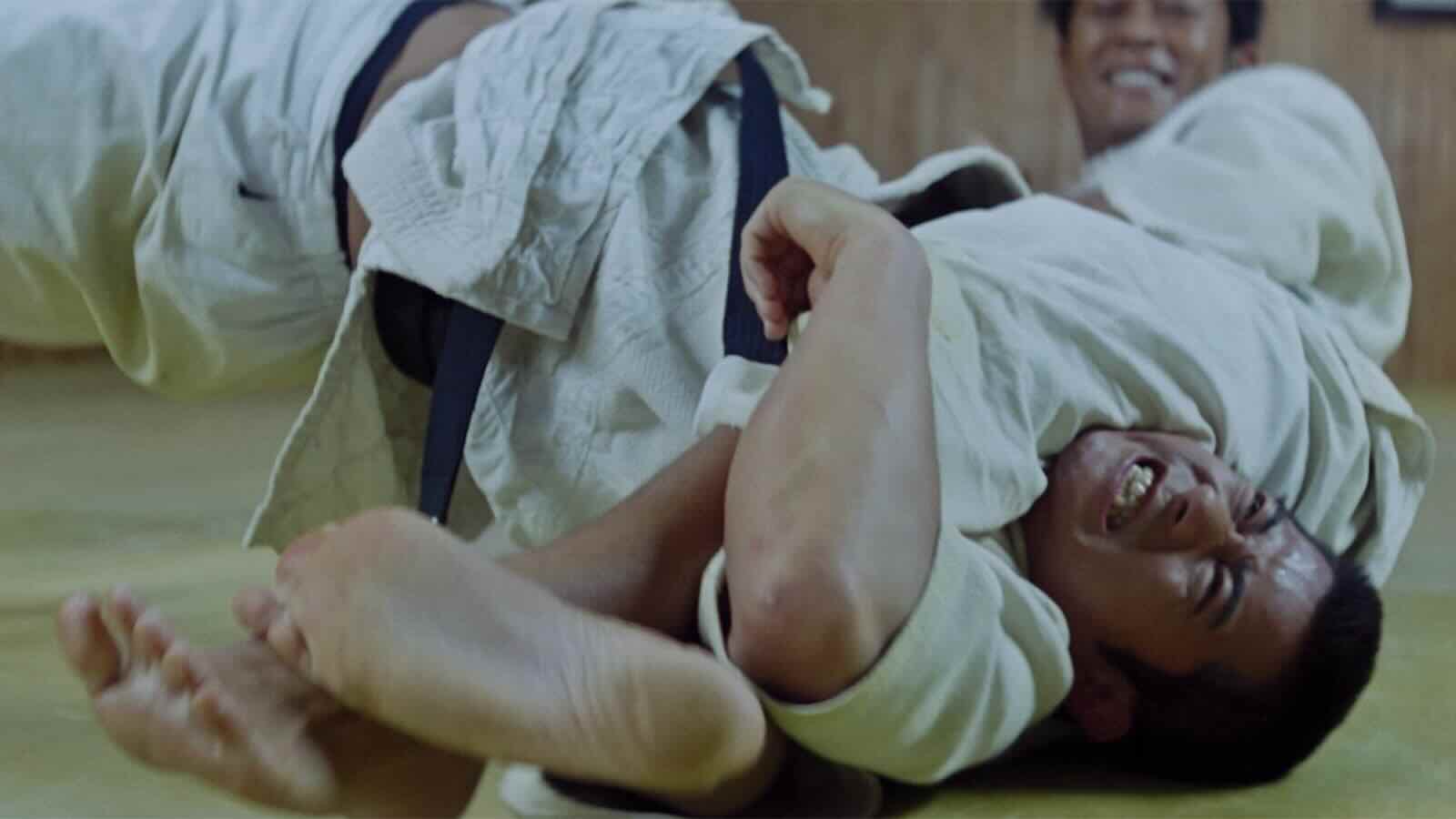
The now-vanished trellises of metal, glass, and gas neon gilding the exteriors of To’s film are perhaps the only unintended layer of evanescent unreality in a freewheeling, if not outright delusive movie experience. Presenting as a triumph-over-adversity sports melodrama that ends in, at best, a draw; a romantic comedy without the slightest hint of rivalry, ardor, or sexuality; a violent crime picture absent clear-cut villainy, coherent heist film process, or sustained conflict; and a “vibes” movie that restlessly keeps its characters in frantic and erratic motion for most of its running time, Throw Down continually subverts casual expectations.
The setup is relatively simple: two otherwise un-allied strangers arrive at the velvet-roped doorstep of nightclub manager Szeto Bo (Louis Koo), a fallen former judo champion turned dipso degenerate gambler. Tony (Aaron Kwok), a pugnacious young judo contender, wants to fight Szeto and won’t take no for an answer. Mona (Cherrie Ying) is an ambitious, marginally talented singer on the outs with her bourgeoise family in Taiwan, and on the run from a local agent whose recent career guidance includes urging adding sex work to her CV in lieu of the fame and fortune she doggedly seeks. Their three-way meet-cute is annealed in a seemingly telepathically improvised yet smoothly executed cash grab from arcade addict and bloodthirsty gangster Brother Savage (Cheung Siu-fai), which the three instant comrades undertake at Szeto’s deeply-in-debt behest. Their literally harmonious bond—they even form a band of sorts, performing at the club, with Bo on guitar, Tony on tenor sax, and both accompanying Mona onstage—begins to rouse Szeto from his slowly self-immolating somnambulance as it emboldens and empowers Mona and Tony to strive towards the next milestones on the road to their individual destinies. Sound odd? Well, it is. Have I mentioned Szeto’s judo mentor (Lo Hoi-pang) and his developmentally challenged son Jing (Calvin Choy)? How about Tony Leung Ka-fai in maximum Brian Ferry louche mode portentously turning up halfway through as Lee Kong, the lordly judo dojo operator and one-that-got-away opponent whom Szeto left at the competitive-grappling altar so many drinks and dice rolls ago….?
Characters, their conflicts and backstories—played out in fights, foot chases, and face-offs galore—careen, swirl, and tumble through Throw Down like squirts of paint on a work-in-progress piece of carnival spin art. A broken limb that fades into physical irrelevance, a Nok Hockey grudge match pitting a box knife–wielding hood against a bespectacled grade-schooler, a reprise of the initial video arcade murse snatch re-costumed in furry drag, a lengthy bathroom-stall comedy digression—the sights and sounds of Throw Down pull you in seductively while logical plot correlatives wriggle away. “I totally didn’t understand why everybody knew judo,” remarked the film’s putative screenwriter Yau Nai-hoi, who inherited, in his words, “an inspirational movie with an ensemble cast” from departing writer Wai Ka-fai during development. “It wasn’t realistic.” But situational realism was clearly not the flame that drew To to make the film in the first place.
Throw Down (2004)
“I wanted it to be messy,” To said in a contemporaneous EPK included, like Yau’s eye-opening interview, on Criterion’s home video release. “I don’t need the audience to understand everything. They just need to understand the tone.” Even by the standards of Hong Kong cinema’s trademark narrative abruptness, Throw Down exalts tone over virtually all else. And the method to achieving the film’s easygoing madness was anything but arbitrary. Throw Down was shot on an evolving schedule that accommodated To’s multiple commitments near the peak of his bankable popularity at home and abroad. Script pages were re-written daily. Scenes were improvised and embellished based as much on the mood of a given day’s work and the casts’ instincts as on extant drafts. Actors only saw pages covering their own parts of the creatively metastasizing story puzzle, and frequently only at the last minute. Over the course of the patchwork shoot, “The initial story was dismantled and rebuilt,” said Yau. As a result, in place of a tidily familiar and formal poker hand of genre tropes, Throw Down constantly doubles back on itself, successively repeating, modifying, and mutating story points, situations, and dialogue; silence and score are substituted for exposition, and kinetic movement for plotted action, with a unique lack of modernist pretension or high-handed irony.
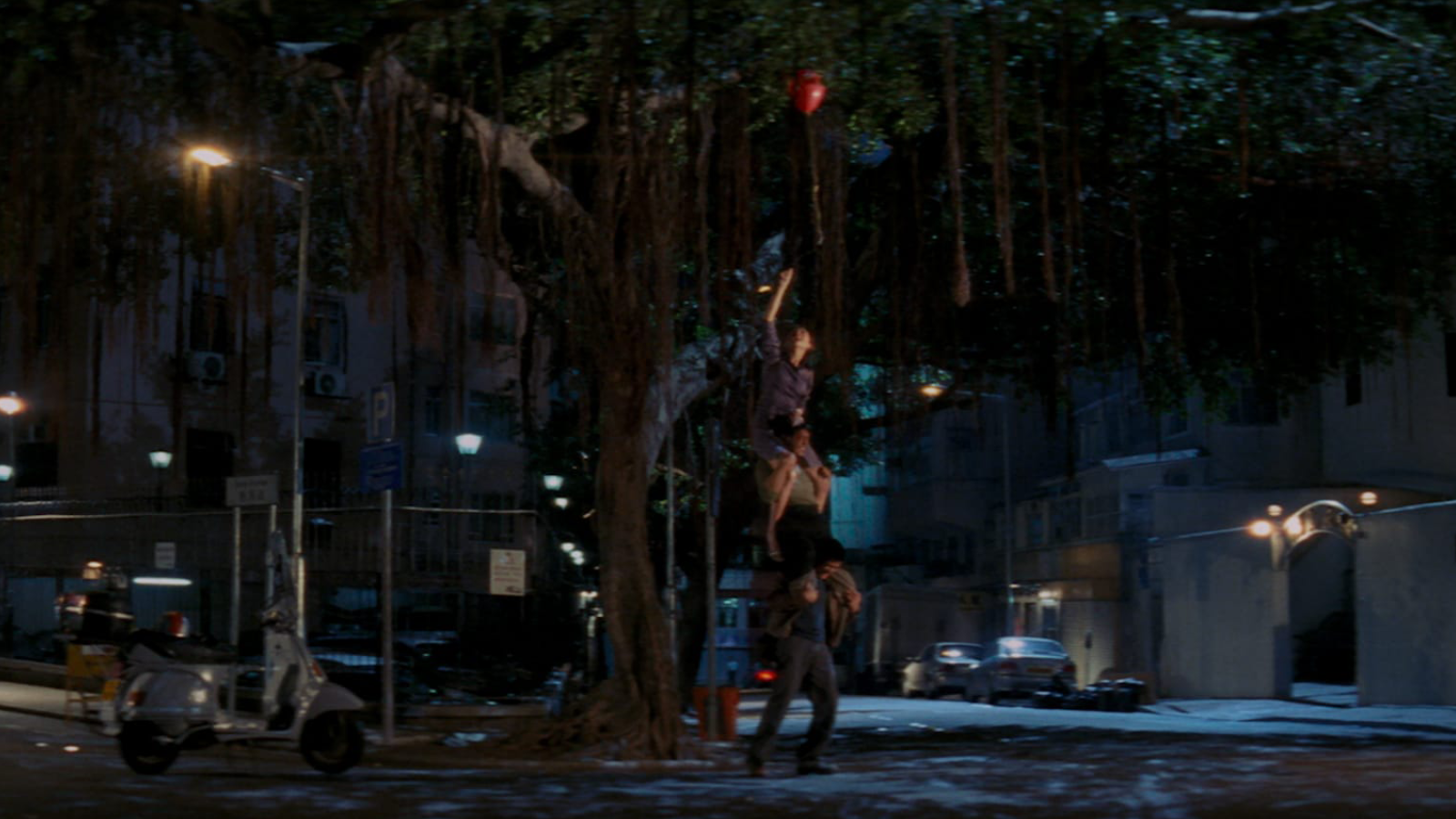
Allowing that there are few more lazily sententious verses from a critic’s epistle than the observation that a film evokes a dream, To’s film is nevertheless remarkable in the way it does indeed move with the intrinsic anti-logic of the unconscious. Throw Down, to quote Chris Fuijwara on Jacques Tourneur’s The Leopard Man (1943), “does not say ‘no’.” In lieu of rising stakes, the film, like Tourneur’s, moves forward not with accumulating character clarity but with “the force and meaning of affirmation; like a dream.” A quietly determined sense of both exaggeration and absence pervades. Tight bundles of cash swiped by Mona in a gambling-hall version of a dine-and-dash blossom into an unmanageable bushel’s worth of bills spectacularly spilling out along the street behind her like preliminary spark trails from a just-launched firework. To shows us Szeto witnessing the tragic outcome of a pivotal judo match not from ringside but from the eerily depopulated steps of a heavily festooned arena. A precipitously melodramatic infirmity climactically swaps characters with an uncompromisingly unlikely convenience rivaling that of an Ed Wood film.
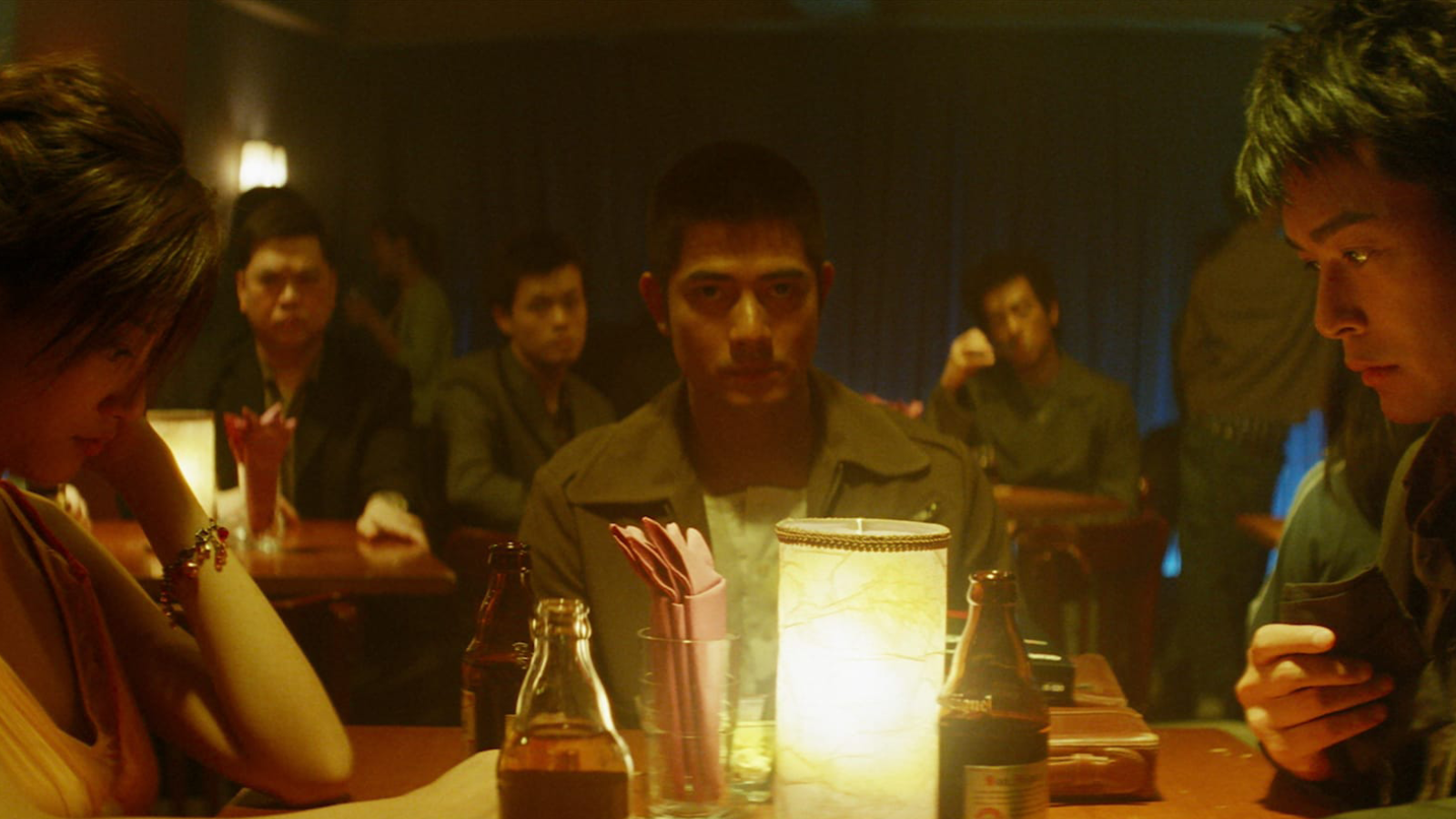
And yet To’s reliably rigorous command of film craft deftly keeps it all from crashing down or floating away. Barroom mêlées and judo one-on-one’s both have the lucid cutting room coherence of fight scenes girded with precision planning. An impromptu nightclub sit-down that spotlights nearly every member of the semi-sprawling cast and every tangled dramatic circumstance involving them is particularly finely wrought. To and his ensemble mesh four adjacent tables’ worth of eyelines, gestures, and overlapping dialogue into a chamber piece of brinkmanship, action and reaction that seems to effortlessly toggle each character from center stage to chorus almost with each cut and camera move.
Throw Down (2004)
Throw Down bears a concluding credited dedication: “A Salute to Akira Kurosawa, the Greatest Filmmaker.” The film itself concretely references Sanshiro Sugata, Kurosawa’s 1943 debut, via a shared competitive judo milieu, a lovely scene echoing a sandal fastening in Sanshiro Sugata, and by Jing rotely yet earnestly name-checking Kurosawa’s lead characters while offering a six-finger handshake on multiple occasions. But directors from Sergio Leone to Walter Hill to George Lucas have freely appropriated and saluted Kurosawa (including To himself, in his 2003 film PTU) for decades. To’s EPK interview suggests that Throw Down’s dedication may itself be another slight misdirect. While generally praising Kurosawa, To goes on to specifically cite Sugata Sanshiro, a 26-episode TV series adapted from the Kurosawa film by Kunio Watanabe and broadcast in Japan in 1970. When the series was aired on HK’s Television Broadcasts Limited network two years later, it became an instant sensation. News reports at the time described such dedicated acts of fandom as a Chinese train conductor blowing past multiple stations en route to clocking out because he “wanted to see the continuation of last week’s episode.” Native pop star Paula Tsui’s cover of the show’s theme song became a huge radio hit, and her version closes Throw Down over the last few shots and credit roll. The original Throw Down script—a conventional sports underdog story inspired, according to Yau, by the then-recent 2003 SARS epidemic and accompanying economic downturn, was intended as a feel-good celebration of the resilience of Hong Kong’s residents in the face of the just-passed double-barreled crisis. As such, that preliminary draft likely provoked To’s youthful memory of a Hong Kong moment when an entire city embraced and adopted a foreign TV show as its own.
The keenly nuanced optimism and kaleidoscopic celebration of Hong Kong’s perils and delights in To’s fractured yet elegiac, slyly duplicitous yet nakedly honest movie are, I think, distinctively homegrown. There’s plenty of darkness on hand in Throw Down—but not a flicker of the sentimental nihilism that mainstream American film has pimped for a century via dramatizing the truly bizarre notion that human endeavors are naturally destined to turn out for the better. And in a contemporary moment when a cursory sip from any media spigot suggests civility and civilization have jumped their chocks, and even the most benign e-vite to a baby shower or Superbowl party includes a clause citing “these troubled times,” To’s film offers not so much a message as a reminder. Whether blind, seeing, drunk, sober, won, lost, famed or forgotten, every second above ground remains a gift worth unwrapping. Perseverance—not for fame or glory but simply for its own sake—is the only happy ending.

Share:
Recommended
- Genevieve Yue’s Trains
 On the offbeat pleasures of the train in Genevieve Yue’s new book.
 - Yuliya Solntseva
 On the actress-turned-filmmaker’s unsung authorship.
 - Futures and Pasts: Socrates
 Rossellini’s one-of-a-kind approach to the costume drama, and his 1970 film on the last years of the Athenian truth-seeker.