

Essay
Roger Moore Gets Real
On the pleasures of 007’s smudgy mirror to the world, and Roger Moore’s final outing as James Bond.
Share:
A View to a Kill (1985)
SINCE THE LATE ’80s, various sources have claimed that somewhere between 25 and 50 percent of the world’s population have seen at least one James Bond movie. The statistic likely originated in an authorized accompaniment to the films, which I suspect may—understandably—have inflated it, but in any case, it seems safe to assume that the true figure is still stunningly high. By 2002, when Anthony Lane wrote a truly great appraisal of the franchise for the New Yorker on the occasion of its 40th anniversary, the estimate he cited was a quarter; in 2018, a survey found that 47% of American adults had seen at least one 007 movie.
Perhaps more shockingly, that same survey found that 27% of respondents had watched every single Bond movie. (Admittedly, whether this includes the 1983 Sean Connery vehicle Never Say Never Again, which was made without the imprimatur of the franchise’s long-time producer, Eon Productions, is unclear.) What possesses somebody to return to these films—which you know, once you’ve seen two or three, will feature the same character going through the same things again and again? For my part, as one of the 27%, it is three things: Bond himself and his comforting imperviousness to the constant threat of death, his better jokes (even the off-color innuendo; forgive me), and the aesthetic universe in which his antics take place. It is not really the variation in these films’ plots that makes them so pleasing to watch and rewatch, but rather their parade of exquisite surfaces: their sets, their gadgets, their very nice cars and suits and lobbies and champagne glasses (though not, mind you, their meals). I come back for the modern house built into tower karst; the car that turns invisible in an ice hotel; the liquidy pink silk of a Jenny Packham dress.
Reddit tells me that the cumulative runtime of every Bond movie sums to just over two days. (Two days, two hours, 50 minutes and 42 seconds, to be exact.) Somehow, to me, this number seems paltry, as if only a work of much greater length could have been responsible for the abundant imaginative residue these films have left behind. I would speculate that much of what gives these images their charm and power is the extent to which the universe from which they come resembles—but doesn’t parallel—our own. Unlike most of history’s highest-grossing franchise films, the Bond movies don’t take place, like Star Wars, in a fantasy world, or, like Harry Potter, in one infused with literal magic. (Among the top 10 most successful, the only other exceptions to this fact are Christopher Nolan’s Batman movies, which, like his espionage films, cast sci-fi elements in a glamorized corporate aesthetic. Arguably, this is a style pioneered by the Bond films, and in particular by those which employed the costume designer Lindy Hemming, who worked on Bond from 1995 to 2006, and on Nolan’s Batman trilogy.) Adding to this verisimilitude is the extent to which these films loosely borrow contemporary issues to fuel their villains’ plots. From the ’60s to the ’80s, they often involved some relationship to the Cold War, after which they became more narrowly topical. In Tomorrow Never Dies, from 1997, we get a lesson on the dangers of media consolidation; in No Time to Die, from 2021, one on genetic engineering.
A View to a Kill (1985)
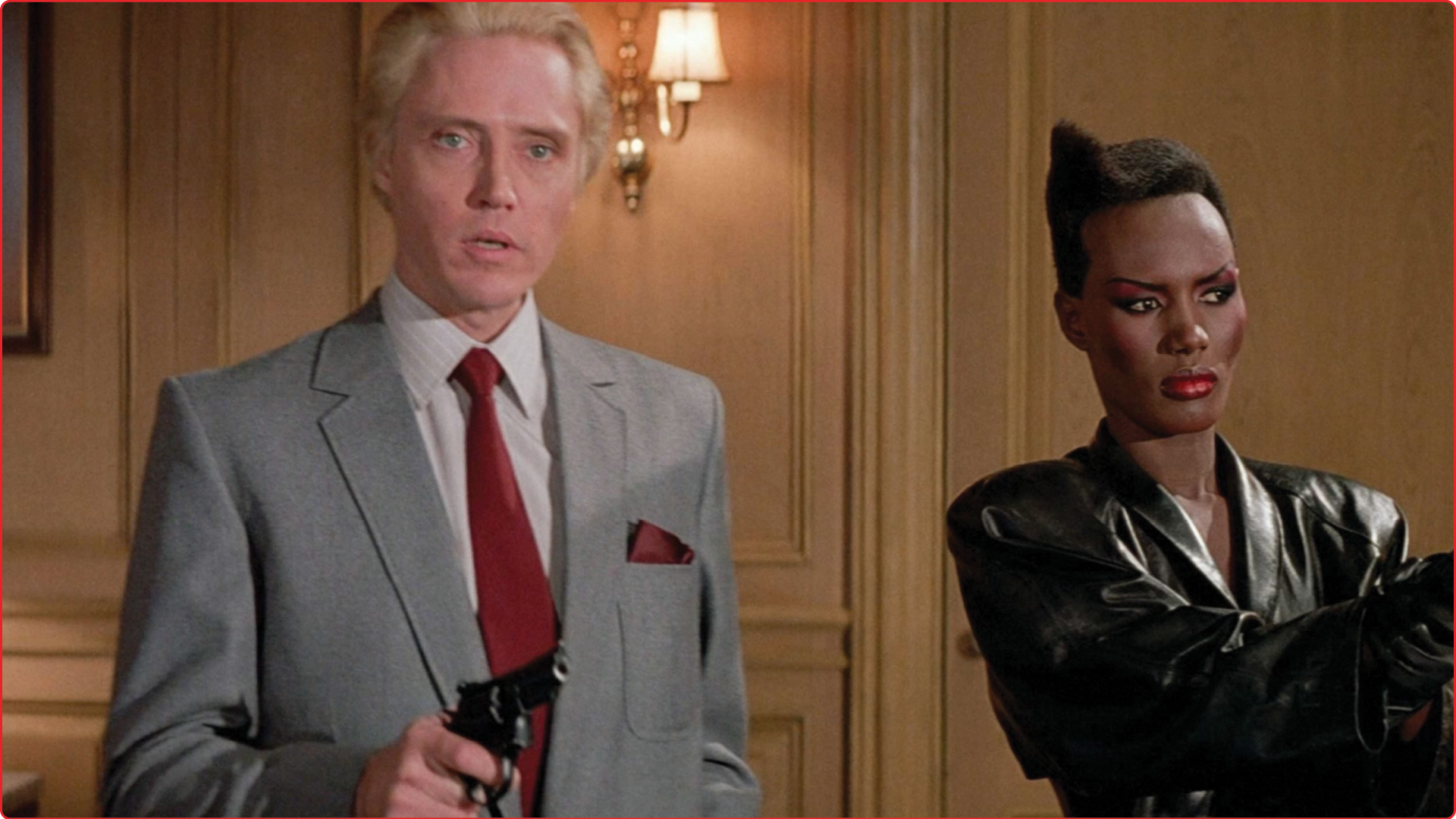
In A View to a Kill, the matter of the hour is semiconductors. Our antagonist is a man named Max Zorin (Christopher Walken), a French industrialist who, in the 15 years since his escape from behind the Iron Curtain, has made a fortune. Now, all Zorin wants is even more money, and he plans to get it by destroying Silicon Valley, thereby choking the international supply of microchips and making him and his business partners the world’s sole purveyors of them. The way in which View converts the inspiration it snips out of the business pages is paradigmatic of the smudgy translation Bond films tend to conduct. In the real 1985, the American semiconductor market was troubled by lingering effects of the 1982 recession and, more acutely, by Japanese competition. In the fictional 1985, all you need to know about microchips is that they’re made in Silicon Valley.
The film’s shallow engagement with its source material is of a piece with most others in the franchise, but there are several things about this installment that mark it out as a slightly odder entry. For one, it has no “exotic” backdrops of any kind—no Orientalizing depictions of Asia or the Middle East, no hideouts that obviously flout the laws of physics, nor any of the other unrealities that both (perhaps second only to the changes in Bond’s treatment of women) date the films and suffuse them with adventure. As Bond zips, per usual, from one continent to another—the film starts in Siberia, then stops in the UK, France, and the US—he doesn’t visit a single hotel. That alone might have tipped the producers off that their project was a little wobbly, but they should have known without a shadow of a doubt when they saw Bond in a woman’s kitchen, pulling a quiche out of an oven after admitting he’s been “known to dabble” with cooking. Since when?
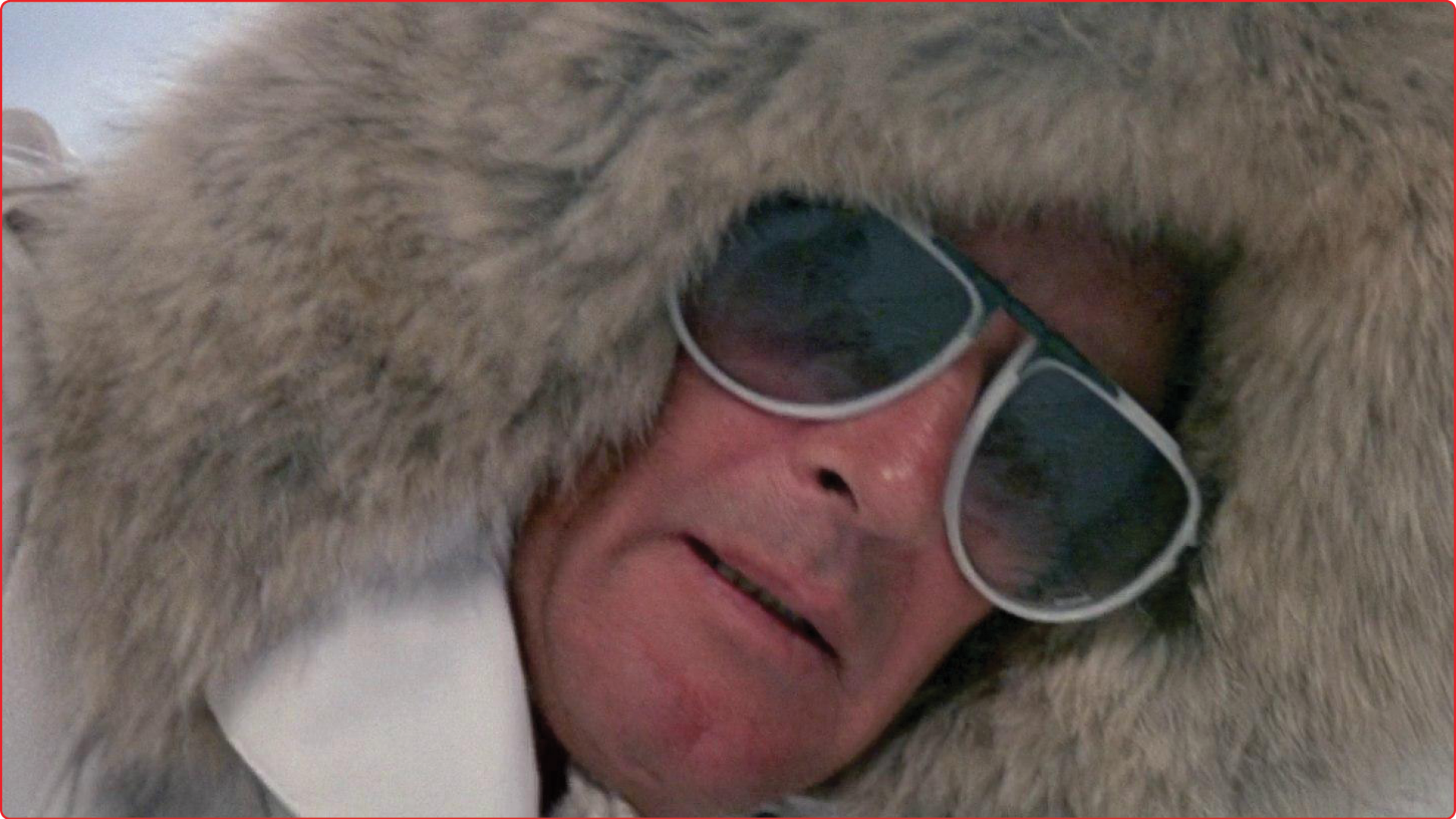
To be fair, it is plausible, for the duration of Moore’s run as Bond, to imagine the character making an omelette in his downtime in the normal, human way—without breaking any proverbial eggs. Moore débuted as 007 in 1973’s Live and Let Die; A View to a Kill, which came out in 1985, was his last outing. During the 12 years between those two films, he played the spy with, basically, a straight face—neither leaning strenuously into the character’s comic moments, nor dialing up his violent or seductive tendencies. Probably, more than any of the other actors who had the role, Moore portrayed Bond like one of the men he could have been if he existed in real life: businesslike and—in the manner that truly effective objective-oriented people can be—occasionally so cold as to seem hollow. In The Spy Who Loved Me (1977), he cuts off a quip of Q’s—sweet Q!—by slamming the door and hitting the brakes, seeming more like a teenage brat than a teasing colleague. In A View to a Kill, when a fellow spy named Tibbett has to pretend to be Bond’s footman so the two can snoop around Zorin’s estate, Bond is briefly more imperious than he needs to be for the purposes of their cover. (Perhaps the treatment seems especially harsh because Tibbett is played, in a delightful Easter egg, by Patrick Macnee of The Avengers, a warm-hearted spy show that ran throughout the ’60s.)

A View to a Kill (1985)
Some actors derive their charisma from the totality by which they abandon themselves to their performances; others from the discernible seam where we can see their personality and that of the character they are playing join up. By many accounts, Roger Moore was a truly nice person. According to Michael Caine, who once asked Moore whether he planned to watch a Muhammad Ali fight, the latter’s response was apoplectic: “I hate boxing, I hate anything to do with violence,” he said. Sometimes, this revulsion comes through in Moore’s performance—a retort Pierce Brosnan might have delivered with flip frustration, Moore does with a hint of deeply grounded moral disapproval. Perhaps he was just too nice; he couldn’t ever seem to believe in the possibility of the character’s inwardness, as if he thought a man so desensitized to both sex and violence could not have an emotional landscape vivid or interesting enough to be worth mapping out. Sean Connery played Bond like a high-minded killer; Daniel Craig, like a ruin. Like both of these actors, Moore is wonderful to watch (when he gets well-written punchlines, especially). But he elided the essential psychological contradiction that makes Bond tick: the way his constant exposure to violence demands an equally extreme indulgence, and how much of his personality—that suave, self-satisfied, unfailingly unperturbed skin—seems like an edifice erected to curb the threats that might be posed by these depths.
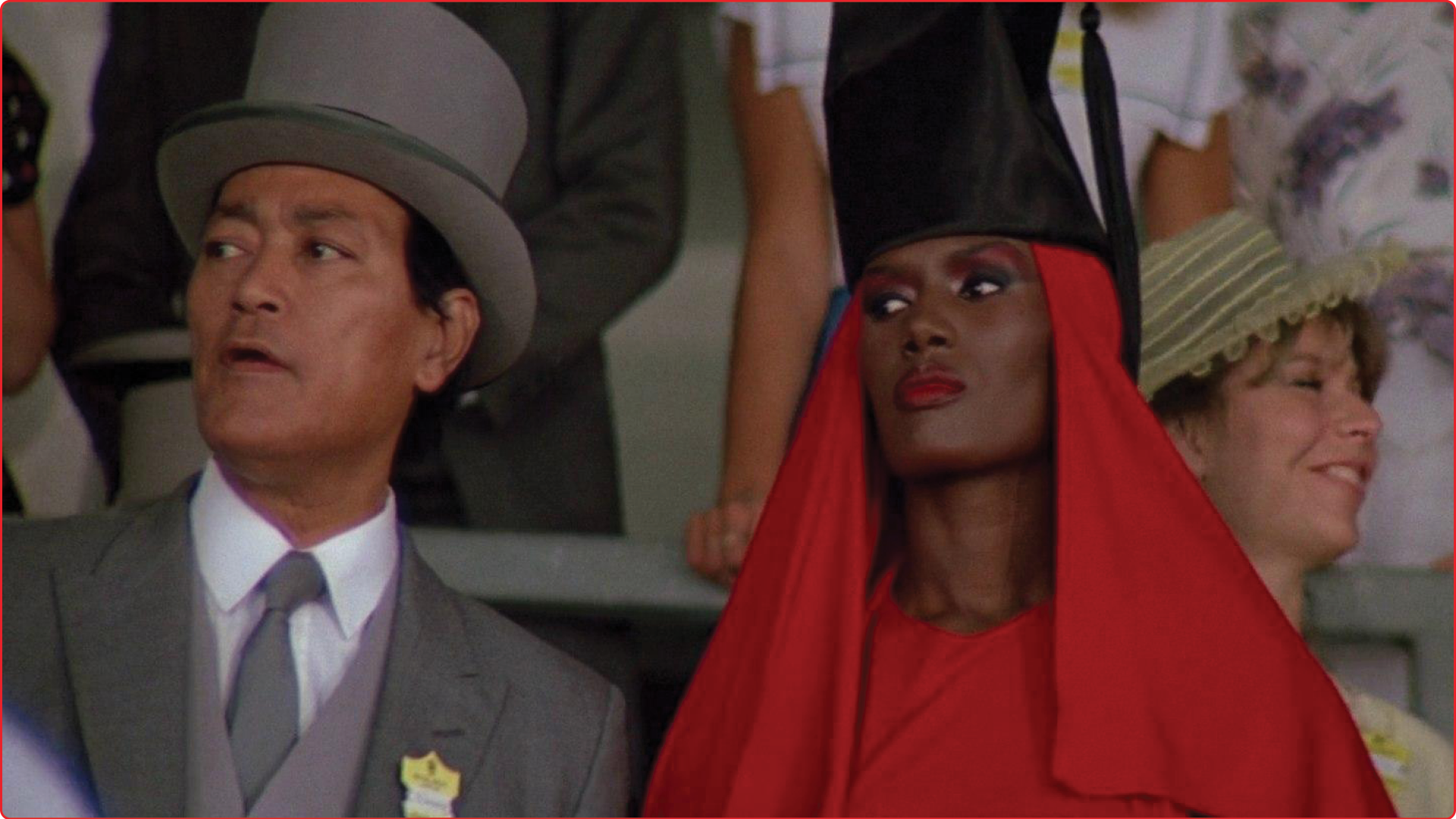
By View, Moore seems a little bored to still be Bond, but he gives a valiant effort, and his performance is enlivened by his character’s encounter with a true novelty: May Day, Zorin’s henchwoman-cum-girlfriend, played by Grace Jones. May Day is possibly the strangest Bond girl in the franchise, the one most memorable for her force of personality alone, rather than her relevance to Bond’s development (as is the case for other noteworthy female characters, like Aki in 1967’s You Only Live Twice, or Vesper in 2006’s Casino Royale). She’s also strong enough to push a parked car into a lake, or lift a man above her head. Jones has no more than a handful of scenes, but her delivery, which ranges from diamond-hard to feral, is indelible. She handles every one of these moments so deftly that she imbues May Day with a whole spectrum of feelings and desires. As one of Bond’s superiors says, by way of an introduction, “We’re not sure about her.” She’s quicksilver.
A View to a Kill (1985)
On the style front, May Day is also the vehicle for the movie’s most alluring visual elements: a series of costumes designed by Azzedine Alaïa. When she first appears, on the sidelines of a horse race, she wears a sleeveless knee-length dress in fire-engine red, topped with a billowing hood of the same color that vanishes into a towering black fez. In a scene where she is training Zorin to fight, she wears a scant black unitard and arm- and leg-warmers—it sounds bad, but somehow it is devastatingly good.
At the end of the movie, during a sequence that requires of Jones no small amount of athleticism, her costume consists of a dangerously short dark gray get-up made of what looks like jersey. The fabric clings to the scaffolding of her shirt’s power shoulders (it is, after all, 1985) and then flutes into a twist on her chest. For shoes, she has tight, vaguely shiny—but not glossy—leather boots that hit closer to her hips than her knees. (Tanya Roberts, sweet as she is as the film’s virtuous female lead—a scientist, yes, but one whose bedroom is stuffed with frilly pink sheets and decorative porcelain—didn’t stand a chance.) Alaïa’s clothes emphasize Jones’s body and the obvious architecture of the garments themselves in equal measure; they are truly artful and weirdly beautiful. They provide a requisite element of Bond movies that would have otherwise here gone unfulfilled: the intrusion of the genuinely modern—the convention-challenging, order-upsetting new—into a familiar world.
The film delivers many other pleasures. For instance, Walken’s Zorin. His aesthetic is more formulaic than May Day’s, reflecting the dark side of the conservatism that Bond—especially in Ian Fleming’s conception, and in the early part of the franchise—strives to protect. Zorin likes well-cut suits, keeps his gold hair combed in an inoffensive way, and owns a thoroughly gilded estate just outside of Paris, decorated in the style of the Second Empire. It’s not a particularly inspired character, but Walken endows him with a mesmerizing affect, of elegance just edged with psychosis. (He also looks amazing in his aviators.) And View offers no small share of the spectacle Bond has taught us to expect. There is skiing and snowboarding; a swan dive from the Eiffel Tower; a car cut in half; another car crushed slowly; Bond hanging from the ladder of a fire engine as it swings from one side of the truck to another, and he half-dances, half-struggles for purchase.
Watching this film now, in an era in which, thanks to CGI, it has become workaday to witness somebody jump from a high place or dodge an explosion, one could imagine that seeing these events might be boring. To the contrary: this is an action movie where the stunts are legitimately gasp-inducing, because it’s so clear how much happened for real, in our common physical world—where bones break, fabric billows with unpredictable grace, and smoke sometimes means a fatal fire. View’s uninspired rendition of Silicon Valley’s troubles might be so inaccurate as to be basically contentless, but there is one sequence in the movie wherein the depiction of an actually existing phenomenon is jolting, though surely not for the reasons the filmmakers intended. When Zorin floods an abandoned mine on the outskirts of San Francisco, the water rushing through the caverns and the passages between them is, unlike the staging of almost every plot by a Bond villain, authentically unsettling. The screen fills with real water—real force—and you remember, because you’re actually beholding it, how little, once you’ve thoughtlessly interfered with nature, nature thinks of you.
A View to a Kill (1985)

Share:
Recommended
-
Susan Seidelman
 An intimate conversation with the trailblazing American filmmaker.
 -
Carol Kane
 Fifty years in 50 minutes with the irrepressible screen icon.
 -
Mark Lee Ping-bing
 The legendary cinematographer reveals his three core beliefs.
- The Illiac Passion
 On the most elaborate of Gregory Markopolous’s modern myths.
 - Jollof Films
 Senegalese visual artists and curators discuss the towering cinematic figures who inspire their craft.
 - Winona Ryder
 A Hollywood “It“ girl comes of age.