
Two Seasons, Two Strangers (2025)
Essay
Two Seasons, Two Strangers
On Sho Miyake’s latest foray into worlds and passions beyond language.
Two Seasons, Two Strangers opens at Metrograph on Friday, April 24.
Share:
Instead of predictable dramas or mainstream love stories, I want to explore human relationships that don’t yet have names.
— Sho Miyake
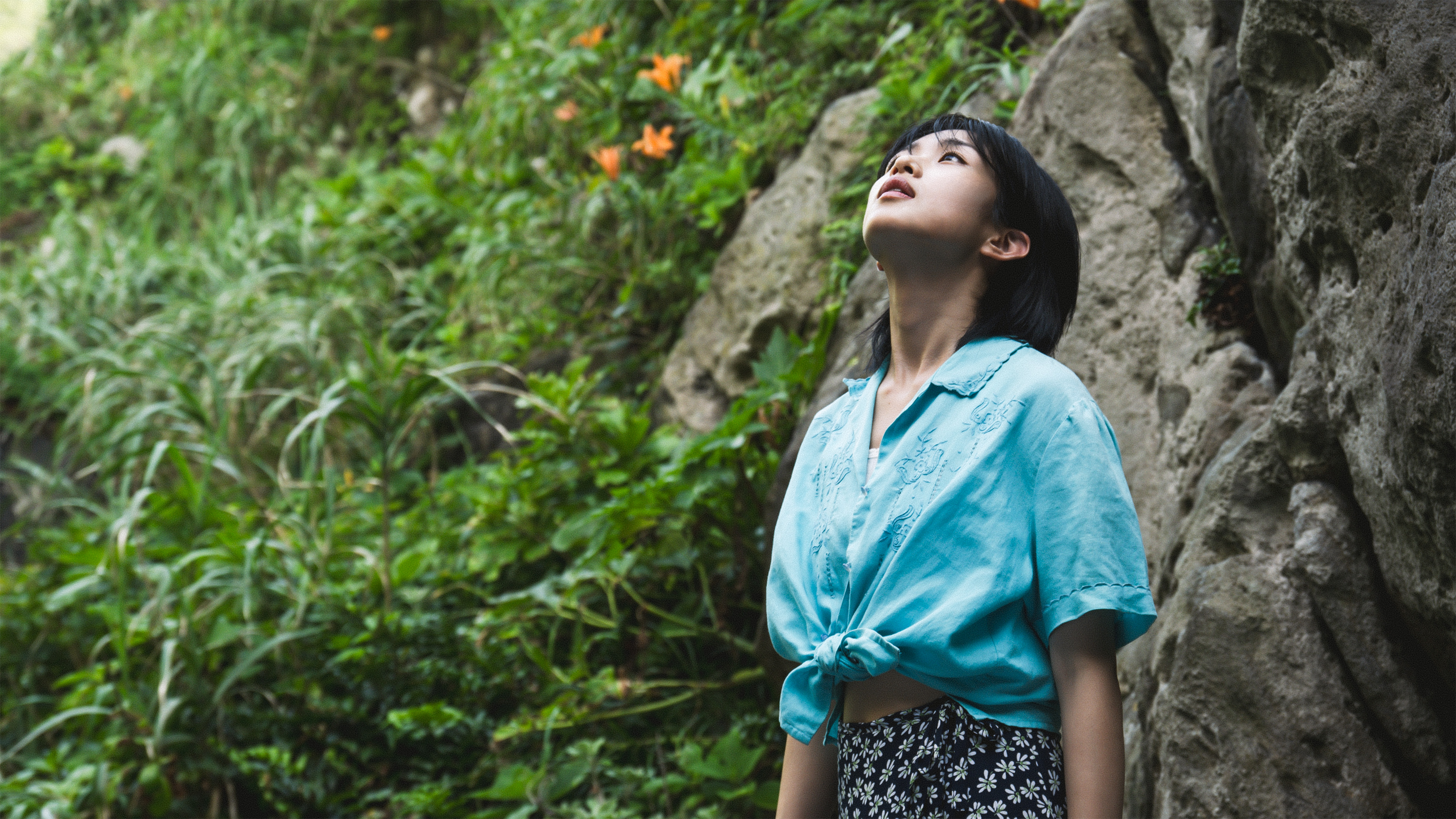
SHO MIYAKE DROPS THE TITLE card of his new film over its final shot. The film’s story unfolds before it is named—a story beginning with the words “Scene one: Summer, seaside.” These are the words that Lee (Shim Eun-kyung), a Korean screenwriter living in Tokyo, writes in Hangul in her journal at the start of the film. We’ll return to them later.
Miyake’s 2025 film is called Two Seasons, Two Strangers (in Japan, Journeys and Days). Though the film delays disclosing this information until the last possible moment, it cannot in the end escape the fixity of names: language defines us all and puts everything in its place. This troubles Miyake, who has spoken repeatedly in interviews about his desire to tell stories that escape or exceed the confines of language, stories that can’t be easily described. It also troubles Lee, who is quietly undergoing a crisis of faith in her own writerly talents. “Things happen in life that can’t be put into words,” she ponders in an inner monologue. “I just want to stand there forever, far away from words. But words always take hold of me without fail.” Everything felt fresh to her when she first came to Japan without a solid grasp of the Japanese language. She’s lost that spark, and now worries that her words, like her days, are falling into the same stale arrangements, drained of surprise or whimsy.
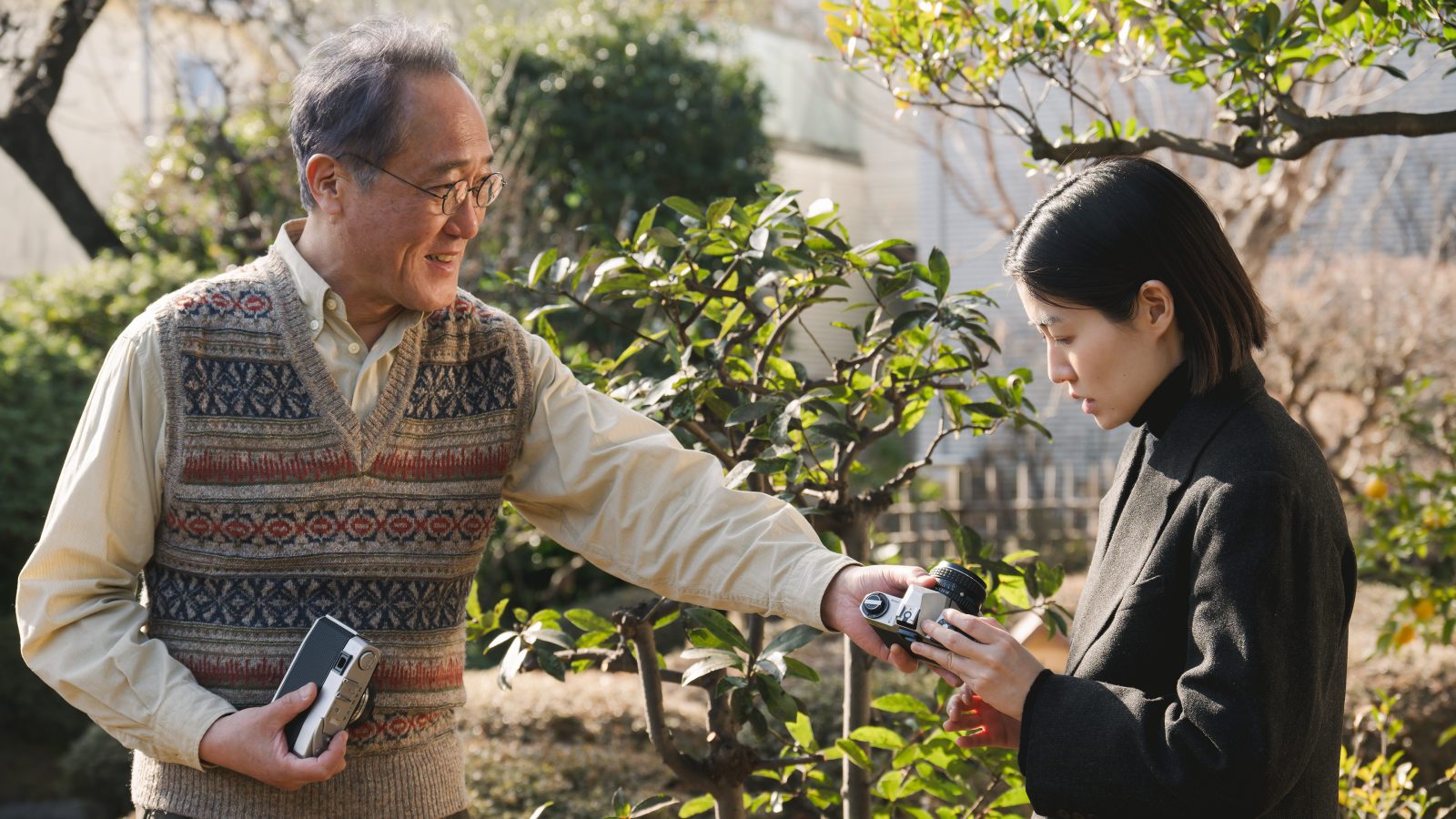
One night, after attending a funeral service for Uonuma (Shiro Sano), a professor friend of hers, a train speeds by her apartment window. Lee rushes to the window with an analog film camera—inherited from Uonuma’s large collection—looking into its viewfinder just as the train passes. We don’t know if she manages to snap a photo. But in her transfixed gaze, we glimpse the opening of a new circuit for her thinking—through images rather than words—and the inkling of a feeling that she’d like to be on a train herself. Thus begins Lee’s impromptu retreat to snow-blanketed Yamagata, where she arrives with no accommodations booked. Every hotel is full (Yamagata is a popular winter destination). A concierge recommends that she try an inn off her map, in the mountains. The ambient chatter of tourists and hotel staff recede and are replaced by her silent, solitary trudging through the snow, emphasizing her passage into this territory outside of what language inscribes.
Two Seasons, Two Strangers (2025)
This sense of adventure is what Two Seasons, Two Strangers shares most with the manga of the late Yoshiharu Tsuge, upon which the film is based. An innovator of gekiga (literally translated in English as “dramatic pictures”—a style of manga with grittier, more adult themes), Tsuge drew characters who often occupy society’s lower depths, and are sent on wild goose chases by strange occurrences. Their wanderings are less an escape from reality than an unveiling of it: a decisive break in the morose daily routines that smooth over the raw passions of life and the cruelties of our base impulses. Lee’s search for the inn is reminiscent of an early Tsuge story, “An Unusual Painting,” in which a samurai is led around town by a cryptic scroll that he believes to be a map, but which turns out to be an abstract painting. Both Lee and the samurai venture beyond the immediately comprehensible, feeling their way through the textures of the environment, and finally stumble upon the glow of lighted windows at night.
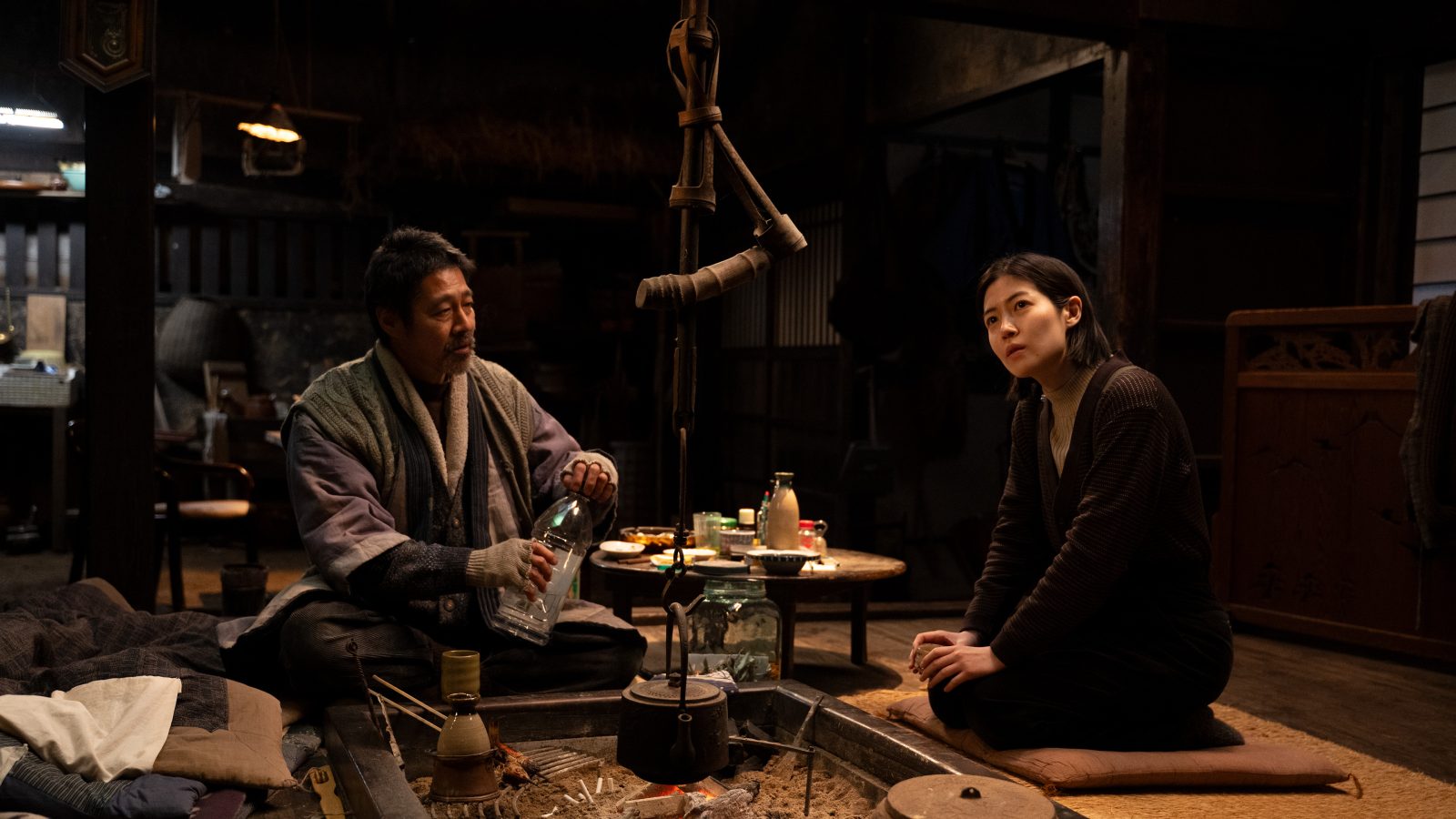
The inn and its owner are taken from the Tsuge story “Mister Ben of the Honyara Cave,” where he’s depicted as a boisterous fun uncle–type figure in contrast to his sullen onscreen counterpart, Benzo (Shinichi Tsutsumi). The emotional extremes and outbursts of Tsuge’s manga are tempered in the film, which adopts a more taciturn mood. Benzo’s inn is too big for only him to be living in, and traces of an absent family abound. On the morning after her arrival, Lee points out a rabbit’s cage cutely decorated with the name Pyon-chan. “That’s a name a child would come up with,” she remarks. Instead of taking this name for granted, Lee pursues a line of inquiry. Who named this rabbit, she wonders, and where did they go?
For Miyake, the stories that precede and accompany the act of naming are more interesting than names themselves. His 2018 film Wild Tour exemplifies this idea. It follows two teenage boys who participate in a workshop in which they collect and identify plants (the film is a fictional story performed by professional actors, but within the context of a real workshop at the Yamaguchi Center for Arts and Media, which commissioned the film). Both have an impossible crush on one of the workshop leaders, an older college student. The film parallels the blossoming of young love with the gradual recognition of the landscape as more than greenish brown blobs. The two boys experience the joy of learning something to get closer to someone you like, and how the world seems richer for it. The scientific names of the actual plants that were collected by the cast are featured in the credits, but some species are listed as “failed to identify” if the cast couldn’t determine what they were. Privileging curiosity and the practice of scientific observation over taxonomic correctness, the film suggests that these boys might not become expert naturalists, but they’ll never forget how they felt.
In both Wild Tour and Two Seasons, Two Strangers, curiosity redraws the world. The recalcitrant Benzo is initially annoyed by Lee prodding into his past. But his defenses eventually crack, and he whisks her away on a spontaneous journey that answers her questions about his family. In the dead of night, they go on a quest to steal ornamental carp from the pond of a mansion in a nearby town. There is little justification given by Benzo for this absurd bout of mischief, less so for why Lee just goes along with it. Even after it’s over, she will not be able to explain exactly why she did it. With nets in hand, they scurry over perilous snowdrifts and wade through freezing rivers. They meet an attentive cat. They catch the carp, but are detected by an unexpected visitor. Lee loses her camera. And then they head home.
Two Seasons, Two Strangers (2025)
In lieu of a direct explanation from either Lee or Benzo, we can hypothesize two possible reasons for this odd outing. The first, and most straightforward, is revealed by the appearance of the unexpected visitor, Benzo’s young daughter (Akira Numata)—the mansion they steal the carp from belongs to Benzo’s ex-wife (Ryoko Asakura), whom he clearly resents. The second, and most honest, is that they did it to have fun—to alleviate, even if only temporarily, their own neuroses and self-pity. The next day, cops arrive to take Benzo away, tipped off by Lee’s camera, which was discovered in the snow by Benzo’s ex-wife. After assessing Lee as harmless (or at least not worth arresting), they leave her in the inn, where for the first time in a while, she writes a new story in her journal.
Journals recur across Miyake’s films: in Small, Slow, but Steady (2022), a deaf boxer writes in her diary which doubles as a daily practice log, and All the Long Nights (2024) shows us a night sky journal kept by an amateur astronomer who died by suicide. In all these cases, the act of journaling creates a temporal axis that stitches the events of the film to the off-screen past and future beyond it. Journals are records which remind us that characters do not live their lives through shots and scenes, but through days and nights, weeks and years, just like we do. Throughout this time, we go on journeys that take us “far away from words,” to places we can’t categorize, meeting people we can’t pin down, having relationships we can’t describe. And after a journey, we return to language, exhilarated and rejuvenated, to talk and write about what we’ve done—and the cycle begins again.
And where were we at the beginning? Right: “Scene one: Summer, seaside.” The film transitions from Lee writing in her journal to a girl (Yuumi Kawai) waking up in the backseat of a car. She’s on vacation, but her life is boring. Like Lee, she wanders wordlessly in the immensity of the landscape, buffeted by wind, surrounded by tall trees, gazing at the sea. She meets a boy (Mansaku Takada) on a secluded beach. He speaks of the lives and deaths of fishermen and fisherwomen. She listens, and they share their loneliness. This is an almost elemental, mythic story. The next day, a storm hangs over the coast. The girl and boy dive in the ocean in the pouring rain, and like Lee and Benzo, they try to find fish in the water. The storm deepens, and the girl returns to land while encouraging the boy to stay out and find more fish. He drifts away in the swelling waves…
We’re abruptly transported to a lecture hall where Lee is screening this film for a group of students. Uonuma, still alive, sits in the audience. Lee has not yet taken that trip to Yamagata, nor met Benzo. She’s all nerves, and can’t answer a student’s question except to meekly say that she feels she has no talent. Strangely, though she mentions that her film is based on the Tsuge story “Scenes from the Seaside,” she never once says what the title of this film-within-the-film is.
If we view Miyake’s film in strict chronology, then the writing and screening of this “summer seaside” film belong to Lee’s past. But I believe things are stranger than they seem. Who’s to say that this entire first part of the film—even the entire film—isn’t just a movie that Lee starts writing about herself in Benzo’s inn after the events of the second part of the film, especially considering how conspicuously details from the “summer seaside” film parallel her own experiences?
Of course, we can’t know that, and that’s the point. Our real lives bleed into the journeys that intersect them with the realm of fiction. Drawn from Tsuge’s manga, these narratives shift and layer, becoming a film that concretely exists to us as Two Seasons, Two Strangers. But maybe it has another name, or has yet to be named, in some other world.
What would Lee call this film, I wonder, if she wrote it?

Share:
Recommended
- Virgina
 On the rediscovery of a lost film tackling the complexities and pleasures of gender expression in the Balkans.
 - Farley Granger
 On the queer star who defied mid-century Hollywood archetypes.
 - Geraldine Chaplin and Carlos Saura
 On the formidable collaborations of the Aragonese filmmaker and his American muse.