
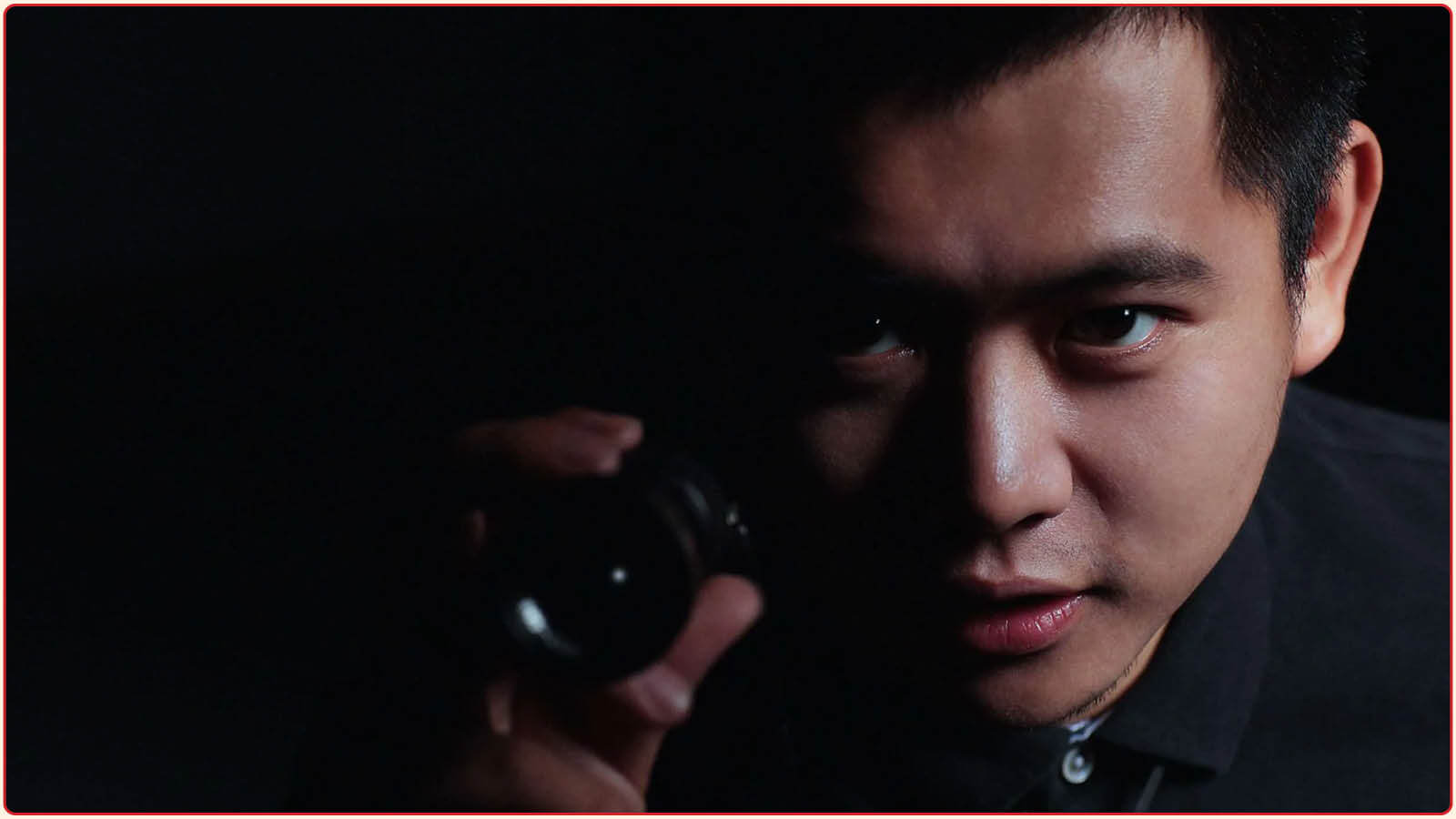
Wei Shujun
Interview
Wei Shujun
The rising Chinese filmmaker discusses the influences that shaped his intoxicating new neo-noir Only the River Flows (2023).
Share:
AMONG THE BRIGHTEST LIGHT OF this new generation of Chinese filmmakers, director Wei Shujun has released four features in just the last five years. The 33-year-old Beijing native has quickly evolved from festival favorite to unexpected commercial success—at least in China, where the third of these films, Only the River Flows (2023), became a surprise box office hit. With its attractive cast, intoxicating neo-noir narrative, and richly textured 16mm cinematography, the film’s appeal is plain to see: what sets it apart is Wei’s idiosyncratic approach to the material, which lends the film a personality distinct from your run-of-the-mill crime thriller. Based on a novel by the celebrated Chinese author Yu Hua, the ’90s-set detective story stars Zhu Yilong as Ma Zhe, a police chief investigating a series of murders in Peishui City that he believes may be linked not by a single perpetrator, but by a force greater than any one man.
A stark about-face from Wei’s earlier semi-autobiographical features Striding Into the Wind (2020) and Ripples of Life (2021)—both of which reckon with creatively frustrated young filmmakers—Only the River Flows is the director’s first period piece, as well as his maiden voyage into pure genre cinema. In lesser hands, the film’s true crime setup and darkly humorous tone might strike Western audiences as another tired retread of Cure (1997) or Memories of Murder (2003). Instead, Wei subtly transforms Ma’s existential plight into a meta-cinematic portrait of personal and professional alienation by evoking classic policier plotting and relocating one of the story’s primary settings, a police station, to an abandoned movie theater.
Not unlike the protagonists of Wei’s previous features, Ma bucks tradition and pushes back against conventional wisdom, though here these actions are motivated less by youthful defiance than by a sense of workmanlike conviction. For such a self-referential filmmaker, it’s unsurprising that Wei’s maturation as an artist has followed a similar course to that of his characters. His latest feature, Mostly Sunny (2024), which recently premiered at the Shanghai Film Festival—where it won the Best Actor prize for Huang Xiaoming (director Jia Zhangke also plays a small role)—is a family drama positioned to build off the success of Only the River Flows. But as with that film, Wei personalizes Mostly Sunny’s familiar setup—about two brothers with very different ideas about how to care for their ailing mother—through shrewd, thematic callbacks to his early efforts and the kind of strange characters beats that have come to characterize his work as a whole. It’s enough to suggest that Wei’s next five years might be as fruitful and unpredictable as these first five.
During a recent visit to Los Angeles, Wei sat down to discuss his start as a child actor, how hip-hop has influenced his creativity, and directing his “big brother” Jia Zhangke. —Jordan Cronk

Only the River Flows (2023)
JORDAN CRONK: I recently learned that you started out in cinema as a child actor? Did that experience encourage you to get into filmmaking?
WEI SHUJUN: Yeah, I started acting when I was a teenager, around fourteen. But I didn’t watch a lot of movies then. So I can’t say that I loved film, or that I knew what a good movie was, but I loved the crew and the setting. So many people working together, with a focus on the camera—it got me really excited.
JC: How did that opportunity come about?
WS: I played piano as a teenager and this film crew was looking for a young guy, sort of handsome, that could play piano for a movie they were making. For me it was just a way to get out of going to school. [Laughs.]
JC: And you’re still making music, right? Hip-hop?
WS: That’s my hobby, yeah. When I was a teenager I got into hip-hop because I thought it made me look cool. I just really like the culture. For a time in my twenties I even considered becoming a professional musician. As a rapper, you have to write lyrics, which for me are like notes about my life at different ages. I can look back at my lyrics and see what I was thinking at eighteen, what I thought was dope at the time.
JC: One thing I noticed as I rewatched your films is that you’ve worked with different combinations of screenwriters on every project. What do you look for in a writing partner?
WS: For me, different stories require different collaborators. I need different people to work with me, and talk with me. We’re all connected in some way. Striding Into the Wind, for example, was written with a classmate [Gao Linyang], and since it was based on our time in film school, we were able to share and draw on our experiences together. Ripples of Life, too, was about filmmaking, and the experiences that me and my screenwriter, Chunlei Kang, who acts in the film, have had making movies. Around that time that I signed the contract to make Only the Rivers Flows, so I asked Kang what he thought about working together again and if he liked the Yu Hua novel that the film is based on. He said, “Of course.” Yu Hua is very famous in China. We respect him a lot.
Yixiang Zhai, my co-writer on the new film, Mostly Sunny, had a small part in Ripples of Life. I called him and said, “What are you doing?” He said, “Nothing. Just chillin’.” So I said, “C’mon then, help me. I need someone new to write with. I don’t think I can do it alone.” I often find myself reworking and rewriting certain parts of my scripts over and over again, so I think the most important thing for me is having someone to talk things through with as I write.
JC: Has the relationship between you and a screenwriter ever been as contentious as how it’s depicted in Ripples of Life?
WS: Never as bad as that. My writers and I discuss. We talk. We battle. But not in the style you see in the movie. Kang never got treatment like that. But these kinds of relationships are interesting to me—not just in the world of film, but in our everyday lives. Everyone has a relationship where someone is more powerful, or more experienced, or even just older than they are—someone that they have to battle against.
JC: How did you approach the writing process with regards to adapting Yu Hua’s novel for Only the River Flows?
WS: Well, first, I really like the book. It’s set 30 years ago, but it’s still very fresh. And second, I wanted to apply a certain cinematographic language to this text. Here’s an analogy I often use: if the novel is an apple, what I want to do is put the apple in the ground to grow a new tree, and the apple that comes from that tree is the film. That’s my feeling. That’s what I set out to do.
JC: Can you talk about maintaining a personal signature in your work as you’ve transitioned from making films based on your life to projects in a more commercial or genre-oriented mode?
WS: That’s difficult to answer, because when I make films I don’t think about these things. I try to only think about my feelings for the characters, about the story, and I do that by staying true to myself—and by extension, the audience. If, as a director, I’m handed four choices—A, B, C, or D—the reason I choose A is because I really trust A. I need to be able to look at myself and know that I made the choice that I trust the most.
Mostly Sunny was made within a more commercial context, and because of that I have a responsibility for the money and to the industry. Arthouse films in China usually don’t do well financially. So if you fail, it’s even more difficult to find money for your next film. It was important for me with this film to find a balance in order to maintain that responsibility. I’m currently working on a TV show [a 12-episode series executive produced by Diao Yinan, director of 2014’s Black Coal, Thin Ice], which will face even more people. So you have to speak loudly, slowly, clearly, and with more drama. But if I can put my signature on it as well, I think that’s good. If you look at an American studio film like Dune (2021), that director [Denis Villeneuve] is putting his stamp and personality on that story. I can easily do a film with no commercial prospects. I’d like it. You’d like it. It’s for us. But there’s something else out there, too.
JC: In Only the River Flows, the police set up an office inside of an abandoned cinema. Is that something you added to the story, or was that in the book?
WS: I added it. I think it frames the story and gives the audience an interesting perspective on Ma Zhe’s journey. You often see him on the stage in front of the screen. Also, at this time in the ’90s, many cinemas were closing because people weren’t going to see movies anymore. A lot of the theaters became markets, clubs, or, in this case, a police station.

Nomad (1982)
JC: Is the film otherwise faithful to the text?
WS: We added a lot of contextual information to the Ma Zhe character. In the book he’s a pair of eyes for the reader to see through. You don’t know much about him. So we added details around the main murder plot, about his family and his life at home.
JC: It’s interesting that even though these new films aren’t about filmmaking, per se, they take place in the world of cinema. The characters are surrounded by cinema.
WS: It was an easy choice for my first two films since those movies were based on my experience in film school and my early years making films. I didn’t think too much about it when making Only the River Flows, but people who have watched it have said things like, “Director Wei clearly loves movies,” I guess because it’s a genre film. But when I go back to watch my first two films, I think, “Yeah, they’re right.” Because I do love cinema and I care about it a lot. It’s a big part of my real life. I definitely draw from cinema. It’s one way I develop stories.
JC: Can you talk about the look of the film and shooting on 16mm with Chengma Zhiyuan, who’s also the cinematographer on Mostly Sunny?
WS: Chegma’s brilliant. For Only the River Flows we talked about how to evoke the period. He’s pretty young, like me—we were kids in the ’90s. It was his idea to shoot on 16mm, which took us some time to get accustomed to and involved certain risks. We had to scan and print the film in Taiwan, not China. But Chegma made me very excited about the possibilities of shooting on film. And, as you can see, the quality and the textures are amazing.
JC: One thing that seems to unite your protagonists is a refusal to conform or to take things at face value. Is this a theme you’re consciously exploring?
WS: I’ve never thought about that, actually. But you’re right. Maybe it’s because I doubt everything—about filmmaking, about life. It’s really hard nowadays to live your life without doubt. Why do we do certain things? Why do we feel we need to say certain things to certain people?
JC: I recently asked Jia Zhangke why he acts in so many films by young directors, and he said it’s because financing is difficult for this new generation of filmmakers, and his presence can help with funding. Did casting him in Mostly Sunny help get the film made?
WS: Yes. I mean, he represents Rolex and collaborates with Balenciaga, Louis Vuitton, etc. [Laughs.] He’s well known in China. But for us, he’s a teacher and a master. He helps give young Chinese directors an opportunity, or a platform: he started the Pingyao Film Festival. He’s really a big brother in that way. When I offered him the role of the doctor in Mostly Sunny, I didn’t say too much about the character. He said, “Yes, I have the time, but can you tell me more about the character?” So I wrote a few more words to him and he said, “Actually, can you give the whole script to me?” I got concerned, because it’s hard to tell if the character is good or evil. But he said he just wanted to make sure that there were no scenes where he’d have to do anything physical, because he wanted to wear his own suits in the film. [Laughs.]
JC: How do you see yourself and other young filmmakers in relation to people like Jia and prior generations of Chinese directors?
WS: The relationships between Chinese directors from different generations are evolving through a process of continuous inheritance, each developing their own characteristics. Most films by the Fifth Generation of Chinese filmmakers, like Yang Zimou, for instance, drew nourishment from literature and cultivated unique Chinese aesthetics. Sixth Generation directors like Jia have been influenced by European cinema, with their works often focusing more on the relationships between real-life and contemporary survival.
Our generation has grown up in an era of globalization and information, where individual differences are gradually eroding. I feel that in our creative endeavors, there will be a greater focus on personal experiences. Therefore, how to find our own identity and position, and how to tell the stories we truly care about, have become essential challenges for this generation of creators. I think what we’re trying to do is translate our life to international life. Everyone knows the taste of Coca-Cola, but not many Americans know the local drink in Beijing. So we must do the work, and translate that experience.
When Americans used to think of Chinese cinema, they would think of kung-fu movies. We’ve come a long way since then, but we still need to find a way to introduce our culture, our real life—not the way our life is represented in the news, and not something derived from stereotypes—and use a new language to do that. Young filmmakers especially have the opportunity to communicate internationally. It’s a problem, and it’s one I’m still working on.

Only the River Flows (2023)

Share:
Recommended
-
Susan Seidelman
 An intimate conversation with the trailblazing American filmmaker.
 -
Carol Kane
 Fifty years in 50 minutes with the irrepressible screen icon.
 -
Mark Lee Ping-bing
 The legendary cinematographer reveals his three core beliefs.
- Futures and Pasts: Socrates
 Rossellini’s one-of-a-kind approach to the costume drama, and his 1970 film on the last years of the Athenian truth-seeker.
 - The Illiac Passion
 On the most elaborate of Gregory Markopolous’s modern myths.
 - Jollof Films
 Senegalese visual artists and curators discuss the towering cinematic figures who inspire their craft.