
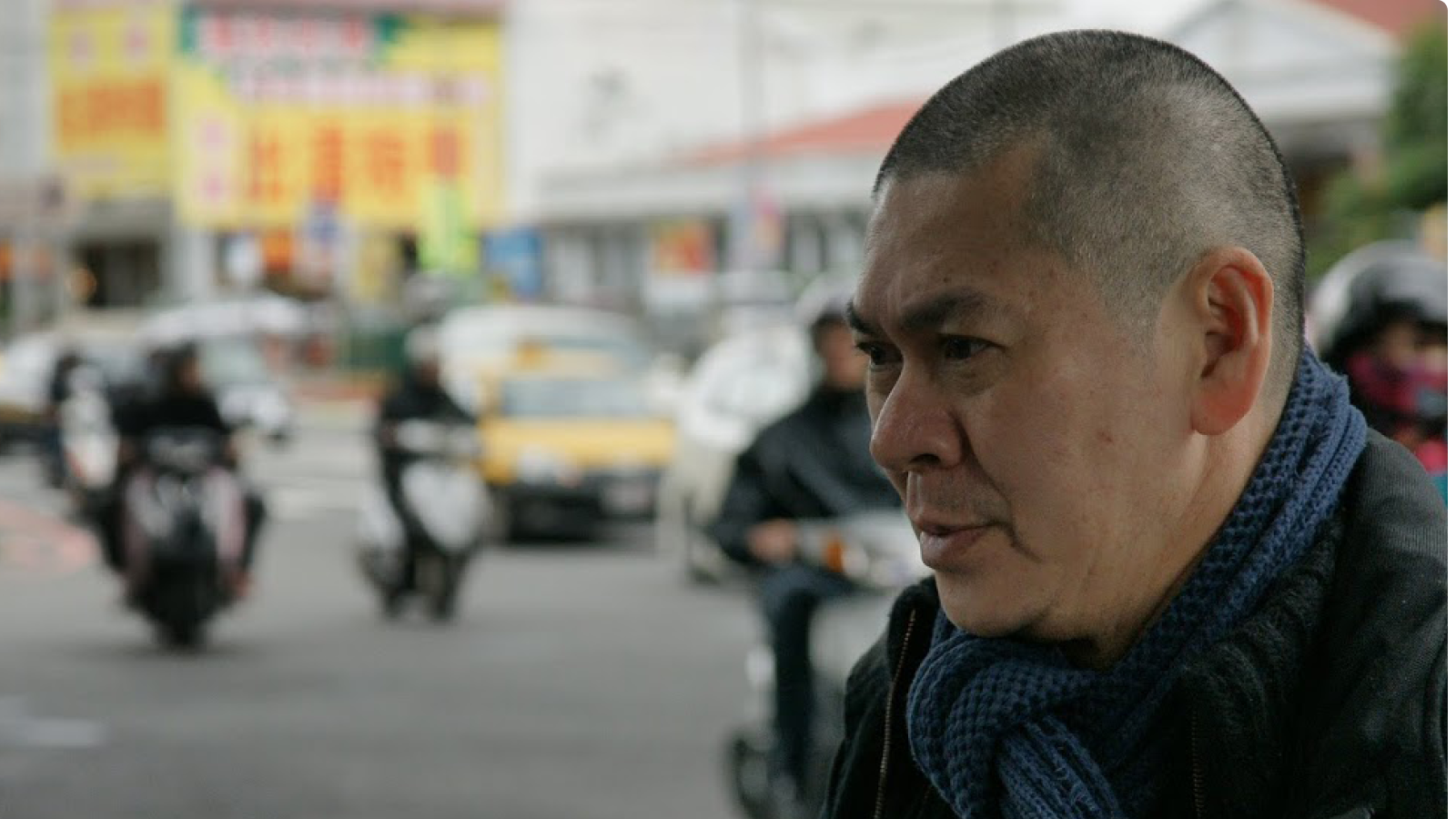
Tsai Ming-liang, courtesy of Big World Pictures
Interview
Tsai Ming-liang
On the influences, personal and melodic, that shaped the slow cinema icon’s quarantine musical.
The Hole plays in a weeklong run on a newly struck 35mm print at Metrograph, from Friday, July 24.
Share:
IN TSAI MING-LIANG’S THE HOLE (1998), a curious epidemic hits Taiwan and compels those left behind suffering the disease to exhibit roach-like behavior. A chamber piece tale of loneliness and longing between two neighbors (played by longtime collaborators Lee Kang-sheng and Yang Kuei-mei) who are trapped inside, with a curious breach between their two homes slowly widening, Tsai’s offbeat romantic comedy sees the filmmaker leaning into his playful, Buster Keaton–esque side, its seamless, surrealist mixture of musical comedy, absurdist slapstick, and dystopian satire marking a restorative register shift from its predecessor, the brooding Oedipal tragedy of The River (1997). The Hole was originally commissioned by French film producer Haut et Court as part of a global Y2K-themed series that counted contributions from Hal Hartley, Aderrahmane Sissako, and Ildikó Enyedi among others. But Tsai’s film has long since distinguished itself as the collection’s enduring classic—a touchstone of millennial panic, whose afterlife as a pandemic movie avant la lettre has only cemented his status as one of contemporary cinema’s most prescient visionaries. It was a delight to speak with the beloved pioneer of Taiwanese cinema’s Second New Wave about everything from Grace Chang to cockroaches to leaky flats ahead of the run at Metrograph of a freshly struck 35mm print of the film. Thank you to Vincent Cheng for translating. —Edo Choi
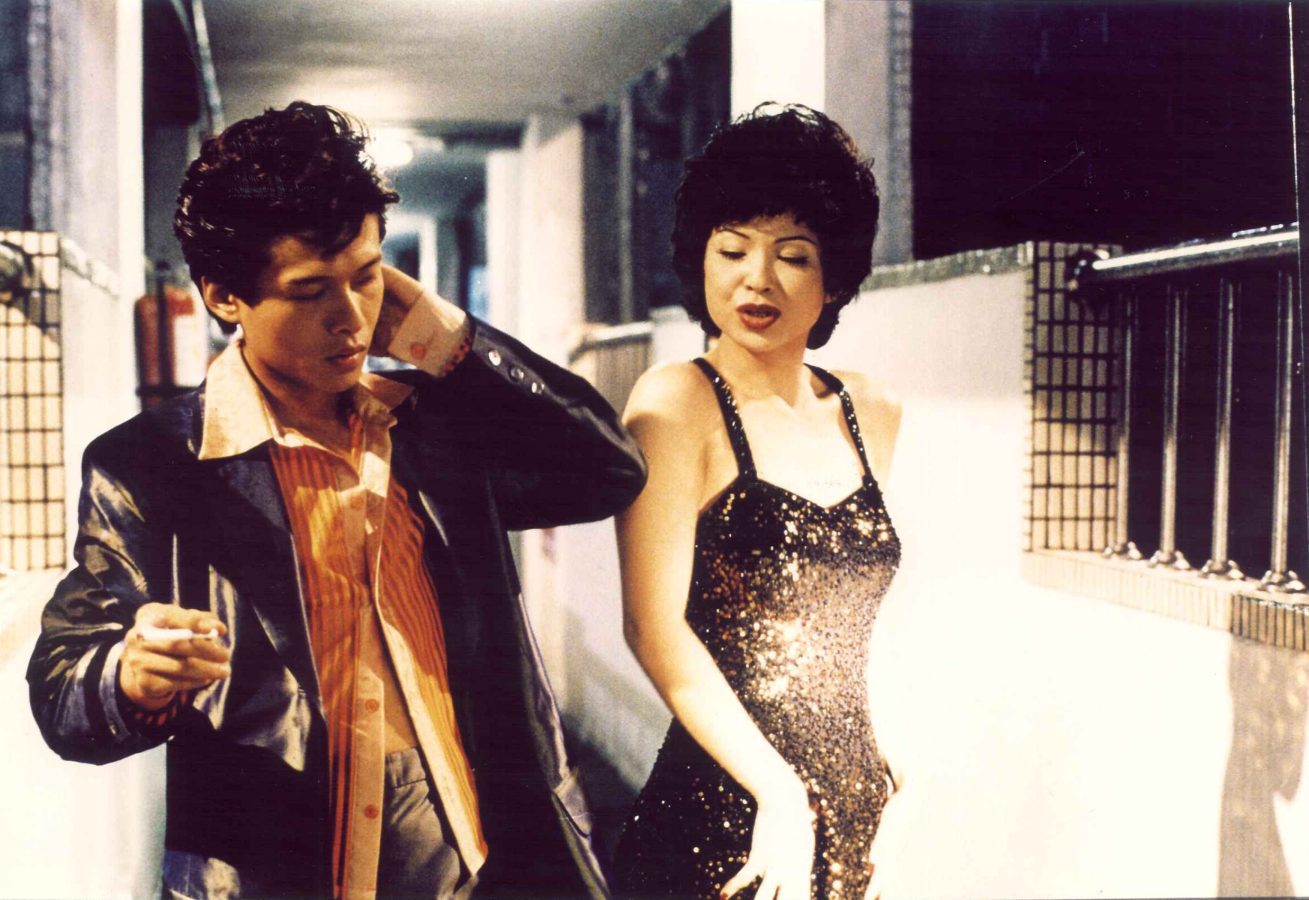
The Hole (1998)
EDO CHOI: I’ve always found The Hole to be your most comic film. One could characterize all of your films as comedies, but this one seems the most overtly so.
TSAI MING-LIANG: I think the reason people have the impression my films have elements of humor is because all of them, definitely, are rooted in reality. It’s all about realism. And part of our reality is the unexpected humor, the comedy in daily life. A huge part of The Hole is the sense of absurdity of living with a hole that’s been created for very comedic reasons, while trying to reconcile this with the fact it actually happened in day-to-day life. For me, this absurdity equals comedy.
Going into a film such as this that is depicting the end of the millennium, you can see the comedic aspects—not just of the hole itself, but also the trash that’s always being thrown seemingly out of nowhere by people out of the frame. Also present is this sense of paranoia, because of the uncertainty faced by the characters, those played by Lee Kang-sheng and Yang Kuei-mei, but also even Miao Tien, looking for his favorite bean paste. And lastly, but even more importantly, is the integration of the musical elements. Going against this particularly serious, dystopian backdrop, I intentionally selected songs more on the playful side, the passionate side. I wanted to create a juxtaposition between the seriousness of the predicament the characters have to face and the absurdity and humor [of the musical scenes].
EC: Speaking of the music, could you talk about Grace Chang? She is such a presence in the film through her songs. Do you have a personal relationship to the music of that era, of the 1950s and ’60s in Hong Kong and Taiwan?
TML: I’m an avid listener of ’60s music, and also ’60s films and musicals. It’s not just in musicals that you get to really listen to music—non-musical films still have the score and the songs that you associate with that film. At the time [I was preparing The Hole], I had been watching a lot of films from the ’60s, not only Mandarin-speaking films but Hollywood films too. Grace Chang became someone I fell in love with. She just so happened to be a superstar at that time, and she plays many, many different important roles—including Carmen in one of the musicals [The Wild, Wild Rose, 1960]. So for me, she really represents that era, and her songs have such sustaining power; even today, people are still listening to them. Two films come to mind when I think about Grace Chang. One is The Wild, Wild Rose, and the other is Mambo Girl (1957). These films both made a huge impression on me, through her songs, her performances. She has such a unique style. Because The Hole is a sort of turn of the century dystopia, it has such a strong element of despair which I was trying to capture that, when I was thinking about making the film, I worried it would be too heavy. I needed to find a way out, to lighten up a little, and the particular exit I found was through the music. It just so happened that Grace Chang’s songs—the themes of her songs—tend to be about fantasy, about love. And they’re always presented in such a glamorous way. I thought that would be such a wonderful juxtaposition to have the character of Yang Kuei-mei lip-syncing Grace Chang’s songs in the slum public housing that I had chosen for the main location. This combination created a very interesting expression of multi-layered feelings and emotions.
When I decided to use her songs, I actually flew to Hong Kong. Through a friend of a friend, I’d had the good fortune of meeting her twice before. I told her I was going to use her songs, but I didn’t tell her how I was going to use them. I worried that maybe she would not agree with the way I had used them—maybe she would reject the film or find it off-putting—so when I was showing the film in Hong Kong, I decided not to invite her.

The Hole (1998)
EC: The film is replete with references to other films and pop culture from this mid-century period. Rewatching it, I noted a specific sequence where Lee Kang-sheng is cleaning the hole, and he uses an umbrella to catch the debris. That struck me as perhaps a reference to a similar scene in the French heist movie, Rififi (1955).
TML: The film you mention, I have actually never seen it. For me, conceptually, this scene is more related to Kafka and cockroaches. It’s really thinking about this particular dramatic device, the hole—how can I develop this into a coherent plotline and narrative? Even the device of the hole is something rooted in reality, something that, in my personal life, I experienced myself. As I was writing the script, a plumber came [to my building] to say there was a problem with the pipes, that there was a leak; they were trying to figure out what had happened and so they dug a hole—in my floor, which is the ceiling of my downstairs neighbors. Then after the hole was created, the plumber disappeared for a month. I had to manage to somehow live with that hole. I decided to use the creation of the hole as a metaphor for this kind of imminent disaster and a starting point for my narrative.
EC: The film was commissioned, as part of a series produced by French producer Haut et Court, called “2000, Seen By…” This series deals with the turn of the millennium, and the sense of apocalyptic doom that preceded it, but your specific response was to imagine a virus and ensuing lockdown in Taiwan. This is pre-SARS, and obviously pre-COVID, but were there current events in Taiwan that inspired this particularly Kafka-esque notion of inescapable quarantine?
TML: I don’t really remember why I incorporated this idea into my film. At the time, I remember Taiwan, and especially Taipei, was going through a dramatic process of urbanization. This transformation really made an impression on me because of its pace, its tempo… and Taipei just looked like a giant construction site. Everywhere, you saw the demolition of buildings, of skywalks. I think there’s a large difference in terms of this kind of urban development between Asian countries and European countries. In Asia, the buildings themselves tend to look or feel temporary, like they’re something that can be removed, demolished, and then rebuilt, along with developments such as the subway or MRT systems. At the time, I really thought this transformation was something that was not necessarily good, or better, for humanity. Especially as it was being done at such a great human and environmental cost.
When I was commissioned to do this particular film to capture the zeitgeist, and the feelings of that turn of the century environment, I remember people were most concerned about issues such as holes in the ozone layer and climate change. I was trying to capture this pessimistic view of our future, using rain as an element right from the beginning. Again, I am not exactly sure why I decided to use the idea of quarantine. The cockroaches, though, are something I was living with at the time, that I personally experienced. And I didn’t really have a good way of resolving the issue of cockroaches in my life.
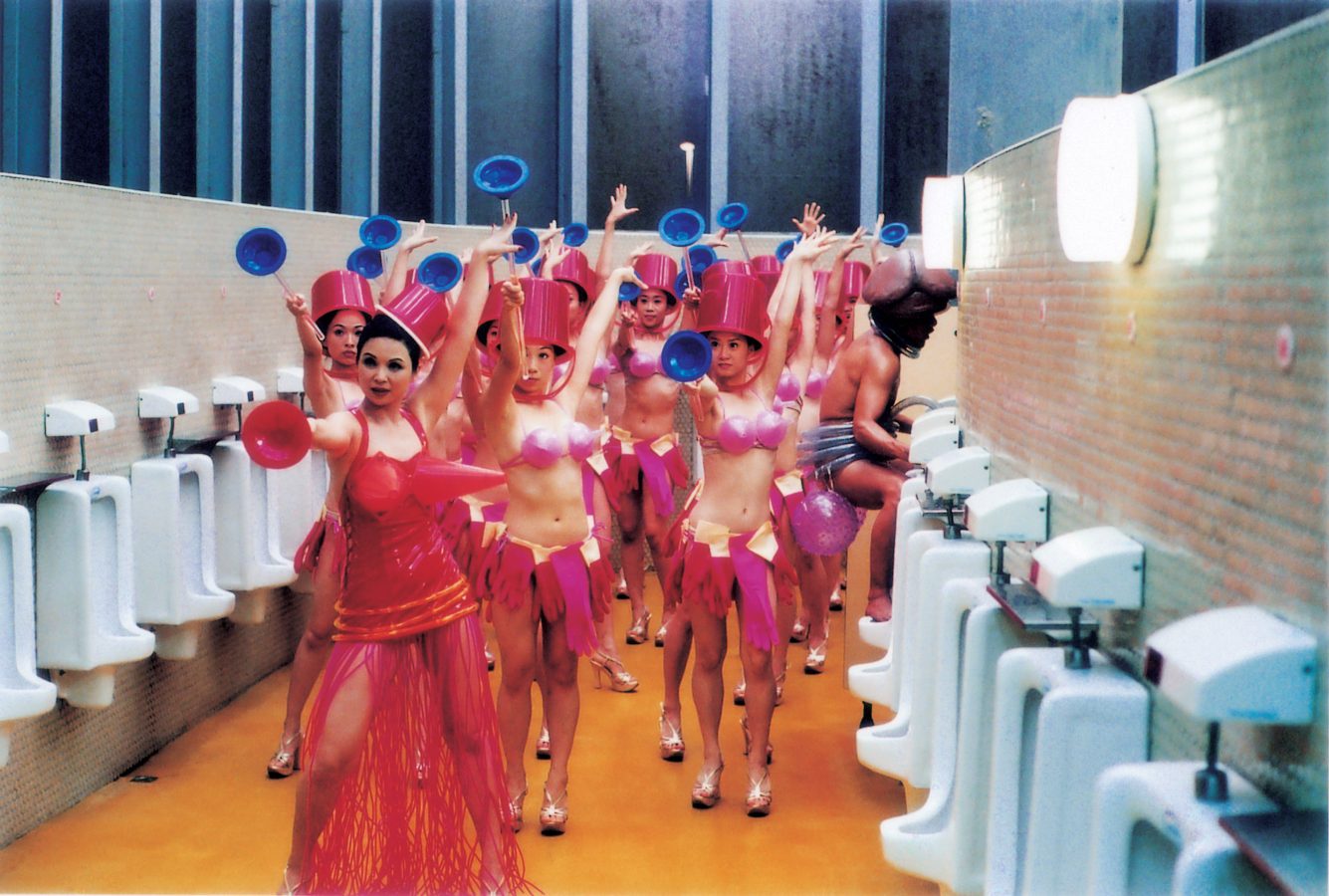
The Wayward Cloud (2005)
EC: I’m glad you brought up the rain. Water is perhaps the recurring natural element in your work, and it’s such a big part of this film. Images of flooding, of saturation, of seeping reappear throughout your movies.
TML: For me, there are many reasons water is an important element of my films. I have always loved taking baths, especially when I was younger. I would smoke and take a bath at the same time and think about my films and my life. And also, since I am an ethnic Chinese who migrated from Malaysia to Taiwan, almost all the apartments I stayed in were rentals. They were not places I owned. So, inevitably, I encountered issues such as leaks, burst pipes—so much so that one apartment was completely inundated. In the apartment that I live in now, which is in a mountainous region up in the hills, the water will sometimes just stop flowing for no reason. So these are some of the different problems I have faced with water in my life. And I’ve thought that to be true to this reality, water is an important element to incorporate—not only as a thematic motif, but also as an absurd device. You can see this in Rebels of the Neon God (1992), The River, or even The Wayward Cloud (2005).
EC: Thank you for this. I hope you solve your water problems, and your cockroach problems!
TML: It’s much better now, yes [laughs]. More under control.

Share:
Recommended
- Genevieve Yue’s Trains
 On the offbeat pleasures of the train in Genevieve Yue’s new book.
 - Yuliya Solntseva
 On the actress-turned-filmmaker’s unsung authorship.
 - Futures and Pasts: Socrates
 Rossellini’s one-of-a-kind approach to the costume drama, and his 1970 film on the last years of the Athenian truth-seeker.