

Wake in Fright (1971)
Essay
Wake in Fright
On Ted Kotcheff’s masterwork and the great rude awakening of Australian cinema.
Wake in Fright (1971) plays at Metrograph from Friday, July 31 as part of The Worldwide West.
Share:
IT’S AN ODD AND, FOR some, uncomfortable truth that the greatest film about Australia was directed by a Canadian. Upon opening in October 1971, Wake in Fright was shunned by the Australian moviegoing public, earning less than a quarter of its AUD$800,000 budget at the box office. Of the few who did see it, many were taken aback by Ted Kotcheff’s brooding, nightmarish vision of a country corrupted by alcoholism and misogyny, of ruddy, boorish, sweaty men interested only in sinkin’ tins and tearing each other to shreds. (All this coming from a Canuck, no less!)
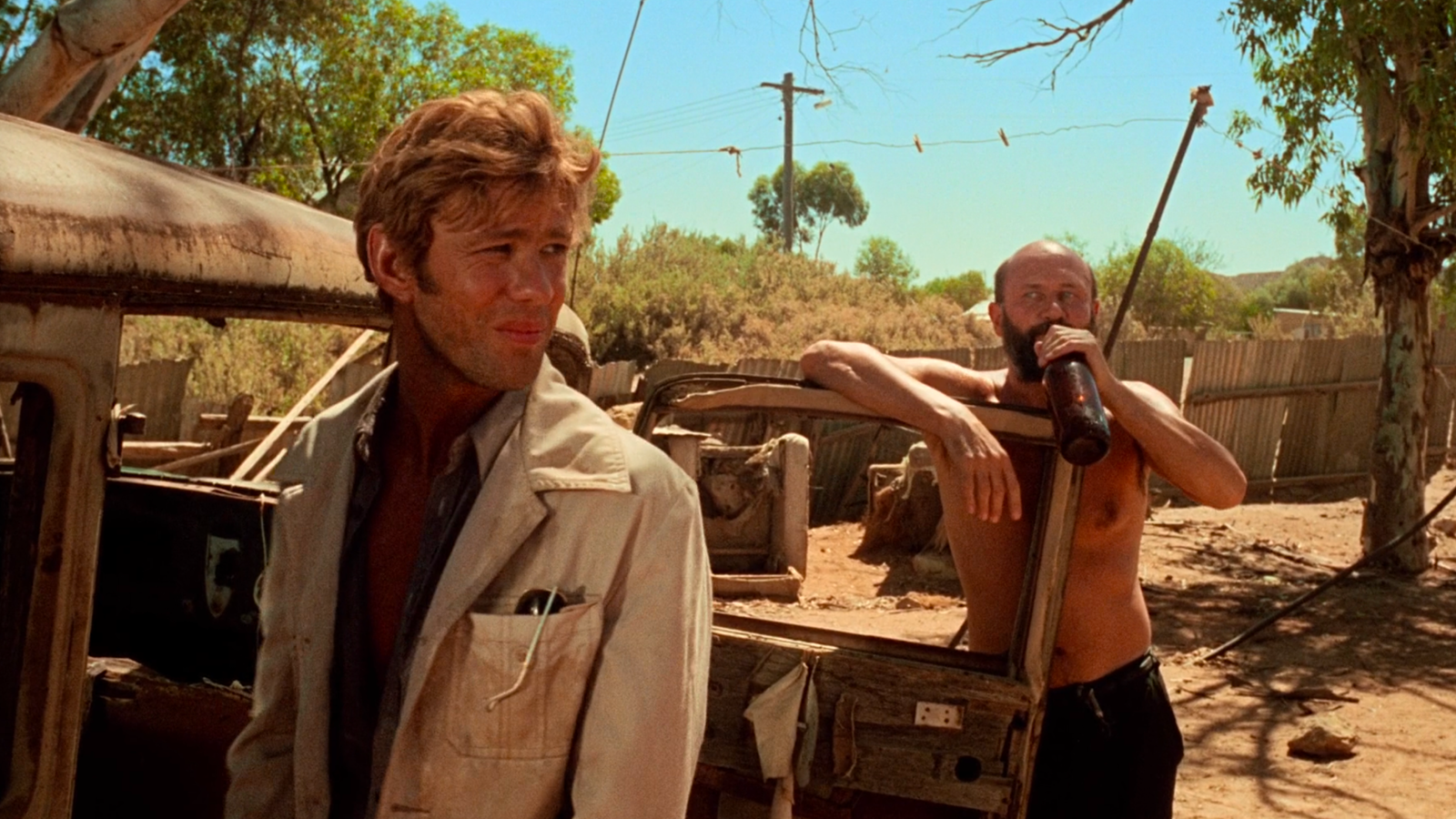
Wake in Fright is set in the fictional town of Bundanyabba, referred to by inhabitants as “the Yabba,” though the location was recognizable to home audiences as the dust-drowned, outback mining city of Broken Hill. From dazed schoolkids to life-marred barflies, locals were used as extras in several scenes, including an older Indigenous Australian passenger on the train from Tiboonda, seated apart from the men carousing about the carriage, silently invoking the violent history of colonial settlement. Also recognizable was the performative welcome given to outsiders that quickly turns menacing should they fail to conform to established social codes—all of which made for discomfiting viewing.
We are introduced to the Yabba through the eyes of John Grant (Gary Bond, one of three British actors to appear in the film), a cocky, pretty schoolteacher posted in an isolated rural township, dreaming of escape. Stopping over for one night on his way to Sydney to visit his girlfriend, his lip curls a little more in disgust anytime a stranger asks, “New to the Yabba?” and offers him a beer. This friendly overture comes to seem more like a curse with each iteration. Fitting, as by morning John finds himself broke, stranded, his money frittered away in an illegal back-room game of two-up—per the Australian Oxford Dictionary, “a gambling game in which coins are spun in the air and bets placed on a showing of two heads or two tails,” which Kotcheff himself got hooked on during the shoot—presented to him by the friendly local policeman, Jock Crawford (national icon Chips Rafferty, in his final role), and at the mercy of the Yabba’s suffocating hospitality.

Wake in Fright (1971)
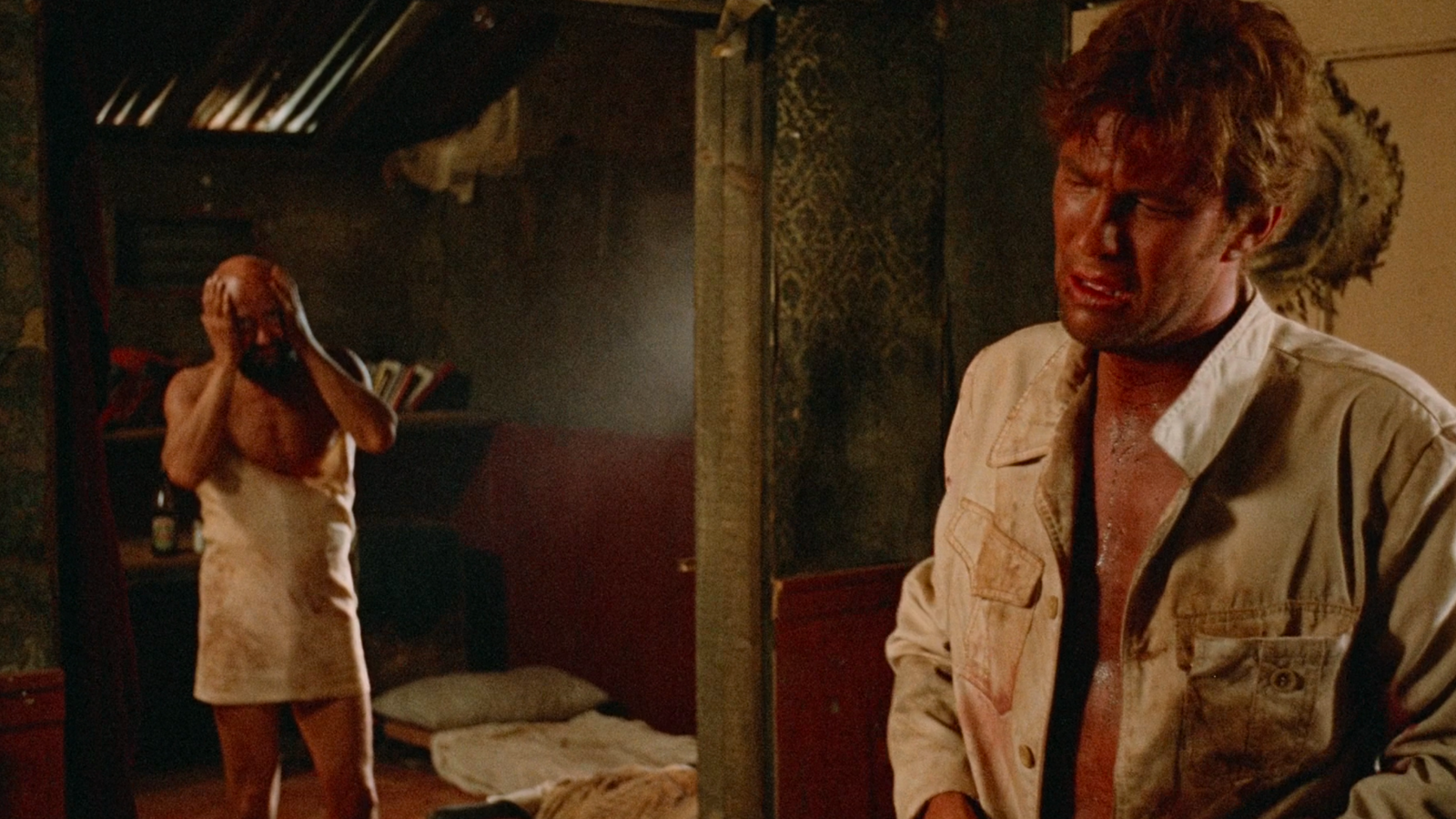
As the next 48 hours devolves even further (a chaotic litany of kangaroo hunting, sexual assault, nonstop drinking, and one suicide attempt), John unravels completely, experiencing a total loss of control, but ultimately comes to some kind of bleak, bleary-eyed self-reckoning—a thing white Australia was struggling to do at the time, as the country was just starting to interrogate some of its founding myths. Future star Jack Thompson, who made his film debut in Wake in Fright playing Yabba man Dick, later recalled that at least one audience member was said to have pointed at the screen, shouting, “That’s not us!” But for others, including a young Bruce Beresford, the film was a galvanizing force, spurring on the shift in how the country saw itself, its history, and the role of its artists. It caps a stream of cultural and political touchstones including but not limited to the publication of Robin Boyd’s architectural manifesto The Australian Ugliness and Donald Horne’s social critique The Lucky Country, the birth of the Indigenous land rights movement in 1963, the referendum recognizing Aboriginal and Torres Strait Islander peoples in the Constitution in 1967, and mass protests against the Vietnam War—all of which fed into the 1972 election of Gough Whitlam’s socially progressive government.
And yet, regardless of the controversy the film stirred, it had only a short theatrical life, disappearing from theaters in less than six weeks. Overseas, it didn’t fare much better. After garnering high praise at Cannes, it was released briefly in the UK and US under the schlocky export title Outback and, despite good reviews, then largely faded from view for nearly four decades due to a lack of materials.
Looking back, it makes more sense an outsider was called in to helm a feature that is so deeply invested in unpicking the Australian psyche—an Australian/US co-production, with a young, almost-all Australian crew—when one understands the pivotal moment at which Wake in Fright was made. The late critic David Stratton identified 1969 as the point when “the once-proud Australian film industry was at its lowest ebb.” The few films still being shot in Australia were, generally speaking, not being made by, or even for Australians. They were largely British or American productions taking advantage of the exotic landscapes, with British or American actors cast as leads. The following year—for many, the unofficial starting point of what would later be dubbed the Australian New Wave movement, launching the careers of directors Beresford, Peter Weir, Gillian Armstrong, Fred Schepisi, and more—an influx of government investment gave rise to local artists attempting to fill this void. But until such homegrown talent could so dramatically bloom, there remained an entrenched tendency to rely on experienced internationals to finance (i.e. legitimize) Australian films. The success of English filmmaker-in-exile Michael Powell’s They’re a Weird Mob (1966) and Age of Consent (1969) was still fresh in many minds, and just the year previous, Tony Richardson had tried his hand at the legend of the outlaw Ned Kelly, with an unconvincingly bearded Mick Jagger swaggering about the bush.
Wake in Fright (1971)
Though Wake in Fright was adapted from a 1961 novel by Kenneth Cook, informed by the author’s months working as an ABC journalist in Broken Hill, much of its appeal lies far beyond its terrifyingly accurate portrait of the nation—for example, in whatever exactly caught the eye of actor Dirk Bogarde, who bought the rights to Cook’s novel in 1963, hoping to make the film with frequent collaborator Joseph Losey. As detailed in Tina Kaufman’s 2010 book about Kotcheff’s film, the financing didn’t come through, the rights eventually fell to the nascent Australian production company NLT, and Kotcheff was hired through the suggestion of Jamaican-born screenwriter Evan Jones, who had previously worked with both Losey and Kotcheff. So what was it about the project that drew in all of these men—many of whom had never even set foot in Australia—at a time when its shallow-pocketed industry had little to inspire confidence in returns on investment?
Bogarde, for one, tired of being a matinee idol, was seeking out more knotty, thought-provoking roles—a thing the part of John Grant offers in spades. (We can only imagine what he’d have made of the homoerotic charge thrumming just below the surface of every interaction in the male-dominated town.) In the end, Bond, an English theater actor, was cast, giving a performance that quickly slides from diffident, stiff, proud restraint to the spaghetti-limbed, knee-walking dance of someone who can’t hold their liquor, let alone a pool cue, propped up by one of his new “mates” with West End Bitter dribbling down his chin.
Emphasizing our waylaid hero’s confusion, cinematographer Brian West repeatedly shoots from below overhead lights so bright that they blind John, his staggered steps frequently accompanied by the wailing theremin of the soundtrack (courtesy composer John Scott) that broadcasts his rising panic. In rare moments of self-awareness, a well of deep internal horror is mirrored in John’s dark brown eyes, suggesting a green recruit dropped onto a battlefield, confronted for the first time by the depravity of man and likely imminent death. We see this particularly after each of the two painful sexual encounters that mark this lost weekend: the first begins with John reciting poetry to the stars, trying to impress one of the few women in the film (Sylvia Kay), and ends with him vomiting in a ditch; the second, waking pant-less beside the sleeping body of the cast-out alcoholic doctor Doc Tydon (Donald Pleasance) and eventually reaching for a shotgun.
Wake in Fright (1971)
For the Toronto-born Kotcheff, it was a relief to touch down in Broken Hill and find that the psychic distance between Canada and Australia was not as far as he’d imagined. As he recounted in 2009,
Canada has the same British colonial background as Australia. There is the same lack of self-confidence, which, in Canada’s case, it’s to the extent of a rampant inferiority complex. Australia has a different kind of energy but, more important, is that the countries are geographically the same. They have the same vast empty spaces, which don’t liberate, they imprison. And I also understood the men of the outback – their camaraderie, their support of each other and their generosity – because I had met the same type of men in the north of Canada. I’ve actually described Canada to some people as Australia on the rocks!
His words speak to what might be described as the more universal dimensions of Wake in Fright. The film pungently evokes a pervasive atmosphere of terror, partly through the exaggeration of details mundane and authentic. There is the claustrophobic gaggle of flies that buzz about every character’s head, the red dust coating every surface, the speech tics, including the Yabba men’s ritual bequeathing of nicknames, like the first step in an initiation—all elements Kotcheff added to the screenplay after spending time in Broken Hill mixing with the locals, which heighten the visceral mood of existential alarm. The result is an incredibly regionally distinct riff on the sort of questioning that was happening across politics and art all around the world of the grand narratives of civilization, progress, and the innate cruelty of men. (It is perhaps worth noting that Kotcheff’s later work also contains explorations of rough-as-guts macho bruising and boozing, including the 1982 Vietnam veteran revenge thriller First Blood, and his 1979 melancholy sports drama North Dallas Forty, the latter of which includes a scene of dumb drunk NFL players on a joyride to shoot cows that plays like a light-hearted inversion of the ghastly roo hunt in Wake in Fright.)
Joining storied traditions, Wake in Fright is another spin on the great divide between the city and town, as well as of the tale of a desperate man just trying to get home. Though he hasn’t explicitly spoken of any link between his 1985 darkly comic downtown Manhattan odyssey, After Hours, and Kotcheff’s film, Martin Scorsese was instrumental in Wake in Fright’s own journey back to screens. In 2009, inspired by his ecstatic memories of the film at its original Cannes premiere, Scorsese selected it for inclusion in the Cannes Classics section after the film was finally restored, following an eight-year search by editor Anthony Buckley for the lost original negative, in effect reintroducing it on the international stage.
A half century after its initial release, Wake in Fright has a now secure place in the canon of Australian cinema. But one might be prompted to ask, to what degree is it a film about Australia, or really one about humankind? And what verdict does it pass? Part of the greatness of the film lies in its openhanded curiosity and compassion. Kotcheff has cited his use of Chekhov as a guiding light, taking for his personal maxim Chekhov’s quote, “I am not the judge of my characters; I am their best witness.” Though we see them engaged in a variety of base behaviors—fallen-down pissed and passed-out on couches, floors and gutters; teasing John by declaring that kangaroo testicles taste better than oysters; and eternally lurching about, throwing shambolic punches—the men of the Yabba are not presented as grotesque caricatures. Nor are they victims. They are haunting subjects, both diabolical and despairing, fascinating to behold. Their tanned, muscular bodies and heavily lined faces—including a number of the sort of gummy, toothless grinning elders that Pasolini so loved—attest to the physically brutal and deeply lonely conditions in which they work and live. And instead of sitting about whining, they manage to have fun. As Doc rebukes John at one point for his snobbery: “It’s worse than death in the mines. You want them to sing opera as well?”

Share:
Recommended
- Virgina
 On the rediscovery of a lost film tackling the complexities and pleasures of gender expression in the Balkans.
 - Farley Granger
 On the queer star who defied mid-century Hollywood archetypes.
 - Geraldine Chaplin and Carlos Saura
 On the formidable collaborations of the Aragonese filmmaker and his American muse.