

Kleber Mendonça Filho, photograph by Victor Juca
Interview
Kleber Mendonça Filho
The director of The Secret Agent on his period thriller and Brazil’s problem with memory.
Kleber Mendonça Filho, That Man from Recife, our nine-film retrospective, opens at Metrograph on Friday, November 21.
Share:
The first knowledge I had of Kleber Mendonça Filho came in 2012—not, as one might expect, through seeing his debut narrative feature, Neighboring Sounds, released to no small acclaim that year, but in noting that we were the only two contributors to the Sight & Sound “Greatest Films of All Time” poll who considered Don Siegel’s The Beguiled (1971) one of the 10 best films ever made. From a man of such discerning taste, much was to be expected. I have not been disappointed.
There are certain filmmakers connected, inextricably, to regions, cities, quarters: Luc Moullet and the Alpes-de-Haute-Provence, John Waters and the precincts of Baltimore where the blue-collar Bawlmerese accent survives, Jean Rollin and the beaches of Dieppe. Mendonça Filho’s muse is Recife, the coastal Brazilian city in the northeast where he was born in 1968, where he cut his teeth as a working critic, and where, with the exception of his excursion to the parched interiors of the Sertão in Bacurau (2019), all of his films take place—several, in part or in whole, even inside the apartment in the Setubal neighborhood where he was raised and that he took over some time after the death of his mother: like the Cassavetes of Faces (1968), the Blake Edwards of That’s Life! (1986), or the Lynch of Lost Highway (1997), Mendonça Filho is the author of true “home movies.”
Mendonça Filho’s films, however, are anything but cozy, domestic affairs. Instead, they describe the subterranean fissures between classes and races that run through Brazilian society: Neighboring Sounds shows us a middle-class community gradually gripped by a creeping mania for security from an underclass enemy presumed to be waiting in the shadows for their opportunity to strike; Aquarius (2016), a woman locked into a war of attrition with developers using any means necessary to pressure her out of her home; his documentary Pictures of Ghosts (2023), a Recife that has thrust skyward while its streets have been denuded of gathering places for people of all walks of life, with its disappeared cinemas Mendonça Filho’s particular focus. As such, he has consistently run afoul of representatives of the reactionary element in his country, most recently with his latest, The Secret Agent (2025), a 1977-set thriller evoking the unchecked violence that was part of daily life under the military dictatorship who ruled Brazil from 1964 to 1985. In spite of the film having earned Mendonça Filho a Best Director prize at Cannes and Best Actor plaudits for leading man Wagner Moura, a concerted effort was undertaken by corporate interests to prevent The Secret Agent from being submitted to represent Brazil in the running for the Academy Award for Best International Feature Film. Similar campaigns had been mounted, successfully, against Aquarius and Bacurau, under the respective right-wing administrations of Michel Temer and Jair Bolsonaro. This one, in what may indicate an incremental shift in the cultural and political climate of the country, failed.
I spoke to the vindicated Mendonça Filho, recently returned home after presenting The Secret Agent at the New York Film Festival, about that film, his others, and, inevitably, about Recife. —Nick Pinkerton
NICK PINKERTON: One of the things most everybody I’ve spoken with about The Secret Agent (2025) agrees on is that it’s got so many great faces in it. I have a hard time remembering a movie where so many characters manage to make a distinct impression in a relatively brief amount of screen time. It put me in mind of Eisenstein’s idea of “typage,” the idea that casting can be a visual shorthand; if you find the right actor, the moment they appear on-screen a viewer will go: “Ah, okay. I know something about this person…”
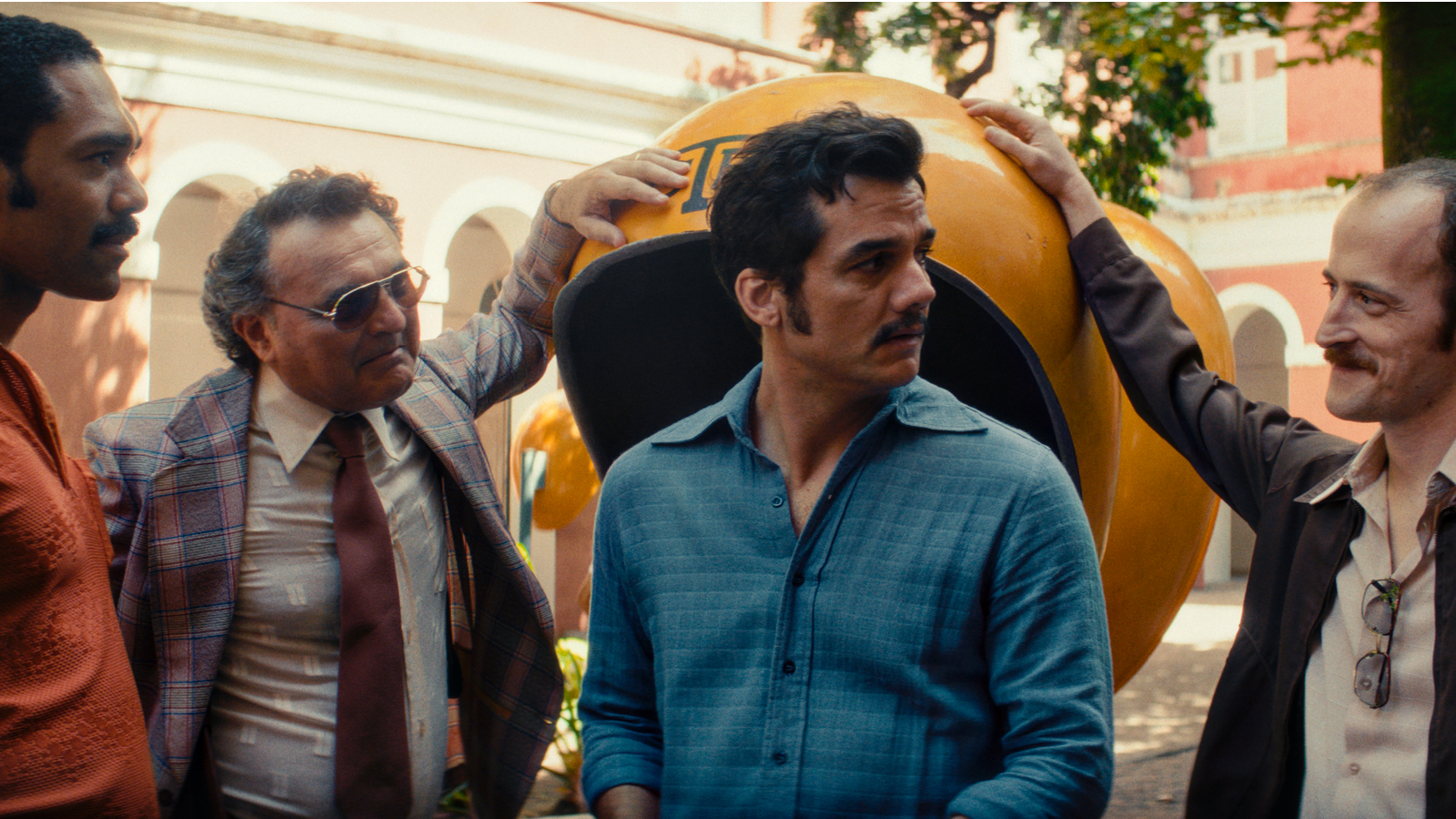
The Secret Agent (2025)
KLEBER MENDONÇA FILHO: I think it comes from the way I look at society. I mean, it could probably be applied to most societies, but Brazil is incredibly mixed, so you get all kinds of faces. And I’m fascinated by that. Of course, the same thing could be done in the US… I mean, look at Inside Man (2006) by Spike Lee. One of the reasons I like that film so much is that it paints what seems to me an accurate portrait of New York City, and a big part of that is the faces. You have the Armenian guy, the Black characters and mixed-race characters and white characters, and then movie star faces, Jodie Foster and Christopher Plummer… It’s an interesting panorama of ethnicities. And that’s how I see Brazil.
NP: A couple of specific performers in The Secret Agent stand out particularly—some you’ve worked with before, but few of whom have long track records in film. The actor playing the gas station attendant at the beginning, for instance: Joálisson Cunha. How did he come into your purview?
KMF: We look at a lot of videos and photographs, and this casting work is done by Gabriel Domingues. We’ve collaborated since Aquarius. And he also did Bacurau with Marcelo Caetano, who also happens to be a wonderful filmmaker; his film, Baby, was in Cannes Critics’ Week last year. We’re on the same frequency: we’re looking for great actors, and great faces. And Joálisson, he is fantastic. He comes from the northeast, two states up from Pernambuco. He has the accent. He understood that the film is a period piece, and the whole thing with the teeth. When I was a kid, many people—particularly from the lower classes in Brazil—they didn’t have teeth, or had bad teeth. That idea was written into the script, so we worked with prosthetics and makeup; I think it helps give a sense of the period, it helps each character feel authentic. Because, of course, public health has improved; people…they have all their teeth, basically. But Joálisson, he’s a professional actor. Similarly, Kaiony Venâncio, who plays Vilmar, the killer, the local contractor… But it’s not like I’m just looking for the most interesting faces. It’s a natural process, you know.
NP: I’m also enamored of Carlos Francisco—the actor who plays Armando’s father-in-law and a cinema projectionist—who was also in Bacurau. The character he plays in The Secret Agent has a real-life analog in the person of Alexandre Moura, who is a central figure in your essay/memoir film Pictures of Ghosts. That film almost feels like a companion piece to The Secret Agent, both films being steeped in your affection for Recife’s old city center, and especially of its cinemas, most, like the Cine Art-Palácio where Mr. Moura worked, now gone.
KMF: Alexandre, I think he was the first great friend that I lost. I was young, in university, and he was 66, working in the booth. We became friends, and I became fascinated by him. I recorded hours of video of him, including the material I used in Pictures of Ghosts, which was done 20 years after his death. I wrote the character while thinking a lot about him—the heart of the character comes from him—but this was fiction, this was not a reenactment… But then, something interesting happened.
Marisa Amenta did makeup and hair on the movie, and Carlos himself has made costumes too. In creating the character, they used Pictures of Ghosts as a reference, without ever talking to me. I was called to see Carlos in full character, and to my surprise, it was… Alexandre, just the way he was. One part of me thought it was a little disturbing, but I was also overwhelmed by emotion, because I had never told anyone to make the character up as Alexandre. Carlos even walked the way Alexandre did. There was a bit of phantasmagoria, I think, in this. But it’s all from the heart. So many people have fallen in love with him after seeing Pictures of Ghosts, because what you see in the film is very much what he was, you know? His spontaneity… He was a very loving man.

Pictures of Ghosts (2023)
NP: There’s an internal contradiction, a tension, in The Secret Agent: it’s both a nostalgic film and very anti-nostalgic. Obviously you have no tenderness towards the regime that you spent your formative years under, but at the same time those years produced cultural objects important to you, particularly a tradition of popular cinema that one can feel your regret for the passing of. Because this was a boom period for Brazilian cinema: not just Cinema Novo and Dona Flor and Her Two Husbands (1976) and other Sônia Braga films, things that traveled outside of the country, but genres such as pornochanchada, Boca do Lixo (“Garbage Mouth”) from São Paulo, Beco da Fome (“Hunger Alley”) from Rio… And this push-pull is difficult to negotiate. It’s like Fellini’s Amarcord (1973): there’s a wistfulness to that film, to how it depicts life in his hometown of Rimini in the 1930s, but then you can only get so misty-eyed about a youth that involves Il Duce.
KMF: When I was a kid, my family didn’t experience any persecution. I remember the ’70s as a kid would remember the ’70s. Every Friday, they made us march like soldiers—the most ridiculous thing, little kids marching and behaving like soldiers—that’s one memory I have of the dictatorship. I also remember uniforms being seen as something sexy by some women, probably because they symbolized power in some way. I felt no uniforms should be featured in The Secret Agent. The word “dictatorship” is not in the film, in fact.
A key reference for The Secret Agent was Héctor Babenco’s Lucio Flavio (1977). We went through certain sequences and froze certain frames, and said: “We should do that: those trousers, that T-shirt, that wall. We’ve got to get those cars.” Because it was shot on the streets. And it was a blockbuster at the time, this gritty, brutal Brazilian thriller. Also, Twenty Years Later (1984) by Eduardo Coutinho, a masterpiece of Brazilian cinema. It’s a documentary made during the dictatorship that haunts me.
But, yes, I think whenever there is a bad moment in history, there is a tendency for the cultural output to be interesting; whenever you go through a tough moment in society, artists react. And that’s in the montage of photographs that open The Secret Agent, too. It’s a cultural overview of Brazil at the time, and it shows that everybody was very much alive, even with so much death and persecution taking place. For you, who’s not Brazilian, they should still be good pictures, interesting pictures. Good faces.
NP: Another connective tissue between The Secret Agent and Pictures of Ghosts is the archival element. In the latter film, at a couple of points, we see you lurking in the stacks, flipping through old newspapers. In The Secret Agent we have Moura’s character scouring birth certificates at the social registration archive, and then the contemporary-set scenes where the two women are transcribing the recordings he appears on and gleaning something of his story, becoming involved in it… Even Aquarius has an archival element, the photo albums being a medium for transmitting history.

Aquarius (2016)
KMF: The Secret Agent really came out of the process of researching for Pictures of Ghosts, and that film was done… I needed time to find and put everything. It was only when I reconnected my childhood memories with the hard facts, looking at old newspapers and films, that I felt I had the emotional background to write The Secret Agent, and to think about what details would make the film interesting as a reconstruction of the time. Making a period piece, you can follow protocols and conventions, which is what many films do, even good ones, but often the way they look at the past is almost industrial: “We just need a couple of cars…” But the details, they really tell the story. For example, Wagner’s character asks Dona Sebastiana [Tânia Maria], “Can I make a phone call?” And she says, “As long as it’s not long distance.” This was a thing: you could call anybody but please, not long distance, because it would be six times more expensive. Those little details are everything. The other thing is: Brazil has a problem with memory. With the preservation of archives and documents.
NP: It only occurred to me while preparing to talk to you that you must’ve been in the middle of working on Pictures of Ghosts when there was the horrible fire at the Cinemateca Brasileira in July 2021.
KMF: Exactly.
NP: That has to have been on your mind.
KMF: All the time. During the Bolsonaro years [2019-2023], he basically told his people to shut the Cinemateca down. Showing no understanding whatsoever of what the Cinemateca offers, what a cinematheque means. And for two years, we had a fire brigade of four men, four men, and two security guards taking care of the Cinemateca. His [time in] government was a long list of disrespectful acts against the country itself, but that was one of the most shocking: treating the Cinemateca as something disposable, uninteresting, irrelevant. Which says a lot about the way he looks at the country. And now, of course, he’s off to jail [laughs]. But memory and archives, all of these are, to me, very interesting. Look at Pictures of Ghosts; it’s like a scrapbook. A photo album of the country, and of the world, and of the city, with bits and pieces contributed throughout the 20th century by so many people. And I love the way that film turned out. And that film led me to this film. One film is, in a way, the result of the last.
NP: Watching excerpts from the homemade films you made when you were young that appear in Pictures of Ghosts,I get the impression that you, like a lot of teenagers who’d had their minds blown by Evil Dead (1981), started out very much doing the gory DIY genre backyard filmmaking thing. Seeing that, it’s interesting to think about the films you’re making today, when your relationship to genre cinema has gotten a little, let’s say… complex. It’s one of those things where, by the time you have the resources to make the kind of movies you wanted to make when you were a kid, you can’t make that kind of movie anymore, that pure adrenaline reptilian-brain filmmaking.

Bacurau (2019)
KMF: I think it’s because I want so much from a film. A film can be a melodrama and a horror film. Most films, they only take care of one side—one aspect, one style, one thing. If it’s a horror film, it’s going to be a horror film all the way through. There’s nothing wrong with that necessarily—say, if you’re making The Texas Chainsaw Massacre (1974), which is a masterpiece, 87 minutes of sheer energy. Aquarius is a film that is full of love, but there are nasty moments—because I really believe that such is the nature of living in society. Bacurau is a Western, but it goes into other territories… I think The Secret Agent is… like a big meal of many moods. That’s life, you know? It makes sense that we should go into so many places. I often think of “Bohemian Rhapsody.” There are so many different moods in that song. Five minutes and 47 seconds, it’s mellow and beautiful, it’s opera and metal…
NP: I always forget about the Brazilian fetish for Queen. I know “I Want to Break Free” was big for you guys. [The 1984 song, a single from the band’s The Works LP, became something of an anti-regime anthem in the last days of the military dictatorship, which ended in 1985. –Ed.]
KMF: It was, yeah. Queen is great.
NP: One critical cliché that bothers me terribly is the phrase “tonally inconsistent,” which is almost invariably used as a pejorative.
KMF: Tonally inconsistent. Like life! Yeah, the US right now is tonally inconsistent. Brazil… I know many people who are tonally inconsistent, including myself. Sometimes you go through a Thursday which is tonally inconsistent… so I’m perfectly alright with that. But I’m completely with you. I find it really, really funny. What about love lives? Tonally inconsistent love lives.
NP: Nothing but.
KMF: Tonally inconsistent is a compliment.

Share:
Recommended
- Kogonada
 On the filmmaker’s observational portraits of time and space.
 - Virgina
 On the rediscovery of a lost film tackling the complexities and pleasures of gender expression in the Balkans.
 - Farley Granger
 On the queer star who defied mid-century Hollywood archetypes.