
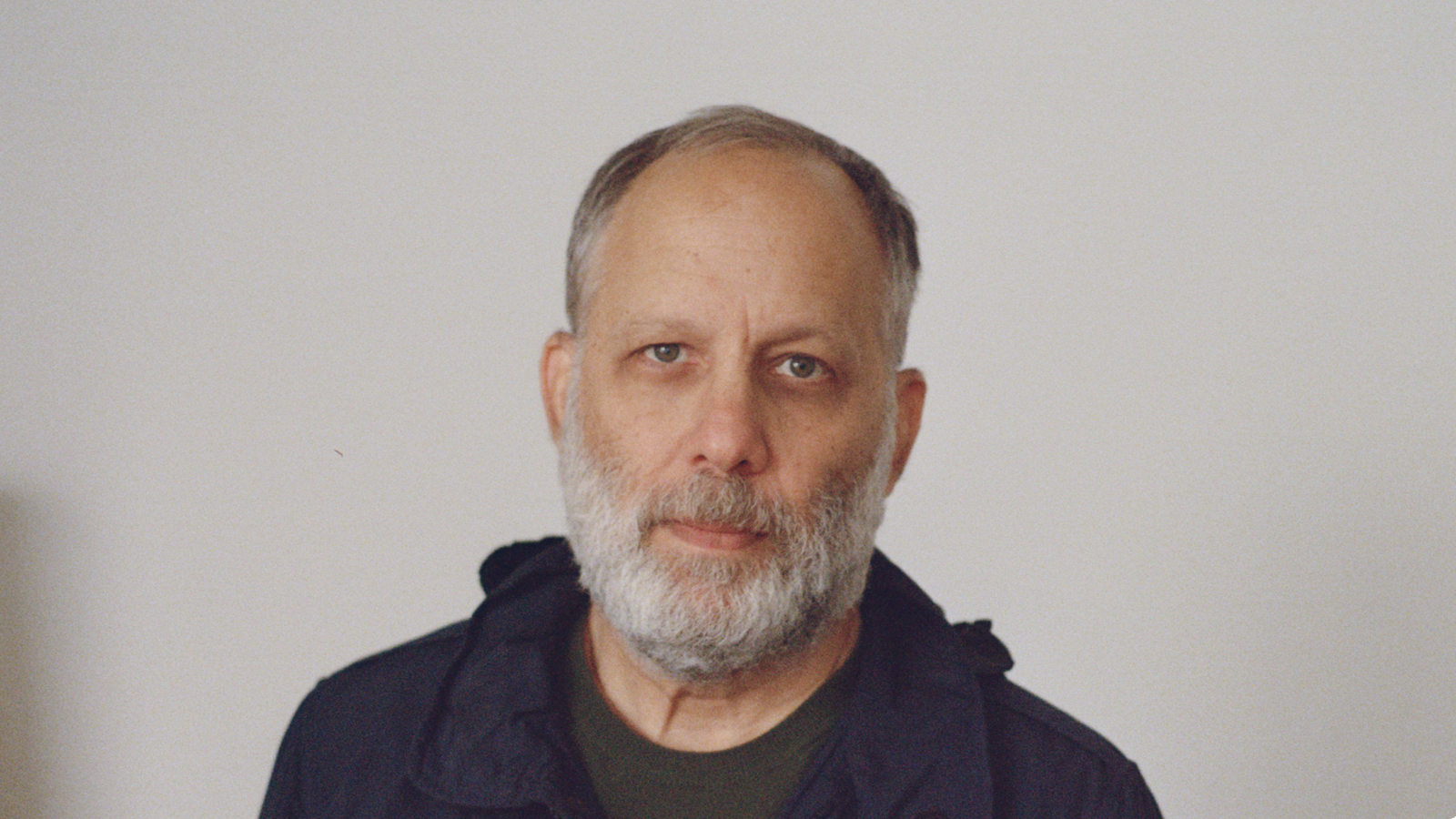
Ira Sachs, photo by Jac Martinez
Interview
Ira Sachs
The filmmaker on living, and making art, without secrets.
Keep the Lights On (2012) is currently streaming on Metrograph At Home.
Share:
IN IRA SACHS’S LATEST FEATURE The Man I Love (2026), Rami Malek plays Jimmy George, something like the Ron Vawter of a Wooster Group–like downtown theater collective, as he is preparing to star (in drag) in their new production, a stage adaptation of Michael Tremblay and André Bressard’s film Once Upon a Time in the East (1974). If, that is, he can stay healthy enough. It’s sometime in the 1980s—Jimmy’s live-in partner Dennis (Tom Sturridge) keeps track of his regimen of pills, and the the film comes closest to nailing down a precise chronology via the detail that Jimmy’s medications include AZT, not approved by the FDA until several years into the the AIDS crisis.
The film, which premiered in competition last month at the Cannes Film Festival, concerns a dying artist with an undimmed appetite for living: both making art, and, in Jimmy’s case, enjoying an active sex life, notably with his starstruck downstairs neighbor Vincent (Luther Ford). The historically major subject matter is both new for Sachs, and not; like Sachs’s last film, Peter Hujar’s Day (2025), The Man I Love concerns a New York artist who will die from AIDS (and likewise costars Rebecca Hall, here playing Jimmy’s sister, as a loving friend whose primary function is to witness and remember him). Jimmy and Dennis similarly recall the open but hardly peaceful relationship of the characters played by Franz Rogowski and Ben Whishaw in the director’s much acclaimed Passages (2023). Again, we have a voraciously creative artist and the partner who nurtures, basks in, enables, and endures his appetites for work and life.
But perhaps the film in the Sachs oeuvre which The Man I Love most recalls is Keep the Lights On (2012), his hushed and devastating study of a relationship marked by deep attraction and mutual need, but marred by dishonesty and addiction, which is currently streaming on Metrograph At Home. Following the regionally flavored Forty Shades of Blue (2005) and the midcentury melodrama of Married Life (2007), Keep the Lights On was a return to the gay themes of his first, small-scale fiction feature, The Delta (1996), but with that early film’s bounded narrative of self-discovery and furtive desire fracturing out across a decade of hookup, breakup, reunion, rehab, relapse, repeat. A film of crucial life decisions made and unmade in rented rooms—apartments, hotels, vacation rentals, artist residencies—Keep the Lights On is at once intimate and sprawling, and worth revisiting in light of Sachs’s latest outing.
If Passages resonated with a young audience eager to work through some feelings about ethical non-monogamy, Keep the Lights On, which begins with filmmaker Erik (Thure Lindhardt) cruising for phone sex, and follows his partnership with literary agent Paul (Zachary Booth) through Paul’s crack addiction and long unexplained absences, explores characters who, though no longer closeted, still pursue their pleasures in reckless solitude. It is perhaps Sachs’s most elegant and ambiguous posing of a question central to his work, namely, the question of the responsibilities that gay couples, living outside the structure of traditional heterosexual marriage, nevertheless have to each other. I spoke to him at Cannes, ahead of the premiere for The Man I Love, about how his new film revisits the emotional terrain mapped by his earlier films. —Mark Asch

The Man I Love (2026)
MARK ASCH: The Man I Love is about a non-monogamous gay couple, one of whom has, when the film starts, already progressed from HIV into AIDS, although he continues to have an active sex life with guys outside his relationship. It’s tricky, I imagine, to treat gay promiscuity—I mean this non-pejoratively—during the AIDS crisis as something other than a cautionary tale.
IRA SACHS: It’s not a cautionary tale. Certainly. I think it’s straightforward. It’s as I remember it. And with Mauricio Zacharias, my co-writer who also wrote Keep The Lights On with me, we both come with some detailed memories, about sex and those times. I’d say, a big difference between Keep the Lights On and The Man I Love is that non-monogamy in Keep The Lights On comes from secrecy, and the illicit. And there’s not really anything illicit in either Passages or The Man I Love. There’s more transparency but transparency doesn’t mean that there are no consequences, or pain. So I think the approach was less tricky, it was more to be honest to the complexity of the situation. As best we could.
MA: To continue to discuss the two films side by side, would you say Keep the Lights On is in the shadow of AIDS? Obviously, the filmmaker character has an HIV scare, early in the film. But also it’s about how the things that the characters seek out outside of their relationship potentially make each other unsafe, or the relationship unstable. And I wonder how much the ’80s is hanging over that film.
IS: I think what’s really at the center of that film was what it was to be gay, and partially what it meant to come out, for me, in the ’70s. So this is a real transition film for me, because I would say all the work that I made before was driven by what was hidden, and the secrets that people hold in intimate relationships. The Delta, Forty Shades of Blue, Married Life—all those films are about hiding, and personally, at the time that I made Keep the Lights On, hiding became impossible and also not attractive. So Keep the Lights On is a film about the secretive, but told with a transparency that was new for me. To even tell those stories felt very new for me. And I guess since that point I’ve been quite repelled by the idea of secrets. I don’t find it attractive. I think I used to. So there was an eros to the earlier films which had to do with hiding. And that no longer seems possible for me, because I don’t find it very sexy.
MA: Well, my next question was about sexiness, because I watched Keep the Lights On on the plane, on my laptop, on the way over here…
IS: Did you have to hide it, a little bit?
MA: I had the screen halfway down.
IS: You were in the closet!
MA: I was in an aisle seat! It was a mistake! Because it’s a very sexy film. The lighting in Keep the Lights On especially is so beautiful. I did notice that, even though I had the screen slightly dimmed. Do you remember anything about how you approached the sex scenes from a performance or a photographic point of view?
IS: In Keep the Lights On, and, particularly Passages, Peter Hujar’s Day, and The Man I Love, really half my intention was to enjoy, appreciate, and promote the pleasures of cinema. That color and light and skin are part of what comes off the screen and excites the audience—and makes the movie a movie—is something I’m very conscious of.
I don’t rehearse my films at all, even less when I’m shooting a sex scene, so I’m in the hands of the people playing the scene. I try to create an atmosphere where the audience can observe, but also be excluded. The exclusion that you feel is significant in a sex scene, because you want to feel that something is happening intimately that you’re not a part of. So it’s actually true voyeurism, right?

Keep the Lights On (2012)
MA: Certainly for the people sitting in the rows behind me. The four films that you mentioned, n, they’re all about artists. Which I take to maybe be because they take a creative approach to… life.
IS: That would also be true in Forty Shades of Blue, which is a film about the making of an album. Love is Strange (2014), too, is a film about the making of a painting. Keep the Lights On, the making of an experimental documentary film. Passages is the making of a feature film. The Man I Love, the making of a play. And my first film was called Vaudeville (1991)—it was an hour-long film about a theater troupe putting on a traveling vaudeville production. Queer, community, on the road, and unhappy. For me, it’s life experience, so it’s also an arc that I’m familiar with: the arc of starting and finishing an artistic project. Somehow, the making of an artwork creates an arc that I can then build a film around. Because it gives a hard backbone to the story. You start something, you don’t know where it’s going. You aim to complete it.
So there is the suspense of creativity in these different films. But maybe mostly it’s just something I’m familiar with without having to be conscious about that familiarity. It comes intimately. I think what was interesting to me about Hujar, specifically, after I finished the film, was finally listening to what Ben/Peter was saying, and realizing that it was one of the few examples that I know of where you understood the circular nature of confidence and doubt, which is at the center of creative practice. Because he’s really only asking, “Did I take a good picture of Allen Ginsberg?” That kind of questioning seems really, really familiar to me. It’s what I’m always asking. “Is it good? To me? And to others?”
MA: Another way Keep the Lights On is an echo of the ’80s is that the music is all by Arthur Russell. Is there significance in having music from that era in a film set in the ’90s and 2000s?
IS: I have no interest in truth on a factual historic level, only on an emotional level. There’s no alignment, period-wise, between Arthur’s music and the story of Keep the Lights On, but they evoke something.
I think the similarities are in the pace, and the ellipses, and the upfrontness of these films. They also, like a lot of my movies, are love triangles. There’s the question of the third. And who the third is keeps changing, right? Like, who seems primary and who seems secondary? That’s what shifts. To me, the big difference between these two films is the summation of the central relationships. One, for me, is a horror film, and the other is a love story.
MA: The music in The Man I Love feels very truthful, the characters’ taste in music. Torch songs and disco tracks, which is so important in a film about gay life in New York in the ’80s. Did you have songs in mind when writing it? Is there autobiographical resonance to any of the music in it?
IS: I keep a list on my phone of songs that I think are inherently cinematic. And I’m always looking for the opportunity to use them. Rebecca Hall sings “How Are Things in Glocca Morra,” from [the Broadway show] Finian’s Rainbow, which is a song that my husband Boris and I would play for our kids all the time. Bo Diddley was someone I played on repeat when I was in college, so to have a Bo Diddley song in a nightclub is to me, quite pleasurable. And then, for “The Man I Love,” I’m grateful to the Gershwin estate.
But the song of the movie is “Lightning Over Water” by Ronee Blakley, which is the last song of the film.
In the ’70s, she was as major as Patti Smith or Emmylou Harris. Now Blakley lives in Southern California, and we’ve become quite friendly in the course of getting her track into this movie. The poetic nature and the intensity of both her voice and her performance was extraordinary. I discovered it because I saw the song she sings in the movie Lightning Over Water (1980), made by Wim Wenders about the last months of Nick Ray’s life. The idea of an artist facing the end of their life, and what they make at the time, was something that seemed very embedded into “Lightning Over Water.”

Share:
Recommended
- Futures and Pasts: Socrates
 Rossellini’s one-of-a-kind approach to the costume drama, and his 1970 film on the last years of the Athenian truth-seeker.
 - The Illiac Passion
 On the most elaborate of Gregory Markopolous’s modern myths.
 - Jollof Films
 Senegalese visual artists and curators discuss the towering cinematic figures who inspire their craft.