
Der Fan (1982)
Essay
Der Fan
Eckhart Schmidt’s newly restored, chilling cult fable and the all-consuming side of pop fandom.
Der Fan (1982) plays at Metrograph from Friday, August 28.
Share:
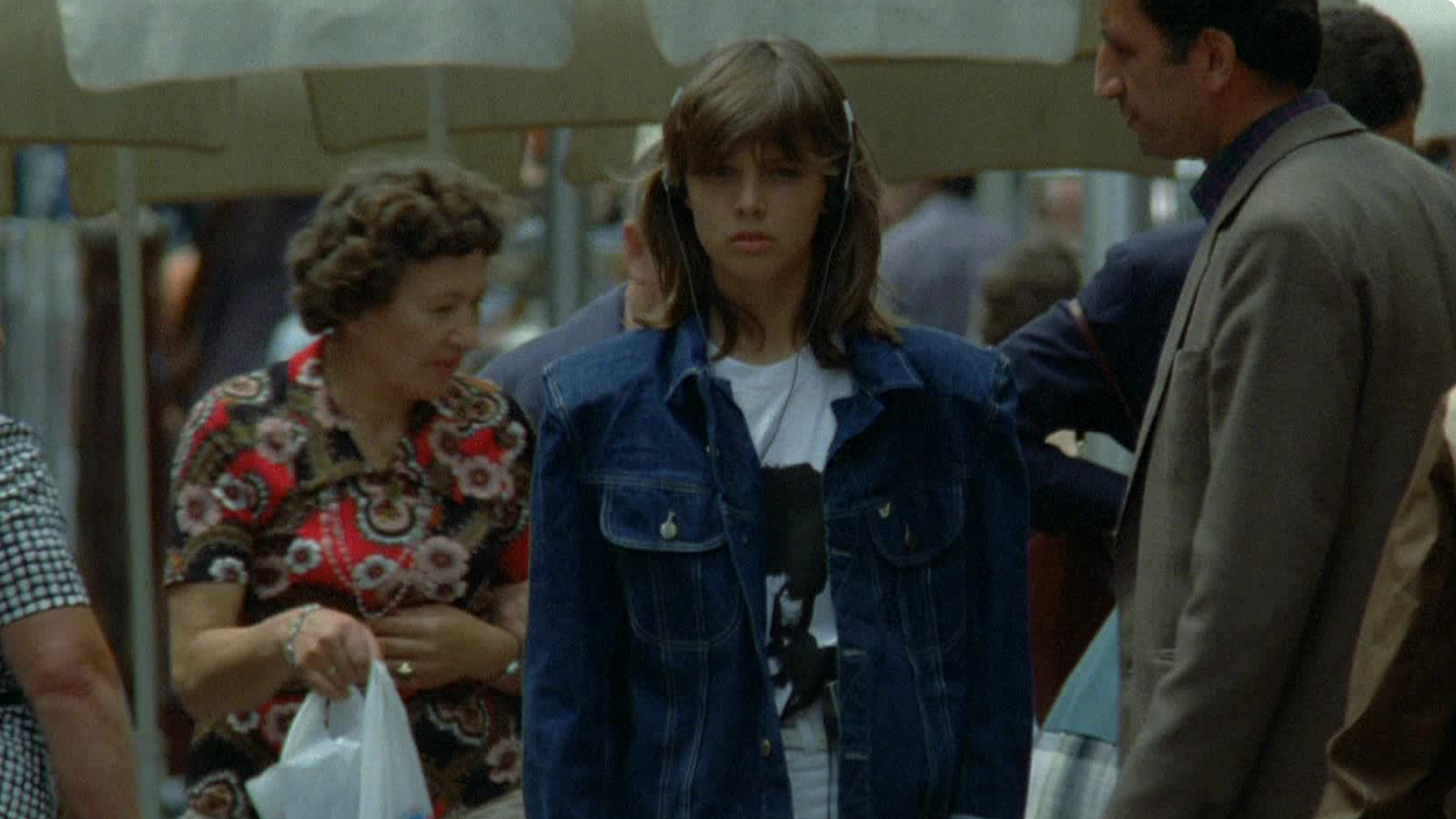
NEVER MEET YOUR IDOLS, they say—but no one’s told that to Simone (Désirée Nosbusch), the 17-year-old at the center of cold-blooded cult shocker Der Fan (1982). With headphones caressing her ears and her eyes glazed over, she moves through the quaint city streets of Ulm, in southwest Germany, as an angelic zombie, attuned exclusively to the musical frequencies of the burgeoning pop star “R.” She lingers day after day in this suspended state, visualizing a future in which she and he are romantically entwined.
Though director Eckhart Schmidt withholds the introduction of R himself (played by Bodo Staiger, frontman of real-life Neue Deutsche Welle outfit Rheingold) until a third of the way through Der Fan, he is omnipresent from the start: his image emblazons Simone’s T-shirt and her bedroom walls; snatches of his music (composed by Staiger for the film) not only play on her Walkman but comprise the score, too—the same sinewy synth refrains repeating throughout, emulating her frustrated desire. At night, Simone lolls sleepless on her bed beneath a larger-than-life mural of R’s waxen visage—fixed in a rather imperious expression and flanked by laurels—hoping that the next day will, at last, bring a response to the chastely amorous letters she’s been penning to her dream lover: “I feel I could give your life meaning,” she writes—the simplicity of her words belying their foundation in pure parasocial delusion. Each day, she confronts the postman with the pained expectancy of someone whose sweetheart has gone off to war, only to slink away sullen and empty-handed.
A Luxembourger by birth, star Nosbusch was already known in Germany, having won fans as the plucky host of ZDF Music-Box (1980-82), a TV showcase for pop and rock chart-toppers—not unlike the one R is rehearsing for when he first lays eyes on Simone, who, fed up with accosting the postman, has hitched her way to Munich in order to intercept her idol in the flesh. There, outside the studio, R glides past the teenyboppers clamoring for his attention, drawn instead to Simone and her gazelle-in-the-headlights mien. But their encounter, which escalates back at his friend’s apartment later that day, ultimately proves disillusioning—at which point Schmidt’s eerily somnolent tale turns from heartsick fangirl reverie into antiseptic horror. R winds up slaughtered and, in a grotesquely literal act of media consumption, methodically devoured by his adoring acolyte. (If only he’d been told, never meet your fans.)
Der Fan (1982)
Schmidt, who passed in 2024, aged 85, was a man unafraid to court controversy, whether through his films or a journalistic practice that encompassed broadsheet criticism as well as niche pursuits such as his storied zine, S!A!U! (1978–80)—in which he collected writing by the likes of New German Cinema debauchees Rainer Werner Fassbinder and Werner Schroeter plus punk and post-punk figureheads like Patti Smith, David Byrne, and DEVO’s Mark Mothersbaugh, alongside his own work. (It was in the pages of S!A!U! that Schmidt published the epistolary short story that became the basis for Der Fan.) Together with a handful of other Munich-based filmmakers, Schmidt declared his opposition to the austere radicalism of Alexander Kluge and the Oberhausen Group, allying himself instead with the lurid pleasures of genre—to which he frequently added Dantean allusions and extremist metaphors for the culture industry. Der Fan—the first in a trilogy along these thematic lines, followed by The Gold of Love (1983) and Loft (1985)—remains the director’s most controversial film, and his most beloved.
Schmidt here chooses to filter the power of pop through the most profane, and, in a certain, perverse sense, iconic chapter of his nation’s history. R’s image riffs shamelessly on the signifiers of the Third Reich: as plastered all over Simone’s personal effects, the logo of this clean-cut heartthrob is a pair of jagged arrows; the Schutzstaffel’s double-S having been given only the lightest of makeovers. In publicity photos, he sports black leather jodhpurs: an S&M iteration of der Führer’s.
By definition short-form, seductive, and mass-transmitted, pop music since its industrialization has oft been cast in films as authoritarian tool, from Peter Watkins’s dystopian pseudo-doc Privilege (1967), whose oblivious pop prophet, Steven Shorter, wears his initials embroidered on his mandarin collar—not coincidentally, “SS”—to Zoolander (2001), with its dreadlocked, milky-eyed “Evil DJ.” In Decoder (1984), another lusciously bleak film to come out of West Germany in the ’80s, Einstürzende Neubauten’s F. M. Einheit discovers a fast-food chain conspiracy to control the populace through muzak. (The antidote? Why, industrial noise, of course.) But none of the above advance such an explicit aesthetic regime as Der Fan.
In a 2017 interview with the film magazine artechock, Schmidt bemoans the failure of critics of the day to clock the film’s “confrontation with National Socialism.” “There are paintings of the 1936 Olympic games in the apartment,” he details. “The cheers from the fans were actually cheers of ‘Heil’ from the archive… and people didn’t catch on!” Contemporaneous German reviews—Der Fan wasn’t released in America, though an English-dubbed version did circulate via bootleg VHS under the title Trance—linger instead on the scandal-inciting lawsuit brought by Nosbusch, aimed at preventing the film from being released at all.

Der Fan (1982)
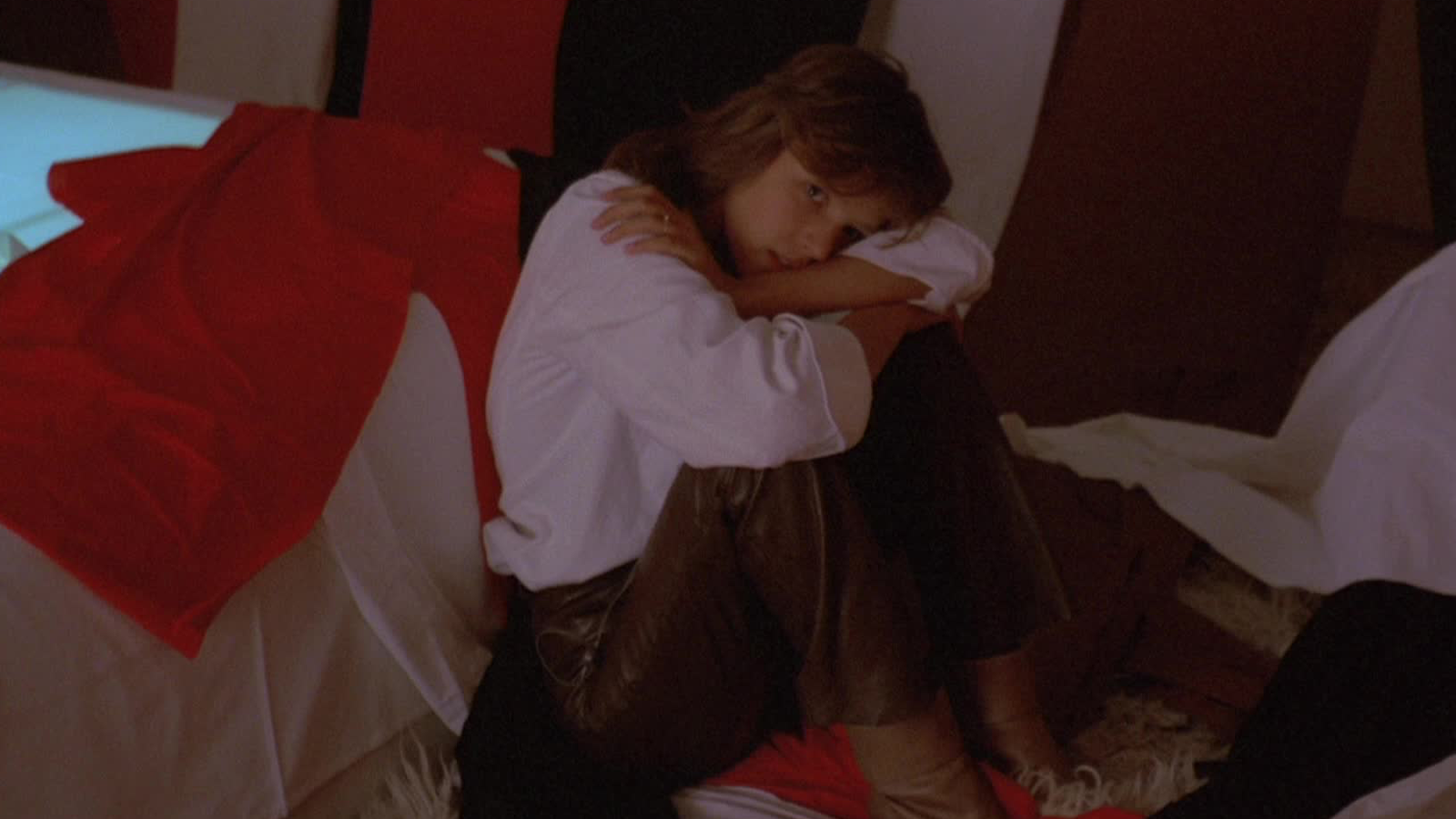
The young woman’s ire was directed at the publicity around her extended nude sequence—which begins with R’s deflowering of Simone, manifest as a series of glacial poses and played out in a room draped portentously with banners of red, white, and black, and climaxes with his murder. Nosbusch was 16 at the time of filming, underage by German law—albeit the precocious teen had already been pushing the boundaries of her primetime-friendly public image, raising eyebrows with a nude scene in her 1981 film debut, Wolf Gremm’s WWII drama After Midnight (in which her character is persecuted by literal Nazis).
She stood by her decision to bare it all in Der Fan, even going so far as to pooh-pooh Brooke Shields’s use of a body double in 1980’s soft-focus shipwreck romance The Blue Lagoon as “dishonest”; Nosbusch’s objection, so she claimed, was to the premature publication of the stills. Her lawsuit was nevertheless unsuccessful, per the Streisand effect serving only to generate a greater frisson around the film, and she returned to the relative safety of small screen: in 1984, Nosbusch hosted the Eurovision Song Contest final.
Despite the imperial tricolor set dressing—and despite Schmidt’s predilection, demonstrated across his nymphette-heavy oeuvre, for gauzy, softcore flourishes—Simone and R’s chilly erotic coupling is not the stuff of Nazisploitation. Der Fan is not a film about sexual deviance or violence; nor is it really a film about the Third Reich. Rather, it’s about the fascistic, ritualistic dimension of popular music, predicated as it is on idol worship—something to which Nosbusch was routinely an eyewitness in her capacity as a TV host. But Schmidt offers a distinctly postmodern take on the brainwash pop subgenre, substituting ideology with… nothing. R’s music is not a corporate mind control mechanism for the creation of dull, conformist teenagers, nor the assassination of the Malaysian prime minister. As for R himself, it seems that he wants nothing more than to get laid.

Der Fan (1982)
Staiger brings to his role such a stiffened composure that R could almost be taken for a “Man-Machine” like the one Kraftwerk, fellow Düsseldorfers, had sung of just a few years earlier—or perhaps simply one of their “Showroom Dummies”: R’s TV performance takes place on a platform crowded with plastic people, his New Wave quiff sheathed sympathetically in a bald cap. “He always sings in the same voice,” acknowledges Simone in her lilting but very nearly as dispassionate voiceover, “but for me, it sounds different every time.”
For R, the opposite is true of Simone: though he initially singles her out, once he’s bedded her, he loses all interest—an outcome foretold in his song “F.A.N.,” whose chorus becomes the film’s taunting leitmotif: “Du bist nur ein F–A–N”—“You are just a fan.” His failure to mirror back Simone’s perfect devotion can only be a gross betrayal in her mind; when he goes to leave the spartan apartment, she resorts to forceful intervention. To hand, standing on a plinth by the door, is a figurine who looks to be Artemis, virgin goddess of the hunt, her arms posed as if drawing a bow, which Simone duly thrusts into R’s chalk-white neck.
When Artemis caught a fellow hunter spying on her mid-moonlit bath, the ancient myth goes, she retaliated by transforming him into a stag, and so he was set upon by his own hounds. Simone’s murder of R is similarly an impulsive act of vengeance occasioned by a horny man’s fecklessness. But her consumption of him is an act of veneration: in eating R’s flesh, she eradicates his faithless humanity, leaving only the pristine image, which will never spoil.

Share:
Recommended
- Yuliya Solntseva
 On the actress-turned-filmmaker’s unsung authorship.
 - Futures and Pasts: Socrates
 Rossellini’s one-of-a-kind approach to the costume drama, and his 1970 film on the last years of the Athenian truth-seeker.
 - The Illiac Passion
 On the most elaborate of Gregory Markopolous’s modern myths.