
Lady in the Water (2006)
Essay
Lady in the Water
On the death of the critic in M. Night Shyamalan’s watery fairy tale.
Lady in the Water plays as part of Like the Wind: Lensed by Christopher Doyle at Metrograph from Saturday, August 29.
Share:
KILL THE CRITIC IN YOUR head. Write him into your movie and kill him there. Finally this useless parasite on art will have a purpose. His fixed sneer will open into an expression of shock and terror. His remove from your work, and his unwillingness to suspend his evaluative faculties and lose himself in your plots, has ever concealed his constitutional fear of the magic of cinema, which he doesn’t understand and which will now devour him, removing him from your work.
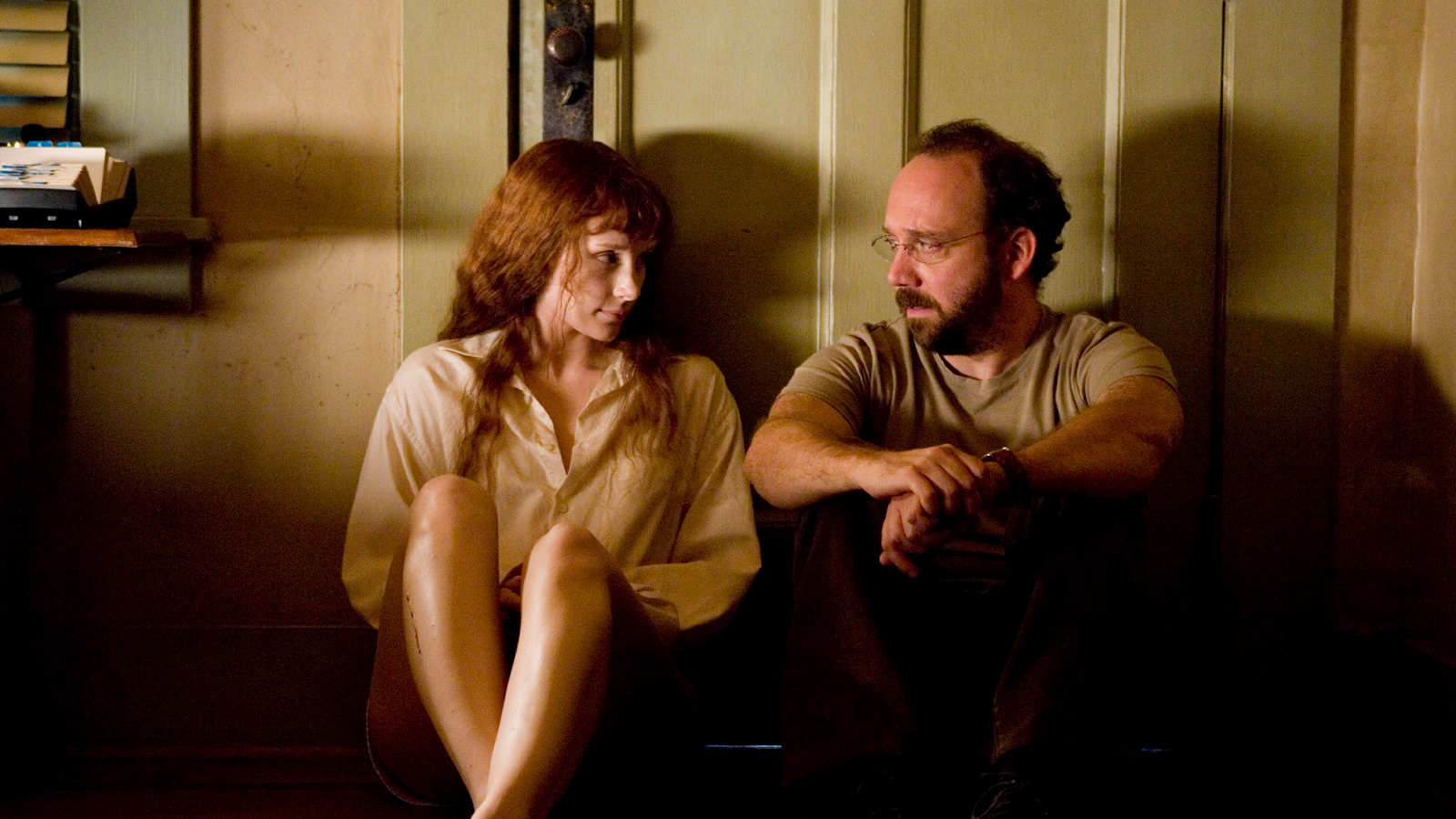
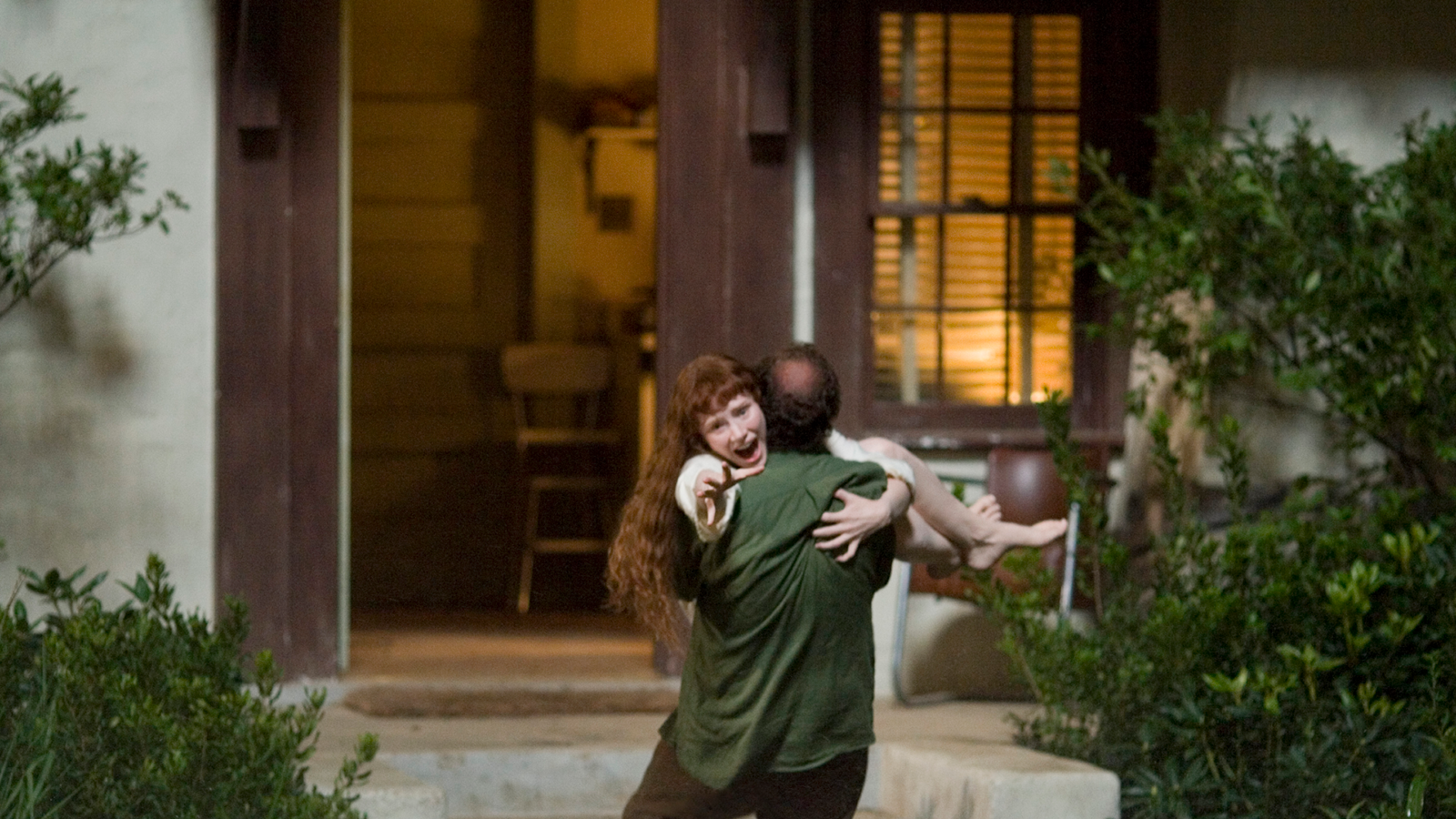
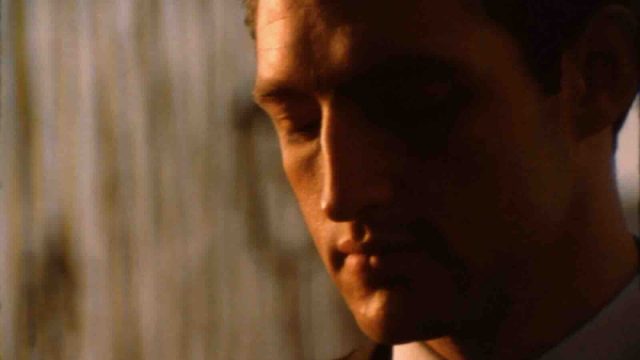
This is the neat trick that writer-director M. Night Shyamalan pulls in his first flop, Lady in the Water (2006), starring Paul Giamatti as a stuttering apartment complex super and Bryce Dallas Howard as a beatific naiad—or “narf,” in Lady’s parlance—who lives in a cavern beneath the community swimming pool. The latter is named Story, and a professional critic played by Bob Balaban can’t bring himself to buy into her whole deal. His lack of faith is disturbing. In the third act, confronted with a vicious, grass-matted dog creature called a scrunt, he monologues about being an “unlikeable side character” in a movie who’s destined to have a brush with death that he will survive, owing to the rules of the film he thinks he’s inhabiting. Then the dog eats him.
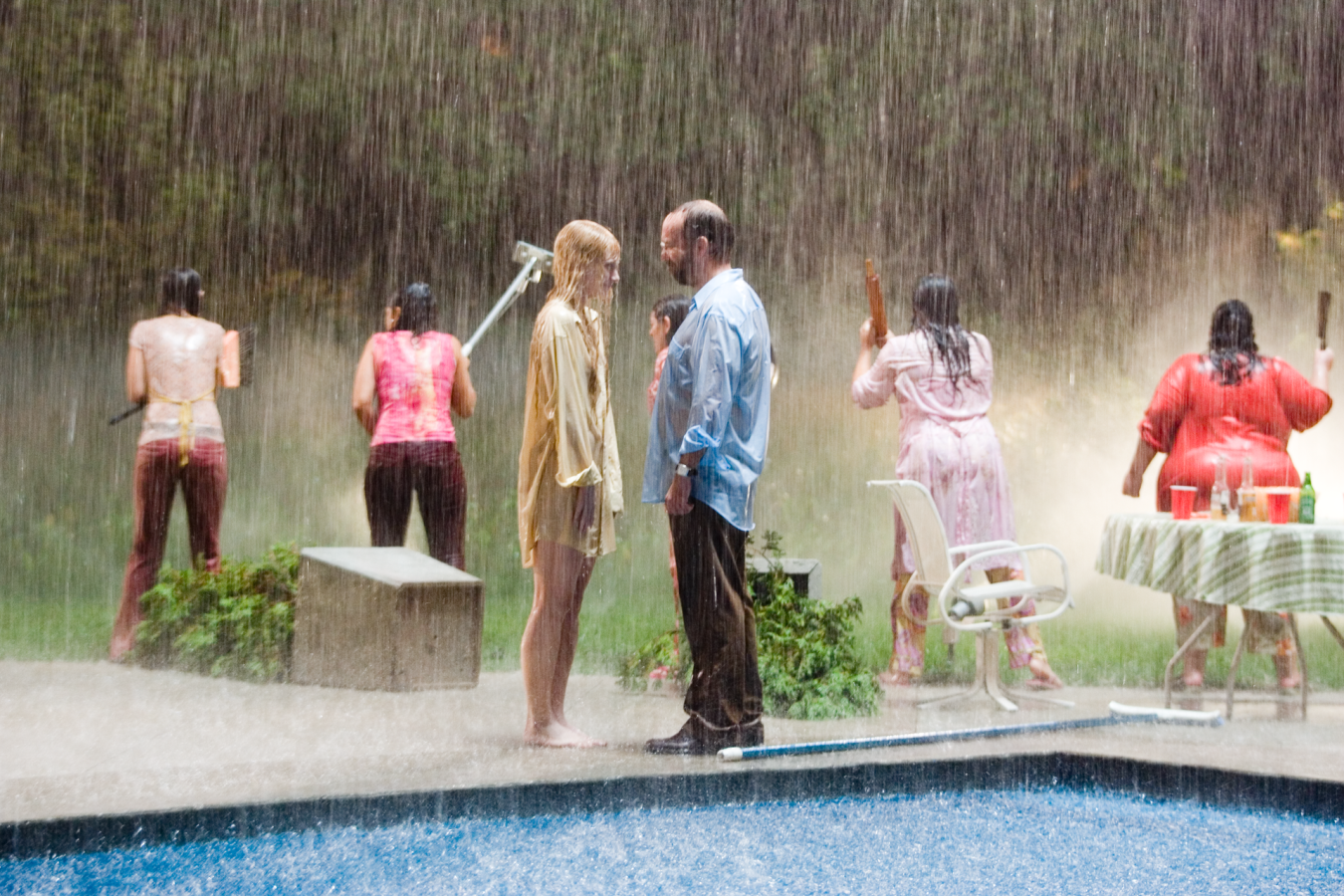
For a director noted for the supposedly airtight earnestness of many of his pictures—hits like The Sixth Sense (1999), Unbreakable (2000), Signs (2002), and Split (2016), as well as misfires like The Last Airbender (2010) and After Earth (2013)—this savage dressing down and disposal of the cynical critic character can read as itself an act of vengeful, vivifying cynicism. I will dissect you; we will laugh at you; I will eviscerate you. Why? Because it’s fun; because I can. Lady boasts a handful of beautifully photographed aquatic scenes—baptismal encounters with water sprinkle Shyamalan’s oeuvre, and cinematographer Christopher Doyle, though reportedly a menace on set, produces a memorable version here—and Giamatti contributes a predictably strong performance. But it could have used a bit more of this bitter, snarling attitude.
Lady in the Water (2006)
The movie is a baggy fairy tale about the unfurling of a baggy fairy tale. The denizens of the Philadelphia-area complex, led by Giamatti’s Cleveland Heep, must uncover the rules and details of a bedtime story about Howard’s naiad in order to help her fulfill her mission of inspiring a nobody writer—portrayed, provocatively and unconvincingly, by Shyamalan—to finish his book, which will in turn inspire “a boy in the midwest of this land” to become a “leader of this country” and usher in “a movement of great change.” The residents tend to possess an identifying quirk: one spends a lot of time in the bathroom; another is a crossword grandmaster. A man named Reggie, portrayed by Freddy Rodriguez of Six Feet Under fame, strenuously exercises a single arm, anticipating the current microcelebrity known as The Crooked Man. After Story completes her task, this group must aid her return to “the blue world” from which she hails, protecting her meanwhile from the scrunts. The tale-within-the-tale’s convolutions and confusions test the faith of the ensemble and, by extension, the viewer, who must also contend with Shyamalan’s clunky mythological vocabulary.
Shyamalan’s characters often experience crises of faith after a traumatic event or are challenged to accept the existence of the supernatural or extraterrestrial. Bruce Willis must learn to believe in ghosts (The Sixth Sense) and his own superheroism (Unbreakable), Mel Gibson in aliens and God (Signs), Jaden Smith in his ability to act like his costar father (After Earth). They confront doubt; they overcome it, sometimes within the crucible of the domestic sphere, where the strength of familial love reaffirms and reforms itself through endurance and revelation. The rebarbative nonbeliever has no place in these worlds; he threatens their coherence as critics have at junctures threatened Shyamalan’s auteur image and considerable ego. (The negative reception to 2019’s Glass, a direct sequel to Split and Unbreakable, reportedly drove him to tears.) Balaban’s critic in Lady is, in fact, a rootless, unproductive mercenary who’s just moved into the complex after a fallow period as the film begins. He does not belong to the community and cannot integrate himself into it. At length, we learn that all his neighbors have been drawn to live there by mystical forces in order to exercise their higher purpose. Watching, I asked myself if those same forces had lured the jaded aesthete there to die.
Lady arrived after a period of ego bruising for Shyamalan. The Sixth Sense, which premiered when he was 28, was a cultural phenomenon and the second-highest grossing film of 1999. Signs, too, drew crowds and was spoofed in Scary Movie 3 (2003), surely evidence of its place in the zeitgeist. But his next film, The Village (2004)—ironically about an isolated commune where the elders maintain social cohesion by inventing monsters, proving Shyamalan is also sensitive to the dangers of blind faith—had polarized audiences and reviewers. (It still made money.) Worse, the executives at Disney, with whom he’d made his previous four features, didn’t get his new script, a state of affairs milked for wince-inducing drama in Michael Bamberger’s tragically fawning and roundly if inadvertently embarrassing book about Lady’s production, The Man Who Heard Voices (2006). (Attempting to convince the Disney bigwigs of the writer character’s importance over dinner, Shyamalan compares the man’s work to Uncle Tom’s Cabin: “It made you feel for the slaves. It’s an amazing, amazing book, but it didn’t change the world” until “Abraham Lincoln read it, became President, and ended slavery. That’s what’s going on here.”) Disney still wanted to make the movie—they offered him a $60 million budget and creative control—but Shymalan no longer trusted his erstwhile collaborators. He broke ties, reworked the script, and took it to Warner Bros instead, where he received an even larger budget.
Lady in the Water (2006)
The critic character already appeared in the draft Disney saw; according to Bamberger, Nina Jacobsen, then president of Buena Vista Motion Pictures Group, had told Shyamalan something like, “You’re going to let a critic get attacked? They’ll kill you for that.” (Some did.) But I can’t help but wonder if the director and studio’s falling out—and the self-doubt it might have sparked in Shyamalan—augmented the ferocity and comedy with which he ultimately skewered Lady’s career skeptic. Time proved Jacobsen right: the film lost money, got panned, and catalyzed Shyamalan’s transformation from a prodigy to a punchline whose signature “twists” could as easily make eyes roll as widen in pleased surprise. Now, amidst the ongoing Shyamalanaissance that kicked off with the vigorously entertaining found-footage horror comedy The Visit (2015), critics have again warmed to the director. In recent years, Adam Nayman and David Sims both have published attentive profiles of Shyamalan in The New Yorker and The Atlantic, respectively.
Shyamalan has yet to throw another movie reviewer to the dogs, but he has continued to dramatize the push-and-pull of faith and doubt. In Old (2019), he plays a malevolent overseer who films the rapid aging and degeneration of unlucky beachgoers from his perch on a nearby cliffside, his camera lens flashing in the sunlight. Interpretive possibilities abound: Is the director poking fun at his penchant for selling mildly gruesome images to moviegoers? Is he gesturing lackadaisically toward the power differential—sometimes welcome, sometimes not, but ultimately essential to his artform—between those filmed and those who film? Sure, maybe, but he’s also depicting a false higher power that deserves to be exposed and brought to justice. Whatever this distant watcher’s noble aims, they do not outweigh the moral repugnance of turning people into unwilling human sacrifices. His faith in his mission is misplaced. Knock at the Cabin (2023) takes up this concern with agency and sacrifice and poses it as a question: What would you be willing to give up for the survival of mankind? In the film, four reluctant horsepeople of the apocalypse break into a vacation rental occupied by a gay couple and their adopted daughter and deliver a grim message. The family must agree to kill one of its own or the world will end. Tied to a chair after suffering a concussion, one of the fathers sees a light gleaming in a mirror. Is it a visual artifact born of head trauma or a communication from God? The answer proves unambiguous, but Groff must persuade his high-strung, skeptical husband of the truth. A loved one must be sacrificed, and disbelief, too.
Shyamalan has described Lady in the Water—a narrative about a narrative that could change lives, if only people would submit to it—as his “most me” movie. I take this to mean that it is the most nakedly wishful about the power of cinema. If we cannot save the world, nor redeem it, whatever either process might entail, we can save up and savor stories about faith hard won, and in so doing douse ourselves in the belief, which will hang on our skin like water and then evaporate in due and short time, that a story about a redeemable world, or the catharsis we feel in the presence of family members beset by calamity finding succor in each other’s company, bespeaks the possibility a coming salutary (even salvific) change in the order of things, whether within the small space of our own lives or on an expansive scale. I do not believe that Lady in the Water is such a story, but what do I know. I’m just a critic.

Share:
Recommended
- Yuliya Solntseva
 On the actress-turned-filmmaker’s unsung authorship.
 - Futures and Pasts: Socrates
 Rossellini’s one-of-a-kind approach to the costume drama, and his 1970 film on the last years of the Athenian truth-seeker.
 - The Illiac Passion
 On the most elaborate of Gregory Markopolous’s modern myths.