
Columns
Futures and Pasts: Socrates
In Futures and Pasts, Metrograph’s Editor-at-Large Nick Pinkerton highlights screenings of particular note taking place at the Metrograph theater. For the latest entry, he considers Roberto Rossellini’s one-of-a-kind approach to the costume drama, and his 1970 film on the last years of the tireless Athenian truth-seeker.
Socrates (1970) opens at Metrograph on Friday, October 9.
Socrates (1970)
Share:
THE PASSEL OF LARGELY MADE-FOR-TELEVISION historical films that Roberto Rossellini oversaw in his later life can, like all films, be discussed individually, but to only do so seems to betray something about their place in a grandiose architectonic conception, something like Henry Adams limiting his observations on Chartres Cathedral to commentary on a single gargoyle or Rood screen. Like the history of Western thought that they endeavor to present—“dramatize” would be far too strong a word—they are interlocked, each a chapter in an unfolding narrative. Created over the last 15 years of his life, from 1962 to 1977, they are the products of an ambition little seen in cinema before or since, and prior to addressing any single film in their number, it behooves us to understand the blueprint that brought them, in toto, into being.
It was sometime in ’62 that Rossellini drew up a document that biographer Tag Gallagher refers to as his “Great Plan.” Rossellini was then laying the groundwork to found a new production house, FIDEC, and proposing to make 25 television documentaries a year, over a four-year period, on an annual budget of two billion lire. These would constitute a narrative of human progress from the Paleolithic to present times. It would cover the ages of Bronze and Iron; it would cover the exploration and charting of the globe, including the voyages of Columbus and Captain Cook; it would cover the Encyclopédistes and their allies—Montesquieu, Voltaire, Rousseau—whose vision of a comprehensive catalog of human knowledge it would echo. And it would outline a history of ideas, with a cast of characters including Augustus, Descartes, and, going back as far as the 5th century BC, Socrates.
Rossellini whose international fame had been made through one of the most self-consciously, acutely contemporary of films, Rome, Open City (1945), had started looking backward, becoming more and more oriented towards the past in the period preceding his grand historical project. He had visited the Middle Ages some time back in The Flowers of St. Francis (1950); his Vanina Vanini (1961), based on an 1829 story by Stendhal, was set in the opening days of the Risorgimento that ended in 1871 with the unification of modern Italy; and was followed later the same year by Viva l’Italia!, made to commemorate the centenary of Giuseppe Garibaldi’s conquest of the Kingdom of Two Sicilies in 1860, a significant landmark en route to that final goal.
Given the limited commercial and critical success of those recent films, the Great Plan could only have been born of delusional optimism—a film cycle with a scope beyond that of Balzac’s La Comédie humaine or Zola’s Rougon-Macquart novels, an unachievable folly! At 56 years of age, the age of prudence, Rossellini was flinging himself headlong into the deep end. This was not a man noted for possessing the qualities of moderation and circumspection, but rather a hustler, an imprudent adventurer, an escape artist—at the beginning of the ’60s, backed into a corner as perhaps never before. To speak of completing one movie, much less a hundred, was far from being a safe bet at this juncture, when Rossellini was at an identifiable low point, projects foundering left and right.
Of these many and varied failures-to-launch, Rossellini had considerable hopes pinned on one, Socrates—a movie that he’d been talking about making for 20 years before finally realizing his ambition. Unique among Rossellini’s histories in that his desire to make a film about the philosopher antedated the Great Plan, it was first conceived as a companion piece to The Flowers of St. Francis, a sort of spiritual/materialist diptych of counterposed figures. Speaking to the magazine Bianco e Nero about the prospective project in 1951, Rossellini said:
Socrates is a man of today. Socrates is bound to reach the same results as Francis, but Francis gets there through the impulse of his dreams and desires, Socrates by logic. Instinct in St. Francis; reason in Socrates. In our civilization, Latin and Christian, we don’t enshrine truth. We’re full of irony and skepticism; we keep on searching for truth. We don’t look at things materialistically just to see their surface, but rather to have perspective. This is how Francis looked at things, Socrates too.
In 1962 Rossellini had been close to making his film, lining up backing from a consortium of Italian, Greek, and Swedish financiers and, in France, François Truffaut’s Films du Carrosse. “I believe this is the film you should make right now and… it will be magnificent,” Truffaut wrote that year to the man he called his “Italian father,” but the project would shortly stall with Truffaut’s withdrawal. (“The truth is we don’t have the same ideas on how to make movies,” he later explained by letter, “I find everything you do good, right and logical as long as you’re doing it. If I were to meddle, we would be heading for catastrophe.”) This setback was fairly typical of Rossellini’s luck in the period when he hatched his Great Plan; the all-in gambler was on an unprecedented losing streak.
The Plan, unlikely as it may have seemed, would in fact provide a roadmap for Rossellini to follow in his work until the end of his life. Opportunities dwindling and debts amassing, Rossellini squared up and went on the attack. His target? Essentially the entirety of film culture as it then constituted, with particular vehemence reserved for the then-ascendant Michelangelo Antonioni and the cinema verité movement, which had been received by some commentators as an inheritor of the Neorealist tradition and its quest for cinematic truth.
Rossellini rejected verité for its obfuscation of the role of the creator and the creator’s personality, and for what he viewed as its ceding of moral obligation, which he regarded as manifestations of a creeping depersonalization—the depersonalization that Antonioni not only diagnosed but, in Rossellini’s view, appeared to wallow in. While Antonioni was de-centering the human form in his framing, the verité directors were playing games of chance with their subjects, and the Nouvelle Vague was celebrating the flamboyant individualistic handwriting of the caméra-stylo, Rossellini was mulling over an approach that would at one and the same time subsume authorial personality to the strictures of a schema and retain a distinct sense of individual authorial presence and, crucially, moral perspective.
He rejected the escapism of the popular cinema and the no-hoper moroseness of the art cinema of the day; and, while friendly and even paternal with the New Wavers, he was not, could not, be of them. He quarreled with the new generation of documentarians, telling Jean Rouch at a 1963 UNESCO film conference: “Rouch, you have a talent to create and you use it to tear down.” He declaimed against the high moderns and the avant-garde, announcing the same year, “Today, art is either moaning and groaning or cruelty. The highest moral stance contemporary artists have taken has been to speak of incommunicability and alienation, that is to say, of two phenomenon that are absolutely negative.” Two years later, he was still harsher when describing the blighted cultural landscape: “What does the art of today learn or teach? It is the expression of a certain malaise, of a state of unhappiness and incomprehension but nothing more.” To roll back this all-consuming pessimism would require, he believed, a return to the basics, a reacquaintance and re-engagement with history.
Socrates (1970)
Manifestos being much the order of the day in the 1960s, that decade of Oberhausen and the “Aesthetics of Hunger,” Rossellini issued one of his own at a press conference at a Punto Einaudi bookstore. “There’s a crisis today not just in film but in culture as a whole,” he stated. “Film, which is the instrument par excellence for spreading ideas, has had the merit of making this crisis evident, almost palpably so. For this reason I intend to retire from film and dedicate myself to television, in order to be able to re-examine everything from the beginning in full liberty, in order to rerun mankind’s path in search of the truth.” In the late ’50s Rossellini could already be found proselytizing for the possibilities of television, telling André Bazin and Jean Renoir: “Modern society and modern art have been destructive of man; but television is an aid to his rediscovery. Television, an art without traditions, dares to go out and look for man.”
The idea that television could be considered to offer “full liberty” may today seem almost surreal, but from the postwar period to the outset of the 1980s, broadcast TV in Western Europe was guided by a mandate of public service that to some made it plausibly appear a feasible grounds for revolutionary, egalitarian creative endeavor, the product of which could reach people of all social classes in their very own homes. Few artists tasked with mustering sizable budgets in order to complete their work can be said to create in perfect freedom, and negotiating with state-owned stations came with compromises of its own, but to Rossellini these obligations seemed small beer compared to those entailed in making films for theatrical exhibition.
It was thus, thundering against the sins of a devolving culture and singing the praises of the cathode ray tube, that Rossellini embarked on one of the most impossibly ambitious projects in the history of cinema—if, that is, we allow our definition of cinema to encompass works intended, in most cases, for broadcast. The resulting corpus, consisting of some 42 hours of moving image-based art, might be likened in its breadth to the encyclopedic undertakings of American nonfiction historians Frederick Wiseman or Ken Burns—Rossellini himself cited Scots-Canadian documentarian John Grierson as a key inspiration—though Wiseman and Burns show a preference for American scenes, whereas Rossellini’s aim was to encompass the life of Western civilization in panorama. (Expeditions still further afield were planned—a Cyrus the Great, a Life of Mao—but none completed.)
The operation was inaugurated by 1965’s The Iron Age, comprised of five one-hour segments—in fact directed by Rossellini’s son, Renzo, and something of a dry run for what came ahead, intended to drum up backers—in which historical vignettes were presented in a kind of newsreel style. The singular approach that Rossellini would develop and refine through his histories would emerge in recognizable form in the following year’s The Taking of Power by Louis XIV, originally written by screenwriter Jean Grualt for his collaborator on La Religieuse (1966), Jacques Rivette, and made for the French national television and radio agency ORTF.
The Taking of Power by Louis XIV depicts precisely what the title suggests, the Sun King’s accession to the throne following the death of Cardinal Mazarin in 1661. The 1969 miniseries Acts of the Apostles, five episodes ranging in length from an hour to an hour and a half made for Italy’s RAI, follows the dissemination of Christ’s teachings following his crucifixion, resurrection, and ascension. The finally filmed Socrates (1970), Blaise Pascal, Augustine of Hippo (both 1972), and Cartesius (1974)—all underwritten by Instituo Luce and comprising a series called I filosofi (The Philosophers)—each show the titular thinkers as they sow the seeds of ideas that will bear fruit through the ages. The three-part The Age of Medici, aired in 1973, is a tour of Florence in the time of Leon Battista Alberti and Cosimo de’ Medici. Anno uno (1974), an outlier in its near-contemporaneity, depicts history that Rossellini himself had lived through, the postwar reconstruction of Italy as viewed through the career of Alcide De Gasperi, former prime minister and founder of the Christian Democracy party—a film that put him at odds with RAI, very much a Christian Democrat stronghold. His final completed fiction feature was 1975’s Il Messiah, a story of Christ excising the miracles of scripture, much as Paul Verhoeven has stated he would were his long-discussed Jesus biopic ever made.
There were more projects in the offing as well. A proposed film about Karl Marx to follow Il Messiah—for Rossellini considered the Nazarene and Marx kindred spirits. A film about Caligula, presumably quite different in character from Tinto Brass’s pornographic epic of 1979 and its various knockoffs. A series about the American Revolution to have been made for public television in the United States—a missed opportunity to be lamented, for there is a dearth of good filmmaking on the Spirit of ’76, and Rossellini alone seems likely to have been able to conceive it not in action movie motivations like revenge and personal grudges, but rather as a dry, page-shuffling affair in which ink-stained intellectuals and orators tested their wits against one another while improvising nationhood.
Rossellini chose his subjects, he claimed, not for the personal interest that their stories invoked or the drama of the lives observed, but for their suitability, their significance as road markers on the path of human progress. To hear Rossellini describe his methodology, this would be the very opposite of a passion project or the pursuit of the ripping yarn; it would be, rather, a systematic process, guided by concerns other than adhering to the strictures of classical dramaturgy or even the basic principles of entertainment. The Taking of Power by Louis XIV at least has something like a satisfying narrative arc, but Rossellini’s later historical films lack even this much. Talking about his decision to make a film about the prodigy of Clermont-Ferrand, Rossellini, boasting of his own perversity, would say: “No one who’s not a kamikaze would make a film about Pascal, a very boring character who never made love in his life. When he was suffering, which was most of the time … he used to solve geometry problems. He really wasn’t much fun.” (The resulting film vibrates with, among other things, the horror of a committed sybarite faced with the spectacle of self-denial at its furthest extremes, with the Italian Catholic sensualist’s terror at Jansenist austerity.)
Socrates (1970)
Recasting himself as no longer a filmmaker but a man of television, Rossellini insisted that he wasn’t an artist but rather a researcher, archivist, and pedagogue—between the years 1970 and ’74, it may be noted, he was a regular presence at Houston’s Rice University at the behest of art collectors and patrons John and Dominique de Menil, whose only other “kept” filmmaker was one Andy Warhol. As far as one could get from the aloof, politically neutral Warhol, Rossellini viewed himself as taking on the Renaissance role of the artist as a public service-oriented figure, unconcerned with questions of personal expression and individuality. In turning to history, Rossellini looked to the future, to the forging of an enlightened and emancipated citizenry—his histories would provide the facts, but not the conclusions.
Rossellini’s perspective on history, and on much else besides, was profoundly shaped by the writings of Benedetto Croce (1866-1952), a Hegelian philosopher, politician, and historian whose influence was ubiquitous in the Italy of the filmmaker’s youth and a figure who, like Rossellini, made something of a religion of the quest for liberty and had little truck with airy-fairy theory and academic jargon. For Croce, any effort to engage with the past must begin with a direct address to its material reality and an imaginative leap across eons. “Do you wish to understand the true history of a Neolithic Ligurian or Sicilian?” Croce wrote, “Try, if you can, to become a Neolithic Ligurian or Sicilian in your mind… Do you wish to understand the true history of a blade of grass? Try to become a blade of grass.” The fault of much historical filmmaking, to Rossellini’s mind, was the failure to follow Croce’s edict; an editorializing tendency, which overlaid presentist attitudes onto the depicted past—something he reviled in Federico Fellini’s Satyricon and Luchino Visconti’s The Damned (both 1969).
It may be said that Rossellini, in his histories, does little to bring the past nearer to the modern eye for inspection, and there is little sense of familiarity with the characters who people these often spare, haunted films. If we are to understand them, in Croce’s sense, we must do so by observing the appurtenances of their daily lives: the chambers in which they dwell, the repast they take, the clothes they wear. (Rossellini had a stated preference for cultures that favor unstitched, draped garments, like the Indian dhoti or the Greek toga, which may or may not have something to do with his fluctuating waistline.) His approach was not immersive or intimate, but rather distanced, contemplative. Paul Schrader, one of a precious few American interpreters who took note of exactly how sui generis the director’s late style was, wrote in 1972:
This false ‘objectivity’ (pretending the past is beyond interpretive alteration) … is an interpretation of its own, but its effect on the viewer is crucially different from conventional film interpretations of history. Because Rossellini makes no attempt to plunge the viewer into the drama of the past, making the past relevant to his immediate feelings, the viewer has a sense of detachment rather than involvement, of awareness rather than empathy. He can fix his attention on the subtler, more revealing aspects of the past—the way meetings are conducted, gestures are made, curtains are hung. Rossellini does not care to make the past ‘relevant’ or ‘personal’; he only desires to give it validity as past. If the past is valid as past, Rossellini would say, than it is necessarily relevant to all humans. When asked how Louis XIV ‘relate(s) to us today?’ Rossellini replied, ‘I don’t know and I don’t care.’ … Rossellini’s contribution is simple but crucial: he allows the past to stand in its own right; he assembles the many threads of history and art so that they reveal their intrinsic truth.
At one and the same time, Rossellini was not himself wholly able to resist drawing syllogisms between yesteryear and today. His Augustine film sets its scene during the final days of the Roman Empire, and of it Rossellini said, “We too are reaching the end of a civilization, and it seems to me that it could be very useful for men of today to reflect upon a historical moment in which, like today, a new age was about to begin.”
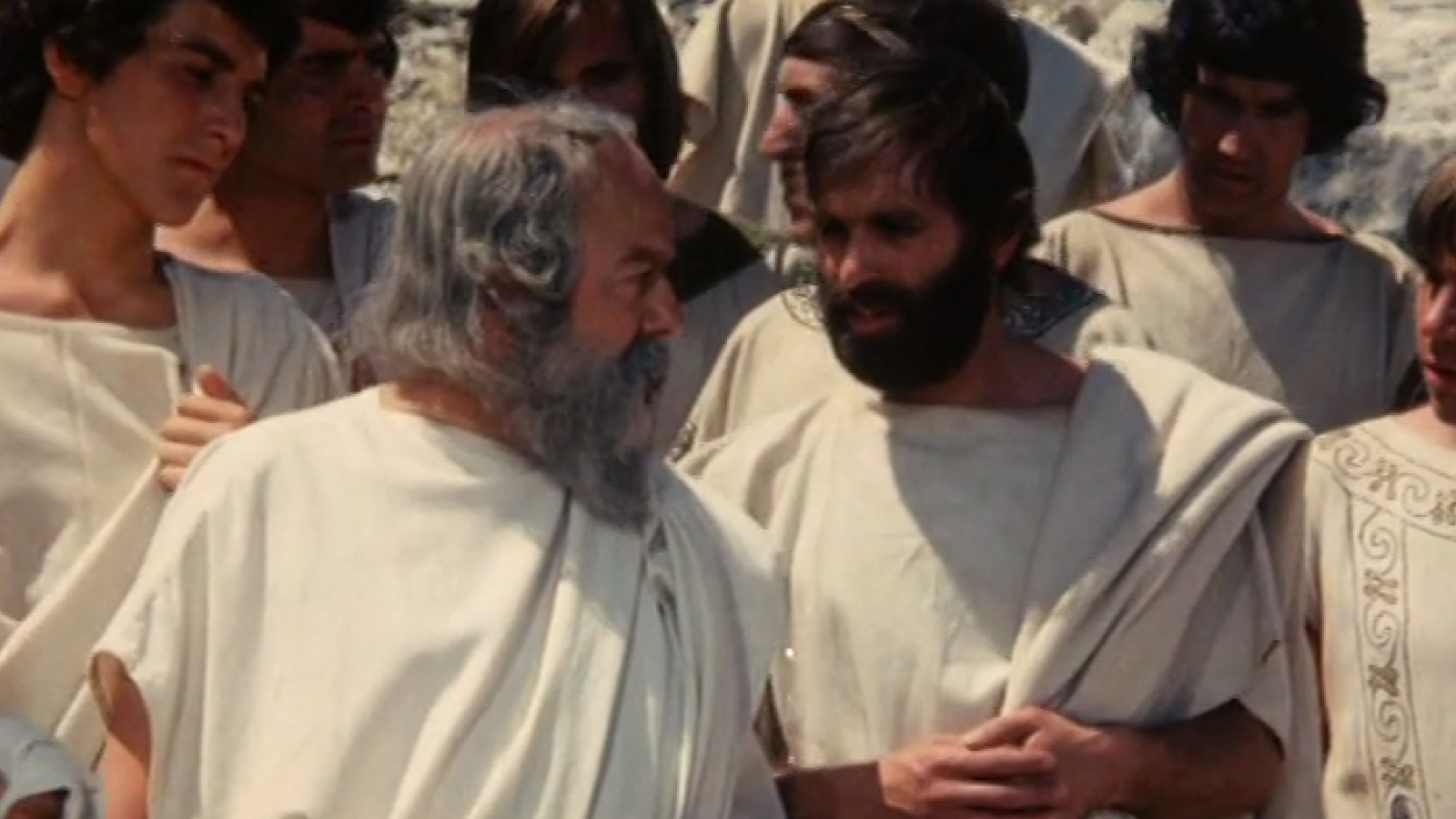
Socrates, too, takes place at a pivot point, as Athens is subsumed in crisis, addressing “the end of [their] power and democracy”—a crisis which, it’s suggested, was brought to a point by internal rot, for “acumen and proportion are virtues the young scorn,” and “today greed and having no scruples rules … now become the symbols of virility and courage.” That a right-wing junta held power in Greece while the film was being made would, presumably, not have been lost on a great many viewers. Rossellini would state that this was his reason for not shooting Socrates in Greece. His decision to film instead in Franco’s Spain, in the town of Patones Arriba outside Madrid and its surrounding scrubland and olive groves, may be considered something of a lateral move.
Socrates (1970)
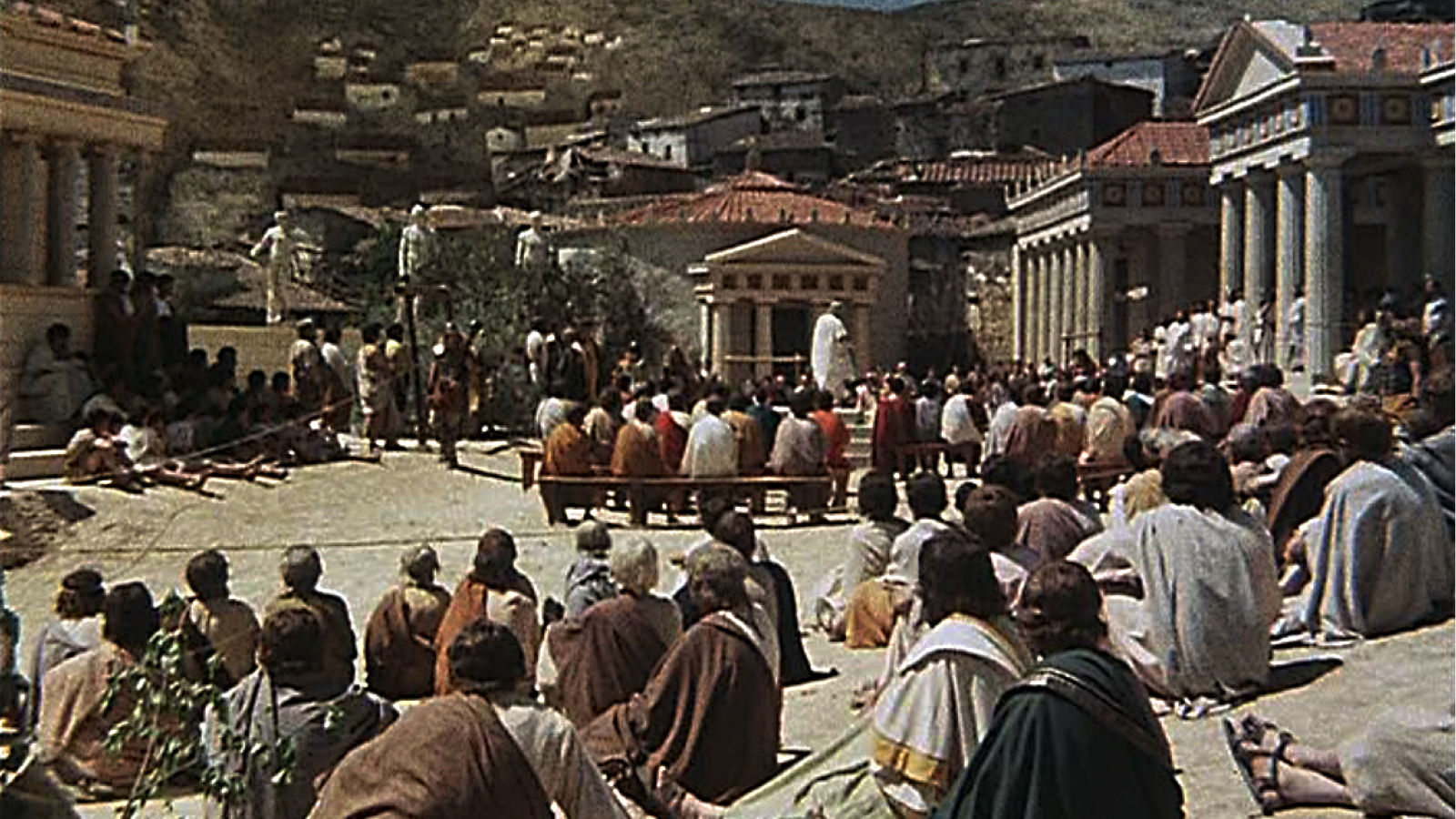
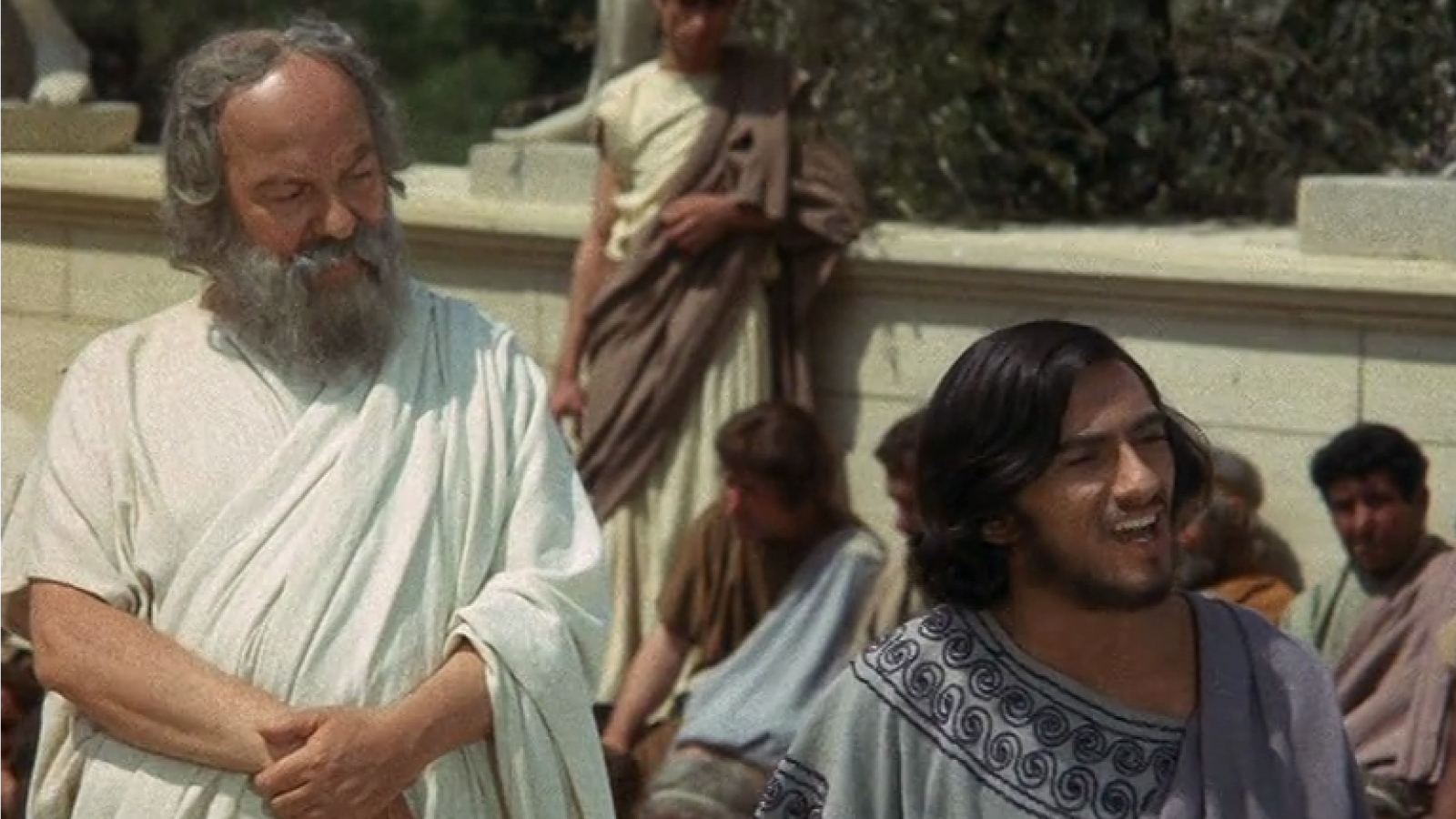
Socrates at long last went before the camera in the spring of 1970, with a budget cobbled together between Spanish television, Italy’s RAI, and France’s ORTF. It premiered at the Venice Film Festival, and was broadcast, broken into two hour-long parts, in the summer of ’71. It begins in 404 BC at the ending of the 27-year Peloponnesian War, the Athenian-led Delian League having surrendered to Sparta, whose army we see proceeding to dismantle the walls of the subjugated city-state. Lysander, the Spartan admiral, has dealt a crushing defeat to the Athenians at sea, and established a naval blockade, forcing the starving metropolis to surrender; Alcibiades, a former student of Socrates and the city’s last best hope, has been vanquished; a new government imposed by the Spartans, that of the Thirty Tyrants, have quashed Athenian representative government; this will be restored following the Phyle Campaign the following year, but an air of rancor and distrust remains thick over the city. The atmosphere in this sullen and suspicious Athens may be compared to that of the Occupied Rome depicted in Open City, or that immediately following the Allied arrival in Italy, when denunciations flew fast and loose.
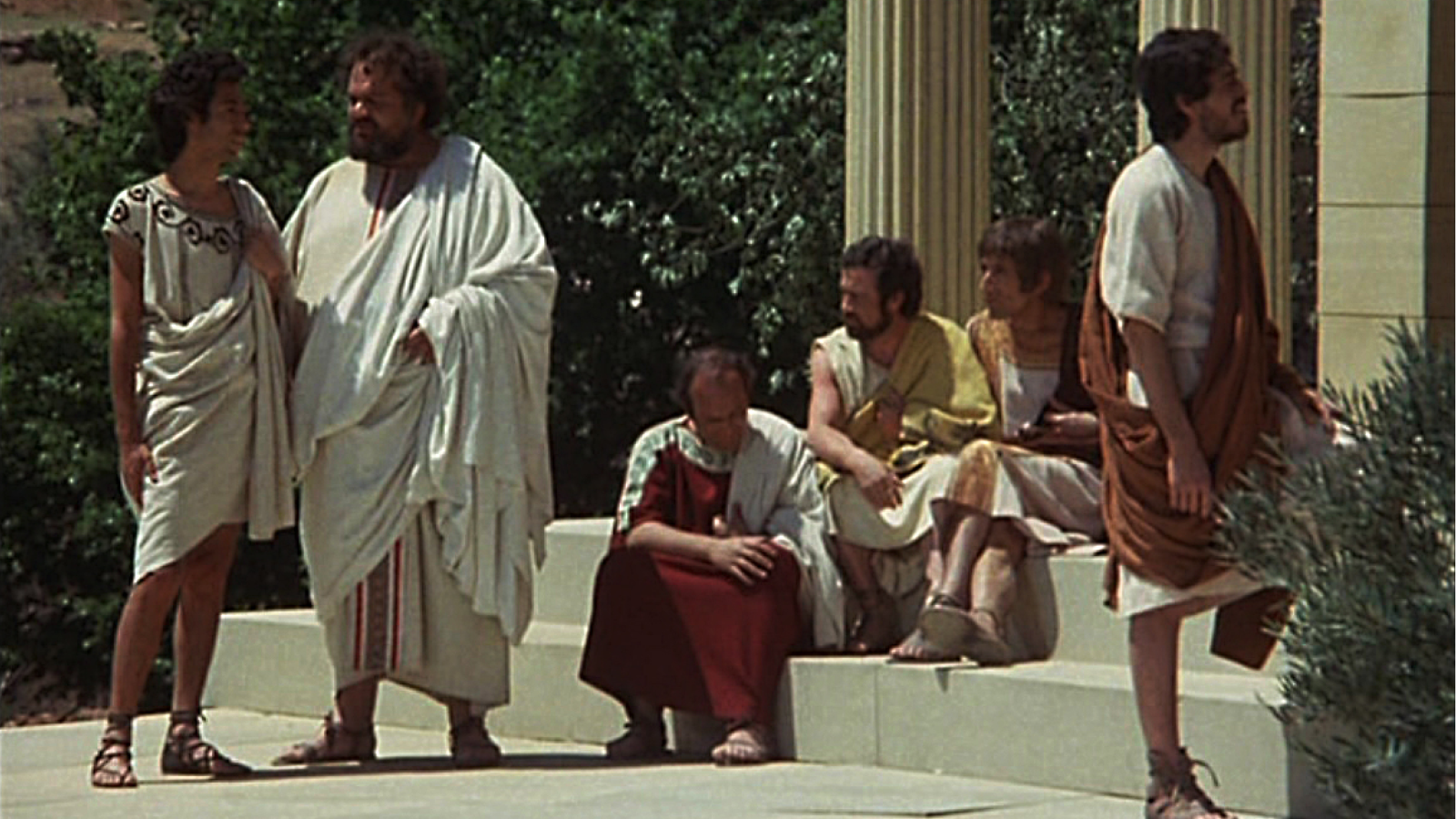
In the course of the film, we observe Socrates in both his public and private life: discoursing to an ever-present cluster of young pupils, buying an octopus wrapped in lettuce leaf from a market stall, coming home to a vigorous henpecking from his wife, Xanthippe, and so forth. Various scenes from Plato’s dialogues involving Socrates are played out—his back-and-forth with Hippias concerning the definition of beauty in Hippias Major, the championing of rhetoric over the written word from the Phaedrus, and the trial defense of The Apology of Socrates among them—with our gadfly protagonist tossing off queries and quibbles as he makes his meandering way towards the hereafter, soon to be condemned by an Athenian jury to neck a bellyful of hemlock for acts of impiety. Already, as Rossellini’s film opens, public opinion has begun to turn against Socrates: he is introduced being dug out from under a scrum of assailants in the agora, and later a local wag taunts him with a recitation of Aristophanes’s comedy The Clouds, in which the philosopher is made a figure of fun.
We see something, also, of the rituals of Athens, both religious—the sacrificial burning of entrails—and legal, as in the trial of Socrates, which involves an accusation by Meletus, the selection of jurors by lot, and a kind of public cross-examination. We also learn that Athenians, like beatniks, applaud by snapping their fingers. On-screen text supplying us names and dates and scene-laying opening titles are eschewed; if they were employed, the film would play rather differently than it does, for though it gives the impression of taking place over perhaps a few weeks or months, it in fact covers five years in Athenian history, from the establishment of the short-lived oligarchy of the Thirty Tyrants to Socrates’s death in 399.
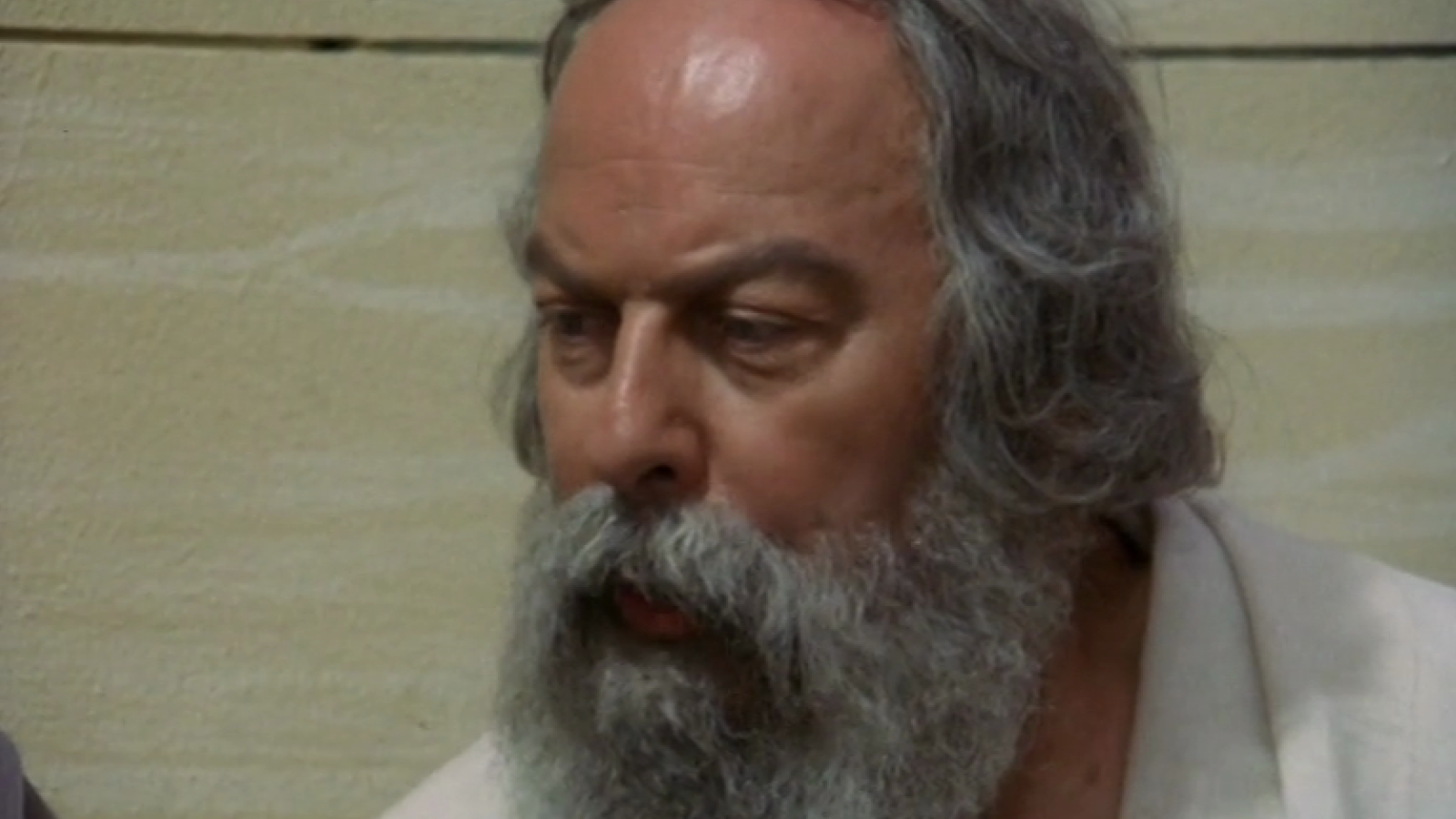
If not always nonprofessionals, the actors in Rossellini’s historical biographies aren’t, in the main, stars, and Socrates does not deviate from this tradition. In The Taking of Power by Louis XIV, the role of the Sun King went to Jean-Marie Patte, an office clerk who had never appeared in front of a camera before, cast in part because he was, like Louis, a diminutive 5’4”. (On proving unable to memorize lines, Patte recited off boards that were held up for him to read.) The stout, beetle-browed Paris-born leading man of Socrates, Jean Sylvère, had been around for ages occupying bit parts in French movies, a specialist in inspectors and concierges, but this would be his first and last title role. Phaedrus, one of Socrates’s many disciples, is played by one of the film’s four credited screenwriters, Jean-Dominique de La Rochefoucauld, while the role of Crito went to the bearish Ricardo Palacios, a favorite of Jesús “Jess” Franco, but hardly a marquee name. It can’t be said that the nonprofessionals or walk-on players are being used to create a documentary effect, exactly, for the performances in these films make no pretext of being either loose nor naturalistic. As Adriano Aprà aptly puts it, performers “do not give us the illusion that they incarnate Louis XIV, Pascal, or Descartes. Rather they ‘stand in’ for these characters, as if they were walking around with placards with their names written on them.”
As throughout his histories, Rossellini in Socrates depends on straightforward exposition—the horror of screenwriting how-to manuals—to situate the viewer, repeatedly relying on “guide” figures to introduce us to the world being depicted. In The Acts of the Apostles, there’s the Greek slave, Aristarco, who explains the political and cultural character of Jerusalem, as well as the peculiarities of its Jewish community, to a visiting Roman magistrate he’s been assigned to serve. In The Age of the Medici we have one Totto Macchiavelli, instructing a new-in-town English merchant in the ins-and-outs of Florence.
Already in Vanina Vanini, Rossellini was toying around with this kind of thing, opening the movie with a chorus of reflections on the death of Pope Pius VII and the forthcoming conclave of the College of Cardinals, and so setting the scene in 1823. From here it is not a great leap to Louis XIV, in which the context of the events we’re about to watch is provided through the conversation of tradesmen and peasants, discussing the unfolding machinations in the royal palace: the death of Cardinal Mazarin and the elevation of the untested young king. In Socrates we see various Athenians at social gatherings discussing the events of the day before the title character steps onto the scene, and later the figures of Mieto and Hermes effectively act as a chorus, giving a sort of remedial history of Socrates’s life, conversationally exchanging information that both presumably know already—“Socrates was a soldier and an exemplary citizen,” etc.—with the purpose of bringing we, the viewers, up to date.
The Age of the Medici (1972)
In Socrates, as in Vanina Vanini and Louis XIV before it, the world of yesteryear is put before us using a simple—and, c. 1970, decidedly out-of-fashion—cinematic wizardry, a custom version of the Schüfftan process. Named for German cinematographer Eugen Schüfftan, it creates an illusion of placing human actors within vast, overwhelming sets without necessitating building those sets to human scale. A reflective surface, placed before a camera, picks up a model or matte painting behind the operator which, capturing performers filmed through an aperture in the mirror, results in an integrated image that effectively situates the performers inside the reflected backdrop. We can see an instance of the process at work in Louis XIV, when the workers are toiling to construct Versailles, and in Socrates when we first catch sight of the Acropolis through the breached walls of Athens. (There was to have been much more of this material in the latter, but merciless winds in the Sierra de Guadarrama foothills played havoc with the mirrors.)
Another distinguishing feature of Socrates, and Rossellini’s histories generally, is their unusual reliance on and use of the zoom, accomplished invariably with a Pan-Cinor lens, the invention of the French company SOM Berthiot, which began its manufacture in 1950. Rossellini had used the Pan-Cinor to his satisfaction for the first time on Il Generale Della Rovere (1959), during a scene of resistance prisoners protesting in a Milan lockup, and was thereafter hooked. He loved the efficacy of the zoom, the fact that it could probe into or pull out of a scene without the necessity of laying down dolly tracks, but bridled at his lack of control over it in the director’s chair. This he addressed through an innovation uniquely his own, a remote control that allowed him to operate the zoom from his perch beside the camera. Some have pointed to this as an instance of Rossellini’s laziness, which was legend—and a characteristic that he shares with a great number of top-flight film directors. (Both Rossellini’s histories and Luis Buñuel’s films for producer Serge Silberman could be profitably studied as instances of not only late style but lazy style.) Working out the kinks in the design, Rossellini was eventually able to effect a smooth zoom from 25 to 250mm.
Writing of Rossellini’s histories, critic Dave Kehr likens his use of the Pan-Cinor to the operation of a scientific instrument: “sometimes a microscope, sometimes a telescope.” Thinking of Rossellini’s self-definition of these films as didactic, educational works, one might also liken it to the classroom pointer. For Rossellini himself, the Pan-Cinor was
like a camera suspended in air. It’s like having the camera in your hand. The director can put the accents where he wants, during the shooting of the scene. And this way we eliminate the rigidity of cutting and speed up the rhythm—which changing angle by cutting inhibits, because cuts impose a tempo of their own. Now I use the dolly to change angle, and the Pan-Cinor to move in and out. Cuts make dialogue stiff; the actor has to stop all the time and then assume a new attitude. Now instead, the director can steal expressions on the actors, without their being aware of it, while the dialogue continues.
The shift in depth of field in a zoom in, Rossellini continued, gave figures the effect of “coming toward the public, toward the pit, separating themselves from the background… leaving in focus only the subject and putting everything else out of focus,” or, in zooming out, showing figures “in an ever vaster field, and not only that… in surroundings ever more in focus, ever more concrete.” With a toggle of the joystick, then, he could shift between “complete isolation [and] the most complete contextualization.” He compared the development to that from the flat planes of the Italian primitives to the revolutionary Quattrocento discovery of perspective, which “permitted a more complicated representation.”
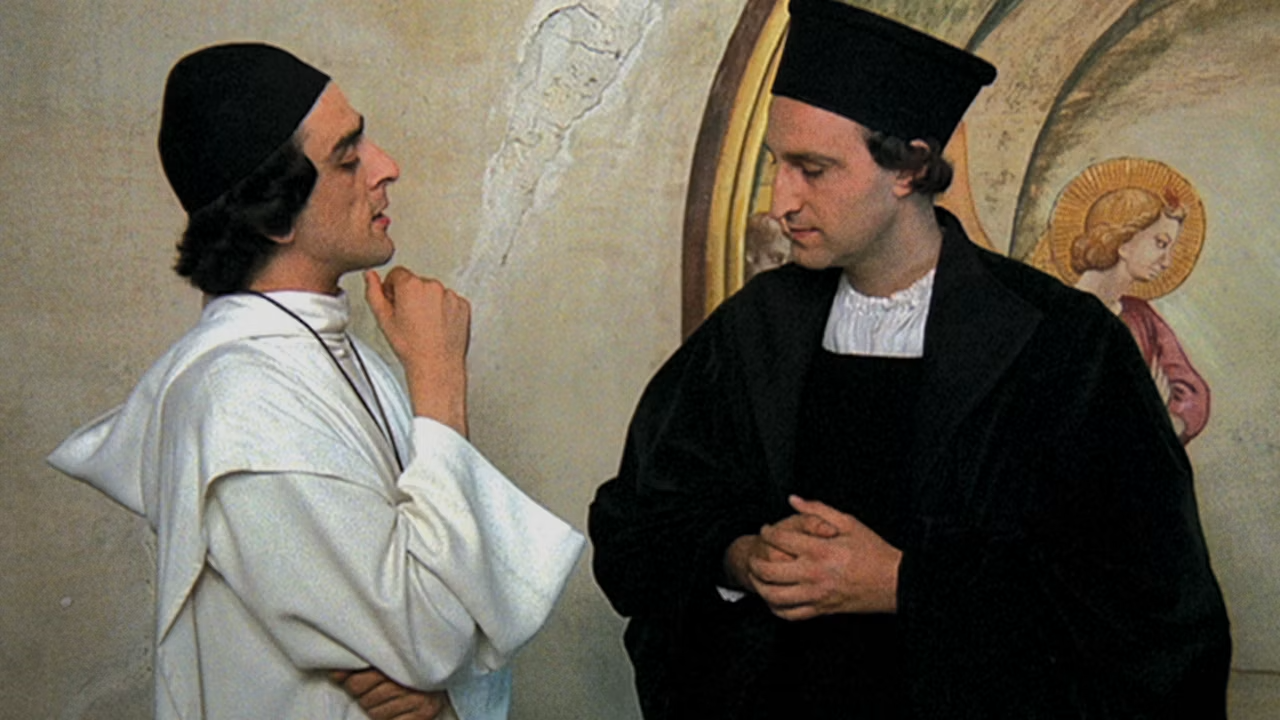
The codification of perspective is addressed at some length in Rossellini’s The Age of the Medici, which has as one of its central figures the polymath Alberti, whose 1435 treatise On Painting contained the first scientific study of perspective, and the film’s trompe de l’oeil backdrops—a key inspiration to Éric Rohmer when preparing his 2001 The Lady and the Duke—put Alberti’s theories into practice. The relevance of this scientific study of the individual act of seeing to Rossellini and his histories is significant, for these most paradoxical films are at one and the same time the result of the imposed, impersonal system of the Great Plan, and the product of a single, individual, idiosyncratic perspective, as represented by the wandering, probing eye of the Pan-Cinor.

The Taking of Power by Louis XIV (1966)
Rossellini made no attempt at fly-on-the-wall anonymity in his history films, but their subjects, as he insisted time and again, were determined by factors other than personal affinity, and little attempt is made to draw a viewer into close confidence with forebears so impossibly remote. Socrates, as Rossellini presents him, is a dexterous thinker and speaker, but not what you might call a font of charisma. He is, in point of fact, a wet blanket and a bit of a “nudge”; during a period of civic strife when the Athenians urgently need a flag to rally under, a man who persists in interrogating and second-guessing the lofty sentiments and sureties that other men turn to for reassurance in an uncertain world.
Gallagher deems Socrates a film of “un-charm,” grouping it together with the preceding Blaise Pascal and Cartesius as “portraits of men remarkable in the abstract but unlikable in life. Their heroes have un-charm in societies that value charm above all else except, perhaps, for the value they place on the abstract—as long as the abstract is a variant on charm.” It shares with these films also a funeral, death-haunted air: Socrates with his looming death sentence, his craggy cell, and his vessel of poison; Pascal, with his long, lingering, multiplying illnesses (it is as good as a sure thing that Albert Serra was thinking of Rossellini’s histories generally, and Blaise Pascal in particular, when he made his 2016 The Death of Louis XIV); the shut-in, often bedridden Descartes of Cartesius, living, as he says, “closed up in my selfhood.” It’s just a little before the halfway mark of Socrates when the accusation that will seal his fate is filed, and even before this we find him imagining his end, musing, “May I die surround by my friends, steeped in the hope of finding the rest of knowledge on the other side.”
The Pan-Cinor zooms are less prominent in Socrates than they would be in, say, the later Blaise Pascal, where they have the slow, in-and-out quality of labored breathing; in Socrates they tend mostly to lean in during oratory, as though to listen more closely. In image-making, too, Rossellini was by this time disinclined to flatter or cajole the eye, his stated intention “not being seductive, which means stripping the images of every element that might be seductive in order to stay inside the things.” There is nothing of the pomp of Jacques-Louis David’s canvas The Death of Socrates, with its gym-toned central subject, in Rossellini’s handling of the philosopher’s final hours; instead he shows us, simply, an old man disappointed in his fellow citizens and resigned to an uncertain hereafter. Confined to a dim cave of a cell, the metonymic drop of water is a constant companion and a single guttering flame the only illumination by night, he holds court one last time to an audience of friends and family. The scene-setting is undressy, even rather homely, and watching it one may pause to think, simply: “Yes, I suppose it must have been rather like that.” One may also, watching the philosopher pace until his legs give way and discourse until his tongue is silenced, be terribly moved—though I’m not certain that was any higher among Rossellini’s priorities than framing prettified compositions. Schrader, commenting on the singular starkness of these films, would write, “Rossellini’s power lies in his ability to let an image reveal itself rather than make it reveal itself. No emotional or editorial contrivances are forced upon the image.”
The emotional and editorial potentialities of the soundtrack are also curtailed—no soaring crescendos here—for Socrates, in common with Rossellini’s history films, represents a break from his previous work in its scoring. From his 1941 The White Ship onward, Rossellini’s brother, Renzo, had written the arrangements of practically every one of Roberto’s films, only stopping with Man’s Struggle for his Survival—a 12-episode series whose script, like that of The Iron Age, was written by Roberto, but was directed by his son. Brother Renzo had secured a job as the music director with a Monte Carlo orchestra, and with the hike in salary, was no longer dependent on his position as Roberto’s house composer to pay the bills. At the same time, Roberto was looking to turn over a new leaf in almost every aspect of his practice for this, his break from cinema and from the past.
It was Renzo the Younger who introduced his father to one Mario Nascimbene, only a few years Roberto’s junior but still very much a creatively adventurous spirit, and Nascimbene would become a crucial collaborator to the elder Rossellini through his remaining years. By the time of his meeting with Rossellini, Nascimbene had distinguished himself with a series of innovative and otherworldly scores including those for Richard Fleischer’s 1958 The Vikings and 1961 Barrabas, on which he worked with a young Ennio Morricone, as well as several films with Valerio Zurlini. The composer was able to produce sounds unlike any other of the era because, thanks to his enormous personal wealth, he had created a synthesizer console of his own design, the Mixerama, and was able to stay on the forefront of magnetic tape-based developments in absolute music in the years after Edgard Varese’s groundbreaking 1954 Déserts. Here is how Nascimbene described the Mixerama in an interview with Soundtrack Magazine in 1986:
The ‘Mixerama’ is an instrument which contains 12 stereo cassette tapes, so you can get 24 different sounds. I have more than 1,000 cassettes like that. I have recorded all the possible sounds the musicians in an orchestra can make, from the piccolo to the contrabass, male and female voices, the strings (now sharp, then soft, then trilling or pizzicato…) on all the notes of the musical scale … When I had all the sounds separately, I recorded the high and low ranges of every single note, and then recorded them separately onto the stereo cassette tapes. So in the end I had truly infinite possibilities of a mixture of sound. Each note had its own sound, but three or four used together change that sound. It’s all pulsating, creative, ‘living’ sound. Unlike modern computer keyboards, the ‘Mixerama’ uses pure sound treated in a human way.
The scoring of Socrates is minimal; repeated passages of groaning, droning dirge, occasionally interrupted by the whisper of an aulos or a tintinnabulation that is something like the clacking of bones. This contributes to the film’s sustained tone of looming dread, always in the background and occasionally heightened, as when Socrates and his entourage pass through a landscape on the outskirts of Athens bristling with suffering crucifixions. While he knew he was looking for new direction in his soundtracks, Rossellini wasn’t known for being particularly attentive to the aural element of his films, from post-synchronization to score, generally trusting to his colleagues to handle that end of things. Describing the soundtrack that he cited as the one that brought him the most satisfaction of his professional life, that for Acts of the Apostles, Nascimbene recalled being left alone in complete freedom for three months to write, record, edit, and mix the music. It is possible, then, that Rossellini wasn’t entirely aware of just how sonically distinctive his histories were, but so they were, and remain.
Socrates (1970)
Taken altogether, Rossellini’s histories are difficult films to classify, works belonging to no school but their own. In their own time they were occasionally received with praise, as in the case of Louis XIV, but more often with hostility, incomprehension—though the project seems to have acted as a restorative tonic upon Rossellini, galvanizing him and giving him a zealot’s sense of mission.
This may have been especially strong in the case of Socrates, a film whose subject—claims of objective indifference notwithstanding—had an especial allure to the director, who in his secret heart might have fancied himself a distant relation of the man dedicated to “keep[ing] truth on the alert.” Long before his film was made Rossellini was more than once likened to the Athenian; reviewing Rossellini’s India: Matri Bhumi (1959), Jean-Luc Godard called it “a film of absolute logic, more Socratic than Socrates.” Fellini, whom Rossellini had helped to introduce to the world of filmmaking by hiring him onto Rome, Open City, recalled his former mentor’s disdain for his protégé’s La Dolce Vita (1960): “He looked at me the way Socrates would have looked at his disciple Crito, if Crito had suddenly gone insane.” Rossellini even ventured a comparison of sorts, saying: “Doing only what interests you, what you enjoy and judge useful (as Socrates did and I try to do too) is a very expensive luxury: the practical problems of life never really get solved. Certainly Socrates is a character I feel close to.”
In Utopian Television, critic Michael Cramer writes that the chilly response to Rossellini’s telefilms “suggests not so much a case of neglect based on inaccessibility as a distaste and even rejection of Rossellini’s claims to be moving beyond art, beyond cinema, and beyond his own auteur status.” Of course, Rossellini wasn’t the only filmmaker around crying cultural and political bankruptcy, but he also made a point of refusing to sign on with any club that might have had him as a member. Even today, when these films have found their coterie of admirers, statements of admiration for them tend to adjudge the works on precisely the terms that Rossellini sought to move beyond or at least outside. Kehr, to take one instance, asserts Rossellini has failed fully to shed all trace of auteur personality: “For all of his scientific ambitions, Rossellini remains an artist who can’t help giving his work emotional shading.” But Rossellini, taken at his own word, didn’t want to be an artist anymore—he wanted his films to operate as an agent of renewal, as a beacon.
Judged against his intentions for it—nothing less than a total regeneration of a morose and moribund culture—Rossellini’s project cannot, then, be called an unmitigated success. As Cramer writes, to see Rossellini’s histories and their “re-appropriation by the world of art cinema as its ultimate validation would be to minimize its difference from the artworks against which it defined itself.”
What remains is that difference, and what a difference it is—for these films propose an approach to historical filmmaking so radical and so alien as to have inspired precious few imitators. Socrates does not give us a demotic translation of a life as lived millennia ago, doesn’t cast its subject as an edgelord of antiquity, but rather observes from a calm distance that evokes certain lines concerning the classical world in Louis MacNeice’s Autumn Journal:
And how one can imagine oneself among them,
I do not know;
It was all so unimaginably different,
And all so long ago.

Share:
Recommended
- Virgina
 On the rediscovery of a lost film tackling the complexities and pleasures of gender expression in the Balkans.
 - Farley Granger
 On the queer star who defied mid-century Hollywood archetypes.
 - Geraldine Chaplin and Carlos Saura
 On the formidable collaborations of the Aragonese filmmaker and his American muse.