
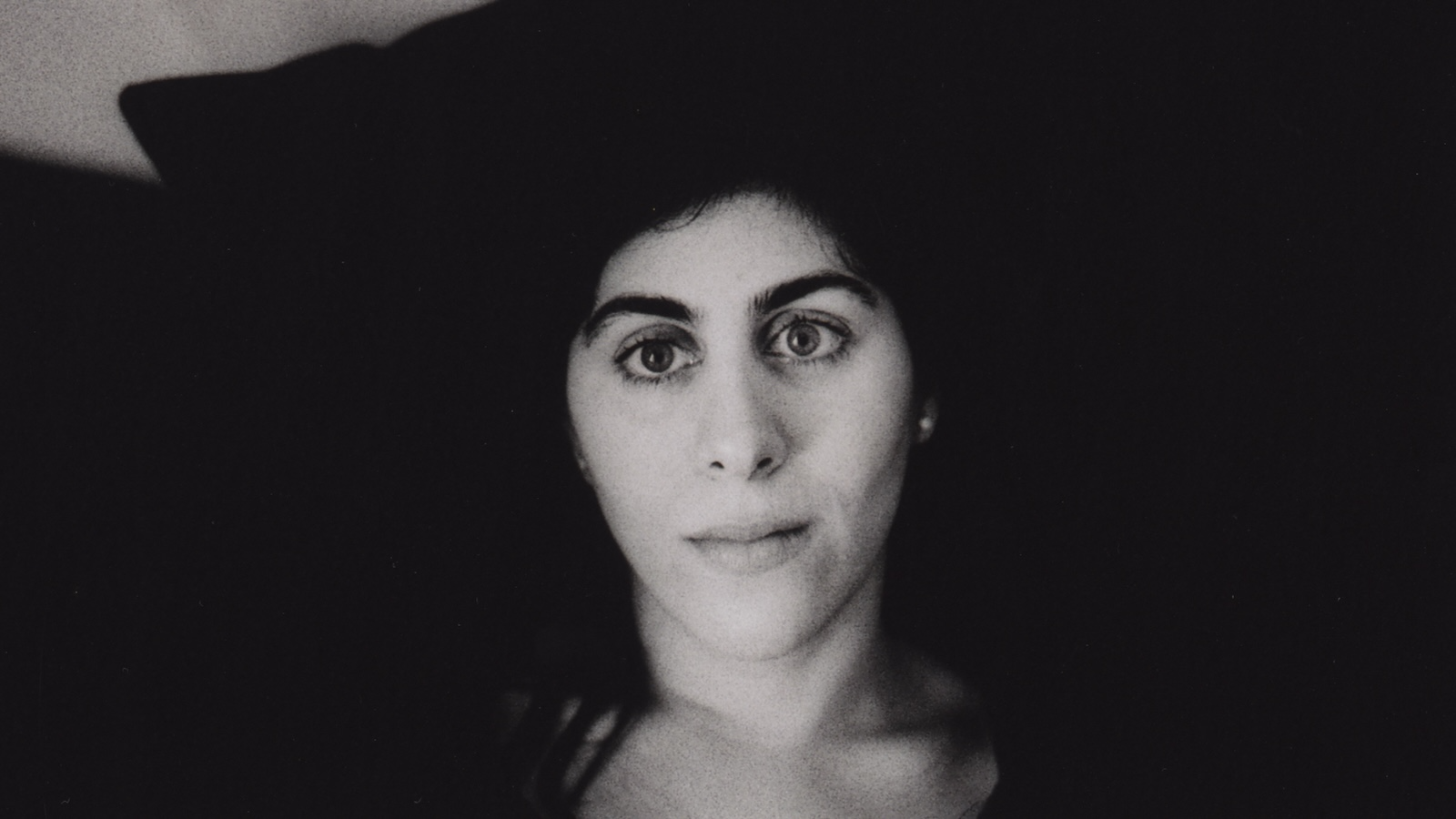
Lana Daher, courtesy the artist
Interview
Lana Daher
The Lebanese director discusses the ghosts of history.
Do You Love Me (2025) opens at Metrograph on Friday, July 10.
Share:
FORTY-THREE MINUTES INTO LANA DAHER’S Do You Love Me (2025), a girl in pink pants and a Tweety T-shirt says, “Film me!” to the person already filming her with a consumer-grade video camera. She squats on a white dining room chair. A three-explosion cluster answers her and the cameraman, her father, calmly explains that it was “a sonic boom,” a conclusion unavailable to Westerners not being assaulted by varieties of Israeli materiel. (See Kamal Aljafari’s 2025 film With Hasan in Gaza for other sommeliers of artillery, those able to identify a weapon’s origin and make by the crack of its report.) The girl grimaces and looks away, then gets up and hugs the balcony walls, the calm green hills of the Shouf district visible behind. She sobs quietly.
Daher’s 76-minute masterpiece nestles this clip into hundreds of other sources both like and unlike it: big-budget features, documentaries, independent shorts, podcasts, home movies, photographs, news segments, songs. The filmmaker spent seven years reviewing 70 years of Lebanese history in order to create an edited mosaic that has more in common with Hank Shocklee’s work for Public Enemy than Thom Anderson’s Los Angeles Plays Itself (2003), the proximate analog in terms of a film that retrieves a city through its history in film. Daher’s vision of (mostly) Beirut touches on clips from well-known directors—the work of Jocelyne Saab appears more than once—but her approach is neither pedagogic nor ultimately partisan. We hear the name “Israel” only twice—the bulk of the film is a Technicolor quilt of everyday surreality, amputees looking across the ocean while cab drivers speak about romantic conquests.
There is no plot or a cast of recurring characters but the film is crystal clear. A man tells a story of almost being shot at a checkpoint, until a former student identifies him, and a long stretch of streaked and blown-out footage seems like a document of the 2020 port explosion, maybe captured by a camera dangling on someone’s shoulder as they ran to help the injured. Where else could this be?
Catherine Deneuve appears in a clip from Je Veux Voir (2008), asking about Burj el-Murr, a commercial skyscraper for which construction started in 1974. It now stands as naked concrete, deliberately unfinished, a memorial to all those who fought in and around it. (Je Veyx Voir is one of five Joana Hadjithomas and Khalil Joreige movies that Daher samples. There is a mini-history of Lebanese cinema in here and the film’s—not exhaustive—website indexing 164 of the sources used is a watchlist for anyone who wants to continue that education.)
Beirut here acts like a de-Orientalizing machine, an agent and a locus of history that is only itself. People dance at weddings, play cards, make faces at their friends, argue, take showers, and go for chaotic car rides. One of my favorite sequences, stitched together from at least three different movies and expanded with sound design, sees a car following a hearse along the highway. The hearse seems to be glowing and blasting music. The car pulls around the hearse, and the music fades. Did it happen? Was it a documentary? Do you love me? —Sasha Frere-Jones

Do You Love Me (2025)
SASHA FRERE-JONES: Of the films excerpted in Do You Love Me, how many would be known to the average filmgoer?
LANA DAHER: Not many, maybe some of the very commercial ones. You saw that list of almost over 200 sources, right? But understand that from one film, we’re sometimes using one shot that’s only a couple of seconds, other times we’re using several shots from one film. Sometimes from one director we’re using four or five films. The actual list of elements and items used is much longer. The website is the briefest possible summary of the sources. What you see in the film is only about 7% of what we found through research.
We used 106 feature films, and a lot of those I only discovered as I was doing research. As I was figuring out what kind of material I wanted, and realizing that cinema would be a big part of it, I was discovering Lebanese cinema. I grew up in Beirut and still live there, but Lebanese cinema was not necessarily available to me. At school they wouldn’t show us Lebanese films. There’s only one arthouse cinema in Beirut, and that is where we discovered most Lebanese films as well as foreign films: German, French, Japanese, Asian, Italian…
Of course, I knew who Ghassan Salhab was, who Danielle Arbid was, but it wasn’t that easy accessing their films. They’re not available online and there aren’t necessarily DVDs. It’s only when you’re lucky enough to come across a screening that you discover the films. A lot of the films I discovered only through the research process. West Beirut (1998), Caramel (2007)—those are different, those are commercial films that went to Hollywood, to Cannes.
SFJ: About two-thirds of the way through the movie, there’s a childhood section that I thought might be your family. What is that?
LD: I do have a bit of personal archives in there. There’s the moment where I was filming my dad, trying to get the sheets off his feet—that’s me filming when I was, I don’t know, 13 or 14, with my older brother.
SFJ: That is such a dad moment.
LD: Yeah, such a dad moment. And there’s a moment where I’m filming my younger brother, telling him to smile, and a couple of still images from my family. But as I was working on the film, I realized that stories that are personal to me are equally personal to many generations of Lebanese.
I don’t have a big family archive, so I started to ask around for people who had home videos that they were comfortable sharing. Bit by bit, friends, or friends of friends, started donating their collections. They were very generous. And what’s really interesting is that you start to see yourself in their home videos, and other people start to find themselves in these videos. It becomes this blurred place of memory, where it doesn’t matter anymore whether the little girl who gets scared by the sonic boom is me or not, because I’ve lived these stories in my childhood, and I’m living these events again in Beirut now. These stories and these memories start to expand beyond time and beyond space, and they become everyone’s memories. So little of that footage is my own, yet at the same time it feels like it is mine.
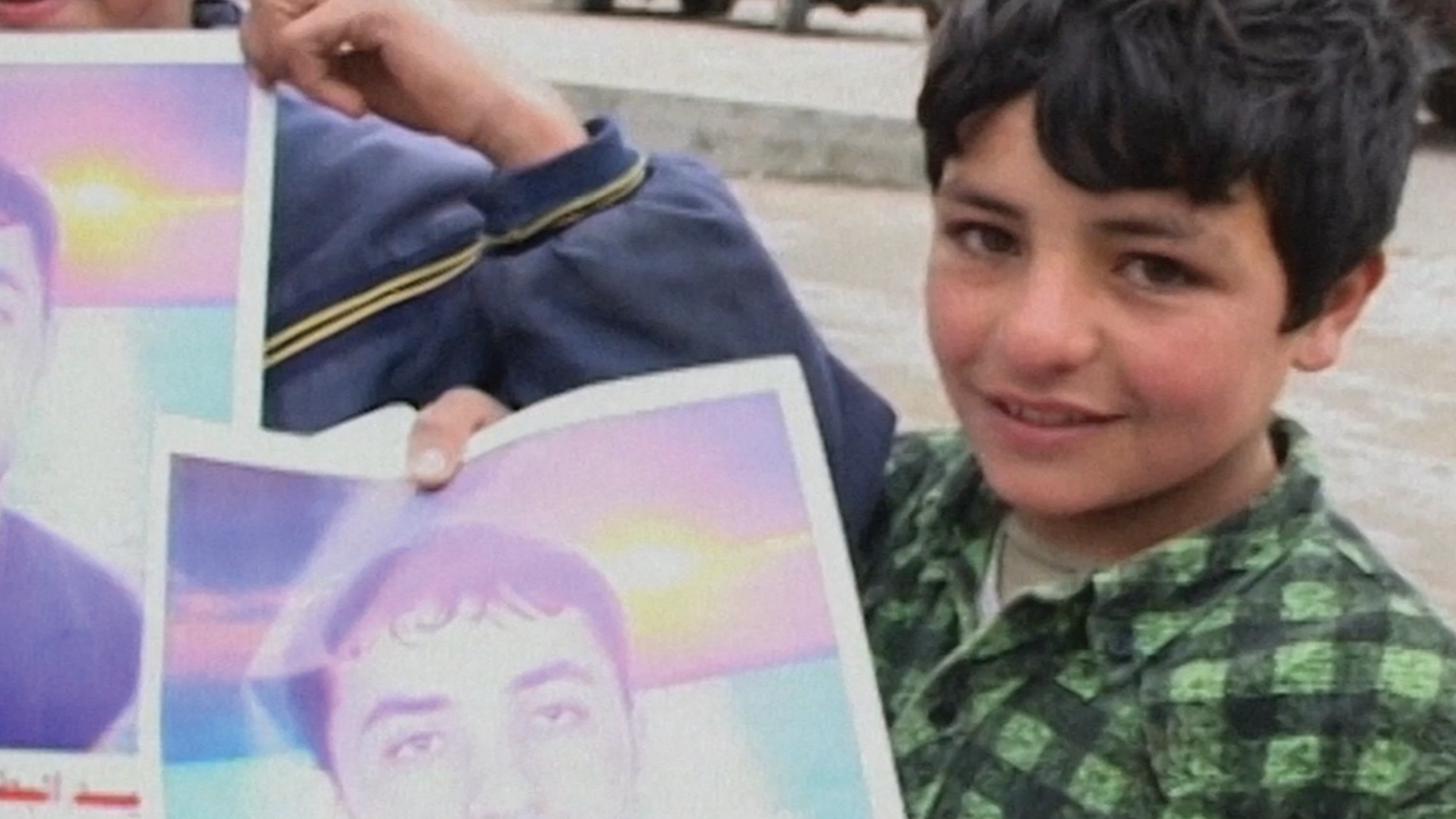
Do You Love Me (2025)
SFJ: There is a great moment with a hearse that seems to be blasting music. Is that a long L-cut between different movie sources? Did you design the audio to make it feel like one movie clip?
LD: We wanted to have fun with the process. Even the hearse shot in the original film happened by chance. They were filming the people in the bus, and a hearse came in behind them. It cuts away in the original film, but we loved it so much that we said, “Fuck it, let’s make this scene longer.” We found another scene from another film with a hearse, and that went to the editor. I ended up working on it with the sound designer—it was all the same energy of being very playful and fluid. This is cinema, not contemporary art. I wanted to make a film for cinema, so we gave ourselves the freedom to do whatever we wanted.
SFJ: How did you start the process and how did you keep going? It sounds like the kind of project where a lot of creative people might say, “It would be cool if we did so-and-so,” and then realize they would need to license 7,000 movies—and give up. You somehow did not give up.
LD: I started working on the film in early 2018. It was always going to be an archive-based film about Lebanon, but it started a little bit more about the relationship between war and music. Bit by bit, I started to realize that it wasn’t the Bendaly Family I was interested in, but my childhood, how we remember, our relationship to history, to memory, the traumas of our society.
SFJ: The Bendaly Family originally recorded “Do You Love Me?” in 1978, yes?
LD: Exactly. It started there and took me to this much deeper, more personal place. I immediately started researching and editing from day one. The only way to write the story was to edit. At the beginning, the footage came from foreign sources, because accessing the archives in Lebanon was much harder. I was finding things on INA [Institut national de l’audiovisuel] in France, British Pathé, YouTube. A lot of the older content exists there. Then I realized I would not be counting on those sources because they represent a foreign gaze into Lebanon. I wanted a local point of view, from a local archive. It was great to research that material, just to watch things and understand. Also, in Lebanon, we don’t have a national archive—it’s not digitized.
The research was wide: cinema, documentaries, fiction films, photography, podcasts. I started organizing it all in Premiere and I worked alone for about three years. Then for two years, once I had a bit of funding, I started to hire junior editors, junior researchers—basically filmmakers who had just graduated from film school and were looking for work. They’d be with me for a few months, helping me organize the research. Around five and a half years in, I had an almost four-hour rough cut, and massive amounts of extremely well-organized research. Then I met Qutaiba [Barhamji].
SFJ: I would love to see that rough cut.
LD: I met him, and he was like, “Okay, are we going to clean up the rough cut, or are we going to start from scratch?” And I said, “We start from scratch.” So the rough cut became a reference point. It turned out to be a way of getting things out of my system, trying things that didn’t work because they were not part of the full language of the film. We ended up doing around six editing sessions over the span of a year and eight months. But I loved it. I was discovering everything about this place I’m from that I couldn’t ever really understand. This film helped me understand why it was the way it was.
And I was so upset about everything that was happening. I started working on the film in 2018. In 2019: worst economic collapse; 2020: port explosion; 2024, 2025: two very violent wars, and in between, very violent events, moments where we had no fuel, no electricity, and clashes all the time. There’s the drone over our heads in Beirut, they’re bombing the south all the time. The ceasefires are never really ceasefires…
The film was a way to stay connected to what was happening while shielding myself. I was creating a barrier, processing everything, but doing it through the work of the film. That creates a degree of separation, though it’s still difficult. It’s like, “Okay, I’m not going to look outside my window, I’m going to look through the screen.” It was a way to deal with it and still stay in Beirut.
My biggest fear is that I leave. I don’t want to leave Lebanon. I love Lebanon. I want to stay there.
SFJ: The girl on the balcony with the sonic boom—there’s something about how a moment where something doesn’t happen is sometimes worse, because she’s just walking around scared. Thinking of her being scared is unbearable, because you know the feeling could have lasted for days and days, maybe forever.
LD: That little girl—she’s a child today in Beirut, she’s the girl from back then, she’s every child in Gaza who has to deal with these horrific sounds, even the quadcopters that fly over their heads and know their names. That moment became so much more, because it carries the effect of violence on the youngest of our society. Time and time again, it does something to you. It changes you. It really changes you.

Do You Love Me (2025)
SFJ: That blurry, almost one- or two-minute stretch which seems to be from the port explosion. Someone is saying, “I won’t film dead people.” What’s that source?
LD: That’s footage from a friend who’s a filmmaker and a DOP. He’d been filming for a long time, for a movie he hasn’t finished yet. At one point, he gave me these files on a hard drive, huge selections of footage. As I was going through it, I came across this shot. It turned out that his camera was on the moment the impact of the explosion happened and he didn’t turn it off. So he’s in the street, running, looking for people, helping people, trying to get home… This was part of that footage—the camera on the wrong setting, forgotten, on his shoulder. When the big explosion first happens, the first few seconds of that shot are a bit clearer, but then he starts running.
We added a short voiceover from another film at the beginning, but the rest of that shot was not color graded, nothing was done to the sound—it’s exactly as it was in real time. It’s probably one of the longest single shots in the film. It was important for me. In Lebanon there’s always so much grief that we’re not able to process. At the same time, there’s a lack of justice. There’s no judicial system that ever helps you come to terms with whatever’s happened. Horrific things happen, and no one’s ever responsible. We’re always left to fend for ourselves.
For me, representing these moments—even without a date, even without a year, even without a title of an event—just the existence of these moments in the film is extremely important, because it’s a way of acknowledging that this happened. The sound in that moment, and the duration of that scene, is so violent that I think when you watch it, everyone gets a sense of something horrific that’s happened. The audio in itself is enough to take you through it.
And this applies to all of the film: I didn’t want to use that image everyone’s seen of the actual pink explosion that looked like Hiroshima. Everybody’s seen it, it exists on the internet, it is already part of your unconscious. If you say, “The Beirut Port Explosion,” most people will think of that image. I didn’t want to use those images. I wanted to create a space where what you’re watching is giving you another sense of time, another kind of entry point into the horror of the moment.
I also didn’t want to use the cadavers and bodies of women and children and horses from Sabra and Shatila [1982 massacres]. Some people say, “Oh, you never put the Port, you never put Sabra and Shatila.” Of course, Lebanese know, because most of them are there, so they’d know that shot is from, but in general, a lot of people think I haven’t used a lot of these massacres. I have. I have at least one shot from each one of those. I just didn’t want to do it in a didactic way, or in a way where violence is taken for granted. That was a big question in the film: how do we treat violence? How do I make a film that Lebanese could watch?
I had this crazy idea of releasing the film during this war, and we did just that. We released it on April 2nd, in Beirut. We had a full house, so we had to open the second theater. It’s nuts, because you’re watching this film, and you literally have a war outside the theater, and you have the constant buzz of the Israeli drone that’s somewhat become a part of the sound design of the film.
SFJ: April 2nd of this year?
LD: Yes, two months ago. I released it literally right now in Beirut, and it’s showing every day, three times a day and it’s been very powerful.
SFJ: Congratulations.
LD: That is my proudest achievement.
SFJ: What was your approach with the music?
LD: It was very clear to me that having an original soundtrack, something composed, would not work, because the entire concept of the film is to use existing material. I felt I needed to be extreme with that. It had to be the case for all the images, all the sounds, and the music.
Again, I did massive research. I used to DJ for many years. I wanted the music to span a huge amount of time as well, to carry the film through and support the rhythm of the edit. I wanted lyrics to be a part of the narrative, which for me they are in moments—with the rap songs and with the Ziad Rahbani songs. The moment you use too much music, it ends up being a music video, and you can fall into that trap. So we had to really dose it. For me, it was so important to have this pulse in the film. Sometimes the images are so old, but the music is much newer.
SFJ: “Do You Love Me?”—you said you started by researching the Bendaly family, but there’s not a ton about them in the movie, right?
LD: No, there isn’t, because it moved away from that. I met with them. There’s a moment in the middle of the film with the dads and the children, where there’s a dad in a theater with a little girl singing a song. That’s actually him, the main guy of the Bendaly Family, and his daughter. She was a famous child star. I start and end the film with two very different versions of the same song: one is an acoustic, unreleased version, and the end is the song that everyone knows, over the credits.

Do You Love Me (2025)
SFJ: You said two things that struck me: that there’s no national archive, and that there’s never any justice, never any consequences. Can you expand on those?
LD: Yeah. So we have no national archive, because everything’s dispersed everywhere. Some people are trying to work on this, but it’s very difficult to manage it in Lebanon. We also have no unified history book at school, because nobody can agree on what happened. It’s impossible to write a version that everyone agrees on. Every political party has their version, and if you were to write a version that blames them all, they won’t accept it. If you were to write a version that blames one side, they won’t accept it. It’s impossible to write that one story.
SFJ: What kind of history did you study in school?
LD: All history. But not Lebanese. You don’t study Lebanese history in school. It doesn’t exist. It’s a bit like the sense of the justice system. We come from a place where there are no memorials.
Not using politicians in the film doesn’t mean it is not political. The moment you don’t use politicians, that in itself is a political decision. It was more about the politics of society, the politics of everyday life, the politics of how history and violence affect our everyday life. It was more about that, and the feelings around it, and the psyche of people going through these cycles of violence, the repetition, all these politics of poetry.
SFJ: What’s the response been from people in Beirut?
LD: Some people get very upset, especially the older generation, because it’s like they’ve forgotten everything else they’ve been through. They feel like they’re born in war, they’ve only lived through war. The younger generation feel like they have insight into things that were never discussed with their parents, because the film gives a sense of transmission of information that wasn’t really there for them. A lot of younger people told me they felt like they were in an EMDR [Eye Movement Desensitization and Reprocessing] session, and the only thing missing was the therapist guiding their eyes. Generally, it’s been very emotional, joyous, cathartic
SFJ: Is it playing in more than one theater?
LD: No, just one. Beirut’s tiny, it’s like 19 kilometers squared. I only wanted to show it in one theater, because this specific theater represents a lot of art-house films, documentaries—it fits.
SFJ: What’s the name of the theater?
LD: Metropolis. The director, Hania Mroue, reopened the theater a week or two into the war. I called her and said, “Look, fuck it, I know our premiere was cancelled as we planned it, but let’s show the film anyway.” And she said, “Alright, let’s do this.”

Share:
Recommended
- Farley Granger
 On the queer star who defied mid-century Hollywood archetypes.
 - Geraldine Chaplin and Carlos Saura
 On the formidable collaborations of the Aragonese filmmaker and his American muse.
 - Genevieve Yue’s Trains
 On the offbeat pleasures of the train in Genevieve Yue’s new book.