
Columns
Futures and Pasts: Éric Rohmer’s Élisabeth
On the French New Wave legend’s life before cinema, and his newly translated first and only novel.
Rohmer’s Élisabeth & His Six Moral Tales opens at Metrograph on Friday, July 10, with copies of Rohmer’s newly translated novel available from the Metrograph Bookstore at 7 Ludlow.
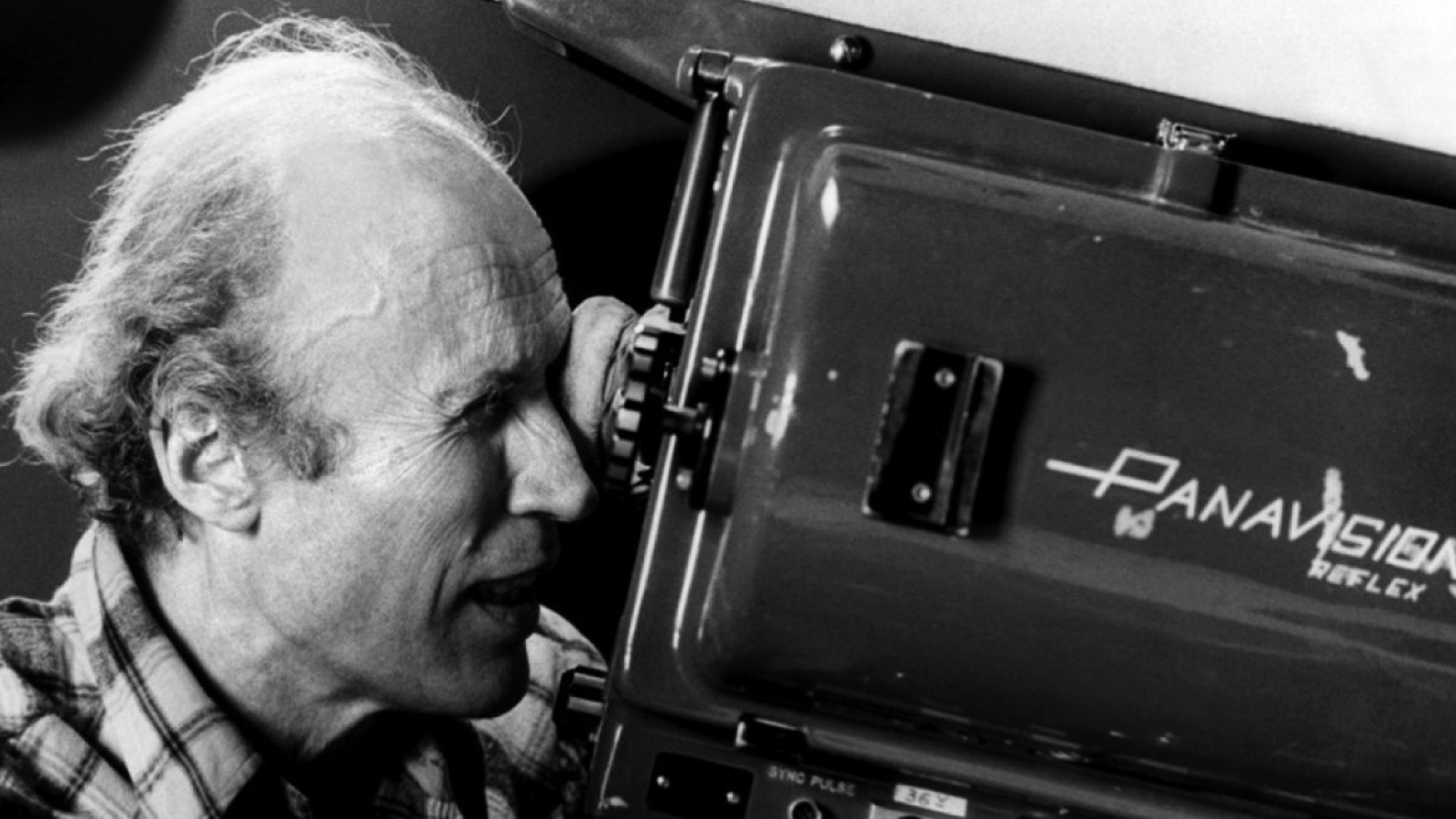
Éric Rohmer, courtesy Janus Films
Share:
IF THERE HAS BEEN A comprehensive study of the filmmaker-written novel, I have yet to encounter it. Should it indeed remain to be written, it will require a reader and researcher made of sterner stuff than I, one who is up to the task of taking on with equanimity Harmony Korine’s A Crack Up at the Race Riots, the pulsing prose of John Sayles, and Tobe Hooper’s Midnight Movie in hopes of better understanding the relationship between page and screen—an individual who very likely does not and may never exist.
With this said, we can at least propose a few distinct categories that make up this literary genre. There is, for example, the filmmaker-written novel that acts as an outline for a movie later to be made; in this number we may include Michael Mann’s Heat 2, co-authored with Meg Gardiner, shortly slated to commence shooting, and John Waters’s Liarmouth: A Feel-Bad Romance, which seems destined to remain only ink and bound paper. (The case of Maurice Pialat’s We Will Not Grow Old Together, published as a novel by editions Galliera in 1972, the same year the author’s film of the same title made its Cannes debut, is somewhat ambiguous.) Adjacent to this we find the filmmaker-written novel that acts as complement to a film that has been completed, as in the fiction output of Quentin Tarantino and Whit Stillman or, putatively, the 1978 novelization of Close Encounters of the Third Kind, which Mr. Spielberg at least saw fit to put his name on. While some filmmaker/novelists keep up parallel practices, at least sporadically active in both roles—Ed Wood of the incontinent typewriter springs to mind—more common are the freestanding one-offs, the lone forays into literary fiction by established auteurs whose ranks include Gus Van Sant (Pink), David Cronenberg (Consumed), Brian De Palma (Are Snakes Necessary?, co-authored with Susan Lehman), and Michael Cimino (Big Jane).
Would any of the above have found an enthusiastic publisher, an indulgent editorial eye, if their authors hadn’t been known quantities in another field? We must leave this to dangle in the realm of the hypothetical; the question, in any case, is moot as concerns the category of filmmaker-written novels to which Éric Rohmer’s 1946 Élisabeth, newly published this month in its first English translation by McNally Editions, belongs. It could be argued that Élisabeth, in fact, is of another species altogether, for it is the novel of a filmmaker who has not, as yet, found their vocation. This places Élisabeth, originally issued under the nom de plume “Gilbert Cordier,” in the rarefied company of the youthful novels of Oscar Micheaux (The Conquest: The Story of a Negro Pioneer), the first pulp fiction endeavors of Sam Fuller (Brainquake, The Dark Page), the slim bibliography of Henri Decoin (Le Flambeau dans le nuit, Quinze combats), the more expansive corpus of Val Lewton (climaxing in 1932’s No Bed of Her Own), Bill Gunn’s semi-autobiographical debut novel, 1964 All the Rest Have Died, and the early literary productions of Ousmane Sembène and Catherine Breillat. (If I hesitate to include Jean Cocteau here, this is because it seems inaccurate to suggest that any one of Cocteau’s creative outlets superseded any of the others in importance.)
Some of the above named would keep one foot planted in fiction after breaking into cinema; Rohmer would not, although the Francophone world has, arguably, the richest tradition of filmmaker/novelists. Describing the editorial inclinations at the magazine where Rohmer would make his name a few years after the publication of Élisabeth, Serge Daney, in a 1977 interview, would state that “the cinema that Cahiers [du cinéma] loved – and always did love – is a cinema that is HAUNTED BY WRITING,” and furthermore that “the best French filmmakers have always been – simultaneously – writers.” To his list, which includes Cocteau, Marcel Pagnol, Sacha Guitry, and Jean Epstein, one might add Breillat, Alain Guiraudie, and the naturalized Eugène Green, as well as novelists-turned-cineastes Marguerite Duras and Alain Robbe-Grillet, the former beginning her long literary career just a few years before Rohmer began his abbreviated one. (The two shared a publisher, Gallimard.)

La Collectionneuse (1967)
Rohmer, who died in 2010 at age 89, is remembered as the Big Brother of the Nouvelle Vague, a decade or more the senior of the Young Turks whom he cultivated as organizer of the Ciné-Club du Quartier Latin and editor of the short-lived La Gazette du Cinéma, and who he brought into the fold of Cahiers. Of this cohort, he was the last to enjoy recognition as a filmmaker, pushing 50 when My Night at Maud’s (1969) had its Cannes debut, going on to enjoy international popular success; as such, it is difficult to imagine Rohmer as ever having been, if not an old man, then at the very least middle-aged.
By way of Antoine de Baecque and Noël Herpe’s superb biography of Rohmer, however, we have a lucid portrait of the young Rohmer who brought Élisabeth into the world. At the time of its publication in April 1946, Rohmer was 25, living in a furnished room at the Hôtel de Lutèce on rue Victor-Cousin in the Latin Quarter managed by one Mlle. Cordier—coincidentally or not, the pseudonymous family name he chose to grace the cover of his novel. He had been installed in Paris since fall of 1943, following stints in Clermont-Ferrand and Villeurbanne, near Lyon, thrice taking and failing his admissions exam for the École normale supérieure. His cultural interests as a young man were wide-ranging—he is said to have painted and drawn with facility, specializing, per de Baecque and Herpe, in “sketches of women in pencil, pastel, felt pen, and even ballpoint,” wrote poetry, and eagerly took in radio lectures on musicology—but up to the point of Élisabeth’s publication did not extend to the Seventh Art. At this juncture he “was not a movie lover,” “had seen only a few dozen films in all,” and “the ones he liked and remembered could be counted on the fingers of two hands.”
A description of Élisabeth’s plot, such as it is, will sound at least passingly familiar to those acquainted with Rohmer’s cinema. The events of the novel, save for a short interlude in Paris, take place in the vicinity of a village called Percy—not insofar as I can discover an actual village, though references to swimming in the Marne, a bus transfer in Meaux, and other context clues suggest we’re perhaps 30 or 40 miles east of the capital—and unfold over the course of three sweltering days in August of 1939, around which time Rohmer had first begun thinking of his novel. Periodicals idly flipped through in a dentist’s office by the eponymous Élisabeth bring ominous tidings of a world in flames, of the Anschluss and Republican reversals in the Spanish Civil War, but this is very far away from the dramatis personae of Élisabeth, given ample time to mull over their own lives, to flirt and flounder and ponder, thanks to the unstructured hours of holiday-time.
Élisabeth is mistress of a country house near Percy which she keeps with her husband, one Dr. Roby, but the better part of Rohmer’s book is given over to the comings and goings of the younger folk staying under the same roof: Bernard, the Roby’s college-age son, about to commence studying medicine in Lyon; Claire, Bernard’s cousin, with whom his relations are slightly more than platonically cousin-ly; and Michel, a friend of the family working as a mining engineer, who for the last four years has been sporadically carrying on an affair with a woman living in the area, Mme. Irène Luzières—a relationship begun in surreptitious secrecy that, following the death of Irène’s estranged husband, is now spoken of openly. Michel is a few years the senior of Bernard and several Irène’s junior, the latter age gap having become a preoccupation for Michel now that the possibility of marriage looms on the horizon, and in Élisabeth’s early chapters, Michel’s wrestling with acceptance of the death of his affection is leading him headlong in the direction of a crack-up.

My Night at Maud’s (1969)
So far, so Rohmeresque. The emotional turbulence against a backdrop of summertime leisure and lassitude connects to the string of en vacances films that begins with 1967’s La Collectionneuse and carries on through Pauline at the Beach (1983), The Green Ray (1986), and A Summer’s Tale (1996)—to cite only those set during the dog days, though several others, like Claire’s Knee (1970), take place in breaches in regular working life. We can make out, in nascent form, the questions at the heart of the six-film “Moral Tales” cycle (1963-72) in Michel’s anguished contemplation of his feelings for Irène: “I chose her, and she’s as good as anyone else; love is a habit you stumble into, never something you choose; choosing is idiotic”—while Michel and Bernard are closer to the characters of the six “Comedies and Proverbs” films (1981-87), still new to the adult world and its expectations, uncertain and untrusting of themselves. Rohmer’s young men are not quite fully formed, and this insubstantiality torments Michel in particular: “I don’t even think the things I think,” he declares to himself after earlier musing on his mutable image, his absence of “a particular look of [his] own.” Not being privy to the tumult behind Michel’s deceptively composed facade, the women tend to credit him with a greater maturity than Bernard, whom Élisabeth describes as “like an animal with its fur bristling,” who comes and goes as he pleases, and whose penchant for reckless driving has left a dent in the fender of the family car. No irrevocable harm will come to anyone in the course of Rohmer’s novel, but the possibility of it hangs over every page, like muggy late summer air.
The matters that “Gilbert Cordier” expends the most space in rendering on the page, one finds, correspond fairly closely to those “Éric Rohmer” would later lavish attention on in his films. Chief among these items are the natural fall and play of light, exquisitely explored in his later collaboration with cinematographer Néstor Almendros, fine particularities of atmosphere—there are several “still lifes” in Élisabeth that feel like the literary equivalent of Ozu “pillow shots”—and the manner in which factors of climate impose themselves on people. (The heat in Percy is palpably oppressive and, as in Claire’s Knee, a sudden downpour here plays a key role.)
Another favorite subject is women: their habits of posture, their physiques, their vocabularies of gesture, the latter often described at exacting length. Élisabeth concludes on a detailed description of Claire, alone, sitting outside the Roby house to read, a description that suggests at times the fixed perspective of a camera eye; when Rohmer writes “A linden branch hides her head and her chest,” one may be tempted to ask: “Hides them from who?” In the same paragraph, the author describes Claire’s “flared and pleated royal-blue skirt [descending] just above her knees”—the last but far from the first appearance in the novel of the succulent joint. Does this particular combination of name and body part, found in the title of Rohmer’s 1970 film, amount to a confession of genuphilia on the part of the artist, a skeleton key to unlock his oeuvre in entirety? Was the sight of some long-departed Claire’s knee to Rohmer what the sight of Colette was to the young Nabokov?
While it’s true that certain themes, settings, and other sundry predilections consistent with those of Rohmer in his filmmaking career are in evidence in Élisabeth, it is also true that a novel, like a film, is something more than a collection of the above, and in the manner of its telling, Élisabeth strays very far from what one might expect from Éric Rohmer. The author’s occasional recourse to interior monologue here—see Michel’s squeamish dissection of his emotions concerning Irène, his pitiless recoil at her aging flesh—may recall his unusual reliance on that same technique in his films of the 1960s and early ’70s, but these passages represent but one of several narrative modes employed in the novel, and taken as a whole it is a work of surprising stylistic promiscuity.

Claire’s Knee (1970)
The filmmaker later renowned for his classical clarity is by no means a concise, crisp delineator of roles as a novelist, and to suss out the relationships between his cast of characters demands an active engagement on the part of a reader—and, in my own case at least, some occasional flipping back and forth. For the better part of Élisabeth we are following the separate but similar peregrinations of Michel and Bernard, though at times it is difficult to discern which of these dual protagonists, exactly, we are keeping the company of. (I say “for the better part” because while Rohmer does move back and forth between the pair from one chapter to the next at times, his novel also makes space for lengthy digressions that foreground Claire and Élisabeth.) That this occasional ambiguity is not a matter of stylistic infelicity is most evident in one sequence in which a young man encounters a group of young people by chance on a swimming outing; identified simply as “he” for the space of several pages, “he” finally gives his name, after a moment’s hesitation, as Bernard, only to later reveal, when he’s got one of the young women trapped in a violent, borderline assaultive clasp, that he has been using an assumed name. (That “Bernard” is in fact Michel is confirmed shortly thereafter.)
We can guess at the motives that Michel, elsewhere given to ornate bits of subterfuge, might have for undertaking such a petty deception—a desire, perhaps, to feel himself momentarily free of the onerous obligations he’s taken on, as free as Bernard—but what might Rohmer be up to with these rug-pulls, keep a reader constantly off balance? In an interview with the author originally included with Gallimard’s second printing of the book in 2007 and included in the McNally release, Rohmer, who one may tend to associate with the bygone Grand Siècle of Pascal and La Bruyère, cites a somewhat surprising list of influences on his novel that include the fractured perspectives of Cubism and the “‘behaviorist’ approach” and “determination to cleave to facts” found in the prose of John Dos Passos and William Faulkner. (In the semi-bifurcated structure of Élisabeth one may discern the possible influence of Faulkner’s The Wild Palms, a key inspiration for Agnès Varda’s 1955 debut La Pointe Courte.) Putting the matter quite plainly, Rohmer observes: “As a novelist, I considered myself quite modern; as a filmmaker, I’m considered classical. (Though I can’t say I completely agree with that.)”
The relation between the two—the classical and the modern—would be at the core of Rohmer’s four-part critical magnum opus, “Celluloid and Marble,” published in Cahiers and later adapted into an essay film by its author that aired in 1966 as part of the series Cinéastes de notre temps. For all that was conservative in Rohmer’s aesthetic credo—and that much of it was is beyond debate—he remained through his years in a fruitful dialogue with what we might call the avant-garde and, as de Baecque and Herpe aptly observe on this point, “His thought is stimulating because it is paradoxical: modern art seen from a classical point of view.” For Rohmer, the modern and classical were not antagonistic concepts but rather interconnected in an ongoing cycle of experimentation and renewal, of exploration and homecoming—a cycle that he, himself, passed through en route to discovering his métier.
In Élisabeth,one so inclined can find flashes of the Rohmer-to-come; one can also see the weeded-over path of a road not taken, the novel of a young man who, reflecting on it some 60 years later, would express surprise that he “didn’t throw in [his] lot with the Nouveau Roman” of Duras and Robbe-Grillet. Rohmer would continue to dabble in fiction up until the end of the 1940s, producing a sextet of short stories, initially rejected for publication by Gallimard but brought out in a variety of translations since 1974, that would provide raw material for his “Moral Tales,” but by that time the author “felt [himself] closer tonineteenth-century authors” than the moderns, leaving Élisabeth an outlier in his life’s work. In due course its author would leave behind literature altogether—a nice irony, that one of the filmmakers to most extensively explore questions of constancy and fidelity should throw over his first love as soon as his straying eye landed on the cinema.
That Élisabeth failed to propel its author to the upper echelons of literary Paris is perhaps understandable—it is not precisely an earth-shaking cri de coeur, willing to dedicate several pages to an act of flower arrangement—but it contains passages of limpid loveliness that recommend it all the same. In a shift to second-person narration opening the novel’s third and final part, for example, Rohmer gives a detailed description of the grounds of the Roby home in the aftermath of a heavy rain, returning at one point to the cherished subject of light. This light, Rohmer writes, “Envelops everything without scumbling lines or softening angles, lending the objects it touches an unfinished, juvenile look, an awkward and tentative grace: the wavering intensity of something still seeking its outline, its purpose, and which prefers the provocative simplicity of a broken line to the rich, contoured fullness of a mature form.”

Share:
Recommended
- Farley Granger
 On the queer star who defied mid-century Hollywood archetypes.
 - Geraldine Chaplin and Carlos Saura
 On the formidable collaborations of the Aragonese filmmaker and his American muse.
 - Genevieve Yue’s Trains
 On the offbeat pleasures of the train in Genevieve Yue’s new book.