
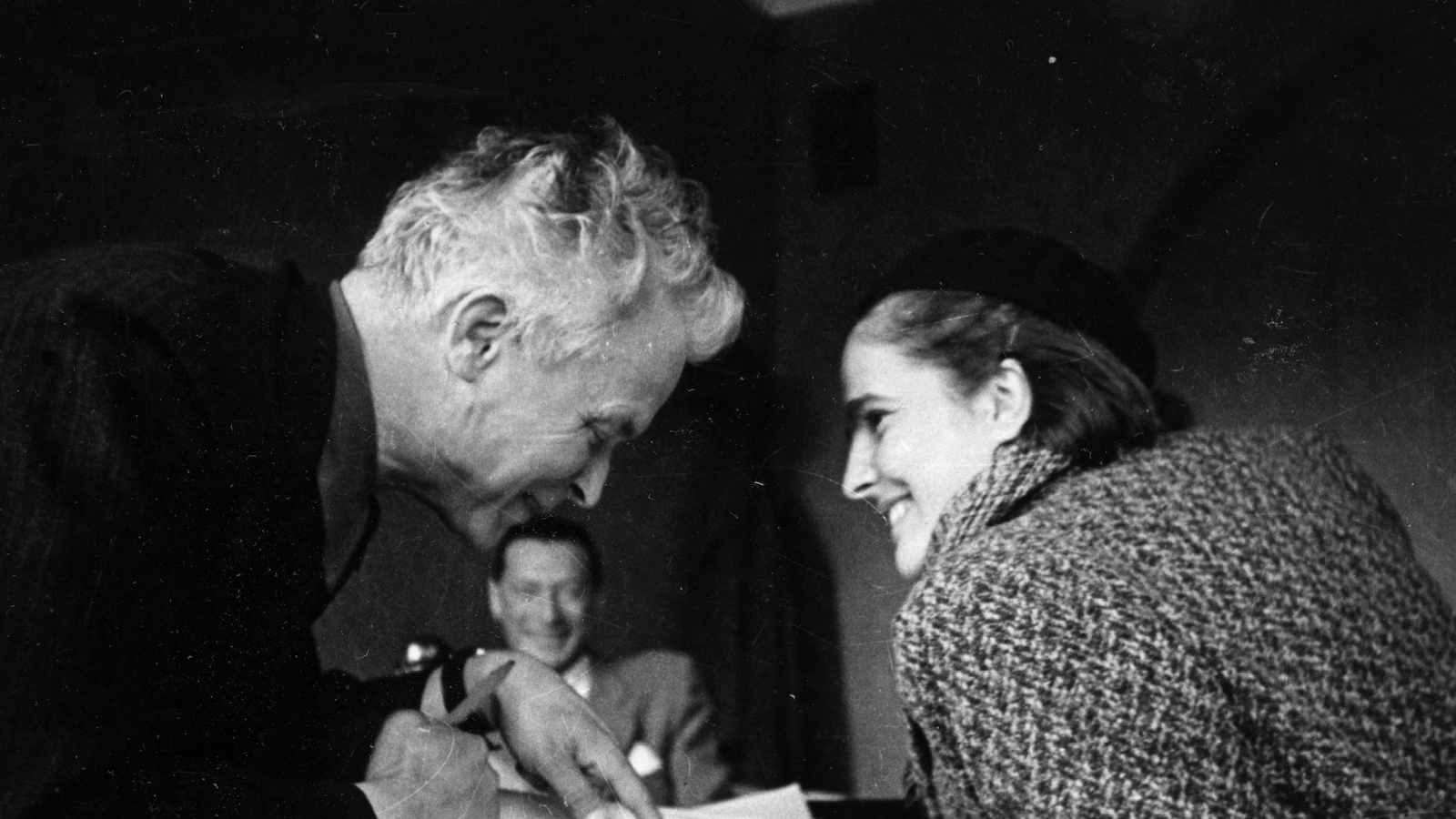
Oleksandr Dovzhenko and Yuliya Solntseva
Essay
Yuliya Solntseva
On the unsung authorship of Oleksandr Dovzhenko’s surviving collaborator, co-director and wife.
Oleksandr Dovzhenko: Earth and Empire plays at Metrograph from Saturday, October 10.
Share:
MOST FILM DIRECTORS MAKE A BID for immortality, but few can boast multiple credits as a film’s author after their death. Ukrainian master of early Soviet cinema Oleksandr Dovzhenko had the strange fate to extend his vocation beyond the grave, employed in this clandestine mission by his surviving collaborator, co-director and wife Yuliya Solntseva. Solntseva directed five features based on the scripts, diaries, memoirs and notes that Dovzhenko left behind, two of which—Poem of the Sea (1958) and The Enchanted Desna (1964)—will show as part of Dovzhenko’s retrospective at Metrograph.
“I am an immortal man, and it makes no difference how many micro-units of time this individual ‘I’ will carry on existing. I am an immortal man, and what I feel and what I do is wonderful.” These are the inner thoughts of the Ukrainian Soviet General Ignat Fedorchenko (Boris Livanov) as he overlooks his homelands from a plane in an early scene in Poem of the Sea—homelands soon to be flooded to make way for the enormous Kakhovka Dam project, the central subject of the film. The general’s measured, monotone delivery strikes an uncertain tone as he stands there, frozen, and light from the window turns an eerie greenish gray. His supposedly empowered evocation of immortality, intensified by the ominous, cool artifice of the scene’s staging, evoke an array of Soviet-adjacent death-minded thought: from the spooky Russian Cosmism of philosopher Nikolai Fedorov—who imagined a literal future resurrection of all human beings—to the ideological parading of Lenin’s embalmed body in the Moscow mausoleum and Putin’s and Xi Jinping’s recent snickering about living to a 150. The Armenian director Sergei Parajanov, who worked extensively in Ukraine, apparently once said to Solntseva,“Dear Yuliya, you pickled Dovzhenko!” speaking of Solntseva’s wilful dedication to resurrecting Dovzhenko’s scripts and keeping his legacy alive. “I pickled him, and I’ll unpickle him!” was reportedly her irreverent reply.
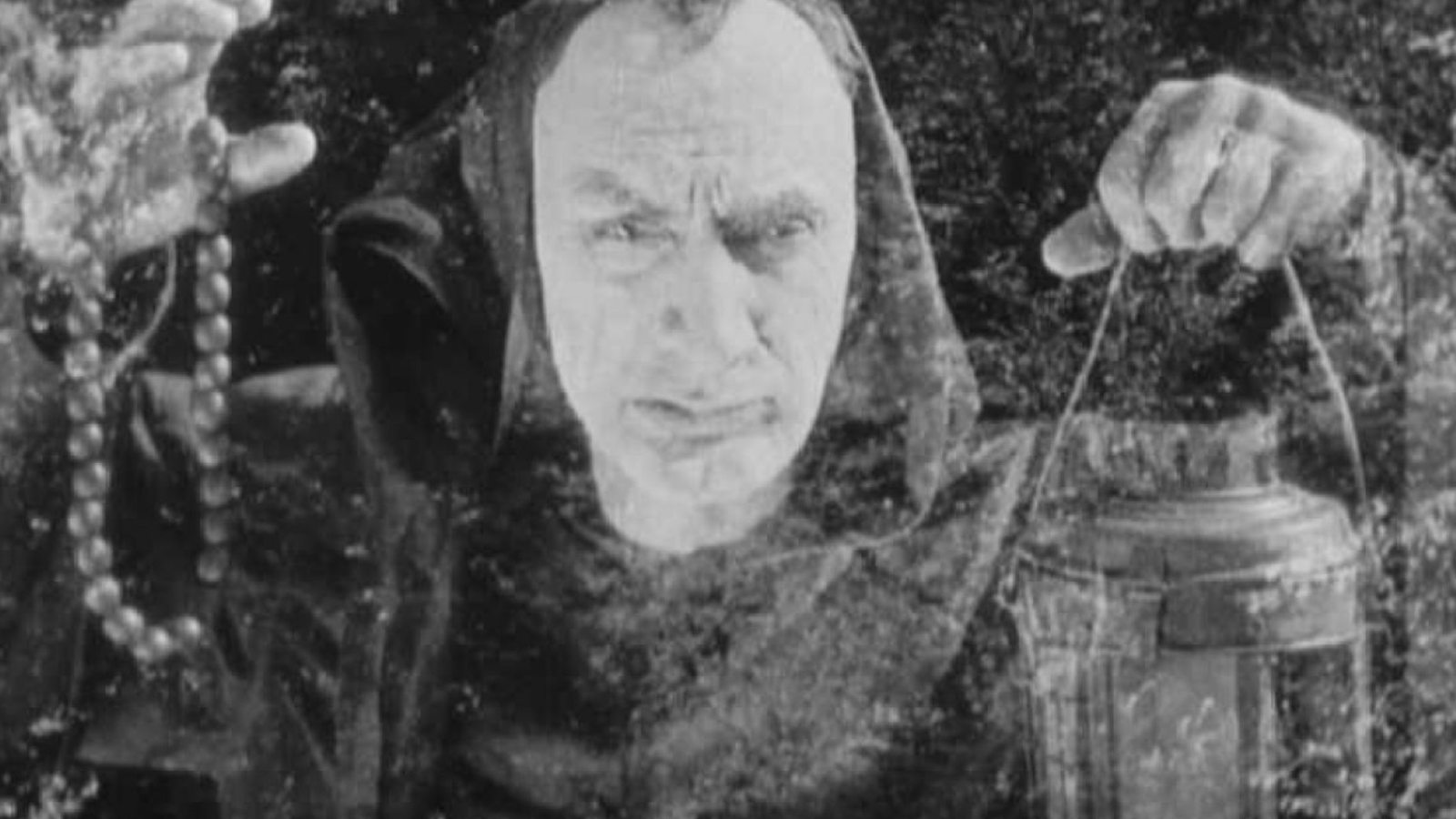
Zvenygora (1928)
If Dovzhenko’s most famous works, from Zvenygora (1928) to Aerograd (1935), are marked by an almost religious fervor for life (think the iconic apple and sunflower in 1930’s Earth, i.e. roundness, the seed, the womb, the cycle of nature, our round planet), Solnetseva’s imagination lurks in the sarcophagal palaces of death. This is what’s most intriguing about her work. Solntseva’s characters speak slowly and solemnly, like spirits from another dimension, and move through the otherworldly spaces she constructs like zombies or holograms—all in SovScope and stereophonic sound, often against rear-projected landscapes, lit by garish oranges, greens and reds. Poem of the Sea opens with another, parallel homecoming of a Ukrainian writer returning to his village on a boat and marvelling at the beauty of his land and his people. The words spoken by him are Dovzhenko’s, yet Solntesva’s scene has more in common with the uncanny weirdness of Raul Ruíz or Manoel de Oliveira than with the earthly sensuality associated with the master of Soviet silents. It is this unexpected toying with Brechtian artifice that makes Solntseva’s work memorable, and is perhaps what earned the high praise of Jean-Luc Godard, who called The Enchanted Desna, her most successful film, his favourite of 1965.
Solntseva and Dovzhenko met at the Odessa Film Studio in 1928. She was a star in the Soviet Union, her fame resting mostly on her acting turn as Aelita, the cool and sexy Queen of Mars, in the immensely popular 1924 Soviet science fiction film of the same name, considered to be the first Soviet blockbuster. Dovzhenko had already begun to earn a reputation as an extraordinary young filmmaker with his gorgeous Zvenygora—a catalogue of Ukrainian mythology and history where past and present collapse into an unruly carnival of images. Solnetseva wrote that after first meeting each other at the studio, Dovzhenko turned up uninvited for tea at her friends’ house, and proceeded to delight everyone by revealing giant oranges hidden in his coat pockets, his shirt, and his hat. They were married that year.
Solntseva was born in Moscow, lost both her parents as a child, and was brought up by her grandparents in St Petersburg. As a young girl she loved reading, went on to study history and philosophy at university, then transferred to a famous Moscow theater school, and briefly joined a theater troupe before being scouted to play Aelita. In Moscow she mingled with avant-garde elites: poets and writers such as Vladimir Mayakovsky and Andrei Bely, as well as filmmakers such as the influential director and editor Esfir Shub, who remained Solntseva and Dovzhenko’s friend through the ’30s.
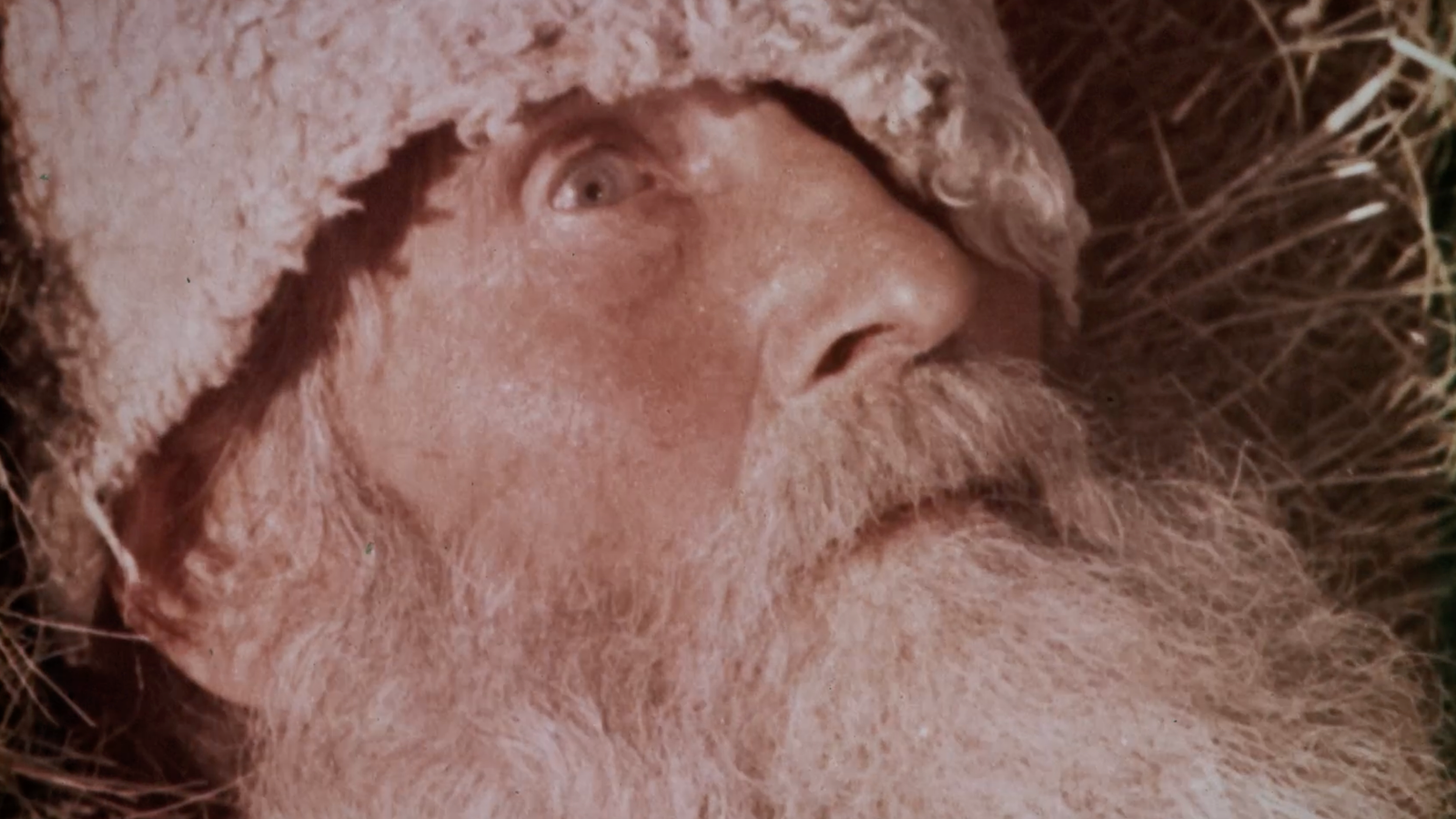
The Enchanted Desna (1964)
After meeting Dovzhenko, Solntseva played a small part in Earth but soon quit acting to forge a new career as a filmmaker. She worked with Dovzhenko on his films, assisting him on the speculative adventure epic Aerograd and co-directing Schors (1939), a work personally suggested to Dovzhenko by Joseph Stalin. During WWII, Dovzhenko and Solntseva made a series of documentary films about Ukraine’s struggles on the front lines. Dovzhenko died unexpectedly in 1962, one day before commencing the shoot of Poem of the Sea. Solntseva took over the production and finished the film.
For her second work, Chronicle of the Flaming Years (1961), she won the Best Director prize at Cannes Film Festival, becoming the first woman to receive the award. The prize was officially awarded to “Madame Yuliya Solntseva, the successor of Monsieur Oleksandr Dovzhenko,” and Solntseva herself keenly supported a vision of herself as a conduit for her husband’s continual creation, stating that she would not have become a director if it wasn’t for him. Apart from directing his scripts, she worked tirelessly on the preservation of his archive and restorations of his films, earning a reputation as a formidable and temperamental gatekeeper of Dovzhenko’s legacy.
The “conduit” narrative is hard to avoid, but it is not most helpful in approaching Solntseva’s work. It isn’t possible to enter and inhabit another’s sensibility, memory and sense of time and space, and film is not a strict fact of recollection—the personal hides somewhere in the mercurial measures of step, word, cut, distances and intonation, and hundreds of other unfathomable factors, located by the director somewhere between choice and accident. Solntseva’s attempt at afterlife ventriloquy led her mostly towards her own self-determination, though how much of this was conscious remains unclear.
Starting in the late ’20s, Dovzhenko and Solntseva were both closely surveilled by a wide network of secret agents ranging from Kyiv and Moscow bureaucrats to colleagues and friends, all reporting to NKVD, Stalin’s secret police. It doesn’t surprise me to read, in excerpts of the declassified files recovered by Ukrainian film scholars in the during perestroika, that, at least according to the secret agents’ obviously subjective reports, Solntseva expressed ambition to direct her own work starting in the ’30s, and even took on two scripts independently from Dovzhenko. These projects never eventuated, and she continued to work alongside him, and later, ostensibly in service of him. Solntseva did finally direct two films unrelated to Dovzhenko—These High Mountains (1974) and World in Three Dimensions (1980)—but as far as I can tell these were not shown outside of Russia. As much as the feminist project has tried to rehabilitate her own legacy, Solntseva’s fate remains inextricably bound to her husband. Yet in her Dovzhenko productions, one finds an undeniable individuality that is wholly her own invention.

Poem of the Sea (1958)
The heavy, melancholic, plangent quality of Solntseva’s films, especially opposed to the light, erratic sensuality of Dovzhenko’s Ukrainian trilogy, may also have something to do with timing. Dovzhenko began directing at the tail-end of the brief Soviet project of Ukrainianization, a short window in the ’20s when self-determination of Ukrainian culture and language was supported by the Soviet State. There is a palpable sense in his early films of faith in the bright tomorrow, the real possibility of communist utopia, in which Ukraine will be free, peasants and workers will rule in justice and kindness, and cooperation between all people and all nations will prevail.
By the time Solntseva was shooting her films, the reality had long morphed into something else entirely. “In ten years’ time there’ll be a paradise here,” a scheming young engineer declares in Poem of the Sea as he greedily eyes the dam construction site. But the giant Kakhovka is shot at night with cool, futuristic unease, and the dam stands both awe-inspiring and horrific, threatening to wipe the world as we know it. Underneath it all are years of suffering, betrayal, and destruction under Stalin’s Soviet rule, the reversal of Ukrainianization followed by Holodomor famine, and the incomprehensible death machine of WWII, mowing millions of Ukrainians. The film’s images read all the more tragically now, after the Russian forces have blown up the Kakhovka Project in a 2023 attack.
The Enchanted Desna commemorates the horrors of war on the Ukrainian front lines, suffering that deeply affected Dovzhenko. The film again revolves around a homecoming: a Ukrainian writer and general, serving as a stand-in for Dovzhenko, returns home as his army enters Ukraine to liberate the country from German occupation. Memories of his rural childhood come flooding in, making way for Solntseva’s most sumptuous sequences. Here come the apples and the sunflowers, barefoot children in pastoral bliss, choreographed scything in the summer rain. A great storm floods river Desna and we are treated to a small Ukrainian Atlantis: villagers cheerfully adapt to their temporary watery life, children’s feet dangle over the currents, cows ride the river in canoes. Here, as in Poem of the Sea, the old world is submerged under water and remains now only as private memory, made public through cinema’s enchantment. Solntseva’s apples and sunflowers have something of the uncanny; they don’t feel quite real. They are fragments of a lost world, someone else’s remembering, someone else’s dream, disappearing under the earth when the beloved can’t help but look back.

Share:
Recommended
- Virgina
 On the rediscovery of a lost film tackling the complexities and pleasures of gender expression in the Balkans.
 - Farley Granger
 On the queer star who defied mid-century Hollywood archetypes.
 - Geraldine Chaplin and Carlos Saura
 On the formidable collaborations of the Aragonese filmmaker and his American muse.