

Paul Morrissey Photo Booth Photos from The Factory Photo Booth, Courtesy of Paul Morrissey Archives.
Interview
Paul Morrissey
From the archive: a 1983 interview between two New York icons, the filmmaker Paul Morrissey and critic Gary Indiana, on Morrissey’s “wicked, sexy comedies,” including the street drama Forty Deuce (1982).
Forty Deuce plays at Metrograph from Friday, September 12 as part of Leaving the Factory: Morrissey after Warhol.
Share:
I can’t think of any American films of the past 20 years that have left as strong an impression as the wicked, sexy comedies of Paul Morrissey. Since Preston Sturges, we have had very few films as memorable for their dialogue: after ten years I can still hear Jackie Curtis, in Women in Revolt, shrieking into a telephone: “Ma, don’t start this Lillian Hellman shit first thing in the morning. I can’t take it…” Or Donna Jordan remarking, “What a pisser!” after disinfecting a Paris pissoir with little blue cakes in L’Amour. Or Viva in Lonesome Cowboys: “One more innuendo and this fuck is off.” Jack Smith once told me that the most troublesome illusion about art is the popular belief that “real” art is heavy, ponderous, and boring. And as a director of stage comedies, I’ve learned how intractable that idea really is in some minds, especially among journalists. If you do something that people actually find amusing, it’s dismissed as frivolous or sensational—as if the spectators felt guilt about having a good time. Frankly, I find what most people take seriously in the theater is completely ludicrous. Eugene O’Neill was bad enough, but the experience of today’s “serious” theater is more predictable than a video game: in the first act you meet the characters, who are horrible; in the second act you learn their secret weaknesses, gleaned from the Penguin edition of Freud; in the third act, Neuroses Collide, creating Drama. That dramatic moment when you realize you’ve paid up to $20 to monitor your own digestion in a darkened theater. And the writing: off-Broadway, tin-ear renditions of TV sitcoms; off-off-Broadway, artless regurgitations of William S. Burroughs.
This brings up to Forty-Deuce, a really astonishing, splendid play by Alan Bowne, written in a made-up language derived from street slang whose characters virtually never stop talking. Forty-Deuce has an airtight plot, characters that really develop in front of your eyes into sympathetic and believable people and pacing that completely takes your mind off your stomach, your date, and whatever other stuff you brought to the theater with you. As a play it opened and closed in about three weeks. Paul Morrissey has turned it into one of the best American films of the past 10 years. We talked about it in Montreal. —Gary Indiana
GARY INDIANA: How did you become interested in Forty-Deuce?
PAUL MORRISSEY: By accident: a friend of mine knew the producer. He’d seen it already and said, “It’s just perfect for you. You should make a movie of it, in fact.” As soon as I hear that, I always think it’s something I hate—whenever people tell me something’s right up my alley I shudder. I never go to the theater in New York. I’m a New Yorker. Anyway, I went to see the play and thought it was great. I told the producer, “Maybe there’s a movie that could be made here.” He told me to come again. I went again the day after. The reviews were really bad in the press, especially in the New York Times, so I guess it was dead, you know. So, it ran for only three weeks, I think. I saw it once or twice more. Then in the last week or so it came to me—I’d kept thinking, “But how do you make a movie of this when the plot keeps you in this room?” You can take it out of the room. It’s a story about being trapped in a room. So, I realized you could take the first half out of the room, but the second half of the play definitely had to stay in the room. Then some sort of momentary thought came to me—this double screen idea. It just came to me that this was a way of keeping the room as a trapped, claustrophobic, real-time thing and increasing the realism of it even though it’s a theater piece. I don’t know, some stupid people said, “Oh, this is so much like theater.” Well, it’s nothing at all like theater, and most people ask me if it was improvised. Obviously, it doesn’t look like theater if it looks improvised, it looks sort of natural. And I think the double camera is not at all like anything you’ve seen in the theater—there’s this constant movement of the camera. Anyway, I did it and I’m glad I did it. I like it a lot.
GI: Something that’s really interesting about Forty Deuce, but also about your other films, and particularly the ones that were thought to be so outrageous—and they were—Women in Revolt, and L’Amour, and all of them really—is that they’re actually morality plays.
PM: Oh, yeah, they all were, I think. You know, I’ve lived in New York City my whole life. I’ve read the newspapers and magazines my whole life in New York City. So, it’s second nature for me, for some reason, the influence of the mentality of journalism, its psychology. It seems to me that journalism, especially in the past 15 years, has been really promoting certain things. They really have won the game. They’re in charge now; and they’re not really happy doing it. They’ve assumed a stance, journalists, even though they pretend not to. And being aware of this in some funny way, I’ve always tried to avoid taking stands. Most people reviewing the films would say there was no judgment made. But that they were comedies is a kind of judgment on the subject. Showing the foolishness of people’s lives, which is the basis of comedy, is in effect a kind of moral judgment. And none of the material was outside of this comical framework. In that sense it had a strong perspective, I think.
GI: You’ve used a lot of improvisation in your films, and you said it was more interesting to work with non-professionals…
PM: To me it was. Now, in Forty Deuce they’re all very professional, but again, it was a very traditional kind of thing, a very well-written script. As much as I like movies, and as much as I like my own movies, I’ve always said that a very strong, effective piece of theater is much stronger than the best movie.
GI: Who are the most interesting people you’ve worked with?
PM: Well, I really like almost every performer I’ve ever worked with. I’m very partial to performers. The most interesting—I don’t know. I really loved that Countess in Night Shift (1982), the way she spoke was so funny and unique. I was really surprised to see something like that, in this day and age. The most interesting person I’ve ever worked with, in many ways, is Andy [Warhol]. He had a very interesting psychology and attitude, which is very determining of his activity. Once you understand who he is, you know where you are with him. And he thinks a little bit differently than most people. But he’s not a performer, he’s a kind of conceptualist. But then, his basic conceptions are very simple, they’re the kinds of things people overlook. He’s a very interesting person.
GI: The period of the Warhol ’60s, or whatever…
PM: No, they weren’t the Warhol ’60s. They were recorded by us, so I guess there’s some sort of connection.
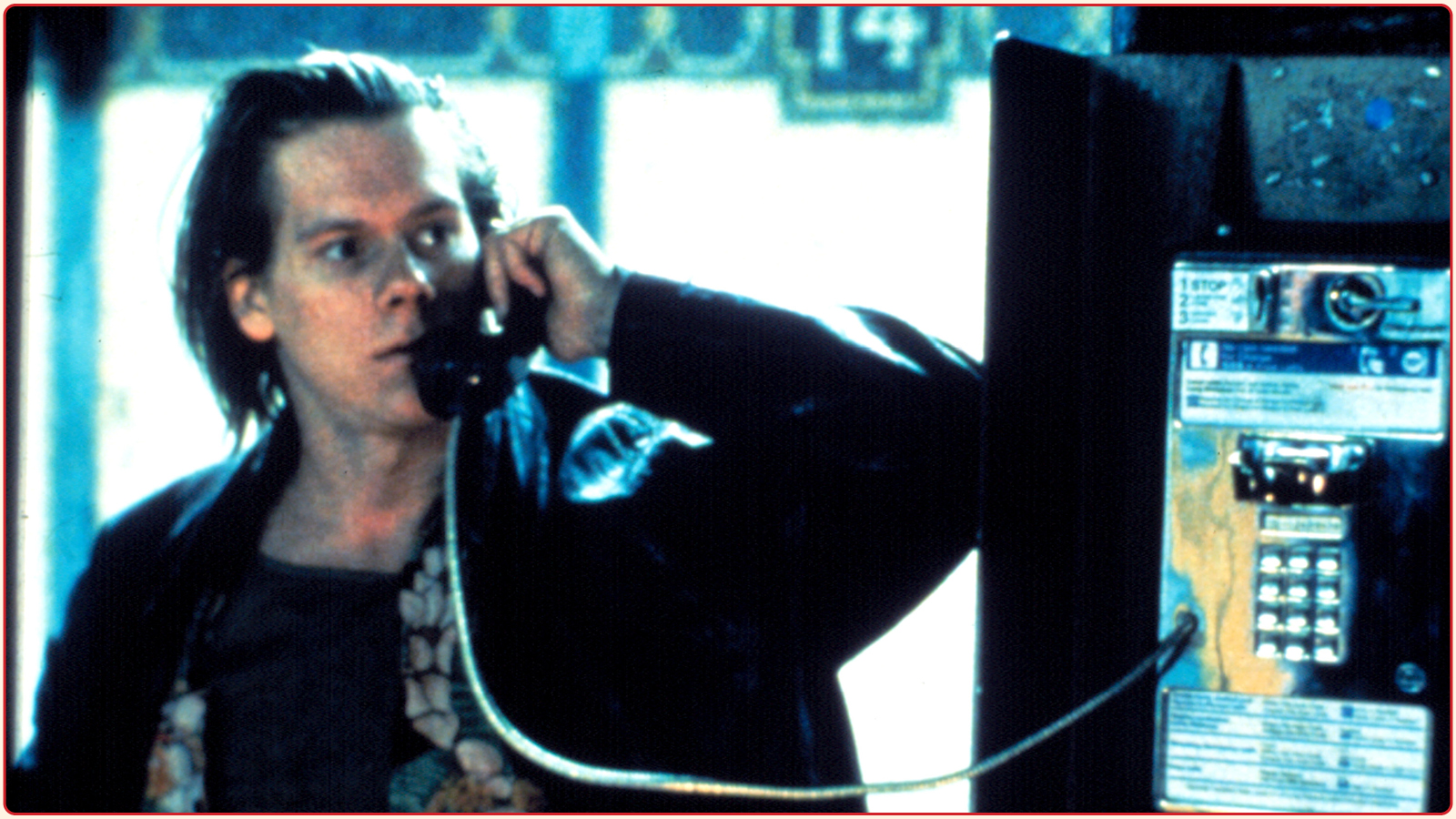
Forty Deuce (1982), featuring a pre-stardom, 23-year-old Kevin Bacon.
GI: Well, that’s become a very heavily mythologized period, and a lot of the participants in it are extremely bitter towards Andy, towards you…
PM: I suppose there might be that. I’ve encountered it a little bit. It’s hard to know what to say. These movies were enormous risks of Andy’s investment. Not that they were big investments, but they were not commercial in any way. They had some commercial success. Some didn’t. Most of them didn’t. And, you have to go on to make another movie after you’ve made one movie. You can’t always use the same people. You have to change. These people weren’t professional actors. They were invited to be in the movie. They weren’t making a career out of it. They drifted into other things. And they drifted a lot, you know? And somehow, if they talk to a journalist, the only thing the journalist wants to know is something to do with Andy Warhol because he’s still current material to talk about. You know, Andy has always wanted to do certain things in life, and he’s kept at it. And I’ve always wanted to make movies, and I’ve kept at it. A lot of these people never really wanted one thing, but sort of drifted from one thing to another. I think they could’ve gone on and done more things if they’d put their minds to it.
GI: One thing that’s been suggested to me about that is that a lot of the people you and Warhol sort of collected for your films were people who really needed a father figure, who invested an extreme emotional energy into working with you and Warhol…
PM: I don’t think that’s true. It’s true a lot of people today want father figures. But I think the particular technique we used for filmmaking, which was improvised, and totally devoid of any kind of importance or pretense—we really asked the performers for very little… almost nothing. There was no obligation on them. They weren’t under contract. They weren’t being paid big sums of money. If the film didn’t work out, it would go on the shelf and just be a loss of commitment, really. You know an actor goes to acting class, he goes for the part, his agents send him, he auditions, he gets the part—well, he’s all emotionally overwrought, by that time. None of that existed. I’d usually ask people the day before we were going to film, “Can you show up tomorrow?” “What time can you make it? “Okay, come at one, two, don’t come after three. Try to get there at two. We’ll be there for two or three hours.” There was no strong commitment on their part. And this very lack of commitment was what produced, in inverse ratio, the strong emotional thing that came from being in front of the camera, in a funny way. I can’t explain it, but I know that’s what happened. I knew if I ever stopped to audition people, and then told them what they were going to do, and asked them to think about this, and rehearsed—I never would’ve gotten what I got. And it was an inverse way of thinking, to get these things, that caused it to happen like that. That’s why, when film studios in Hollywood started doing this improvisation, to me it was deadly. Because there was this obligation on people to come up with something to say and they were paralyzed, they couldn’t come up with anything and usually reverted to screaming to make believe they were improvising. And about these people with the father’s figure—they weren’t collected, you know. They came around to be in the film, three or four days of their life for a couple of hours. So, maybe later if the film came out and had success, that meant a lot to them. But there weren’t hangers-on or hanging around. People have a misconception about exactly what went on and how these things were made. I have no guilty feelings.
GI: I asked because I read this book, Edie, which seemed to me one prolonged whine after another…
PM: But you have to consider the source, when someone’s whining, who’s the whiner, and ask who they are and what they do, and think about it like that. You have to consider the source, you know? This was a rather dishonest book that wanted to make a kind of impression. And the impression was that this was a poor girl who got involved with a kind of unsavory character, Andy, and that he exploited her. That is the impression everybody gets. The reality was, she was a nice girl, but Andy was a nicer boy. He was a nice person. He was nice to her. He never exploited her. He never asked her to take drugs. He never asked her to take her clothes off in a movie. He never asked her to use bad language. He never asked her for anything. He was nice to her, he photographed her talking on the phone and polishing her fingernails, and just indulged her as if she were the Queen of Sheba. He gave her an identity and a personality that she had been denied by everyone else. And Claire Booth Luce has the definitive word on all that: she said, “No good deed goes unpublished.” I’ve always found that if you really do something, they resent it. Not that she resented it, because she passed on. But people want to make him suffer for being nice to her. She might or might not have been taking drugs. There’s only a few months she knew Andy. She wasn’t obviously taking drugs. If she was doing it, she was doing it privately. She left Andy and went to live in Woodstock with Bob Dylan. When she came back, she was a heroin addict and died a heroin addict. There’s no reference in the book—nobody goes and asks Bob Dylan’s friends what a creep he is. He’s sort of a sacred figure to journalists. Andy’s kind of a whipping-boy. You know, it’s really a kind of distasteful, dishonest book, and anybody who really knew Andy then, or knows him now, knows a really nice person. He doesn’t take advantage of people. He’s always actually trying to help people, in a way. But the impression is that he was sort of a vampire. And this is just a journalistic prejudice, I guess. Books like that are going to distort anyway, but I think this book particularly wanted a kind of simple-minded explanation, to make it look like, “No wonder she had such a hard time.”
GI: Yesterday at your press conference there was a filmmaker who had very much admired Flesh, Trash, and Heat and had been influenced by them because he thought they were arguments for sexual liberation, so he was upset to realize that they are really quite antithetical to your own—
PM: It wasn’t antithetical, but to me, sexual liberation—which occurred during that period in a big way and is now the establishment religion of the masses and the journalists—is a foolish thing, an enormous area for comedy and showing characters in the most foolish, vulnerable situations trying to partake of this sexual liberation. I was neither for it or against it, but just showing it as silly. And if it looks silly to somebody, it surprises me that somebody else should take a militant stand in its favor.
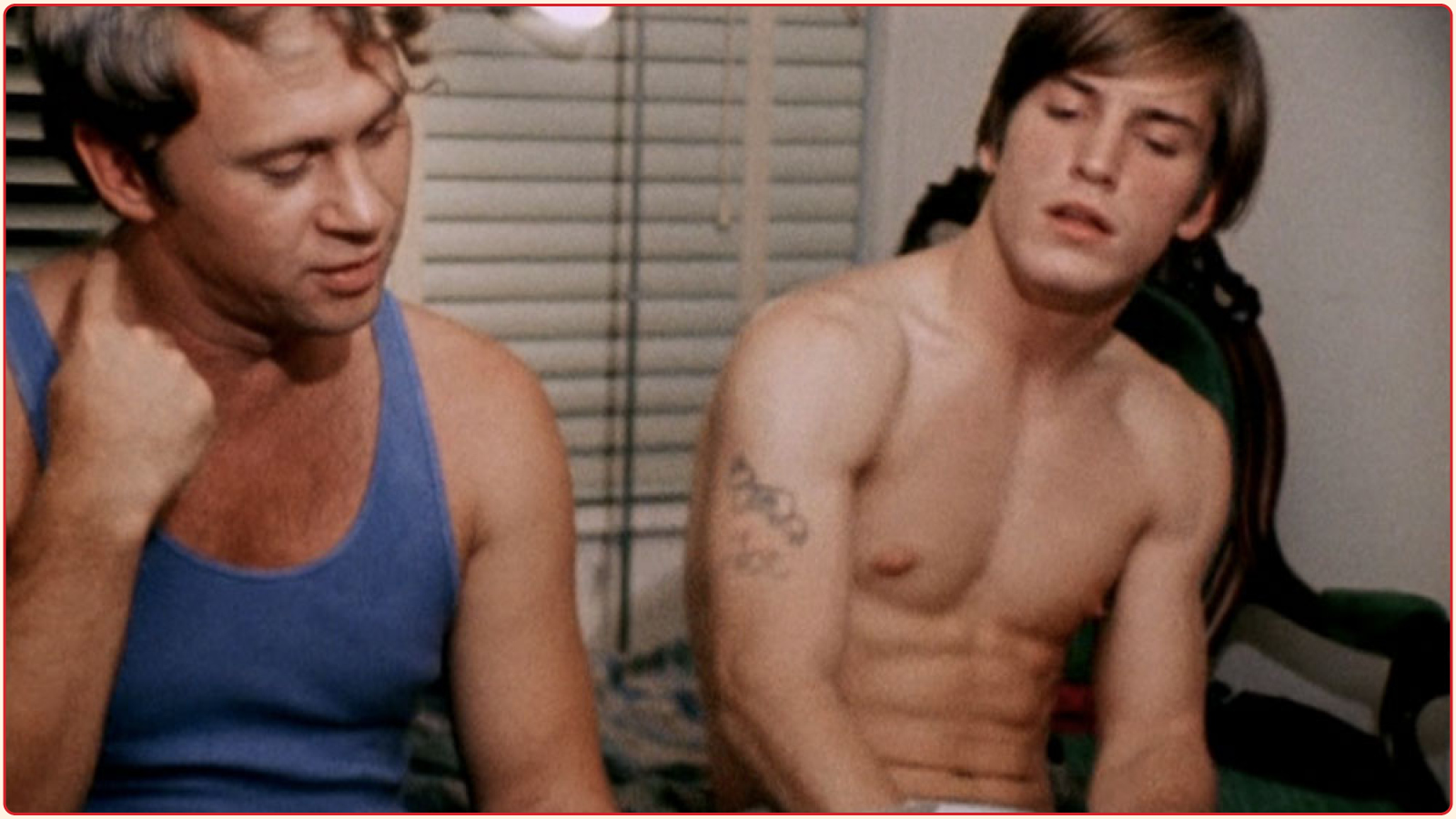
Flesh (1968)
GI: I think it was maybe because you showed a lot of things that were being shown for the first time, like the erect penis in Flesh, and maybe the reason why people—
PM: Well, they thought it was sort of, “Yes, let’s do it, because it has to be done”—there are many reasons why it was done. There is never just one reason for any action anybody does, I suppose. But certainly, when you are making a film with hardly any money at all, it’s only natural that you hope to put something into the film that they’re not going to get in their $20-million Hollywood films. This was always part of the psychology of low budget filmmaking, to go into areas that other people don’t go to. Forty Deuce is the same thing. It’s a kind of view of life, a type of life, that wouldn’t be touched with a million-foot pole by a commercial filmmaker. And the situation was the same then. Nudity was not done by anybody—at the time we did it, we were told that legally we could be arrested in different states and cities and put on trial. And sued. So, it was really a difficult thing, there was always the danger of it. Blue Movie was seized in New York, and it went on trial for years. They finally threw it out, they were bored with the case, I think. Anyway, nudity was certainly an added incentive for the public to see the film instead of the latest Barbara Streisand film; but to use something just for the effect is pretty humorous; anything that’s really humorous is rather human. But when I did try to put it in, I hoped it was in a humorous context that became part of the character. It was never a clarion call, “Let’s have nudity, or sex,” it was simply a reflection of the period people were living in and how they might react in that situation. My view was that they would react in a kind of foolish way.
GI: I remember reading somewhere that none of your films ever lost money.
PM: No, they never did. They were all made at a certain cost and recovered. Some went on to make a lot of profits. One film I made lost money; it was the only film where I ever had, let’s say, a lot of cooperation. I had to cooperate with people. That was the film I made in England, The Hound of the Baskervilles. Part of it is unfunny, I think. It was a very expensive film, and I myself wouldn’t have spent that kind of money if I’d had a controlling interest as a producer in that particular material.
GI: And what about Madame Wang’s?
PM: Madame Wang’s cost so little money that we knew that we’d get our costs back just through certain cable sales, and we’ve had some foreign sales already. But I’m holding back Madame Wang’s for an opening around the time of Forty Deuce in New York, just because they’re so contrasting I think they’d be interesting one next to the other.
GI: When I saw Forty Deuce the other night, at the point the split-screen comes on they have to draw back the theater curtains… is that a problem that’s built into the film—
PM: It’s not a problem. It occurs, but many projectionists just push a button to bring the screen back. But at that point there’s a little intermission when you just see 42nd Street, at night in the rain, and the music plays again, and that goes on almost for a minute, so it gives the theater plenty of time to widen the screen. I guess that’s kind of a first, too, not that it means anything; I don’t think I’ve ever seen a film that changes its scope or its ratio in the middle.
GI: The language in the film is extraordinary.
PM: It’s wonderful. It’s a really old-fashioned writer’s use of language for effect. Which is a very poetic notion of language, that it’s used for effect. Even though many people would hesitate to call it poetry, some people call it “gutter poetry” or “porno poetry” or something. I don’t think of it as poetry—that’s a little bit precious. It’s simply very vigorous prose that has a really interesting effect. It’s the rarest thing in the world to go to a movie and encounter the phenomenon of language coming from the screen, having an effect. Like I say, I’ve always purposely left out most of the effects other directors use and put the emphasis on characterization. Characters who don’t have adequate language don’t exist as characters, no matter how much they’re photographed through dreamy landscapes or running over bridges or something. A character cannot exist unless he exists verbally—if it’s not verbalized it’s not dramatized.
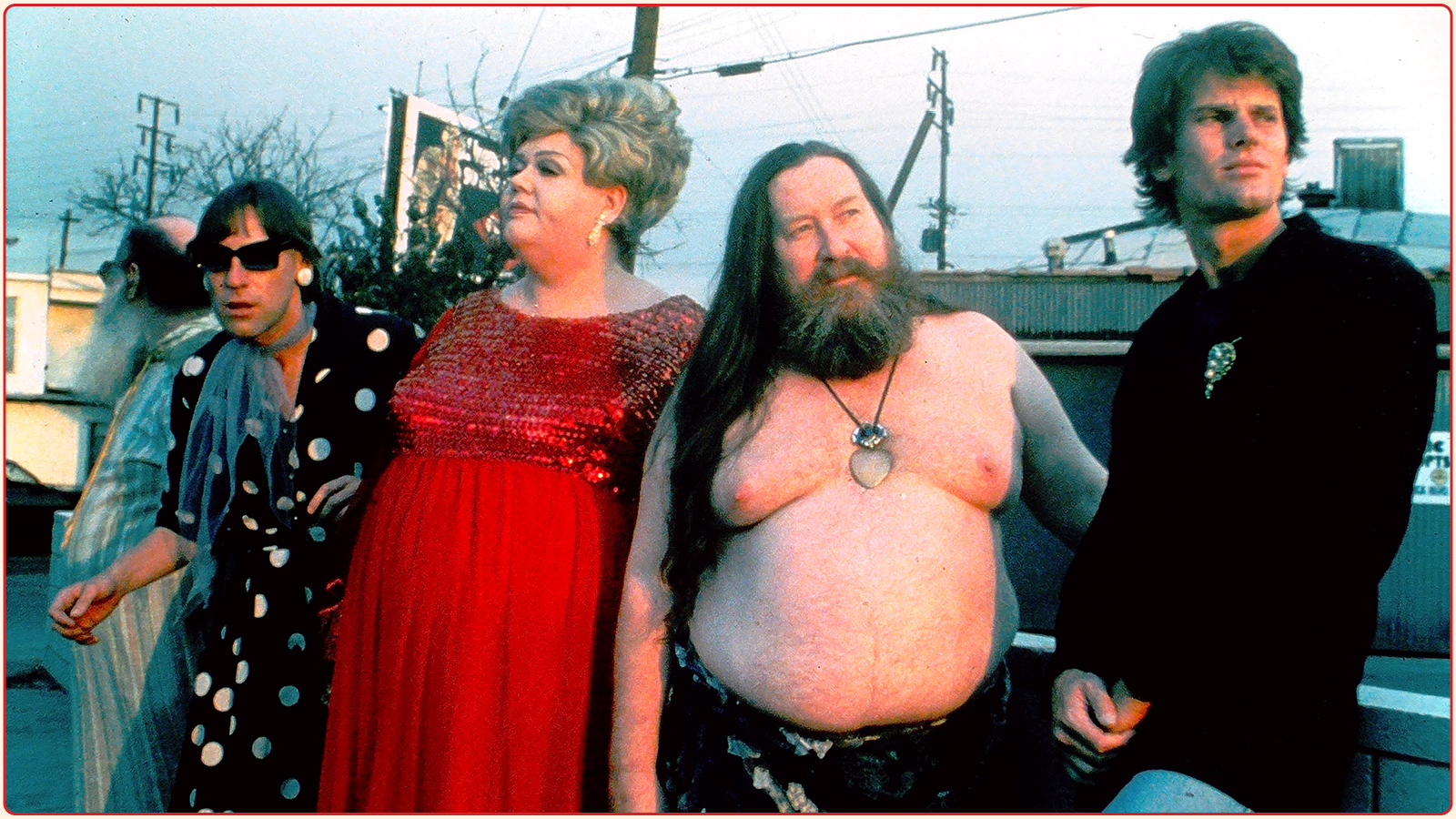
Madame Wang’s (1981)
GI: Do you have plans for a new film?
PM: I do have a couple of scripts floating around with producers: which one gets picked up, if any, I don’t know. I really find it difficult to find serious material that’s not laughable; rather than keep looking for what I’d like to do, which is another comedy, I think young people are always good subjects for stories.
GI: I haven’t seen Madame Wang’s. What’s it about?
PM: Very silly. It’s something I shouldn’t have done, I realized, and I don’t think it really worked. But I tried, anyway. It’s about a Russian agent who comes to America to coordinate the imminent Russian takeover. He loses his money and his spy papers; he takes up, in Long Beach, California, with some over-the-hill, out-of-work, overweight female impersonators whose drag queen nightclub has been torn down by an urban renewal project. And they’re all hiding out in an abandoned Masonic temple, living there illegally. They support themselves by stealing, and shoplifting, and selling things they’ve stolen at a swap meet next to the temple. And the poor Russian agent, who’s very serious, can’t go and run around much. He doesn’t have any papers, and he has an accent and doesn’t have any money. So, the female impersonators take him in; he tries to get them interested in his Soviet schemes, but they’re trying to get back into show business by forming a punk rock group. That’s the plot.
GI: Thank you.
PM: It sounds like a good story, but most people react in a very peculiar way. Anyway, the Russian agent’s very serious, and he meets people who aren’t serious about anything, and that’s the conflict.
GI: That’s a premise that’s in a lot of your films…
PM: Yes, it is. It’s in Trash, too. You’re right. I didn’t think of it until you mentioned it, but it certainly is. In Trash it’s the conflict of people wanting to have sex with a drug addict who has no interest in sex. But it’s reversed in this; the main character is the committed person, and the group of people he meets are totally uninterested.
GI: What are your favorites, of your own movies?
PM: Oh, I always think Women in Revolt and L’Amour—which had no success.
GI: Those are both terrific.
PM: But they were very silly, and they came right after Trash, which people felt was terribly strong. So, they expected this strong stuff from the next two, which were so relentlessly silly that they were really scorned. And I certainly love Trash, and Flesh, and Heat, and Frankenstein and Dracula, which I’m really fond of, but I feel sorry for those because they had so little currency. They weren’t seen much.
GI: I’ve heard rumors of Trash 2, is there any—
PM: Well, I think so. I wrote the script, and it costs a lot more than Trash. I should’ve just made it as soon as I wrote it, the same way I made the first one. But you go on and you find it difficult to go back to 16mm. Once you do it in 35mm, you’re into a larger budget, and it’s kind of a mental block, because you’re reluctant to go back to 16mm. You want the sharper image quality, and I think people would resent it—going back to the poorer image quality. But you know, like that film we saw last night, which was 16mm that looked like 8mm—if a filmmaker is just beginning, you pay no attention to the quality if the basic goods are delivered, which that girl did with her little characters, I think.
GI: You don’t think the auteur theory is too valid…
PM: Certainly, a good director has a long-term, continuing influence on his material, yes. But the director can only exist through his actors. John Ford exists as a director because of John Wayne, Ward Bond, Victor McLaughlin, and Maureen O’Hara—that’s who John Ford is. Visconti exists through his actors. Carol Reed exists through Trevor Howard and Ralph Richardson and James Mason; this is the identity of the director. It’s only realized through his characters—not through his camera, or his themes, or his ideas—that’s all garbage. The emphasis is misplaced by this stupid critical theory. There’s a great director named Mitchell Leisen—I just saw his film Easy Living (1937) for the 15th time; you can’t get better movies than this. He’s a wonderful director, because you see this quality of acting over and over again, and an attitude on life, through his directing of material written by other people. He went from one studio to another and did it over and over again, very much like a director who’s even better, George Cukor. These people knew the difference between phony attention and good work. I think a lot of people today are just phony, pretentious people who wouldn’t know good work if it bit them.
I thought Diner (1982) was a nice film. It emphasized characters: you went to a film, you met people, you came away glad you liked those people. A film can’t do much more than that. Death in Venice (1971), yes. But there you’re talking about a man coming from a world of theater; we don’t see those kinds of people anymore. The people in the latter part of the 20th century have been raised in a mindless, illiterate, totally barren wasteland of journalism and rock ’n’ roll. You can’t expect much. But even with the kind of primitive educational system that exists now in the United States, even as backward and stupid as it is, this surfacing of human personality through stories seems always to be there if the person wants to look for it. One great character and a couple other good characters and you have a pretty good movie.
GI: Well, Forty Deuce is pretty good all the way through, I think.
PM: Oh, I agree.
GI: We were talking the other night about Japanese culture and how it was an extremely refined culture yet extremely realistic, in the sense that when terrible things happened, people’s reaction was, “Well, that’s life. That’s the way it is.” I think that’s reflected in your films in a way that may look cruel to some people. But it’s actually very realistic—
PM: Well, I’m not Mediterranean. I’m Irish American. And the Irish have this resignation to events. They also have a sense of humor, which I think all very interesting ethnic types have. Especially the ethnic types who have had the most adversity, like the Jews, or the Irish—the Irish haven’t had a great life in Ireland, it’s a pretty barren country. The Italians, too, have lived in poverty for thousands of years. But they instinctively smile. It’s really wonderful to find humor in something. It gets people through life. God knows, you need something.
This interview was originally published in March 1983 in the East Village Eye as “Aces the Deuce: An Interview with Paul Morrissey.” It is republished here with the permission of the Gary Indiana Estate.

Gary Indiana, photo by Hedi El Kholti

Share:
Recommended
- Futures and Pasts: Socrates
 Rossellini’s one-of-a-kind approach to the costume drama, and his 1970 film on the last years of the Athenian truth-seeker.
 - The Illiac Passion
 On the most elaborate of Gregory Markopolous’s modern myths.
 - Jollof Films
 Senegalese visual artists and curators discuss the towering cinematic figures who inspire their craft.