
Essay
Green Snake
On Tsui Hark’s subversive reimagining of an immortal Chinese folk tale, starring Maggie Cheung as a serpent demon looking for love.
The new 4K restoration of Green Snake (1993) plays at Metrograph from Saturday, February 7 as part of Days of Being Maggie Cheung.
Share:
“THE LEGEND OF THE WHITE SNAKE” is considered to be one of the four most popular Chinese folk tales. It tells of the doomed romance between the scholar Xu Xian, a mortal, and the white snake spirit who seduces him, Bai Suzhen. Over centuries, these star-crossed lovers have inspired numerous artworks, from literature and painting through to traditional opera. The tale has continually evolved, and travelled, including to Japan where it morphed into one of the nine Kaidan (ghost stories) collected in the classic collection Ugetsu Monogatari, published in 1776, and later adapted by Kenji Mizoguchi as Ugetsu (1953). However, Tsui Hark’s film Green Snake (1993) is without a doubt the most subversive reimagining of this immortal story, a work of kaleidoscopic visual and alchemical sound that turns the original’s didacticism into a high-camp meditation on the human condition.
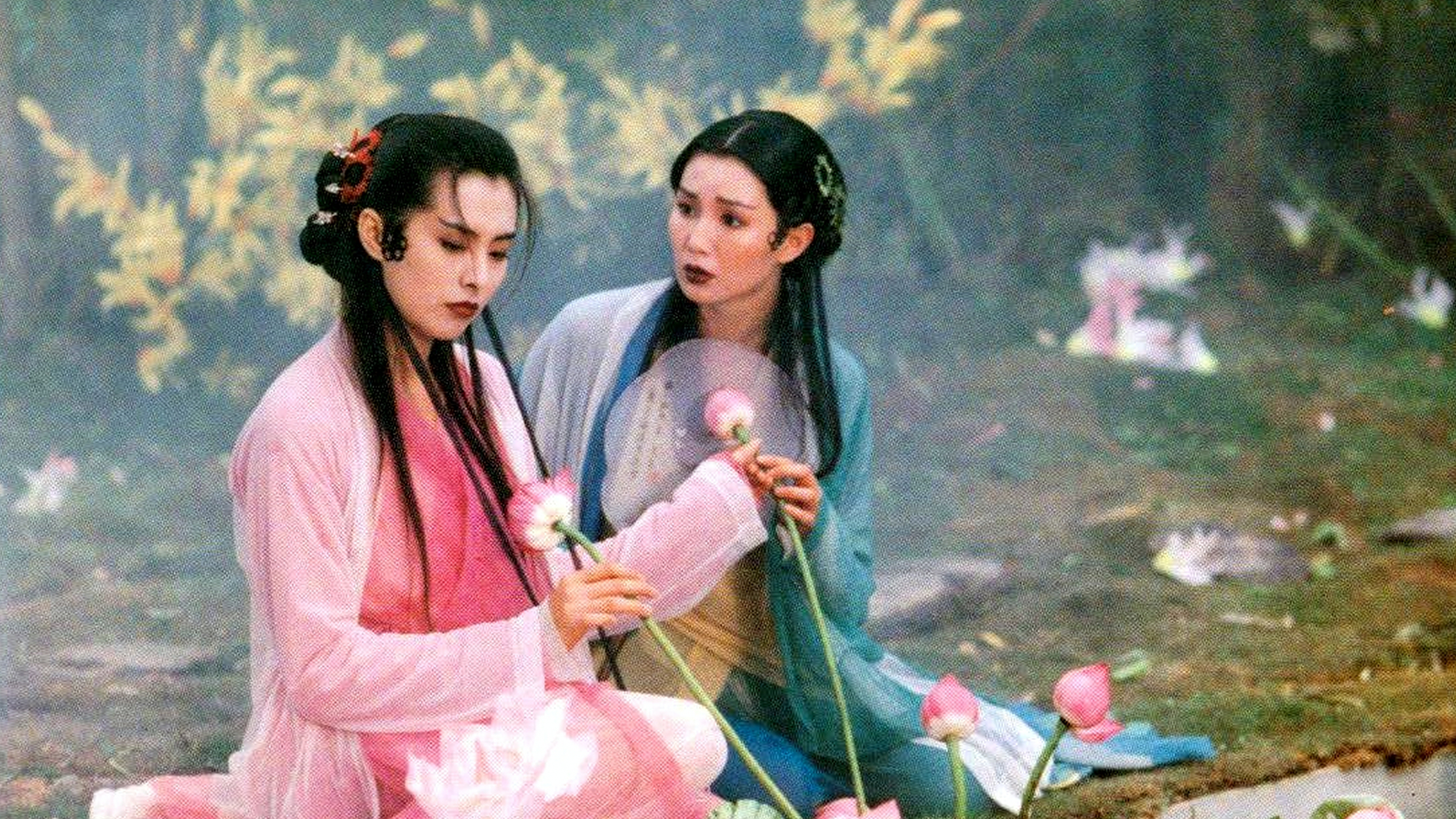
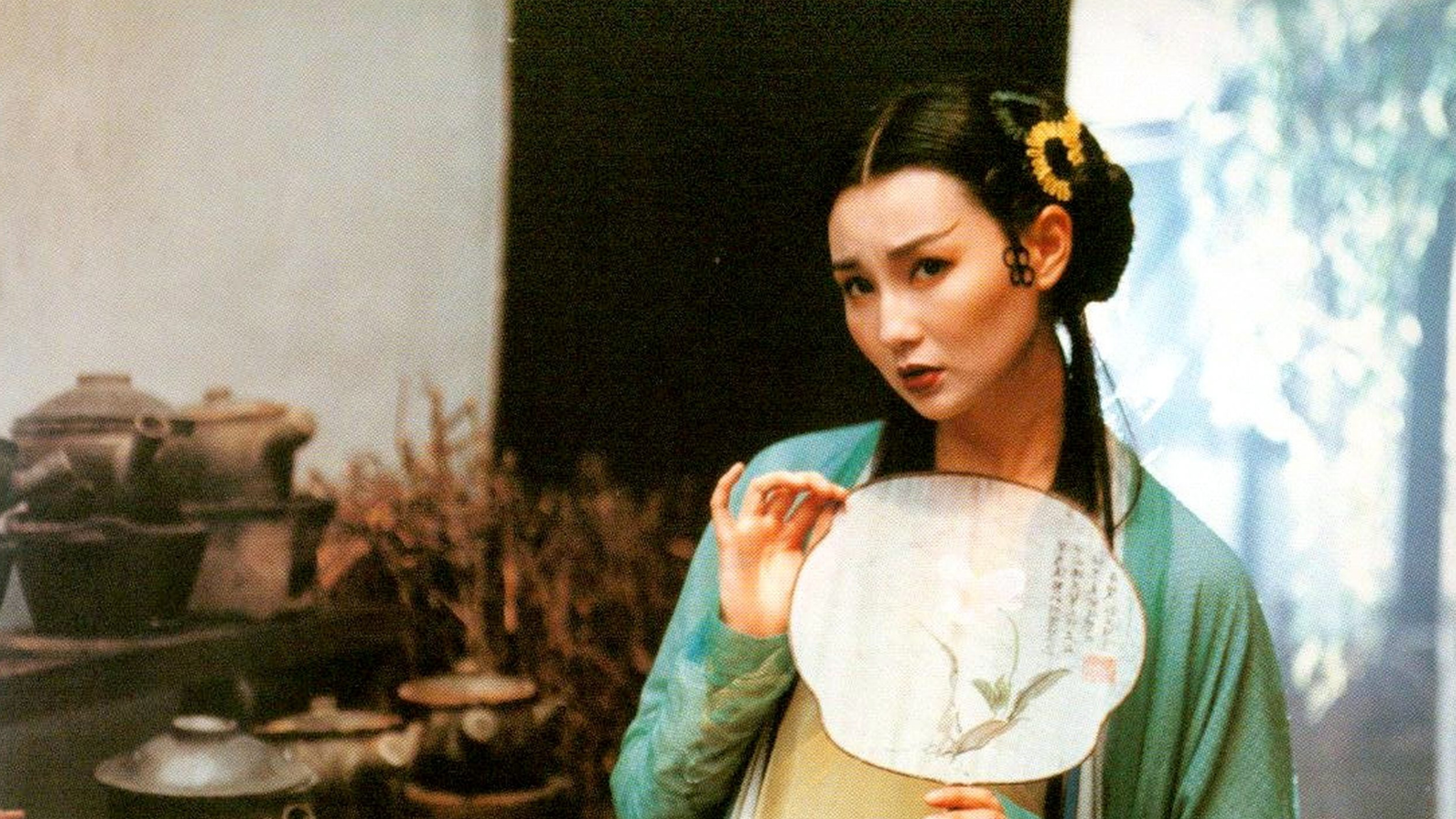
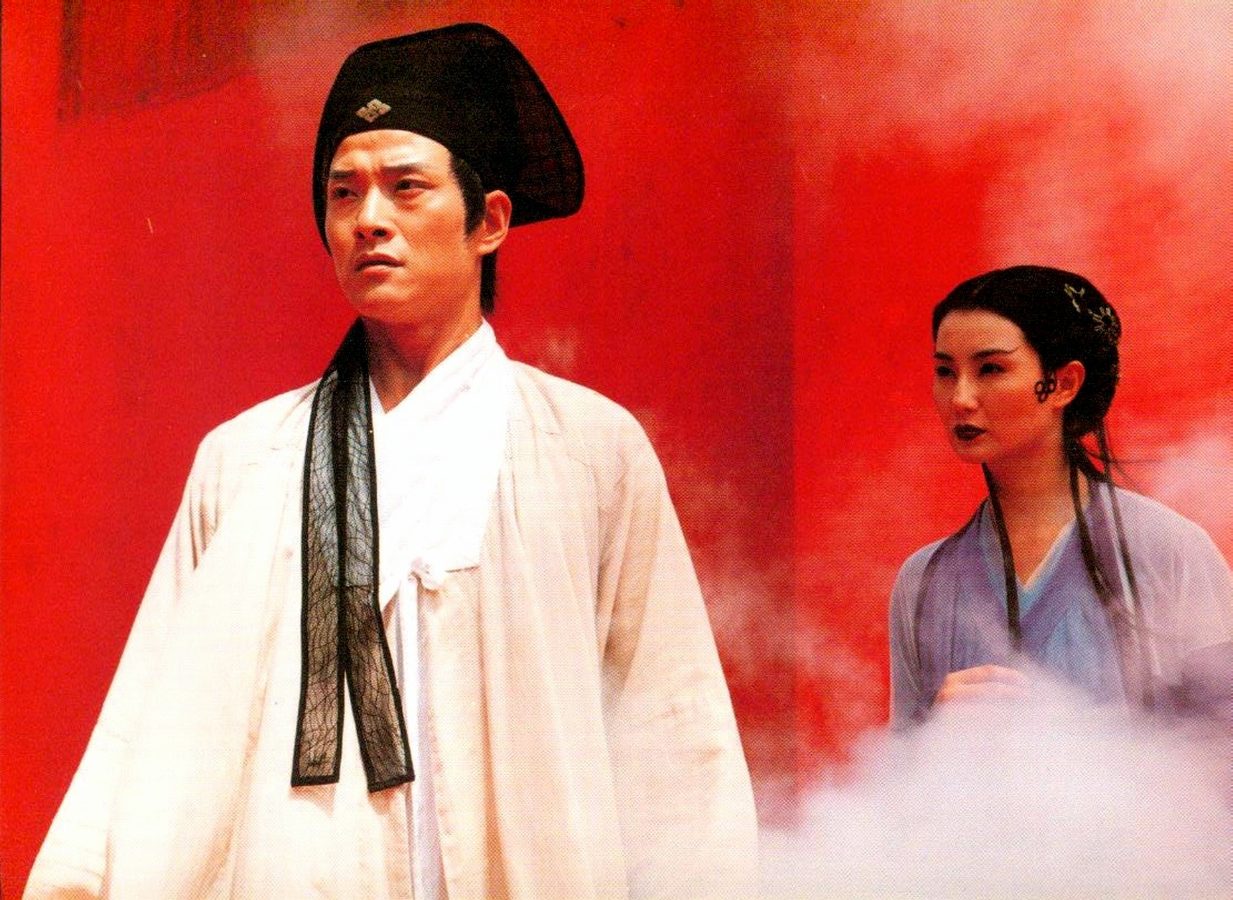
Another unmissable entry in Tsui’s revisionist fantasy oeuvre, landing between Zu: Warriors from the Magic Mountain (1983) and The Lovers (1994), his subversion begins with the title itself. In most iterations, the Green Snake, aka Xiao Qing, is merely the maid of the demon-woman lover, a supporting character. In Tsui’s reworking, though, this younger and more unruly sister—a snake demon, played by Maggie Cheung, who also takes human form and yearns to experience human emotions even as she doesn’t fully understand them—takes center stage. By making Xiao Qing the protagonist, her transformative journey propels the narrative, while Tsui sets up new relationships between the not-quite-love-triangle of the two sisters (with the elder, the white snake Bai Suzhen, played by Joey Wong) and the bumbling Xu Xian (Wu Hsing-kuo), and then, most iconoclastically, the powerful, demon-hunting Buddhist monk Fahai (played with a terrifying intensity by Vincent Zhao).
Green Snake (1993)
Tsui’s unconventional approach also announces itself during the 20-minute prologue. Instead of the expected first chance encounter between the two lovers, the film opens on the “villain” Fahai. We are introduced to the monk’s Bosch-esque nightmarish vision of a world populated with cavorting, deformed human masses, followed by his wire-fu treetop pursuit of a spider demon whom he battles and fiercely punishes, not for doing anything wrong (the demon has disguised himself as a Buddhist priest and has been striving to spiritually better himself), but solely because of what he is. This introduction establishes Fahai’s world as one of strict puritanical order, setting the stage for the ideological collision to come.
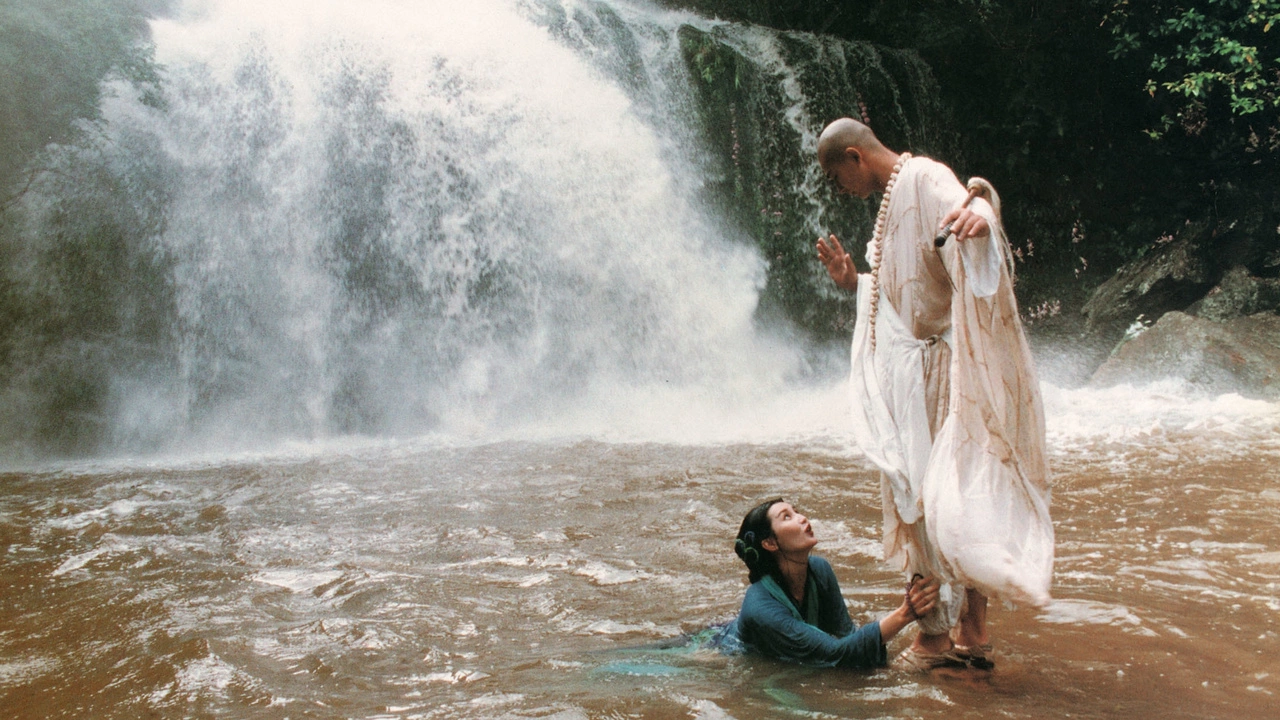
Traditionally, the Monk serves as the moral authority of this tragic romance, separating the human from his demonic lover and thus restoring order. Tsui, on the other hand, transforms this binary view into a critique of authoritarian fanaticism. During the film’s climatic flood, as the various powers all do battle, the monk’s red kasaya (monastic robe) magically enlarges, blocking out the sky and the sun. Yet this act inadvertently redirects the flood to hit nearby villages and his own Jinshan Temple, killing the very innocents that he claims to be protecting. Though the flood is a staple of the original legend, for a 1993 audience, this imagery would have likely conjured visceral memories of the 1991 Eastern China Floods that killed over 1,700 people and displaced many more, inspiring a massive relief effort from the Hong Kong film industry, including the speedy production of The Banquet (1991), a star-studded comedy that Tsui himself co-directed.
Green Snake (1993)
In Green Snake, however, this flood is a singularly man-made catastrophe. Fahai’s top-down zealotry, cloaked in a red-and-gold color scheme, is hard not to read as a visual metaphor for the all-encompassing state power and the series of political movements of the Mao era, which brought death and suffering to millions in China. In Tsui’s revision, when authority is so obsessed with its own ideological purity and institutional survival, no room is left for the hybrid, the emotional, or the heterodox—elements that were, and still are, essential to Hong Kong’s own unique identity.
Much has been written on Tsui’s lush sets, costumes, and the overall art direction of Green Snake, which expresses this tension between the stiff and the fluid. Across the film, there’s an emphasis on highly saturated colors and an abundant use of sensuous, flowing fabrics—especially in scenes taking place inside the mansion where the sisters live—as Tsui draws heavily on traditional Chinese watercolor paintings to heighten the fantastical, dream-like mood, anticipating the “global wuxia” aesthetics of the early 2000s, most evidently in films like Zhang Yimou’s Hero (2002) and House of Flying Daggers (2004). But what truly distinguishes Green Snake is its soundtrack. Cantopop legend James Wong, along with music arranger Mark Lui, here pushes the standard ’90s Hong Kong synth-pop standards into the avant garde, resulting in a listening experience that feels both ancient and futuristic at the same time.
Though there are only a total of 31 Chinese characters in the lyrics of the opening song, “Life Is Like This (人生如此),” Taiwanese singer Winnie Hsin’s ethereal, hypnotic vocals distill the story’s core themes: questions about human nature, desire, jealousy, and love. The track also uses acoustic guitar, the strings plucked like those of a guzheng, signaling the modern interpretation. Throughout the soundtrack, traditional Chinese instruments like pipa, erhu, and a variety of percussion combine with pop phrasing and modern textures such as synth pulses.
Green Snake (1993)
But perhaps the most unusual part of Green Snake’s soundtrack is the influence of Indian instrumentation. This was born from a specific request from Tsui, after he had written the lyrics of “Mahoraga (莫呼洛迦),” the song used for an early, Bollywood-style dance number in which Xiao Qing drops naked from the roof into a house filled with sari-clad Indian dancers, Cheung’s physical performance here a marvel of sinuous, reptilian movements. The title of the song refers to a race of deities in Indian mythology associated with music who are often depicted as anthropomorphic beings with reptilian bodies from the waist down.
Following Tsui’s cue, Wong channeled his admiration for the legendary Ravi Shankar into this scene with a composition rich with sitar and rhythmic percussion. This cultural commingling may strike some viewers as a bizarre choice, open to charges of exoticism, but a closer look suggests also that it befits the narrative, evoking what many academics believe to be the Indian roots of the original folk tale. The music here is more than decoration. It sonically marks the two snake spirits as “the Other,” establishing right from the start of the film that this contemporary, destabilizing update of the folk tale rejects the type of binary metaphysics advocated by Fahai. If the monk’s project is to enforce strict borders between human and demon, good and evil, the music insists otherwise, countering with a bold and seductive celebration of hybridity.
Later, as the final flood cleanses the screen, the audience again encounters the haunting echoes of “Life is Like This.” Cheung’s personal transformation concludes with a devastating close-up as, faced with the hypocrisy of human emotions, she sheds her first tear. Outside the temple, the monk and the demons’ epic battle wreaks death and destruction—a reminder that in Tsui’s worldview, beauty and chaos are one and the same, and that it is only within chaos that we can find our humanity.

Share:
Recommended
- Farley Granger
 On the queer star who defied mid-century Hollywood archetypes.
 - Geraldine Chaplin and Carlos Saura
 On the formidable collaborations of the Aragonese filmmaker and his American muse.
 - Genevieve Yue’s Trains
 On the offbeat pleasures of the train in Genevieve Yue’s new book.