

Albert Serra, photo by Claudia Campoli ©Locarno Film Festival
Interview
Albert Serra
From Locarno, an interview with the indefatigable Catalan filmmaker on his acclaimed recent works, including his Ingrid Caven documentary Sixteen Moments of My Life (2026).
Pacifiction (2022) is currently streaming on Metrograph At Home.
Share:
PREMIERING LAST MONTH AT THE Locarno Film Festival, and soon to screen at the New York Film Festival, the latest by Catalan auteur Albert Serra is a hypnotic work of nonfiction. Sixteen Moments of My Life (2026) documents a concert given by the chanteuse and actress Ingrid Caven, most recognizable as a beguiling peripheral presence in many of the films of Rainer Werner Fassbinder, her one-time husband, as well as those of Werner Schroeter and Daniel Schmid. Serra, for his part, enshrouds Caven on the stage of Paris’s Théâtre des Bouffes du Nord in a bath of rich, Rothko-esque reds, oranges, and blues: garbed in a backless black satin gown, she looks to be the center of an all-encompassing flame. Condensed into a suite of 16 dramatic and sometimes discordant songs—originally recorded as the 2025 album Heidschi Bumbeidschi, 16 moments de ma vie—Caven relates the story of her remarkable life, notable episodes including her stage debut, aged four, singing Christmas carols for Nazi soldiers, and her first time on camera for Fassbinder. Backing her are the band Molforts, longtime collaborators of Serra.
My interview with the director was scheduled for right after the world premiere of Sixteen Moments. (It being Switzerland, we met in a former bank vault.) With his louche air and penchant for wearing sunglasses indoors, Serra has adopted something of Fassbinder’s swagger—and, not incidentally, his calculated sadism too. To hear him describe it, an Albert Serra production seems like a kind of grueling psychological bootcamp: the mood is one of “pressure” and “oppression”; he refers casually to his actors “losing all hope”; to the feelings of “impotence” this hopelessness engenders.
It’s all in the name of cinema, of course. For his superlative Cannes 2022 competition title Pacifiction, a Tahiti-set neo-noir realized in postcard-saturated hues and sultry with a menacing languor—now streaming on Metrograph At Home—Serra not only employed multiple camera operators, as he has long done, but also used an earpiece to feed lines at will to his cast members, primarily star Benôit Magimel. Both are strategies meant to destabilize performers: by multiplying the angles from which the action is captured, by demanding that lines be parsed and delivered in the moment, Serra compromises their ability to consciously modulate their self-presentation—this being a near oxymoronic position for an actor to sustain. But what Serra hopes to engender through these interventions, and often seems to get, are new modes of being on screen.
Magimel here plays De Roller, a representative of the colonizing government in French Polynesia, at ease in a provincial existence lubricated by luxury. But his suave demeanor, of late, conceals mounting anxieties around his position, which may or may not be under threat by unseen forces. Meanwhile, sightings of an alleged submarine lurking offshore have sparked rumors among the locals of an impending resumption of French nuclear testing.
That Pacifiction was sculpted from a staggering 540 hours of footage—180 hours from each camera—goes some way towards accounting for the diffuse quality of its mysteries. Characters breeze in and out of view, each in possession of their own private motives, their exchanges courteous but elliptical to the point of opacity. The cumulative result is a narcotic postcolonial tone poem, a toxic tropical bloom, and one of this century’s finest films thus far. Serra showed up to our interview in a black aloha shirt boldly festooned with parrots and palm fronds; caught in the heady current of our conversation, I failed to ask whether it was a souvenir of his time in the South Pacific. —Keva York
KEVA YORK: You’re coming direct from the premiere of Sixteen Moments of My Life, so let’s start there. You first collaborated with Ingrid Caven on your 2018 stage production of Liberté at the Volksbühne theater in Berlin, but who was she to you before meeting her—what did the name “Ingrid Caven” signify?
ALBERT SERRA: Names don’t mean a lot to me. I am not into the mythology of whoever, just because they’re famous or because they’re a part of the history of cinema. I mean, I am 50 now: it’s no time to be into mythomania. I only start to really go in deep if I know them personally, or if they’ve influenced my work directly. So—I like Ingrid since I know her. Of course, I know [of] her because of Fassbinder, because of Daniel Schmid, because of other things, but I don’t choose actors because of what they did in the past. I don’t care. Even Magimel, I hadn’t seen any of his films before. I saw The Piano Teacher (2001) at the time, but that was years ago. I like him, and it starts, and then I prefer not to see anything.
Only during the edit do I start checking out some things, to make sure [the actors are] not doing anything the same. But usually they develop things in my shoots, because of my way of shooting. I just did this new film with F. Murray Abraham, and he was developing things he had never done before. I don’t care about the past. I care about the present and the future. So this was what inspired me: to create something new.

Sixteen Moments of My Life (2026)
KY: I believe you were involved in the creation of the Ingrid Caven album, prior to the film.
AS: The creation of the music, yes; the album, no. I was in deep on the creation of the songs.
KY: You appear on one of the tracks.
AS: Yes. And during the recording itself, I was there all the time, but I didn’t agree with some ideas. After all this effort, I said, “I have to do something where I am really the last one responsible.” With a concert, I have total control of the hierarchy of the elements.
KY: So the film wasn’t originally part of the conception of the project?
AS: Yes. But I think that the live [aspect] fits very well with the attitude of Ingrid and the musicians—this performance is something that looks improvised. Obviously, it’s not, but it has this special feeling of communication in real time. This intimacy, it develops better in life. In a record, okay, you can recreate that, but…
KY: Most people don’t have good speakers at home either.
AS: Yeah, and in the cinema, there is the big image—you feel you are inside the concert.
KY: Your approach here—homing in on Caven, suspending her in her own world, on her stage—mirrors how you chose to shoot the matador Andrés Roca Rey in Afternoons of Solitude (2024). Do you view these two films as being in conversation?
AS: You have to create every film as a world that is totally closed, independent of all the others. I like this idea—that you really respect the inner logic of every project, and there is nothing outside. I don’t even like the idea that it’s “reverberating”—when people start to say that a film is “reverberating with reality,” or that it explains things about the world. Okay, that’s your interpretation—but, like Ingrid says, it’s an artificial construction. If you start thinking that it “connects” when you are doing it, you start imposing ideas. This, I don’t like. I never control the content. I don’t know what the film “says,” what the point of view is. I don’t care. I just choose the formal elements that I like.
KY: This is actually the second Ingrid Caven concert film, after Bertrand Bonello’s Ingrid Caven: Music and Voice (2012)—which also premiered here in Locarno. His has a very different vibe—did you watch it?
AS: No—because my goal was to create musical expression. This was the thing. It’s not like we took young musicians in order to do what Ingrid was doing before. No, no, no. This is a totally new object.

Sixteen Moments of My Life (2026)
KY: Given how you typically work, did having a lot less material make the editing process easier, or perhaps somehow more difficult?
AS: Of course it’s easier. [Laughs] Documentaries are easier in general because fiction can have a lot of different tonalities. It’s much more limited in documentaries. The richness of having so many possibilities at the level of performance, it doesn’t exist here. In the end, it’s about visuals, rhythm—and here, I was serving the music. I’m just here to make this possible, to make it exist. But it’s them—they created the music.
KY: But you’re in the film too, briefly—you appear on stage at the end.
AS: Yes, of course—and it was my idea, and I put it together. It was a long process, I had to push everybody. I was translating Ingrid’s ideas to [the band], and translating their ideas to Ingrid—because they never talked to each other. Maybe at the very end, when they were already recording. But before that, never. So, I am a medium, a translator, or whatever.
KY: The film opens with Ingrid backstage, waiting to go on, and she’s coughing. I was curious about your decision to open like that.
AS: It was a way to say that she’s very old. She was 86 when she did the concert, she’s 88 now—you have to feel this a little bit, that it’s a landmark not only of creation but energy. Energy and will. It’s quite remarkable. It has a moving element when you understand that she’s very old.
KY: Did you film any more backstage material? In the conversation between you and her partner Jean-Jacques Schuhl that appears in Ingrid Caven: I Am a Fiction, the 2024 FIDMarseille/Fireflies Press book, you spoke about wanting to film her preparations for the performance, as you were doing with Roca Rey for Afternoons of Solitude—but there’s no such footage in the movie.
AS: No, because, as I said, I like the music. In the case of bullfighting, the preparation is part of the show. The pressure is so enormous that it’s reverberating before and after. Without this, you cannot understand. But here, no. The preparation is more relaxed. Of course, everybody that has to go on a stage has some kind of pressure, but it’s not the same thing. But we shot a lot. We shot even when they were recording the album.
KY: Not including any of that material is part of what produces the film’s concentrated quality, but then, in conceptual terms, it’s quite grand, it’s a whole life on stage—so there’s this contrast.
AS: Yes. The lyrics are the only thing that really go out of the frame, because they are talking about the past and a lot of intimate things—and collective things. It’s not all about Ingrid. Ingrid is expressing something that is part of the collective feelings of the 20th century.
KY: In that same interview, Schuhl describes her as someone who “directs herself,” but in your fiction films, you work to strip the actors of control over their performance. How did you approach working with Ingrid?
AS: What I say to actors is, “You are lost anyway, so forget it. Concentrate on the inside, not the outside.” Ingrid understood this quickly. And as the lyrics are also intimate, she said she lost hope of communicating with the audience. Okay, the audience is enthusiastic, but Ingrid is not receiving their applause as a gift. [Her performance] is not really connected with the audience. It’s connected with herself and with the musicians.
In this way, yes, she’s directing herself. But in the edit, I have some resources. For example, when she cries like a little girl, I did not like the face she was making, so I chose a shot with the camera behind. These are the kinds of little choices that I can afford, in order to impose my taste a little, but I think they benefit.
KY: On stage, Ingrid wears a gorgeous dress that was designed for her by Yves Saint Laurent, who called her his muse… I don’t know its history though, perhaps you do?
AS: He designed two for her. But as I said, I don’t care. I care that it works for the image. I am not a fetishist.

Pacifiction (2022)
KY: But you obviously care a great deal about clothes—Magimel’s costumes in Pacifiction are particularly memorable to me. The double-breasted white suit, the blue glasses—wherever De Roller goes on the island, he is this sort of beacon. Can you speak about his look?
AS: The sunglasses were [Magimel’s] suggestion. I liked the idea of sunglasses, but I was afraid that if we didn’t see the eyes, his performance would lose something. So he found this [tinted] alternative where we see the eyes, but we are losing a little of the true expression. They’re what gives a perverted edge to the character, because you can’t tell if he’s talking seriously or making jokes or if he’s really scared—or if he’s intelligent or stupid. They create a little ambiguity, and a lot of atmosphere.
The costume, I designed it myself—the shape, all the details. Then some months after, when [Magimel] came to Polynesia, he was a bit fatter. And there was not even one tailor who could adjust this. It’s too complicated—which says a lot. So it’s a little tight—but that created something. It’s more interesting for the character.
KY: There’s a slight decadence.
AS: Yeah, more decadent. He’s a little fat, with a suit that doesn’t fit. We are not in Paris, we are not in New York, we are in fucking Polynesia. We are in the territory of the losers, you know what I mean? They send the mediocre politicians there.
KY: “You go play over there, and don’t mess with us big boys.”
AS: This was the idea. And [Magimel] lost hope of controlling his own image at the beginning because of my methodology. When you lose all hope of controlling your image, you don’t care about anything—as an actor, I mean. You think, “The results of this film are not my responsibility anymore. These cameras, this system, it’s more powerful than my will. Even with all my energy, I will never be able to deliver a performance that is structured in a coherent way.”
KY: Was he surprised by his performance in the end?
AS: Of course. He won the César, and everybody told him this was the best performance of his career.
KY: Which must have been a mixed feeling, given how it came about.
AS: At the end of the day, my actors feel very unsatisfied, because they don’t feel that they are working with a grammar, you know? They feel that they are totally misused somehow. There’s a sensation of impotence. But they have to keep going: they’ve signed a contract; they trust the director; they are there. And of course, they get used to it: the second part of a shoot is better than the first because people start getting used to it, and everything is faster and more precise, more natural.
Pacifiction (2022)
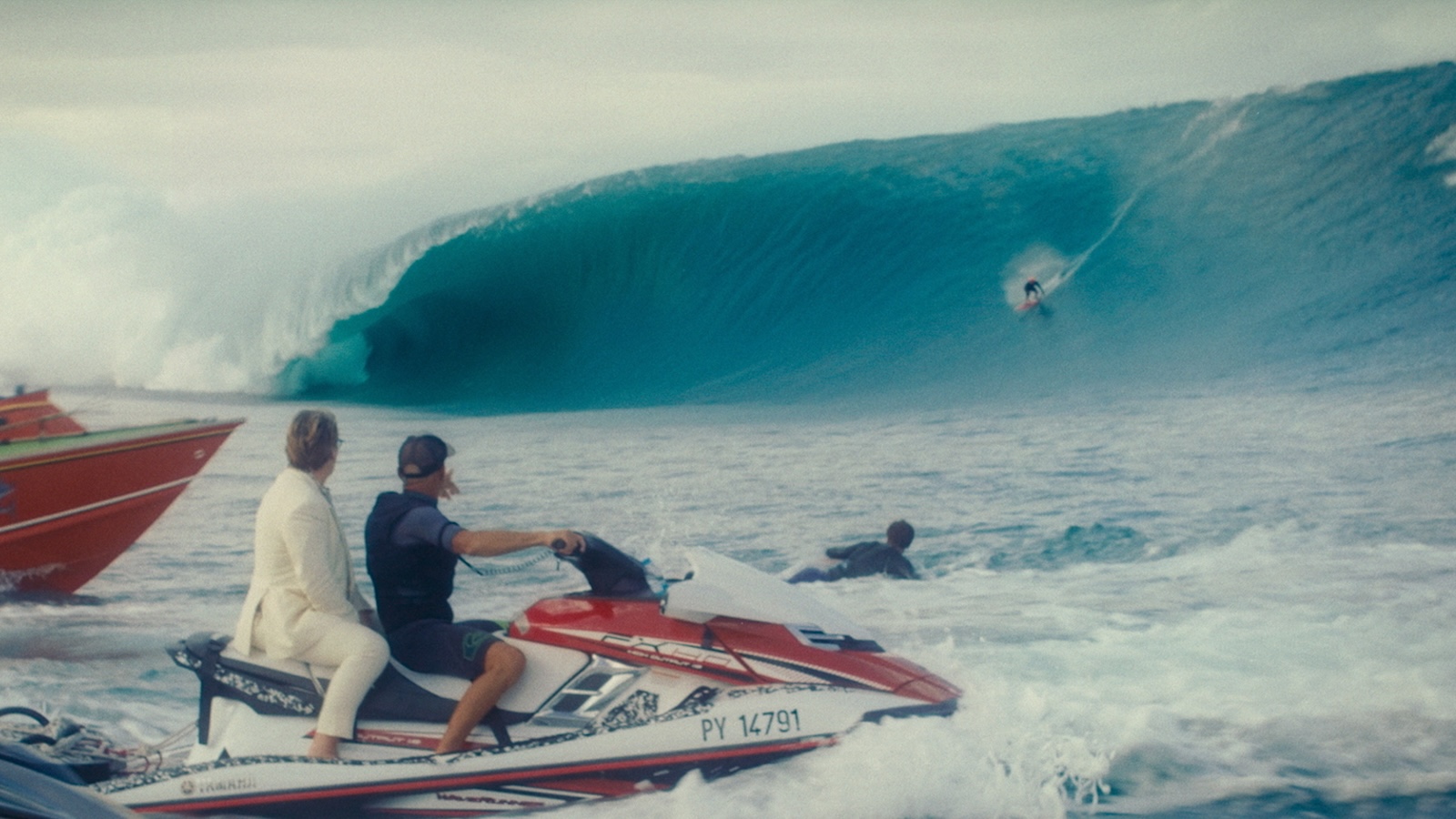
KY: I wanted to ask about one of the more spectacular scenes in Pacifiction, being the surfing competition that De Roller attends, which takes us right out to the water, buoyed up by these huge waves. Even revisiting the film on my laptop, my stomach dropped watching it. It’s transcendent and a little frightening and also comical at the same time, with De Roller in his bare feet on the back of the jet ski… How was it shot?
AS: We were lucky because we had already rented everything for this day two or three months prior; that there were big waves was by chance. [The rental company] offered us a lot of money to give back the boats because some other people wanted to go and see the surfing competition, but we said no.
KY: Wait, the waves were just there by chance?
AS: The waves are always there, but not as big. I would have created something different—that they were training, or something not based on this spectacular thing. This is what I do in general: I adapt. I will decide how to get the maximum potential out of what we have that day, in that place, with those people. For this reason, my shoots are intense, and short—because you cannot sustain this.
KY: There’s a tension in the methodology you’ve been describing between the idea of complete surrender to circumstance and total control. It feels kind of Warholian…
AS: I mean, the attitude during the shoot is the same, and [the method of] directing actors—that you direct actors not while shooting, but beforehand: one hour before, or even way before. I don’t say anything during shooting, just about. So, okay, here it’s similar to Warhol. But he wasn’t using digital cameras. He couldn’t shoot as much as me, and, of course, he didn’t have the knowledge to edit with the material of digital cameras, where you can really push things in the direction that you want, and you can hide a lot of things—but you need to be very skillful, and to be skillful at that, you have to have work with a lot of heterogeneous material, with a lot of rushes. If not, you will never learn. This is the key point. I think I am the man who has worked more with this kind of quantity of heterogeneous material for one project—which has to become homogeneous at the end—than anyone in the world, because all my shoots are out of control. I mean, there must be editors [who have dealt with similar quantities of material], I don’t know. Probably on Apocalypse Now (1979), or Heaven’s Gate (1980), or whatever. But that material was already homogeneous, made with some kind of control. Mine is not.
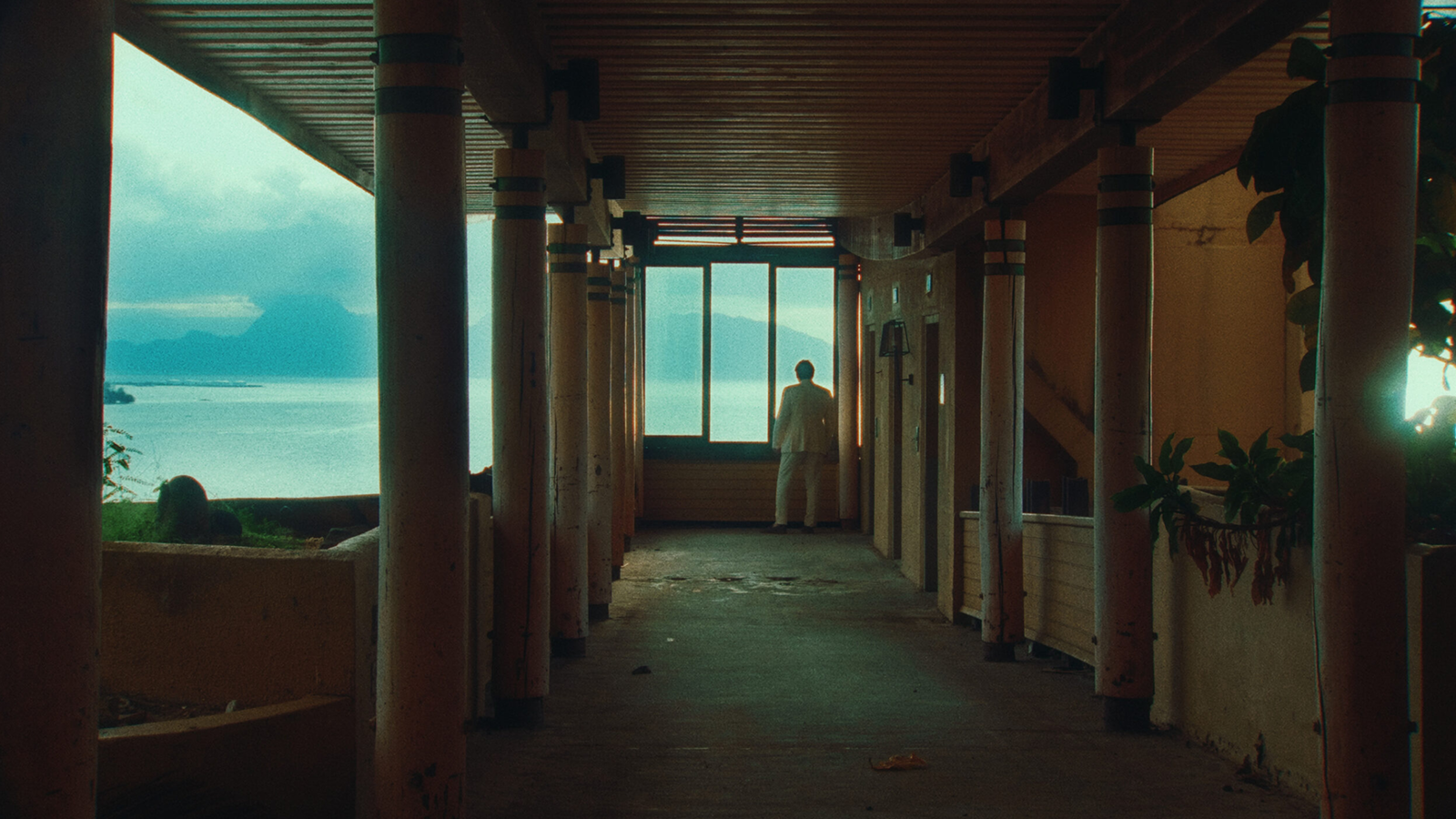
KY: Tone is a big “homogenizing” factor, and I know it’s something you think deeply about. Watching Pacifiction again, I was struck anew by how claustrophobic it feels—it’s maybe one of the most claustrophobic widescreen films I’ve seen. We tend to associate widescreen with a sense of spaciousness, but here even long shots of the landscape feel like they’re kind of being sandwiched. I was interested in how you created that effect.
Pacifiction (2022)
AS: It’s mostly about pressure. I put a lot of pressure, for example, on the camera operators. I don’t want them to just capture what’s going on in front of the camera. We are not at a football match, it’s cinema, and I get upset if they don’t give me cinema images. With the actors, the same: a lot of pressure. They receive a lot of money, so they have to give me something original. “Should I have to do everything? Why do you receive the money then, just to be a puppet? No, you are not a puppet.” I put pressure on them to give me inspired moments. So, it’s a combination of this, how to say, visual pressure and human pressure. This pressure creates an oppression. And you feel that it’s there, in the atmosphere, and it creates some kind of intensity.
With the wide shots, it’s what you said. This I discovered on Story of My Death (2013): they composed [the shots] in 4:3, and then I decided that it will be totally the opposite, CinemaScope. I said, “Nobody has done this before. Nobody!”—because, usually, CinemaScope is a narrative tool; a lot of things are happening in the frame at the same time. It’s narrative by definition. You would not do a portrait of a person like this because nothing is happening. But with cinema, it’s not a painting that you can analyze; it’s in real time, so you can play with sensations and confuse the spectator. What is narrative? What is not? Impressions appear, but when you feel something, they have already disappeared. You cannot grab them again.

Share:
Recommended
- The Illiac Passion
 On the most elaborate of Gregory Markopolous’s modern myths.
 - Jollof Films
 Senegalese visual artists and curators discuss the towering cinematic figures who inspire their craft.
 - Winona Ryder
 A Hollywood “It“ girl comes of age.