
Cracked Actor
Arnold Schwarzenegger
How the heavyweight star became America’s favorite father figure.
Terminator 2: Judgment Day (1991) opens for a weeklong 35th-anniversary revival run at Metrograph on Friday, July 3, as part of the series When Carolco Was King.

Terminator 2: Judgment Day (1991)
Share:
MOVIEGOERS CONFRONTED WITH THE ONSCREEN presence of Arnold Schwarzenegger can bet with more or less steady confidence that they’re in for (a) at least one sequence where someone’s brains end up on the wall, (b) legions of rogue law enforcement packing rounds of semiautomatic heat, (c) deaths punctuated with a dippy quip, and/or (d) generally blood-soaked cinematic product. Throughout the ’80s, those were basically the unspoken rules. Schwarzenegger wasn’t just some rifle-jacking, stogie-ripping hunk of action beef: the man made any movie feel like testosterone psychosis.
But faced with Schwarzenegger at slightly later points in his career, moviegoers might want to rethink putting money on that manic alpha maleness. For one, there’s Junior (1994), the film in which the Austrian behemoth gets pregnant. Or Jingle All the Way (1996), where the former bodybuilding lollapalooza plays a mattress salesman having a tough time securing his son a Christmas present. You might consider your cash safe around 1990, the year he took top billing in the carnage-crazy Total Recall—until you realize months later occasioned the premiere of Kindergarten Cop, in which he stars as the Hulk-sized caregiver to a class of mutinous six-year-olds who will not shut up. All that shrieking, bumbling, kiddie-forward havoc—had something mutated inside the seven-time winning champion of Mr. Olympia? Were these movies not wimpy to the son of a Nazi sergeant? “Everyone always tells you never to work with children or animals,” he said while shambling off Kindergarten Cop’s set. “When I went in, I was sweating.”
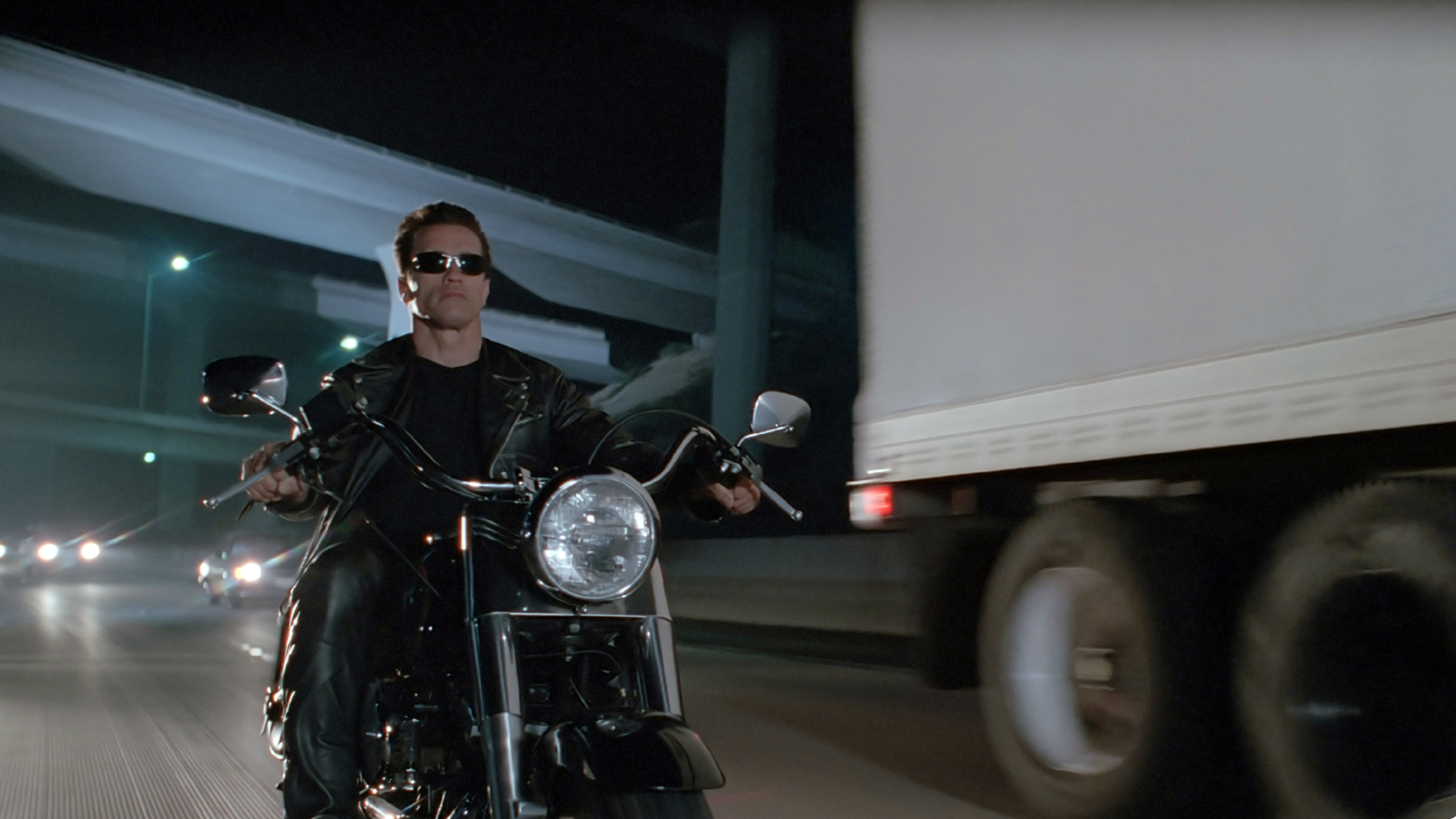
Released in 1991, Terminator 2: Judgment Day would mark his most notable occasion to sweat afresh. In what became the perfect zenith of his new, radically evolving image, the film gave the bankable meathead his most blockbusting feature, reinvented his most mesmerically hypermasculine role, and granted him the character that would be his for years to come, both in and out of films. Bet on this: for a time, Arnold Schwarzenegger was America’s favorite father figure.
Terminator 2: Judgment Day (1991)
Putatively, Schwarzenegger was absolutely not director James Cameron’s first choice to play the Terminator. In early 1983, Cameron, begrudgingly seated at a roundtable lunch among producers, industry heads, and later, Schwarzenegger himself, had decided the role of the cyborg had to go to an actor with the ability to, as the Canadian filmmaker put it, “disappear in a crowd.” Most of his team agreed. Schwarzenegger was too foreign, too mealy-mouthed, not quite the figure they envisioned as a smooth, skulking assassin—the Terminator couldn’t be less suited for a man with the grace and build of a Panzer tank. (Orion Pictures’ co-founder Mike Medavoy had O.J. Simpson as front runner for the role of the homicidal monster.) But Schwarzenegger descended like a hurricane on the bistro. He announced his candidacy for the role in his Teutonic, mangled delivery, declared his passion for the murderous instincts that the script demanded of its leading, leaden man, and Cameron, staring back at the actor, was at a loss. “Fuck,” he thought. “It would be monolithic.”
Slablike and surreal, The Terminator begins with a storm of blue lightning and the sudden presence of its star, naked and with greased-up triceps. Schwarzenegger is the T-800, an android grim reaper sent back in time from 2029 A.D. to the 1980s, care of his warmongering manufacturer Skynet, an AI-powered US defense system gone berserk. His sole assignment is to execute waitress Sarah Connor (Linda Hamilton), who, unbeknownst to her, is fated to sire a cosmically significant son destined to lead the human revolution after a nuclear holocaust that Skynet will enact in 1997. Simultaneously, the human Kyle Reese (Michael Biehn), sent back through the same inexplicable time-travelling portal by a team of future resistance fighters, materializes to protect her. As the Terminator hunts his prey, Reese and Connor chase around LA until they pause for a night in a rank motel. We realize it all at once: Reese was sent to knock up Connor, making him the father of the hero of the future revolution.
True to its twisty, Old Testamental plot, much whamming, blamming, gothically nasty horror abounds. Schwarzenegger’s Terminator bears battants of plasma missiles, sunders Reese via pipe bomb, gets scalped, fully skinned, then finally pretzeled inside a giant hydraulic press—by the astronomical reception for the film alone ($78.3 million international gross at a $6.4 million budget), it was obvious: America loved watching that big hunk robot go.
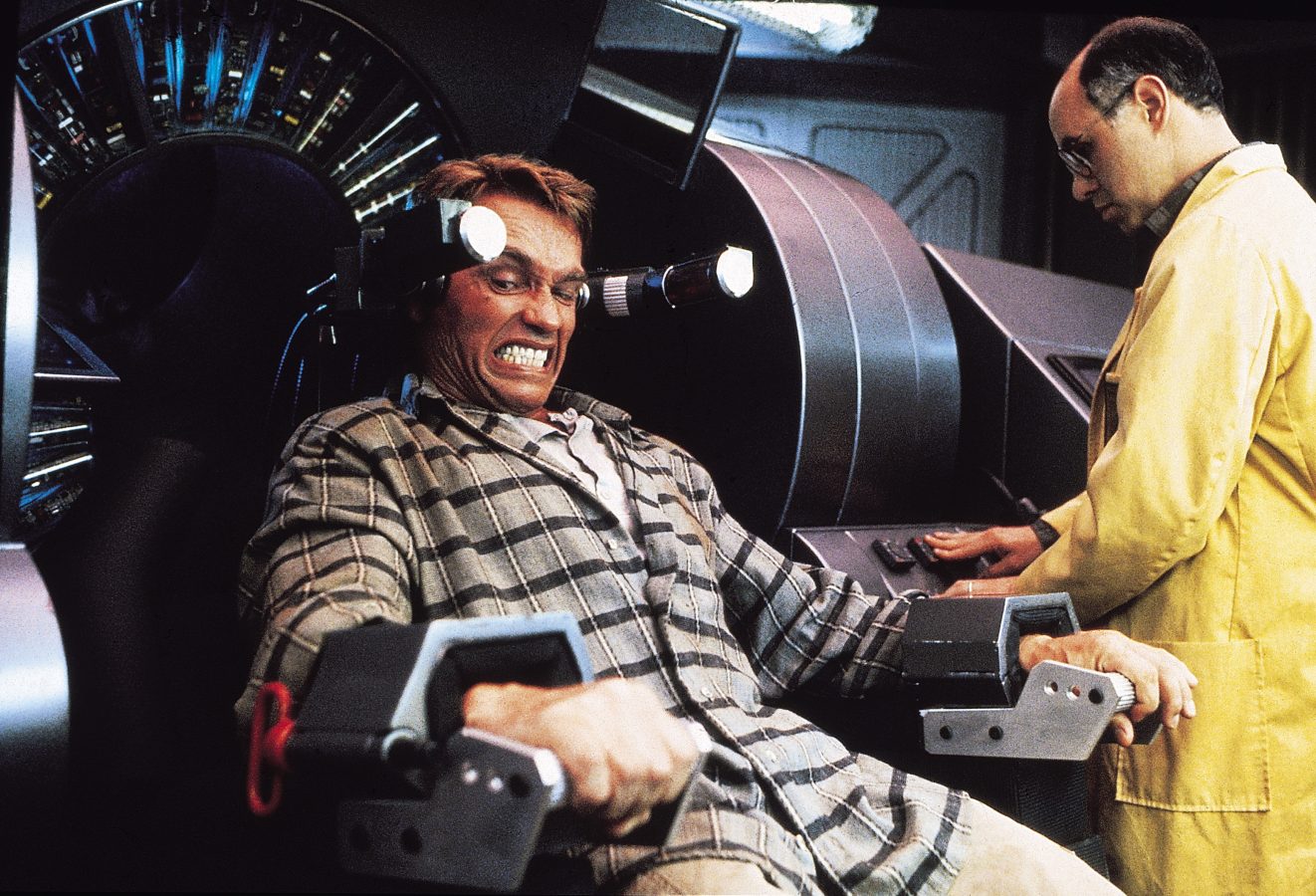
The gangbusting success of Terminator flung Schwarzenegger into what felt like every viable cranny of action stardom. It was a wonderland of sandals and swords (1985’s Red Sonja), jungle munitions (the Melvillian Predator, 1987), and triple-titted Martians (again, Total Recall), all of which sent his order of celebrity soaring to a different stratosphere. If the hallmark of American cinema in the ’80s was the action movie—not unlike what the Western was to the ’50s—Schwarzenegger had become, by no exaggeration, a folk hero of the Reagan-era cultural imagination.
Total Recall (1990)
In fact, Schwarzenegger had allegedly been thinking of himself as the natural ideological descendant of that very movie-cowboy-turned-California-governor-turned-President. Already a self-proclaimed Republican after admiring Richard Nixon’s stand off against Hubert Humphrey in a 1968 Presidential debate (in Schwarzenegger’s autobiography, Total Recall: My Unbelievably True Life Story, he calls Humphrey’s points about welfare and government programs “too Austrian,” whereas “Nixon’s talk about opportunity and enterprise sounded really American,”), the actor notes his respect for Reagan had been growing to a near-worshipful fever. An inconceivable passage in that same autobiography details Schwarzenegger Scotch-taping above his bed “this cool black-and-white poster of a cowboy with two guns drawn” that he bought in Tijuana for five American bucks in 1969, completely unaware at the time that it was a promotional photo of Ronnie.“It looked so beautiful hanging there,” he writes.
With his combination of Republican vim, bootstrapping optimism, and belief in the American Dream, at the heyday of his celebrity, Schwarzenegger spent a mammoth amount of the early ’90s knocking about the US Presidential cabinet. Ever the enterprising hulk of American capital, Schwarzenegger—who’d missed his opportunity to cozy up to Reagan—befriended George H.W. Bush at the dawn of his presidency, and their inseparable, Pinky-and-the-Brain relationship became a charming tabloid mainstay. (Another portion of My Unbelievably True Life Story festively recalls an incident in which Schwarzenegger accidentally breaks First Lady Barbara Bush’s leg while sledding on one of his many holidays with the family at Camp David.)
One year before the release of Judgment Day, Schwarzenegger began his largely ornamental post as Chairman of Bush’s Council on Physical Fitness and Sports, much of which was spent presiding like a monster over annual ceremonies of hacky sack and basketball on the White House lawn. His moments at the podium allowed him to announce the basic tenets of what would become his future platform—pro-enterprise, anti-drug, anti-laziness, plus one declaration to all American children to “get off your Nintendos”—in a spectacle of paternal politics. “The youth in this country have a terrible problem,” he bemoaned in his opening remarks for his “Great American Workout” on the sunlit south lawn. “They are getting fatter and slower.”
John Connor (Edward Furlong), on the other hand, is shrimpy and agile. Aged 11ish, the son of Sarah Connor is the orphan boy-hero, emotional center, snot-nosed mallrat, and sweetening agent of Terminator 2: Judgment Day. If action sequels necessarily have to raise the stakes of the original—whether that’s by making the bad guys badder, giving the good guys new reasons to fight, or introducing new characters altogether—incorporating a tween Connor at the film’s core amends the noirish nastiness of The Terminator with a sneakily heartwarming Part Two.
Cameron has taken pains to emphasize just how loudly Schwarzenegger initially balked at the idea of a tender Terminator. When presented with the script, “Schwarzenegger goes, ‘It’s very well-written, but I don’t kill anybody.’ I’m like, ‘I know, that’s what’s so great about it! We take this guy who’s this monster and we make him a hero!’ He was aghast.”

Conan the Barbarian (1982)
Fortunately, Judgment Day would offer Schwarzenegger plenty of opportunities to slake his gun lust. The film opens by dropkicking viewers into a quick, two-minute montage reminding them of Skynet’s nuclear war on the human race in 1997 (many tumbling human skulls, the cold blue light of Armageddon, etc.) until the film shuttles back to 1995. It’s been 11 years since the tribulations of Sarah Connor in the original Terminator, and the time-travelling portal is evidently open for business again. An entirely different Terminator-style robot has been ported in from 2027 (Schwarzenegger, in the nude anew) re-programmed to protect the young John Connor from the advances of an implausibly tricked-out, state-of-the-art, whole other Terminator (an unblinking Robert Patrick). Naturally, the latest bogeyman’s perdurable upgrades (a body composed completely of mutable liquid crystal; arms that slice, dice, enucleate) up against Schwarzenegger’s outmoded model (standard human flesh stretched over a metal endoskeleton), pose horrific, pedicidal problems for both Connor and his robo-attatché.
As far as targeted children go, Furlong plays Connor with rather whiny aplomb. But the prodigal son (check his initials) of the future revolution could be forgiven: he’s both motherless (due to mom’s internment in a mental institution after harping on and on about a robot-led holocaust) and fatherless (recall his dad was blown up vis-à-vis the Terminator). His perpetually pissed-off foster parents offer little in the way of ministration for their young ward, leaving him to spend his days roaming LA’s arcades and sluiceways with the aimlessness of a kid bum. This is to say, the new Terminator’s advances are an addition to his growing list of problems. It’s not just the future that wants him dead—the present doesn’t care much for him either.
When we are finally reacquainted with Sarah Connor (Hamilton, reprising her role), we notice some material changes. Embittered by her diagnosis as a hysterical nut, relentlessly abused by her pervy doctors, and given to explosive outbursts (typically of the “Don’t fuck with me!” stripe), The Terminator’s naïf has become Judgment Day’s nihilistic battle angel: a jacked, cyborg-liquidating, shrieking menace.
All the more interesting, then, that Connor’s venom feels most acute when directed toward human men.
Schwarzenegger’s robot can only watch with impassive, ape-like interest as mother Connor holds a rifle before the inventor of the tech hardware (played here by a trembling Joe Morton) that, if developed to completion, will domino the destruction of humankind. “You men don’t know what it’s like to really create something!” she screams, a Colt Commando wobbling at his forehead. “To create a life, to feel it growing inside you! All you know how to create is death!”
True Lies (1994)
Notwithstanding its R-rating, Judgment Day’s success should be credited in no small part to its considerable audiences of children. Millions of young T2 fanboys flooded mall and suburban multiplexes in colossal measure courtesy of Judgment Day’s dynasty of tie-ins, marketing deals, jigsaw puzzles, action figures, and fast-food commercials (including Subway’s heavily advertised “T2 Terminator Meal,” which promised to “Terminate your hunger. Terminate your thirst.”)—all of which hinged on Schwarzenegger hype. From the 32-ounce Subway cup wrapped with Schwarzenegger’s bipartite face, to the way that his T-800 crunches through the doofy ’90s kid-speak John Connor teaches him (ex. “Hasta la vista, baby,” or “Chill out, dickwad”), Judgment Day’s rollout seemed primed for John Connor–sized and –aged preteens in the throes of Schwarzeneggermania.
But an action hero marketed toward children poses inherent questions about what precisely makes him a hero. Certainly, Schwarzenegger maintains a unique gift for blowing holes through enemies in both The Terminator and its sequel, which is heroic enough as is. But Judgment Day belongs to a specific canon in which children walk through the counterspectacle of apocalypse with some sort of useful companion—much like in A Boy and His Dog (1975), Children of Men (2006), or even the adaptation of Cormac McCarthy’s The Road (2009). When the malevolent killing machine of the original film has been given a touching, protectively paternal mission in the second, it’s difficult not to see Schwarzenegger’s robo-step-daddy as a treatise on the necessity of a male shepherd in a young man’s life.
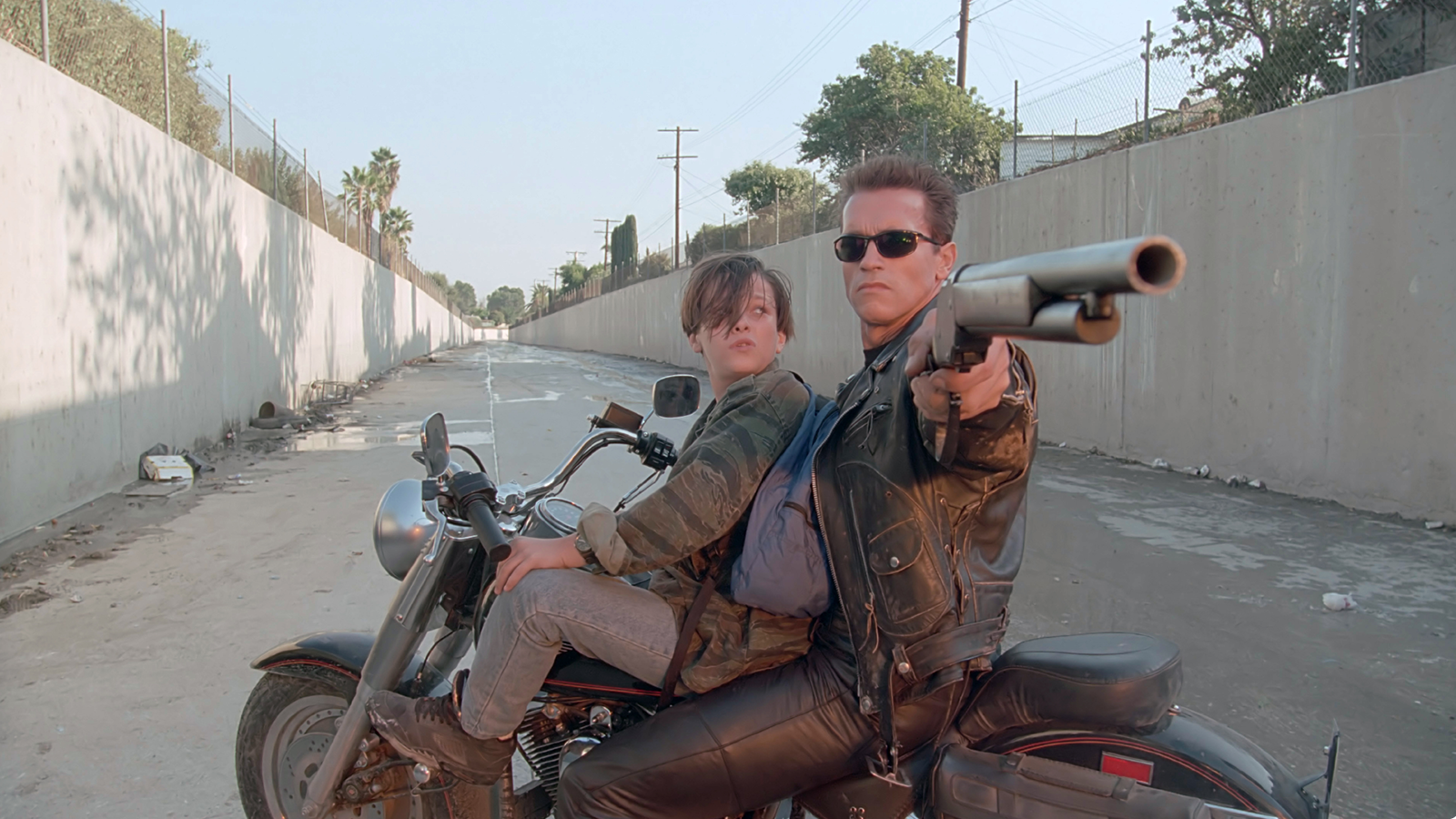
In Judgment Day, Connor—bewildered and victimized by the rules of a game he never learned, motherless, and handed an unreliable but certainly vicious future—has only the Terminator to indoctrinate him into his warrior-manhood. The T-800 offers the same sort of nurturing masculine guide of the ilk historically identified with shamans, seers, gurus, and otherwise holy chaperones, qualified to give second birth to young men in lack of guidance. An action-figure-meets-father-figure that’s not strictly savage, but a primal, virile force. “Of all the would-be fathers who came and went over the years,” says Sarah Connor, gazing fondly at the Terminator offering an Uzi to her child, “this thing, this machine, was the only one who measured up.”
Terminator 2: Judgment Day (1991)
On television, at malls, in civic auditoriums, state assemblies, and anywhere else Schwarzenegger’s majesty happened to present itself, his Terminator seemed to follow him. “I wanted to be an action hero for kids in the movies,” Schwarzenegger announced in his public entry into California state politics before his run for governor in 2003. “Now, I want to be an action hero for kids in real life.”
If Judgment Day seems to suggest that the ideal father can come only from an unknown future, Schwarzenegger’s ascension to power in American politics a little over a decade later felt like a mystic prophecy fulfilled. Off the big screen and on the gubernatorial stage, he offered himself as the candidate to rescue humanity from slavery (i.e. taxes) and annihilation (i.e. climate change): to serve as a father substance to lead thirsty Californian citizens to water. If the people wanted action, here was its hero.
His term, it turns out, became a tally of rather unremarkable policies. (He vetoed legislation that would have made California’s illegal immigrants eligible for driver’s permits; kept consistent, though strangely disillusioned support for the Iraq war; remained open to climate change policies, all of which, during his later years in office, were eclipsed by the 2008 financial crisis.) In fact, if there’s one thing his governorship was consistently remembered for, it was the sheer cinematic circus of its campaign. With his proclivities to, say, announce his candidacy on The Tonight Show With Jay Leno while on the Terminator 3: Rise of the Machines (2003) publicity tour, drop a massive weight on a junked Buick to represent his plan to crush the California car tax, repeatedly vow to “terminate the deficit,” and bid “hasta la vista” to incumbent Gray Davis—all of it blurred Schwarzenegger-as-action-star and Schwarzenegger-as-political-star. As he pronounced in his 2003 victory speech—with a sentiment as duty-bound as the lines spoken by his paternal cyborg in T2—“I will not fail you. I will not disappoint you. And I will not let you down.”
In a bit of twisted irony, the final days of Schwarzenegger’s governorship were blighted by one of the largest celebrity scandals of that decade. In January 2011, he publicly admitted to a 14-year-old infidelity with his family’s housekeeper, in which he had sired, and hidden, a son.

True Lies (1994)
For all the big bangs of Judgment Day, it’s difficult to accept its finale as anything but a whimper. The Terminator is lowered into an acid vat; humanity hangs in the balance. Just before the credits scroll, Sarah Connor’s sighing soliloquy of sympathy for the cyborg (“I face the future with hope, because if a Terminator can learn the value of human life, maybe we can, too”) will and should nag contemporary viewers familiar with the present reality—one in which robots already seem to be in the noxious employ of every American child, and an AI-induced dystopia seems in early swing.
Instead, consider the film more as a Herculean portrait of an actor at his hybrid peak. The father-figurehood, the bone-smashing bombast—Schwarzenegger’s evolution of action-heroism here reaches its apotheosis, and Judgment Day might be best approached as an impressively vivid metaphor for the ideas that would follow him into the political theatre. Ideas that would warp, melt and fade, just like his T-800 does in the magma of his making.
Near the midpoint of the movie, Schwarzenegger’s robot delivers a rather fatherly piece of advice. ”It is in your nature to destroy yourselves,” he says flatly to John Connor.
The kid, staring into the sun, responds: “Yeah. Drag, huh?”

Share:
Recommended
- Bram Stoker’s Dracula
 On the set of Bram Stoker’s Dracula (1992) On Francis Ford Coppola’s gorgeous and stubbornly old-fashioned approach to the immortal…
 - Christopher Doyle
 The legendary DP discusses working in different cultures, his collaborations with Wong Kar-wai, and dancing with Pina Bausch.
 - Cracked Actor: David Gulpilil
 Looking back at the inimitable Indigenous icon.