
Columns
Futures and Pasts: Pirosmani
In Futures and Pasts, Metrograph’s Editor-at-Large Nick Pinkerton highlights screenings of particular note taking place at the Metrograph theater. For the latest entry, he considers Giorgi Shengelaia’s tender and altogether sublime biopic of the Georgian painter Niko Pirosmani.
Cinema Naïf presents: Pirosmani screens at Metrograph from Saturday, May 30 as part of The Lives of the Most Excellent Painters.

Pirosmani (1969)
Share:
A FEW YEARS BACK the earth was stricken by a terrifying and mysterious outbreak: “Van Gogh Alive”! “Beyond Van Gogh”! “Imagine Van Gogh”! Not since the appearance of Shen Yun has a pseudo-cultural event spread so rapidly as that of the immersive Vincent van Gogh experience! One of these, the aptly titled “Immersive Van Gogh Exhibit,” was designed by digital artist Massimiliano Siccardi; per producer Corey Ross, Siccardi’s work allows the visitor “to go into van Gogh’s mind to show us what flashed before his eyes before he passed away.” The lonesome end of the redheaded Dutchman—deemed too precious a property to be vouchsafed to him alone—is now be had for $29.99 and up. In an age where such spectacles not only exist but are highly remunerative, Giorgi Shengelaia’s extraordinarily sensitive biopic Pirosmani (1969) acts as much-needed antidote.
The subject of Shengelaia’s film, the painter Nikoloz Pirosmanashvili, better known as Niko Pirosmani, was believed to have been born into a peasant family sometime between 1862 and ’66 in the village of Mirzaani in the eastern Kakheti region, then, like most of the territories comprising modern-day Georgia, a suzerainty of the Russian Empire. In 1861 Tsar Alexander II had abolished serfdom in Russia, a process that would shortly thereafter begin, with halting progress, in the march principality squeezed between Rus and the sclerotic Ottoman Empire. In 1870, following the deaths of both parents, Pirosmani is said to have found himself attached to the household of an Armenian family, the Kalantarovs, and with them come to live in the city now known as Tbilisi, then a metropolis of some 100,000 souls going by the name of Tiflis. Starting to work young, he earned his daily bread in a variety of odd jobs—farmhand, typographer, cook, brakeman on the Transcaucasus Railway, shopkeeper—while, in his spare time, doing a bit of daubing.
By around the turn of the century Pirosmani, unlucky in love and unsuited to business, concluded that he was made for painting and painting alone, and thenceforth lived a peripatetic existence, trading his wares for drinks and a night’s backroom board in the dukhans (taverns) that dotted Tiflis—he favored the Old Town on the left bank of the Kura River—and the rugged Georgian countryside. Malnourished, his liver pickled with drink, he died of influenza sometime around Easter of 1918, a little more than a month before the establishment of the Democratic Republic of Georgia, itself fated in a few short years to be annexed by the Soviet Union. As is true for all of us who manage to pass a few decades on this planet, and perhaps more than usually so in Pirosmani’s case, the world he left was radically altered from that which he’d come into, but the taproot of his art was the countryside of his youth, and traditions that must have seemed as ancient and unchanging as the Caucasus.
Pirosmani worked swiftly, decisively, and forcefully, using factory-made oil paints, rarely mixed before application. His favored canvas was black wax cloth intended for industrial usage—he often used sections of unpainted base as part of his compositions—while he also occasionally turned his brush to cardboard, tin-plated sheet metal, and the walls of various dukhans (none of the last-named work has survived). His corpus includes still lifes, genre vignettes depicting rural rituals, portraits (most of these full-length), battle scenes, historical paintings with subjects drawn from his homeland’s glorious distant past, and eccentric renderings of animals, both domestic and alien, including a giraffe as distant from its real-life model as any of “Le Douanier”Henri Rousseau’s jungle beasts. (This pale giraffe, doleful eyes turned towards the spectator, is the first of several canvases that appear alone against a black backdrop in interstitial moments in Pirosmani.) He favored flat, frontal compositions that have drawn comparisons to Byzantine and medieval art and would, in his lifetime, gain the admiration of a handful of avant-garde artists looking to unloose themselves from the strictures of Renaissance perspective. In 1972, a few years after Pirosmani had its premiere, Pablo Picasso contributed a drypoint etching of the artist to accompany the French translation of a 1914 article on Pirosmani by Ilya Zdanevich, one of a small cadre of the Georgian’s early champions in Russia.
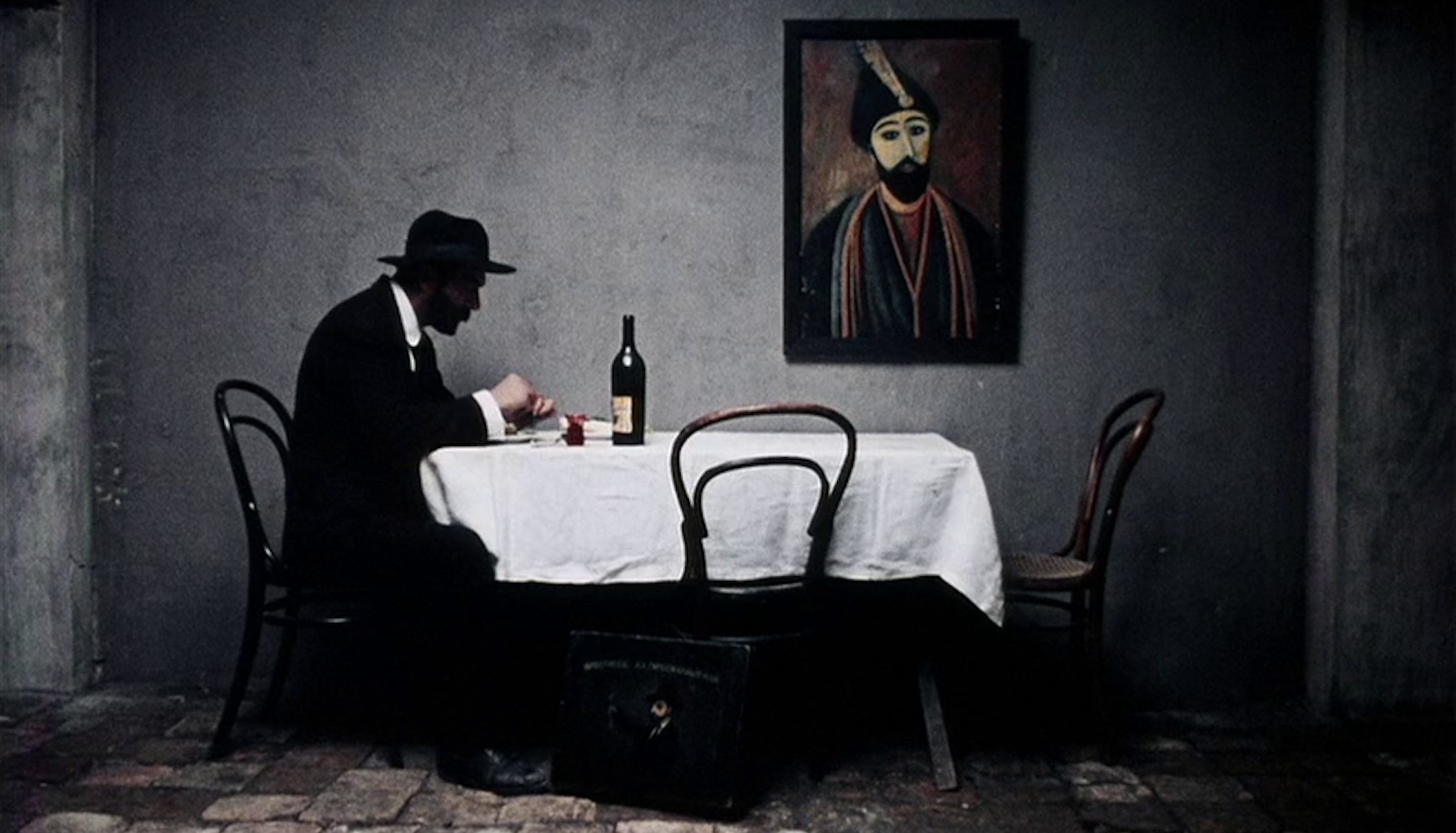
Pirosmani (1969)
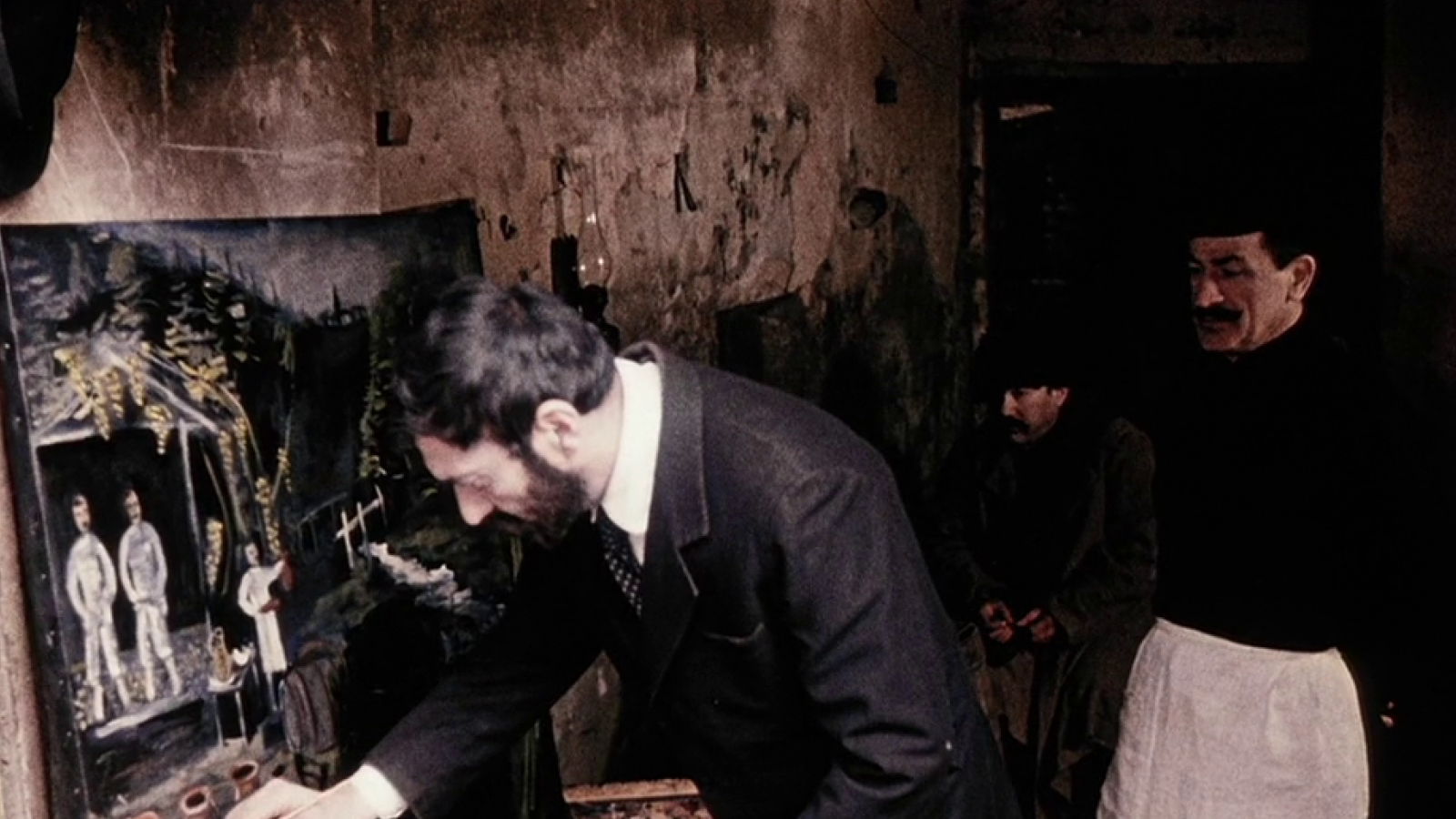
The first of these was the painter Mikhail Le Dentu who, on a 1912 visit to Tiflis, stumbled across a Pirosmani during a visit to the Varyag tavern, and spent a summer trying to track down the artist, events depicted in Shengelaia’s film. Its first 50 minutes are occupied by this languid pursuit, toggling back and forth between scenes from Pirosmani’s life and, with just enough frequency to remind us of their existence, those of a pair of citified dandies on his tracks, poring over his work silently in drinking cellars and bawdy houses. (The pursuers are not identified as Le Dentu, Zdanevich, or Zdanevich’s brother, Kiril, but they are the clear inspirations for these characters.)
It becomes evident in time, however, that Shengelaia has taken a highly unorthodox approach to this particular chase; while his two admirers don’t age a day or change their dapper outfits from one appearance to the next, their quarry passes from relative youth, in which he sports a jet black moustache and expresses modest commercial ambitions, to prematurely wizened middle age, his now-full beard streaked with gray, his every aspiration to living a settled domestic life abandoned as impracticable, incompatible with his need for absolute freedom. While a few weeks, perhaps, pass for this duo, some 20 years flit by for Pirosmani. A further piece of chronological sleight occurs later, as Pirosmani returns to the home in the country shared by his sister and brother-in-law: Shengelaia crosscuts between the hollow-cheeked, stoop-shouldered artist and a boy in peasant dress bounding across the same landscape with all the verve of youth, suggesting that what we’re seeing in the scenes with the adolescent are Piromasi’s memories of his childhood in the countryside.
The painter is played, with a potent plangency and a nigh Bressonian impassivity, by Tbilisi-born artist Avto Varazi, also credited as the film’s art director and production designer. Varazi was in his early forties when he appeared in Shengelaia’s film, released at the end of the decade of his greatest public success, and would be dead at age 50 in March of 1977, his premature end, according to what little information exists on Varazi, hastened by steadily worsening alcoholism. Varazi’s Pirosmani is an increasingly ghostly presence, silently taking in the world through velvety eyes beneath beetled brows. When raptly watching a performance by the visiting French chanteuse and dancer Margarita de Sevres, whom he will immortalize in his 1909 The Actress Margarita, he has a funeral pallor, his sallow face the chalky white of which Pirosmani was so enamored. He is often on the move, but with the slow, deliberate, drifter’s gait of someone in no great hurry, welcome most anywhere but expected nowhere. When Shengelaia shoots Varazi from behind, I was reminded of Sam Peckinpah’s reported response to seeing a certain shot of William Holden in dailies of The Wild Bunch (1969): “Look at that back! That’s a lonely back!”
The stock of trustworthy biographical information on Pirosmani is scanty, but much of what comes down to us becomes the skeletal framework of Shengelaia’s spare, solemn film. Representing the artist’s various early attempts to situate himself in a sound vocation, we see his establishing a creamery with a partner, as well as his reported penchant for purchasing donkey loads of fresh-mown green grass to lie out on in reveries during business hours. We see the painter of so many banquet scenes, in a dukhan or en plein air, refuse an invitation to join a convivial party at a neighboring table, as he was said often to do. (“It happened quite often that the people feasting in the cellar invited him or bought some wine for him,” reported wine merchant Nikoloz Sozashvilie. “First Niko would refuse politely and then, if they insisted, he would get very offended. In 15 years I had never seen Niko sitting and feasting with other people.”) And we see, finally, his appearance, on May 25, 1916, at a meeting of the then-newly formed Georgian Art Society where Pirosmani was heard to express his modest vision of Utopia: “Let’s build a big wooden house in the middle of the city… We ought to buy a big table and a big samovar, and drink a lot of tea, and talk about painting and art.”
Pirosmani (1969)
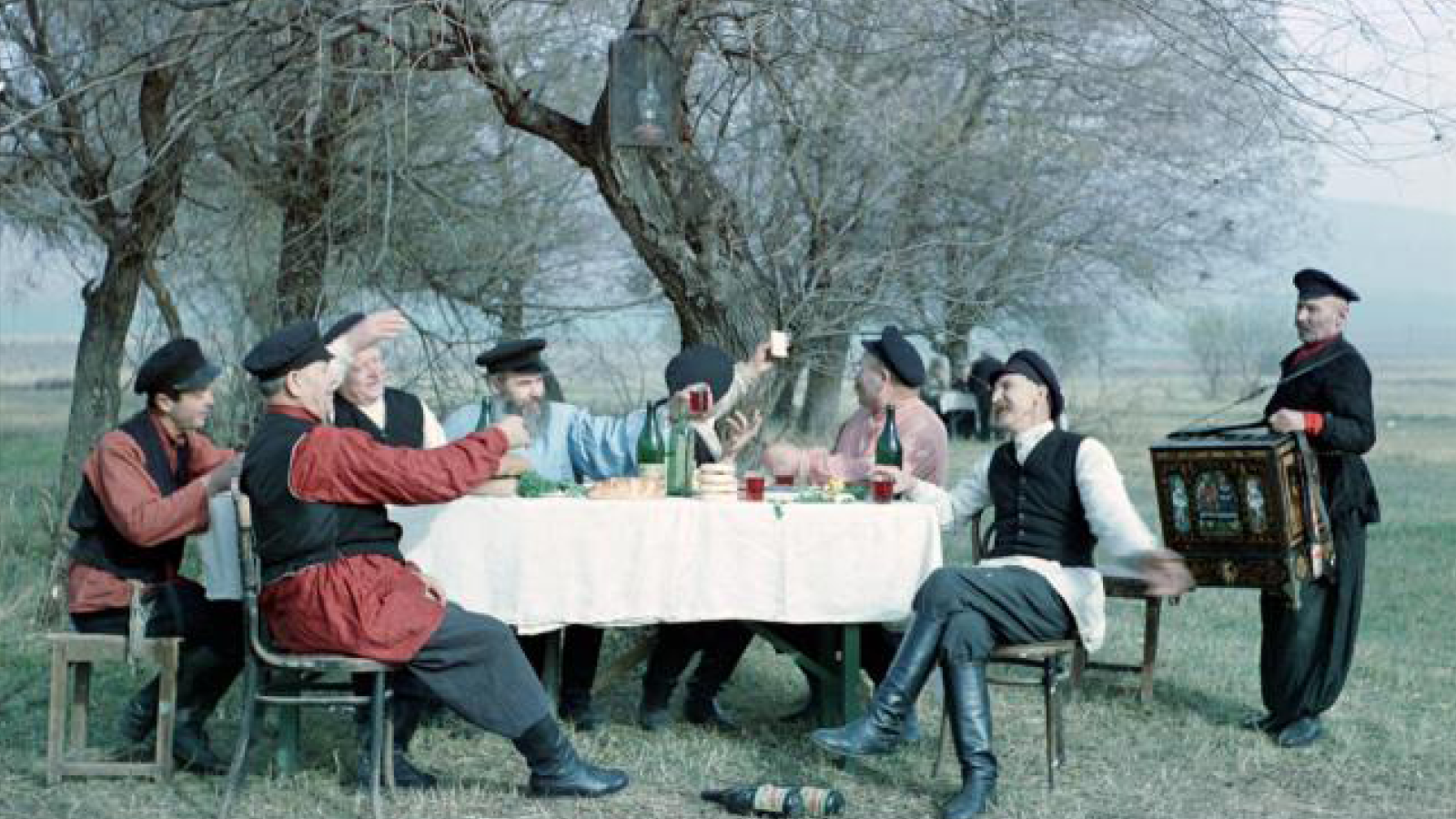
Shengelaia doesn’t, contrary to what much extant writing on Pirosmani suggests, stage precise tableaux vivants of his subject’s canvases, even in cases where he cites certain of them explicitly: the sight of a laden table—its occupants all seated on one side facing the spectator, wineskin resting on the ground in front of them, a serenading band to one side—is unmistakably Pirosmani-esque, but the cold urban backdrop of cobblestone and brick is foreign to his work. What Shengelaia does, rather, is what the authors of the most intelligent artist biopics do—Peter Watkins with his Edvard Munch (1974) and Maurice Pialat with his Van Gogh (1991), for example—which is to make films as much about a milieu as a single man. (I would suggest the same is true of exemplary art historical writing; reading Robert Hughes’s Goya, one practically inhales the dust of an 18th-century Madrid struggling to realize its pretensions as a capital city.)
In the case of Pirosmani, we have a film about a booming, rapidly industrializing Tiflis that is half-city and half-country, where roughnecks in peasant garb rub shoulders with St. Petersburg aesthetes, and where an itinerant farmer’s son ekes out a living creating little windows to a mythologized, harmonious rural past. Places and people painted by Pirosmani appear in the film bearing his name—what is presumably his “Didube ferry,” crossing the Kura on a guide rope; a bearded man in a red blouse solemnly treading the contents of a barrel straight out of his Grape Harvest Feast—but imagined as he might have encountered them, not in imitation of how he described them in paint. His Woman with a Mug of Beer, with her massive décolletage, is monumental, canvas-filling; the analogous figure that Pirosmani encounters in the film is seen in a long-shot landscape, her scarlet dress a tongue of flame in the gloaming. Rather than attempt to reproduce his subject’s works to the slightest compositional detail, Shengelaia locates distinctly cinematic means to evoke something of the particular tonal qualities of Pirosmani’s images, his canvases aptly described by art historian Bice Curiger as radiant with “the exoticism of normality—one that never really existed in this form.”
One aspect of Pirosmani’s “exoticism” is the crisp delineation of forms, both through use of contour lines and the even spacing of so many of his figural groupings. His people tend to either stand apart from one another, apart from the background field, or, when they do jostle in close quarters, to appear as deindividualized masses arranged in serried ranks; they never, however, intermingle casually, or appear strewn about a landscape by individual volition. Another defining characteristic of Pirosmani’s work is its uncanny sense of stillness, of quietude—which may seem an unusual way to describe the static and silent art of painting, but if one compares a Pirosmani banquet to, say, one of Jacob Jordaens’s riotous tavern revels full of entangled, flushed, fleshy forms, the ceremonious hush of Pirosmani is stark in comparison—his celebrants have something of the air of holding a pose, and their breath, for a long daguerreotype exposure. Georgians like to boast of their culture’s unbroken connection to the world of antiquity, and it is possible to discern something of the calm archaic smile playing upon the lips of certain of Pirosmani’s subjects.
A desire to summon the same sense of apartness found in Pirosmani’s oeuvre governs the mise en scène of Shengelaia’s film. Intimate caresses are almost unknown here—the artist exchanges a few with his young goddaughter early on, when his alienation is not yet total; a peasant mother in a passing caravan suckles her infant—but by and large the film’s inhabitants are as islands unto themselves, its nomadic protagonist the most remote of them all. As to the tranquility of Pirosmani’s work, for all the time the film bearing his name spends in taverns and on the edge of celebratory gatherings, the ambient noise rarely rises above a conversational murmur not much louder than the plash of an indoor fountain in one of his favorite dukhans. The exceptions to the generally subdued tone, aside from a single table-upturning outburst that’s shocking in its incongruous violence, are the occasional eruptions of music played on traditional Georgian folk instruments—the reedless salumuri, the zurna—the sound of the musicians who appear in so many of Pirosmani’s canvases made audible. Finally—and here Varazi is due credit—Pirosmani adopts the distinctive palette of its subject: the tablecloths are pristinely white; the men’s clothing and the spelean shadows of the underground taverns, inky black; the cerulean on the proscenium of a cabaret theater matched perfectly to that of Pirosmani’s skies.
Pirosmani (1969)
The son of Soviet Georgian filmmaker Nikoloz Shengelaia and actress Nato Vachnadze, Shengelaia, fils was raised in an artistic milieu—his brother, Eldar, was a filmmaker as well, his 1983 Blue Mountains a fine Kafka-inflected depiction of bureaucratic purgatory. In 2017, towards the end of his life, Shengelaia told an interviewer that in his youth he commonly encountered Pirosmani’s paintings in the homes of family friends: “I’d be alone sitting, looking at these paintings. I entered into them very easily, and stayed there—I couldn’t get out.” His studies would take him to Moscow’s All-Russian State University of Cinematography (VGIK) where, like near-contemporary Otar Iosseliani and the elder Sergei Parajanov, both countrymen, he was a pupil of Alexander Dovzhenko. (Parajanov, too, owed a great debt to Pirosmani, and produced a short film on the painter, Arabesques on the Pirosmani Theme, in 1985.) A 1961 documentary titled Niko Pirosmanishvili is Shengelaia’s first credit as a director—a student work, one suspects, and in any case a testament to the filmmaker’s long engagement with Pirosmani and his art.
Even through the heyday of state-sanctioned Socialist realism, as expounded by Georgia’s own Joe Stalin, né Dzhugashvili, the folk artist retained a certain protected status in the communist world as pure product of the rural proletariat. In Poland, the 1968 death of Nikifor Krynicki, known simply as Nikifor, author of endearing, scratchy panoramas of railway stations, public squares, and Orthodox churches, was regarded as the loss of a national treasure. (He would come in for the biopic treatment himself in Krzysztof Krauze’s 2004 My Nikifor.) In Yugoslavia, the Croatian Ivan Generalić achieved a similar stature; the Ukrainian actor/filmmaker Ivan Mykolaichuk, in his Babylon XX (1979), drew inspiration from Generalić’s landscape paintings, their humped hills teeming with color, life, bounty.
The class-consciousness of Shengelaia’s Pirosmani is instinctual rather than doctrine, and matches what is known of the man. As an artist, Pirosmani’s customers, his public, and the greater part of his contemporary subjects belonged to what might be termed the common people, rather than the bourgeoisie or the aristocracy, and while only a few of his works, like that known as Childless Millionaire and a Poor Woman Blessed with Children, offer much of an opening for interpretation as social commentary, his reported indifference to material wealth indicates a socialism that, if not precisely Marxist, is at the very least Tolstoyan. At one point he offers his relations the gift of an iron plough, but only with the caveat that they don’t lend it to rich neighbors: “They’re a cunning kind; they’ll never return it.”
That this artist of the people should have kept himself aloof from those people—an aristocrat of the sensitive, in E.M. Forster’s memorable phrase—is a paradox that Shengelaia doesn’t endeavor to explain. Nor does he presume to show us the world “through Pirosmani’s eyes”—what he does, modestly and majestically, is convey a sense of the world that Pirosmani painted from, the artist’s uneasy relation to it, and the plaintive, curious gaze that he lay upon it. Shengelaia’s esteem for the mystery of Pirosmani’s art is too great to belittle with explanation, or to reduce him, in the style of so many contemporary museum wall didactics, to a manifestation of a socio-political phenomenon. He does not violate the privacy of his solitary subject, nor pretend to share in his quiet suffering; following the advice of Iris DeMent, he lets the mystery be.
Share:
Recommended
- Futures and Pasts: Éric Rohmer’s Élisabeth
 On the French New Wave legend’s life before cinema, and his newly translated first and only novel.
 - When Carolco Was King
 On the maverick indie studio who ruled the multiplex for a golden decade.
 - Arnold Schwarzenegger
 How the heavyweight star became America’s favorite father figure.