
Essay
Sunshine, Lollipops and Rainbows
On the subversive pleasures of Agnès Varda‘s Le Bonheur.
Share:
Le Bonheur (1965)
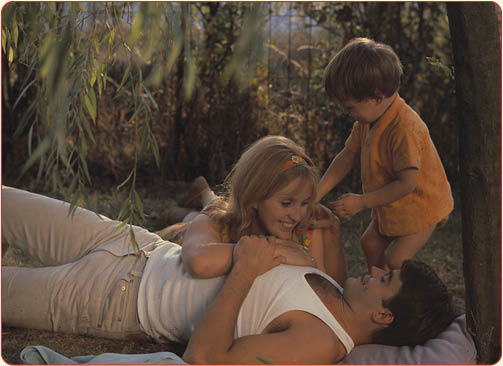
FOR THOSE WHO ONLY ASSOCIATE Agnès Varda with the image of the sweet, cuddly, meme-ready grandmother that she cannily cultivated in her senescence, wandering the Venice Biennale in a potato costume or letting herself be snapped while snoozing on lounges in cultural institutions around the world, it might be something of a shock to encounter her third feature, Le Bonheur (1965). A mordant study of a working-class family whose peaceful co-existence is threatened when the husband picks up a mistress, its blissful surface, Impressionist-indebted compositions, and color bomb fade-outs between scenes mask a seething fury. Amos Vogel, in his Film as a Subversive Art, describes it as a film with a “secret.” Varda herself referred to it as “a beautiful summer fruit with a worm inside.” Much like the cancer that may or may not be spreading through the body of the statuesque pop star heroine in her previous feature, Cléo from 5-7 (1962), something is lurking in Le Bonheur, a nebulous fury gnawing away beneath the film’s sumptuous surface.
By the mid-‘70s, this disquiet had fully taken form and flight in France as the women’s liberation movement, with its concerns and demands baldly articulated—which, from today’s vantage point, makes Le Bonheur feel like a largely unheeded premonition. At once a ragged scream of horror and modish intellectual riddle posed through the tidy geometry of a love triangle, Varda’s critique remains largely conceptual, as abstract as our first glimpse of the idealized de Gaulle-era family unit in the sunflower-filled opening credits: out of focus but discernibly a made-to-order man, wife, and two kids, holding hands while crossing a field.
Despite the Arcadian environs, this increasingly rapidly cut credits sequence—accompanied by Mozart’s ominous Adagio and Fugue in C minor with its incongruous, stalking parts for clarinet, flute, and oboe—heralds nothing but doom.
What we come to observe of the couple’s relationship is almost eerily anodyne, husband François (Jean-Claude Drouot, then-star of the dopey medieval adventure TV series Thierry la Fronde) pawing greedily at his wife while spouting happy-fool lines like, “I wonder what I like more: the smell of the trees, the grass or the river?” Of all cinema’s philandering blaggards and Bluebeards, perhaps none is more dreary than this chiseled, beatific, simple sap, who wishes he could eat rice pudding every night and blithely saunters around the outer Parisian suburb of Fontenay-aux-Roses, happily employed as a carpenter, happily married to the young dressmaker Thérèse, and happily the father of two button-cute, perfectly behaved toddlers (played by Drouot’s real-life wife, Marie, and their children): tick, tick, tick.

Le Bonheur (1965)
Stripped of any form of explicit conflict or antagonism, their lives hum by in a cheerful daze. That is until François sights Émilie (Marie-France Boyer), a pretty, blond, free modern woman whose ice-blue eyeshadow matches her postal clerk uniform. Though far from a pants man, he can’t help but make eyes at her through the glass door of the telephone booth he’s using while she’s working behind the counter, the exchange of glances that sets events in motion.
When Varda was making Le Bonheur, the ancient chestnuts “What is happiness?” and “What do we need to be happy?” were perhaps in the air. The question posed just four years earlier to people on the streets of Paris in Jean Rouch and Edgar Morin’s Chronicle of a Summer—“Are you happy?”—had been taken up with wheeler-dealer relish by advertising and women’s magazines—much like the one Thérèse is seen idly flicking through in the opening scene, sitting under a tree, not wanting to wake her husband as he sleeps in idiot serenity on a lazy afternoon. Here and throughout the film, Thérèse’s every thought appears directed towards François, her entire sense of self predicated on fulfilling his desires.
Varda, backed by her studies in art history and extensive training in photography, regularly found inspiration in, and had a penchant for quoting artworks, such the Picasso and Braques paintings that led to compositions in La Pointe Courte (1955), or the crucial role played by Hans Baldung’s Death and The Maiden as a reference in Cléo from 5-7, and this first idyllic image in Le Bonheur of a picnic blanket, surrounded by wildflowers and verdant trees, littered with foodstuffs, and presided over by a sexually alluring young woman, nods to Édouard Manet’s infamous Le Déjeuner sur l’herbe (1862-3). (Jean Renoir’s 1959 social satire Picnic on the Grass, which drew from the same canvas, is also later fleetingly seen playing on a living-room television.)
Manet’s painting—much like Le Bonheur—baffled and scandalized in equal measure when it was exhibited publicly in the Salon des Refusés (a space to display works rejected by the official Paris Salon jury), partly thanks to the inscrutability of the central woman’s defiant gaze. A thread could be drawn from here to Varda’s Vagabond (1985), which is defined by the straight-to-camera punk stare-down of Sandrine Bonnaire’s Mona, a tramp who refuses to explain or justify her actions. It’s a film where once again Varda lets images supersede plot: “What we need is more spectacle or image or the unexpected and less story, psychology,” as she wrote in a note to herself during its making.

Le Bonheur (1965)
While Vagabond was generally embraced, winning the Golden Lion at the Venice Film Festival, contemporary viewers of Le Bonheur were disturbed by the lack of any clearly signaled moral stance, though it was awarded a Silver Bear at the Berlin Film Festival. For some, it’s a film sticky to the touch with irony, and yet, curiously, in an interview with Cahiers du Cinema just months after the film’s release, Varda decried the accusation, stating “I don’t make ironic films.” Unquestionably, though, she uses 2D characters and discordant action to dismantle clichéd images of happiness, as are produced in the wedding photoshoots that we see taking place on the small town’s main street while locals crowd and gawk, flash cuts accentuating the way the moment will be isolated and transformed mechanically for posterity into an uncomplicated snapshot of conjugal bliss frozen in aspic.
Earlier in the film, the bride-to-be comes to Thérèse asking for a dress to be made in the latest style, with a cape over the shoulders, just like in the fashion magazines she reads. This request feels notable, perhaps, for being made not in a big, bustling city like Paris, but in a close-knit provincial town that feels still somewhat innocently sheltered, holding out against the slow creep of consumer culture. Leisure time in Fontenay-aux-Roses is passed lunching with friends and family, and François even works in a pleasant family-run atelier where an afternoon can be taken off to celebrate a co-worker’s name day—part of a world fast disappearing, living on in such touching memorials as Varda’s husband Jacques Demy’s portrait of a Loire Valley clog-maker, Le sabotier du Val de Loire (1956).
Equally, the Impressionist’s landscapes, so often associated with pleasure and relaxation, are evoked by Varda’s pastoral scenes, with cinematographers Claude Beausoleil and Jean Rabier using sensuous bursts of color—rainbow hues of purple, forest green, sky blue—and floods of golden light: “I did not want to do a Monet, a Renoir, a Bonnard, but I did copy the chromatic gamut,” Varda said. Le Bonheur was written in just three days (supposedly in a fit of rage, after funding was denied for another feature, the sci-fi Les Créatures, later made in 1966) though Varda was careful to fill the script with picnic scenes, so that she’d have an excuse to spend more time outdoors, in nature. “I find it hard to persuade [Jacques] to come on picnics,” she once said. “So that’s why I put the picnics in Le Bonheur, I guess: to relieve my frustrations.”
These were each shot at Bois de Vincennes, a public park on the eastern edge of Paris, triple the size of Central Park, and about as lush and peaceful as Monet’s gardens at Giverny. It’s during one of these picnic scenes that the film admits its only moment of open friction, as the birds twitter loudly in the trees and François exultantly informs Thérèse about his affair with Émilie—“You see, it’s a shame to deprive oneself of life and love”—and Thérèse struggles to process the news. He reassures her, they make love, and then they sleep on the grass as is their habit, except that when François wakes his wife has drowned herself in the lake. After a brief period of mourning, François returns for a picnic with Émilie, newly installed as the children’s mother, walking hand-in-hand, the pair wearing his-and-hers knit sweaters that match the tumbling autumn leaves. This echo of the bucolic opening image horrifies, in part, because of how smoothly, how elegantly, how easily it all takes place. You might even call it a new season look.

Le Bonheur (1965)
Share:
Recommended
-
Susan Seidelman
 An intimate conversation with the trailblazing American filmmaker.
 -
Carol Kane
 Fifty years in 50 minutes with the irrepressible screen icon.
 -
Mark Lee Ping-bing
 The legendary cinematographer reveals his three core beliefs.
- Music Sets You Free
 An excerpt from the prodigious musician’s remarkable, newly translated autobiography.
 - Albert Serra
 From Locarno, an interview with the indefatigable Catalan filmmaker.
 - Futures and Pasts: Don’t Play with Fire
 Foul times in the Fragrant Harbor, in Tsui Hark’s newly restored third feature.