Essay
I Didn’t Even Have To Pretend to Like Them
By Madeleine Wall
On mixing art and pleasure in I’ve Heard The Mermaids Singing.
I’ve Heard The Mermaids Singing is playing now In Theater & At Home
 Patricia Rozema
Taking its title from a line in T.S. Eliot’s poem “The Love Song of J. Alfred Prufrock,” I’ve Heard The Mermaids Singing (1987) is a fictional self-portrait of an adrift 31-year-old who, at first glance, appears to be struggling through most areas of life. Winner of the Prix de la Jeunesse at the 1987 Cannes Film Festival and a national box-office hit at the time of its release, the film was the feature debut of both director Patricia Rozema and the actress Sheila McCarthy, emerging from the Toronto New Wave of the 1980s. Both small-budget and about a small life, it is a warm, queer drama about the nature of art and one woman finding inspiration, on her own terms.
“I guess that makes me a spinster or something,” says Polly (McCarthy), introducing herself to us by directly addressing a small video camera, with her spiky orange hair and sheepish grin. Polly comes up short by society’s conventional standards-she is neither much of a career nor a family woman, described by her employers as “organizationally impaired” and living alone-but she is self-sufficient and content. She’s had boyfriends in the past, she says, but “I could never really talk to them of all the things I think about sometimes, and all the things I’ve seen.” And so Polly records her video confession, telling us what she has never been able to tell anyone else.
Polly climbs up the side of an office building using suction cups, to the shock of a worker inside (a Rozema cameo), before she takes us flying over Toronto.
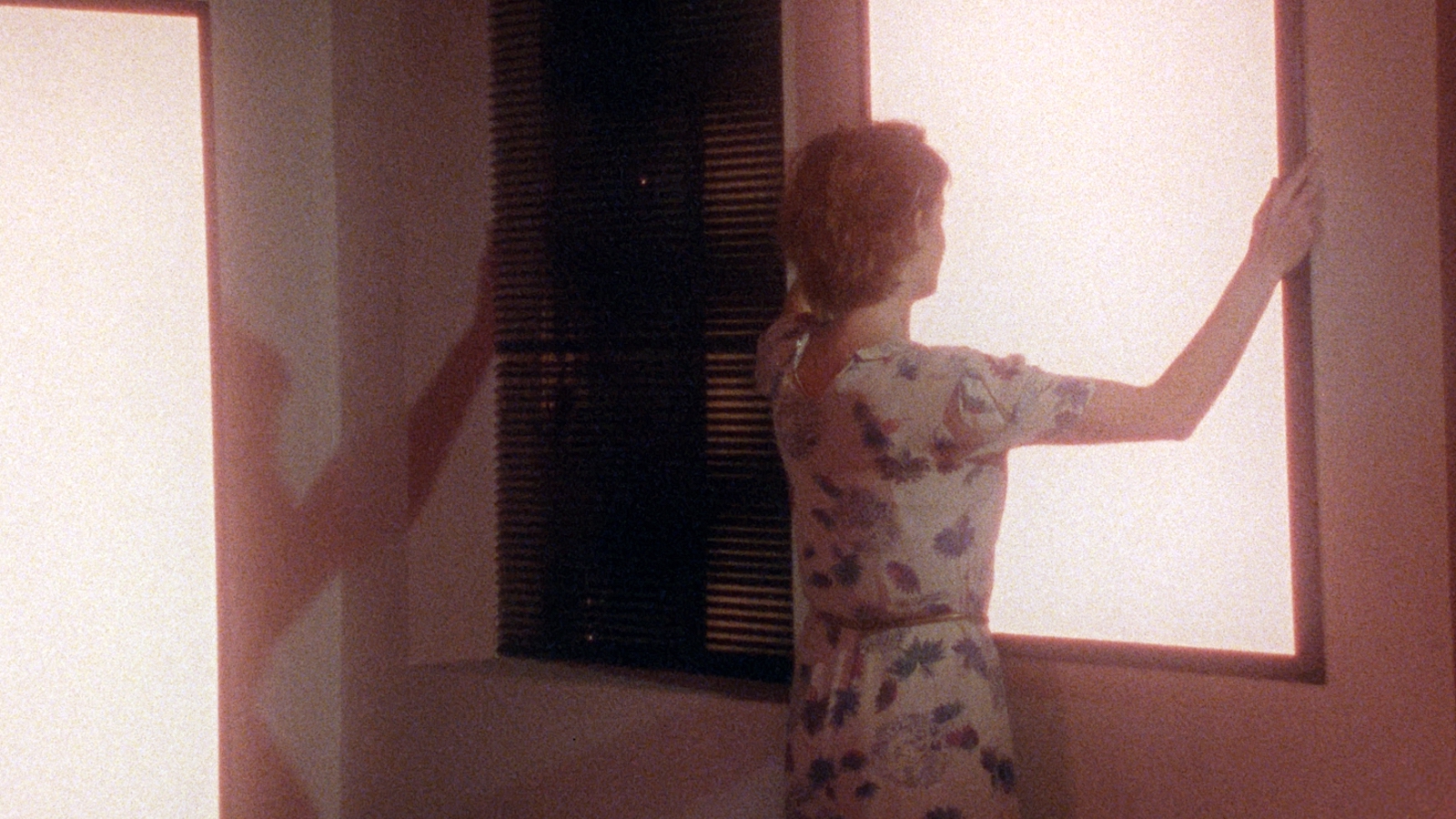
McCarthy plays her innocent and childish, with an warmth and openness that disarms. She bikes through the streets of Toronto, looking up at a sky dissected by streetcar wires. Most of her free time is occupied by her hobby of photography, taking photos of mothers with children, lovers in the park, Toronto high rises reflecting the golden sun. Polly may gaze out at the world around her with great wonder, but she keeps it close to the chest: she doesn’t show her photos to anybody, and they never include herself. When Polly does let us truly see her, it’s through “all the things I think about,” which Rozema depicts in a number of memorable black-and-white fantasy daydream sequences: feeling awkward in real life, she imagines herself as an aristocratic woman, speaking confidently, walking alongside a dazzled companion through the woods; in another sequence, Polly climbs up the side of an office building using suction cups, to the shock of a worker inside (a Rozema cameo), before she takes us flying over Toronto.
Coming back down to reality, however, Polly shuffles from temp gig to temp gig as a this “person Friday,” the agency she works for has recently rebranded their employees, until one day she finds herself in a position she’s definitely unqualified for but thrilled to have: the part-time secretary to an art curator. The gallery is tucked away next to the Eaton Centre, the largest mall in the city, and dwarfed by surrounding office buildings. Gabrielle St. Peres (Paule Baillargeon) is professionally successful, middle aged, sharply dressed with giant single earrings, and has a sophisticated French Canadian accent. Polly is smitten, if intimidated, but Gabrielle takes her under her wing; soon the pair are installing modern sculptures throughout the gallery of women’s bodies with built-in CCTV cameras. Polly would have happily stayed like this forever, but Gabrielle, sadly, has her eyes on someone else: the up-and-coming artist Mary Joseph (a pre-literary fame Ann-Marie MacDonald), who begins as Gabrielle’s punkish lover and soon becomes her accomplice in something more sinister.
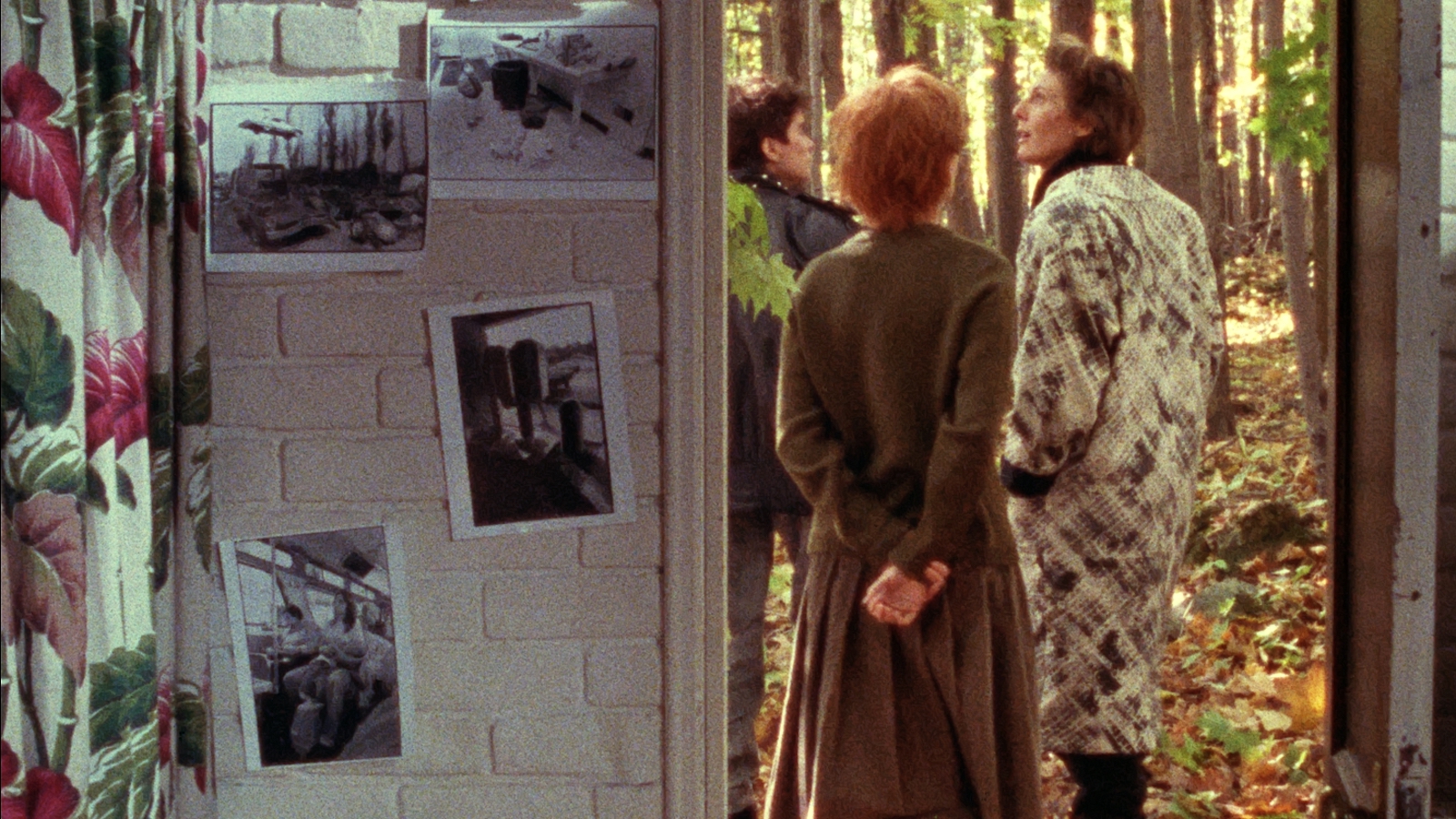
Watching from a screen in another room, Polly spies on the two women through a CCTV camera. There’s a playful queerness to I’ve Heard The Mermaids Singing that goes beyond the fact that two of the three central characters in this triangle are explicitly gay. There are very few men at all in Rozema’s world, and when they do appear it is only ever briefly, to purchase or critique art. Whereas the three protagonists-which Rozema has described as three different parts of herself-have deviated from the more traditional roles expected of women, and they’re are all creators and artists, albeit of very different kinds.
Invited to Gabrielle’s birthday party, Polly arrives too late, with a large gift, and then proceeds to overstay. Her tipsy and morose boss opens up to her: “You don’t need anything more than you have, do you?” Despite appearances, Gabrielle, however, does want more. She may be a success as a curator but she reveals that she’s actually a failed artist, and she has a childish need to make one single painting that will be deemed universally as “good.” Encouraged by alcohol, Gabrielle takes Polly see her “art”, hanging in another room of her chic, modernist home. Entering her own Bluebeard’s castle, Polly is confronted by a series of golden paintings, glowing bright lightboxes illuminating an empty room, with Rozema letting the audience decide what this “good painting” might be. Polly is awestruck-she doesn’t even have to pretend to like the work-and, though perpetually racked with self-doubt, she covertly takes it upon herself to share one of Gabrielle’s pieces with the world, wanting others to see her talented boss the way that she does. But this piece is not as simple as it first seems. We learn that Gabrielle desires fame and recognition more than she wants the actual work involved in making art.
By contrast, Polly’s tiny “bachelorette” apartment, as she calls it, is a living work in itself, full of plants, her own darkroom, and walls plastered with her photos. As Polly is left to decide for herself what forms of art are valuable to her, and why, we watch her at home spending an evening conducting a Delibes score to a cat contentedly eating off the kitchen counter, or looking out at the light changing as the sun sets-and it is hard not to share in her pleasure. Rozema has created Polly’s world so richly that her fantasies and secrets spill out, even over the end credits. Amongst the film’s many dramatic revelations, its most poignant is perhaps also the simplest: Polly’s life may be a small life, but it is rich because it is hers.
Madeleine Wall is a critic and programmer who lives in Toronto