

Essay
The Holy Girl
On Lucrecia Martel’s transfixing portrait of adolescent fervor and faith.
The Holy Girl (2004) opens at Metrograph on Friday February 27, as part of Sex is Confusion.
Share:
“POCA MORAL Y MUCHA CURIOSIDAD.” Lucrecia Martel once said in an interview that each of us has a different view of the world; that we are all compelled to know what lies on the other side, and that to do so we need another person’s perspective. This belief—that perspective itself is material, territory, and tension—animates much of her work, including her second feature, 2004’s The Holy Girl, and echoes in the deep excavation of history and myth in her later cinema.
My own fascination with The Holy Girl was partly personal. Growing up in Gijón, I had a Catholic friend—much like the two adolescent girls that Martel’s film orbits—whose schizophrenic vantage point made my view of the world seem dull by comparison. I was not fluent in metaphor or euphemism—I hadn’t gone to Catholic school. So I relished escaping my grim existence by attempting to see reality through her powerfully colorful mind.
The Catholic schoolgirls I knew allowed themselves to be opaque, confusing. Without the protection of mysticism, we public school girls were overtly sexual yet fully responsible for our actions. We could easily access contraceptives and navigate the confusing, frustrating terrain of teenage sex through a pragmatic lens shaped by scientific classroom sex ed. We were fun but also crude and plain, possessing what felt like the open sexuality of a dog. If something felt wrong in our prepubescent games, we couldn’t blame the devil for it.
When I curated The Holy Girl as part of a series on fascism last year, I chose it because my fascination with the film mirrors the enamorment that I felt toward that teenage friend. She came from a family steeped in conservative ritual and had attended Catholic school her entire life. Her magical thinking—an ability to enfold reality in a shimmering haze of mysticism, absolution, and metaphor—transformed the simplest things into pure poetry. The mental gymnastics she used to excuse bad behavior could have qualified as an Olympic sport—what Martel herself described in one making-of documentary as “the least heroic, yet most seductive, strategy for survival.”
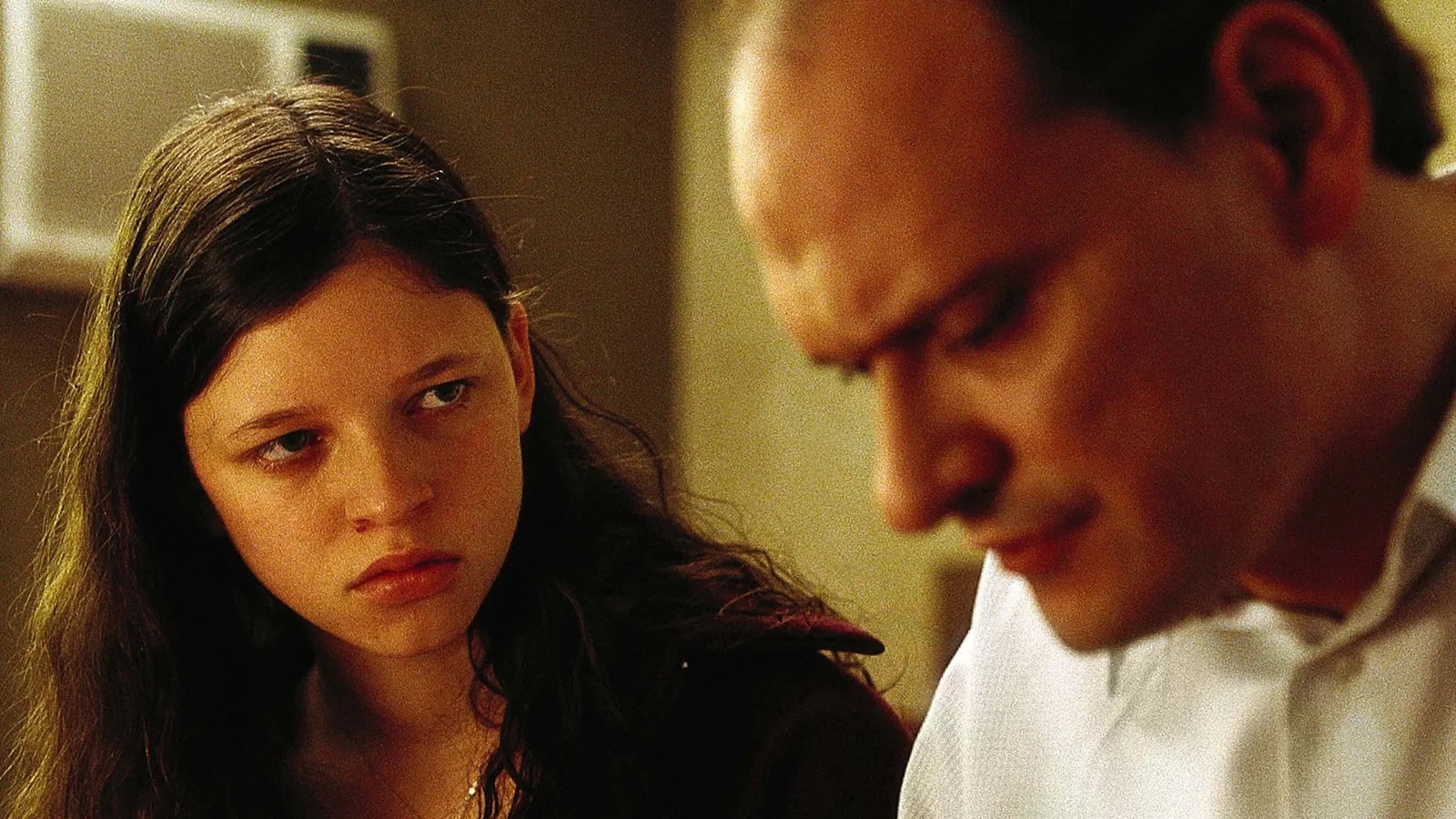
The Holy Girl (2004)
The Holy Girl unfolds in and around a provincial hotel in Salta during a medical conference, where the fervent Catholicism of the two teenage friends, Amalia (María Alché) and Josefina (Julieta Zylberberg), becomes entangled with growing questions about desire, power, and spiritual certainty. The film is less a conventional narrative than an impressionistic, sensory portrait of adolescence; layers of sound, close-up visuals, and oblique structure accumulate to create a world in which good and evil, fear and desire, innocence and experience are questions of perspective shaped by time, place, and sensation rather than clear moral binaries. The Catholic discussion group that opens the film, in which the two protagonists participate with near-ecstatic devotion, repeatedly veers into absurdity, slipping from pious speculation into stories that border on horror. This is something that rang true to my experience, as, even at 15, my Catholic friend still suffered from childish nightmares about hell in its most cartoonish form: flames, pitchforks, and eternal torment. I was captivated by this kind of arrested development, and I understood why the opposite sex—particularly older men—could be drawn to these juvenile riddles. I was a little jealous, too. Years of critical thinking didn’t allow for this sort of delusions.
In The Holy Girl, the presence of the older man is punctuated by the unsettling diegetic sound of a theremin, played by a visiting street musician whom Amalia—the “holy girl”—watches in awe as part of a mesmerized crowd. It is while standing here that Amalia finds herself being silently rubbed up against by a middle-aged doctor, Dr. Jano (Carlos Belloso), who is attending the conference. Within this charged atmosphere, his unsettling, inappropriate gesture—a brief act of frottage—becomes in her mind a sign of spiritual and moral peril. Repulsed yet galvanized, Amalia embraces what she interprets as a mission from God: to “save” this flawed figure. But also: an excuse to conceal her own arousal and convert her desire into saintly intention.

The Holy Girl (2004)
In an interview for Bazartv around the time of the film’s release, Belloso describes his character as a formal man who keeps up appearances—until his diabolical tendencies begin to surface. I find that choice of words telling: diabolical. It echoes contemporary Christian TikTok rhetoric, where moral failure is often framed as either possession or temptation, and where women are encouraged to endure betrayal as a test of faith.
Beyond gendered power dynamics, in South America, the virtues of propriety and formality are deeply entangled with whiteness—a topic that remains reluctantly addressed in Argentina, and one that Martel began to confront more blatantly with her last fiction film, Zama (2017), depicting a magistrate languishing in a remote colonial outpost. In The Holy Girl, people with Indigenous features populate the background of many scenes, performing menial labor, while the white protagonists navigate their privileges and missteps with relative impunity. Transgressive behavior by powerful men, even in spaces structured around morality and professionalism, is treated as entitlement rather than violation. Indulging in ephebophilia during a medical conference is a white man’s pastime after all. What remains subtle in The Holy Girl is made explicit in Martel’s latest, Nuestra Tierra (2025), a documentary examining the 2009 murder of an Indigenous community leader in Argentina by men attempting to seize his community’s land. Here, the white intruders defend their innocence by invoking both their Christian beliefs and their country club affiliations, presenting them as interchangeable markers of virtue and respectability.
Unlike the hotel maids, bartenders, and other Indigenous workers in The Holy Girl—figures rendered almost anonymous—Amalia and Josefina occupy a position that allows them to remain pure and innocent until challenged. Their devotion, belief, and vulnerability grant them a certain narrative agency: they can claim moral purpose and be taken seriously. They are sheltered by the veil of Catholic make-believe. They can be forgiven. In the final image of The Holy Girl, the two girls giggle and playfully drift away in a swimming pool, while a brown hotel worker in uniform walks past them to continue his labor—a quiet but intentional reminder of the structural orders that scaffold the hermetic world we’re watching.
This ending is representative of Martel’s cinema in that it refuses to offer tidy moral judgments. Instead, it invites us to sit with ambiguity—to recognize that desire and belief, guilt and innocence, authority and submission are shaped by perspectives that are multiple. She wants us to remain curious so as to better see what lies on the other side.
Share:
Recommended
- Juliette Binoche
 On the eloquent hunger of the iconic French actress.
 - I’m Not Everything I Want to Be
 On Libuše Jarcovjáková, the queer photographer drawn to the social fringes of Soviet Prague.
 - Letters to His Wife
 Translated into English for the first time, a selection of the esteemed Soviet filmmaker’s devastatingly honest and bittersweet letters.