
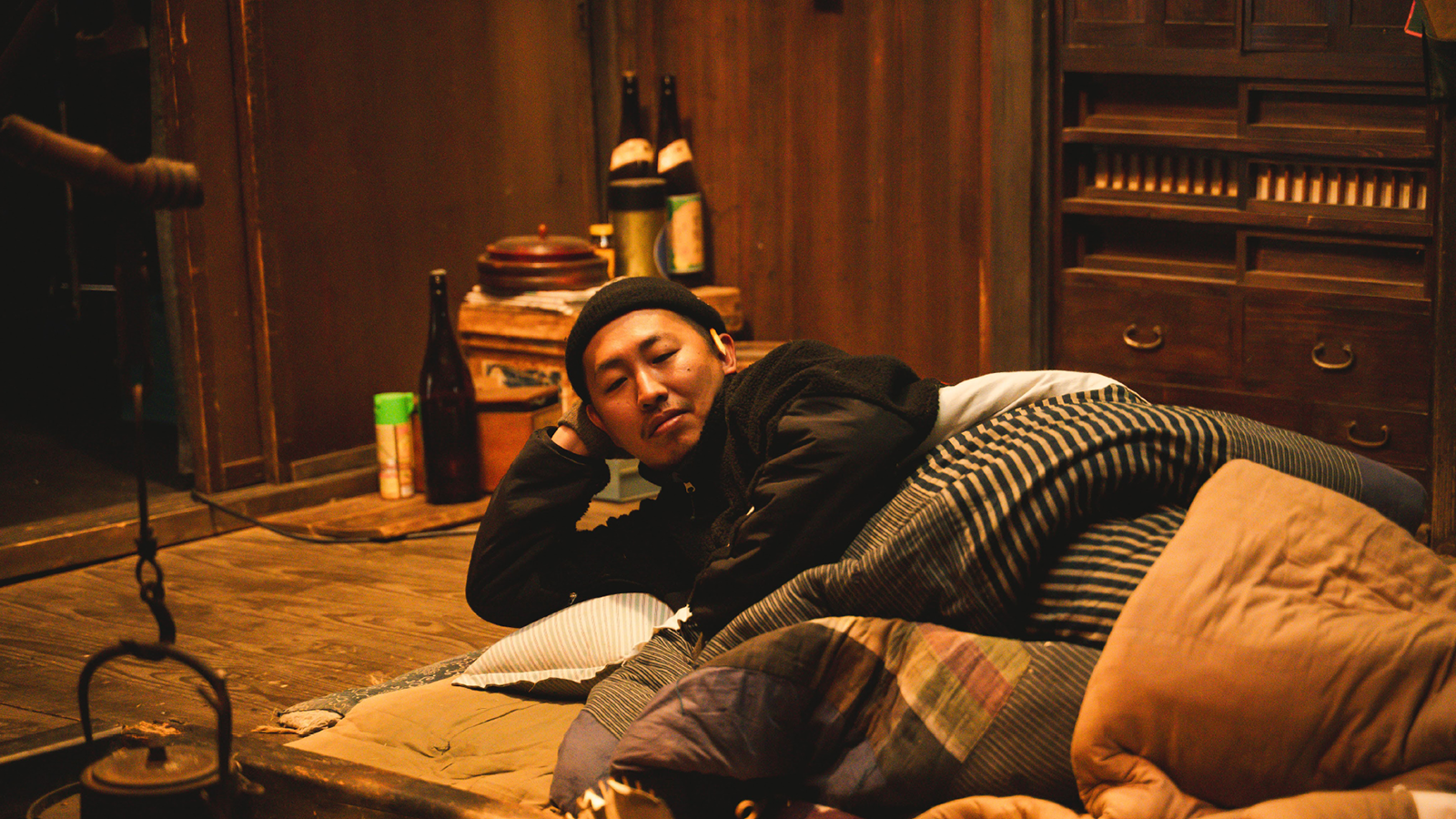
Sho Miyake, courtesy of Sho Miyake.
Essay
Sho Miyake: The Young Master
An essay from Ryûsuke Hamaguchi on why the ascendant filmmaker Sho Miyake is, in his eyes, the young master.
Unspoken Gestures: The Films of Sho Miyake opens at Metrograph on Saturday, November 7, while Metrograph hosts a Members Only screening of Hamaguchi’s latest film, All of a Sudden (2026), on Friday, November 13.
Share:
This essay was translated from Japanese by Monika Uchiyama for the forthcoming printed program published by Japan Society, on the occasion of the joint Japan Society and Metrograph retrospective Unspoken Gestures: The Films of Sho Miyake. It is shared here with their kind permission.
A YOUNG MASTER. SOMEONE WORTHY of this title is on the verge of being broadly introduced to the world. I’ve known of him for a long time. We’d moved in the same circle of Tokyo filmmakers. In 2010, when, at the age of twenty-six, Shō Miyake released his feature-length debut, Good for Nothing, I wrote to him with feedback and questions. Here is how the email began:
Frankly, I have to admit that I couldn’t stay clear-headed while watching it. I’m not just saying this to be polite, but I realized that watching the work of a young person far more talented than myself isn’t exactly a pleasant experience.
Reading back, I’m surprised at my candor at thirty-two. My feelings toward him haven’t changed much. However, some things have shifted slightly.
The striking white snow and black school uniforms in Good for Nothing were shot by Miyake himself. There’s no question that doubling as the cinematographer was a burden for the director, but in scenes like the one where Hideki Tamai jumps into the back of a pickup truck, the risks taken on set seep through, imbuing the images with a kind of “youthfulness.” Meanwhile, the monochromatic imagery and the subject of “crime prevention” keep the protagonists grounded in depictions of everyday life, yet preserve an air of crime that wafts from the screen. A “presence” that only a director who has already watched plenty of films could possess—one who has internalized, on a visceral level, the technique of placing the subject at the intersection of the axes of the light and the lens—permeates throughout this feature film.
It was likely Playback (2012) that convinced everyone of his talent. Reminiscent of Edward Yang’s That Day, on the Beach(1983), the film’s complex structure—with its perplexing chronology and blurring of fact and fiction—reflected the slightly premature “old age” of an actor approaching forty. (This impression of maturity was elevated further by the precise cinematography by Hidetoshi Shinomiya, who is of my generation.) I’d known the actor Jun Murakami for a long time, and speaking as someone who had worked with him before, no one had ever captured him with such allure. I had never made a film that centered an actor a generation older than me, so that alone struck me an impressive feat. As he masterfully rides his skateboard, he straddles the midpoint between youth and old age.
And Your Bird Can Sing (2018) miraculously succeeds in balancing youth and maturity. Miyake, then in his mid-thirties, encourages the younger actors to be free, and captures them with unparalleled tenderness and precision. All three leads are wonderful, but Shōta Sometani stands out, conveying resignation and acceptance with few words. The scene where he and Shizuka Ishibashi walk across the bridge is memorable, and strangely, this scene and the title of the film resonate together for me.
In Small, Slow But Steady (2022), Miyake appears to have taken a decisive step toward maturity. It’s not hard to imagine that choosing to shoot on granular 16mm film put a strain on production, which was by no means high-budget, but this motivated Miyake to thoroughly prepare for the shoot. Spending several months training at a boxing gym alongside Yukino Kishii, who plays a deaf boxer, likely helped build a foundation of trust for the film. There is an unmistakable development in not only his collaborations with actors, but also his eye for finding locations—not merely where to shoot, but where to place the camera. The role of sound is always considered alongside these decisions.
Young men and women, derailed from society’s tracks due to panic disorders and PMS, are the focus of All the Long Nights (2024), which is possibly one of Miyake’s current pinnacles. That there is a steady evolution in his own filmography, even after having officially entered the Japanese commercial film production system, struck me as a feat, as someone working within similar production environments. No decisive events occur, but by simply sitting together, walking, and occasionally visiting one another, the two characters help each other heal. It is not simply about the two leads, but about the time each person possesses. Coming together and drifting apart—that is what makes up life. If I were to name a film that lends a similar impression, it would be Yasujiro Ozu’s Early Summer (1951), which portrays the corrosive effects of time without depicting any major incidents. Yet, to depict the healing power of time so precisely in just two hours is actually far more difficult. This film was immensely influential to me in writing the screenplay for All of a Sudden (2026).
The sudden lightness of Two Seasons, Two Strangers (2025) was yet another surprise. The sight of Yuumi Kawai’s skirt fluttering in the wind is unforgettable. The vibrance of the transitional scene that connects the two stories is breathtaking. The final shot of Eun-kyung Shim leaving footprints in the snow evokes the white landscape of Good for Nothing, while simultaneously reminding us that this filmmaker’s journey has been a seemingly steady (and thus, incredibly difficult) tightrope walk. His impressive filmography is also shaped by works I haven’t mentioned here, including the documentary The Cockpit; Wild Tour, a film born from a workshop with teenagers; and the Netflix film Ju-on: Origins. While winning the Golden Leopard at the Locarno International Film Festival for Two Seasons, Two Strangers undoubtedly brought Shō Miyake to prominence, that too is merely a part of his journey. Created through endless challenges interwoven with observations and insights into the everyday, his films will likely continue to be an evolving balance of youthfulness and mastery.
In 2019, there was a major development in my relationship with Miyake. At the invitation of film critic Tetsuya Miura, the three of us formed a study group on directing. For nearly seven years now, we’ve made an effort to get together every month or two to watch films by a selected filmmaker and share our discoveries and questions regarding their direction. Sometimes we ask each other in detail about how we shot our recent films. Although we see each other more frequently now, my impression of him hasn’t changed much. His pointed observations on details of the frame, the questions he sometimes poses, and the sensitive and astute qualities these evoke remain the same. What has changed is that a profound sense of respect has grown within me as these shared moments accumulate. My recent works greatly reflect the influence of his ideas and approach to directing. How should people be positioned, distanced, brought closer, or occasionally seated? How should you prepare for production? What does it mean to create something with someone? And how do you cohere these considerations into an ethic? He offers questions rather than answers. Those questions serve as my guide. In a sense, through our time together, he has become a young mentor to me. Shō Miyake, the Young Master.
Ryûsuke Hamaguchi, Shô Miyake and critic Tetsuya Miura have been holding film study sessions together since 2019. In 2025, they published a book in Japan documenting their discussions, 演出をさがして 映画の勉強会 (In Search of Mise-en-Scène: Conversations from a Film Study Group), published by フィルムアート社 (Film Art Inc).

Share:
Recommended
- Sho Miyake: The Young Master
 Why Sho Miyake is, in the eyes of Ryûsuke Hamaguchi, the young master.
- The Woman in the Window
 On Fritz Lang’s slippery noir about the power of images and dreams in the American police state.
- The Curse of Frankenstein: To Victor, The Spoils
 The Old Dark House smash that rang in Hammer’s postwar horror new wave.