

Essay
Moving
On Shinji Sômai’s’s youthful exuberance.
Share:
Although relatively unheard of here in the West, the late director Shinji Sômai (1948-2001) has long been heralded in his native Japan. Directors Kiyoshi Kurosawa, Hirokazu Kore-eda, and Ryusuke Hamaguchi have all cited him as an important influence. In 1990, the magazine Kinema Junpo voted him the greatest Japanese director of the 1980s. Three years later, Sômai’s Moving (1993) premiered at Cannes in Un Certain Regard, and though still little-seen in the US until now, thanks to a new restoration, it has since become one of his most beloved films, commonly regarded as his most fine-tuned stylistic effort.
The director explored the lives of teenagers in films such as Sailor Suit and Machine Gun (1981), P. P. Rider (1983), and Typhoon Club (1985), privileging the perspectives of kids over that of the (often unreliable) adults. Frequently, Sômai’s young characters are seemingly rootless and choose to forge their own communities among each other. Moving veers from this framework with a lead who is headstrong but dolefully tethered to her parents. The film focuses on 12-year-old Renko (an exuberant Tomoko Tabata), and her emotional and psychological spiral amid her parents’ ongoing divorce. Frustrated, rebellious, and alienated by her schoolmates, she embarks on a solitary coming of age in a tale that is more emotionally steered than plot-driven, swaying in lockstep with the whims of a capricious adolescent.
The film opens on a stormy night: in a quietly tense scene, Renko, her father Kenichi (Kiichi Nakai), and mother Nazuna (Junko Sakurada) eat one last meal together before her father leaves the family home. Seated at a sharply pointed triangular dinner table that visualizes their disjointedness, Renko’s parents refrain from directly addressing each other, offering only cursory responses to Renko’s constant prodding. The child recites a phrase from memory as if reading from a book: “Family meal, a moment of joy and sharing.” The ironic idiom falls on deaf ears. Toyomichi Kurita’s cinematography adds dimension to the trio’s interaction, highlighting one parent’s facial expression while the other speaks. Though obviously distressed, Kenichi and Nazuna do not argue with each other; Kurita’s attentive camerawork, in concert with the actors’ nuanced performances, clues us in on things left unsaid. At last, Kenichi, visibly sullen, excuses himself from the table and heads to another room, where he twists open his flask and sits down to watch the rain alone.

Moving (1993)
Awake in her bedroom later that night, Renko announces that she hates the rainy season and wishes it would end. Unfortunately for her, it often rains in Sômai films, where water is a thematic fixture: in the shower, in a swimming pool, spraying from hoses or pummeling down from the sky, water tends to represent an unexpected weight, overcoming characters just as they arrive at the verge of a nervous breakdown, or breakthrough—Typhoon Club, in which a group of teenagers are trapped at their school during a violent storm, is particularly emblematic. Forced to socialize with each other during an extended period of time, their claustrophobia eventually draws them outside, where Sômai shows them strip and dance feverishly, filming them in a mesmerizing long take as they are quickly soaked to the bone. They appear to be having fun playing in the rain, but each of them harbors intense pain of their own, and water gives them the opportunity to process overwhelming emotions physically.
For Renko, too, the rain also serves as an expression of her raw, neglected emotions. When she says that she hates the rainy season, she obviously alludes to the current “phase” of her parents’ separation, which she repeatedly attempts to mend by urging them to reconcile. However, just as the rain cannot be stopped by outside forces, Renko has trouble curtailing Kenichi and Nazuna’s divorce, leading her to rebel: arguing with her mother, cutting class, and even starting a fire at school. Closely attuned to his young lead throughout the film, Sômai allows her more closeups than perhaps any character in his previous films. Here, Tabata shines, providing a thoroughly convincing performance that is kinetic and unpredictable, embodying all the volatile emotions that come with youth.
Sômai himself entered the film industry very young, reportedly roaming the set of Uchida Tomu’s The Outsiders (1958) and taking notes at the tender age of 10. Sômai made his first 8mm film, Hibi no hate ni (To the End of Our Days), in 1965, before beginning his law studies at Chuo University in Tokyo. Eventually he quit law school in favor of filmmaking and joined Nikkatsu, where he apprenticed under their Roman Porno line (a series of softcore pornographic films released theatrically in Japan) for eight years. In 1980, he branched out on his own and directed 13 films before his untimely death aged 53 in 2001. In just two short decades, he forged his own path, directing a mix of studio and independent projects. During a tenuous period of Japanese cinema, Sômai helped to usher in the wave of new independent cinema of the 2000s. As a result, many of the Japanese directors we now admire learned from Sômai and even adopted some of his distinct techniques.

Moving (1993)
He was especially skilled at directing long takes: both static and sweeping, with the camera set at a distance from the action or following the actors in medium closeup. Both Typhoon Club and P. P. Rider boast impressive, gliding wide shots that track moving characters across the screen. Moving employs the same flourishes, including a striking, narrowly framed long take that occurs in the Urushiba family home and follows four characters as they tumble over each other along the so-called “z-axis” that stretches from the front to the back of the image. During the “magic hour” of pre-sunset lighting, Renko hides (unseen by the audience) in a locked room while her parents argue and two of their friends struggle to keep them separated within a small corridor. Fighting and squeezing past each other like denizens of a clown car, Nazuna recounts an anecdote from early in their marriage that sets off Kenichi, leading Renko to cry out. The entire sequence is superbly orchestrated, from the choreography to the dialogue. The sense of claustrophobia is palpable, highlighting and amplifying the cracks in Nazuna and Kenichi’s fractured relationship. Renko had hoped that her hiding stunt would bring her parents together, but it only cements their estrangement.
The most cathartic experience for Renko does not involve her parents, but a solitary journey out on Lake Biwa, northeast of Kyoto. In the final third of the film, after running away from Nazuna and Kenichi, she first encounters an elderly man who takes her to a mammoth fireworks display, in a sequence reminiscent of Leos Carax’s The Lovers on the Bridge (1991). There, she runs into her distraught mother, and in an attempt to comfort Nazuna, declares, “Don’t worry, it doesn’t matter anymore… I promise I’ll grow up as fast as possible.” Her announcement is bittersweet, its irony hand-in-hand with the very innocence she hopes to tamp down. She quickly runs away again, and in a dark fairy tale-like sequence, spends the night traversing the forest, her white shirt glowing icy blue in the full moonlight. The next morning she experiences a kind of hallucination, in which she embraces her younger self and bids farewell to her parents as a happy couple. Renko is energized by the vision, propelled into acceptance, in spite of its somber overtones, intensified by Shigeaki Saegusa’s poignant score. It is tragic that her parents consider her a burden at such a young age, rendering her swift “maturation,” or abdication of her past, a cold comfort. Unable to fix their behavior, Renko is compelled to move forward.
All of the scenes at Lake Biwa are visually daring and ethereal, and likely contain some of Sômai’s most memorable images. Tabata’s presence is commanding, as her face visibly registers countless feelings. Trouncing through her surroundings like a melancholic Zazie dans le Métro (1960), she animates the film with her precocious energy. She was the perfect muse for Sômai, whose own instincts were profoundly youthful. Their partnership fused together disparate talents, resulting in one of the highlights of Sômai’s career. For a man whose life was cut terribly short, his films will always project a tender and buoyant vigor.
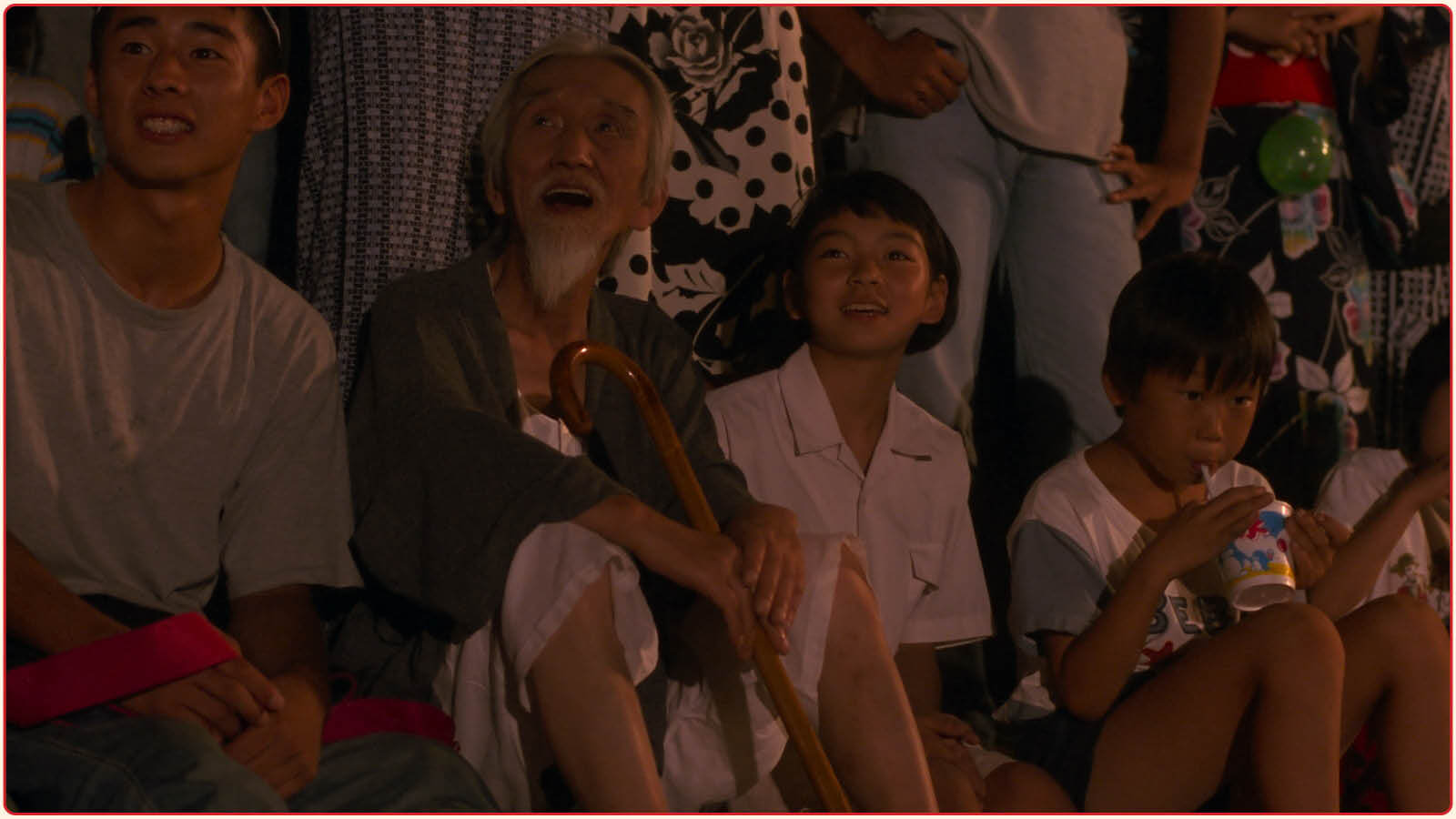
Moving (1993)
Share:
About the Contributor
Recommended
- Green Snake
 On Tsui Hark’s subversive reimagining of an immortal Chinese folk tale, starring Maggie Cheung as a serpent demon.
 - Travel Companions: Bahram Beyzaie & Amir Naderi
 On two defining Iranian filmmakers, and two of their most enduring works.
 - A New Love in Tokyo
 On the pulse of pleasure in Banmei Takahashi’s effervescent Pink drama.