
Interview
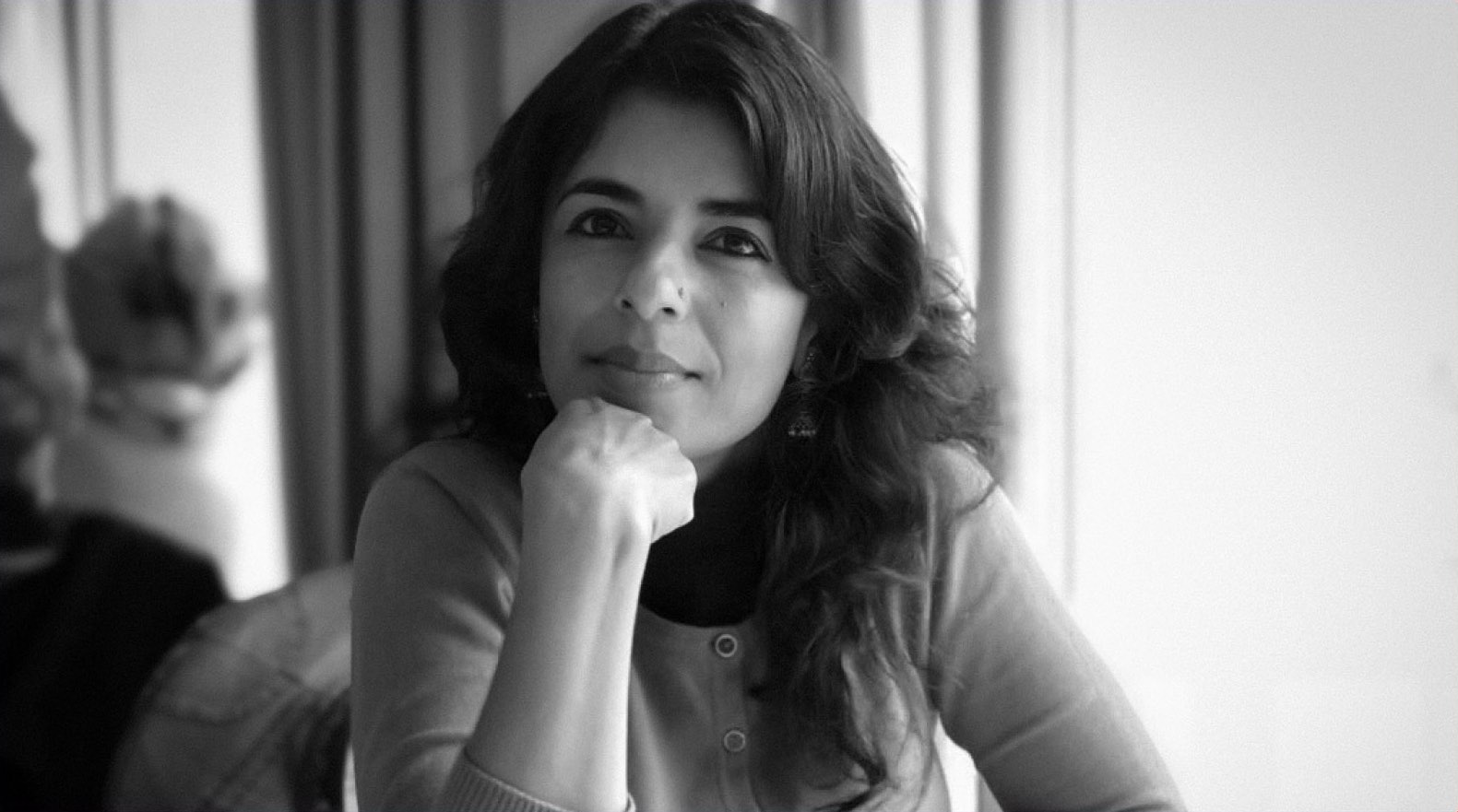
Sandhya Suri
The ascendant filmmaker speaks about making the transition from nonfiction to narrative in her bold feature debut.
Share:
Best known for her documentary I for India (2005) and her lyrical short film The Field (2018), director Sandhya Suri’s debut narrative feature Santosh (2024) is a hard-nosed Indian cop drama that wears its social commentary and 10 years of research with inconspicuous ease. Shahana Goswami plays the title character, a young widow financially compelled after the sudden death of her husband to take over his former job as a police officer. She is tossed headfirst into a hellish pit of corrupt and misogynistic men, save for Inspector Sharma (Sunita Rajwar), a female detective who’s learned how to operate in-step with her male colleagues—a vision, perhaps, of Santosh if she chooses to stick it out on the force. Together, the two women investigate the chilling murder case of a Dalit teenage girl whose body is found in a village well. A convenient suspect arises when they learn her Muslim lover is on the run, but Santosh begins to doubt the narrative she’s being fed by Sharma and those around her.
Suri crafts a measured portrait of India’s persistent ills—Islamophobia, casteism, codified patriarchy, and corruption—with scrupulous specificity, perhaps a vestige of her origins in nonfiction. And yet the film still feels subtle and organic as it unravels the ubiquitous failures of all powerful systems, societies, and countries. The central pillar of the film is Goswami’s melancholic, cast-iron performance, which maintains a steely baseline while always betraying the constant permutations of her character’s consciousness. Premiering in the Un Certain Regard section at the 2024 Cannes Film Festival and part of a wave of stellar Indian films receiving international distribution this year, Santosh, a Metrograph Pictures release, has been shortlisted by the Academy Awards for Best International Feature Film of the year.
IP: Congratulations on the success of Santosh. How has the journey been for you of putting it out into the world?
SS: It’s been good. It’s nice to see it working for Indian audiences. We’ve had limited exposure, but it’s been really well received by critics in India. And then to feel that universality when we play it out in other places, like Japan, to see that shining through feels like a real vindication.
IP: You’re a London-based filmmaker and you’ve previously made documentaries that deal with the representation of India on film. How did you come to make a fiction film in India, and did the way the country has been portrayed in the past shape your approach?
SS: India is always what inspires me. It’s where I find the stories and I think that the similarity [between my nonfiction and narrative filmmaking] has probably always been about asking questions. It’s about complexity, and leaving space for the audience within the film. I’ve tried to maintain that through everything.
IP: Why this story in particular? It’s one that’s very much about the social fabric of Indian life and the corruption endemic to its systems—corruption that’s not unique to India certainly, but nonetheless.
SS: I was trying to make a film about violence against women as a documentary. I was researching and finding it all very horrific. I was trying to get inside the violence and dissect it somewhat, so I abandoned that documentary approach. Then I got struck by an image that I saw in 2012 after the horrible gang rape on the bus in Delhi, when all the world’s media attention was on it. There was an image of female protestors facing an Indian female cop who had such an interesting expression, faced with their hatred and anger, that I just instinctively knew, “Okay, that’s the starting point I was looking for.” It’s about her. And it’s about examining what it means to have the power of that uniform, but to also have this shared sense of injustice or be a victim and a perpetrator. It’s about her because she’s both things. Naturally that meant it had to be fiction, because it wasn’t going to be a documentary with the Indian police. And then I just had to go on a very steep learning curve.
IP: What was that process of transitioning from a documentary to a fiction film?
SS: It was interesting. I knew that I needed to have good anchors, because I’m not particularly decisive in life. I knew that so many decisions get thrust upon you as a fiction filmmaker so for me it was always about knowing where Santosh was. What mattered to me was to feel the authenticity of the locations and the people I met and the research I did and to ground myself in those. Then whatever else that overwhelming journey would bring, I knew I’d be able to manage it.
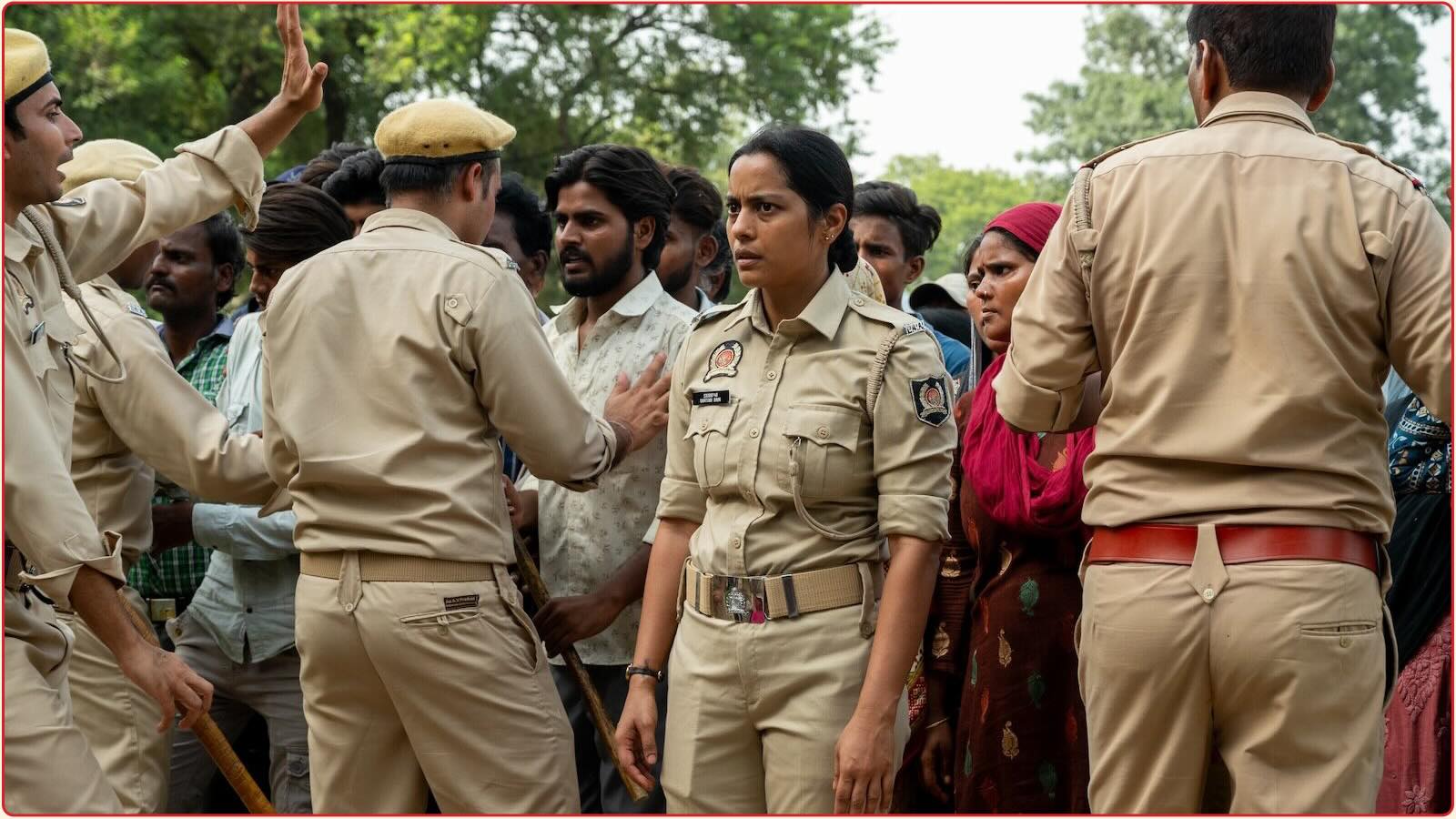
Santosh (2024)
IP: Speaking of anchors, this is definitely an actor’s film, centered around the two powerhouse performances by Shahana Goswami and Sunita Rajwar. With Goswami especially, you can always see something intense is happening under the surface for her character. For example, in the scene when she’s confronted with the anger of the townspeople who have discovered a corpse in their well; it’s one of the moments where you can see that she is awakening to the true nature of what she’s doing and the system she’s a part of. Can you talk about finding your two lead actors and working with them to build these characters?
SS: There’s fantastic performances from both of them, especially Shahana [Goswami]. She’s kind of iconic for me in her uniform, and it really touches me to watch her. It was important for me that they spent the time doing research with me with the police—that was absolutely required; I didn’t want anyone making a sort of amalgam of different cops [seen] on television and cooking soup with it. They dedicated themselves to that process of being in the field during the day, and then working on the script in the evening, so that they were also grounded in that reality.
I’m very lucky to have both of them. Shahana, she’s a very instinctive actress and really understood the complexity of her role. I like the restraint she displays in this role, the softness and hardness within her. We also sense a passion—a passion of a marriage that we never see—I feel that in her. I feel her love for her husband. All these things aren’t in flashback or anything; we just have her emotion, her uniform, and a photograph [of her husband]. She encompasses so much with her hunger and her ambition, but also [with her] will to do the right thing.
I was so interested in casting Sunita [Rajwar] because she comes from a very different space. Even though she’s NSD-trained and absolutely brilliant in her craft, she’s been playing comedic roles for quite some time. To have her come with that deep humanity and vulnerability, it gave the archetype of the matriarch role, which is a big one in Indian cinema, a great depth. Her character is a mystery to all of us still at the end of the film: who Sharma really is and what she actually believes of her own rhetoric.
IP: Was there a process for discussing and negotiating performance style given these actors’ backgrounds in mainstream Indian cinema? Or was there an understanding from the beginning that this was a more naturalistic film?
SS: Shahana’s probably done more independent films than Sunita has. I was always discussing [performance] with Sunita; she’d be like, “Oh, you want less, don’t you?” It was a constant conversation, but after a certain time everyone understood that I was always looking for the lightest touch possible, that is my particular taste.
IP: Can you talk a little more about the research process, where you embedded yourself with Indian cops? Is the script something you had written beforehand? Was it a living document that changed as you did research? Did the actors have input?
SS: I can’t say a huge amount about my access, but yes, it did take a long time to make that work. The script has always been in a quite good place from early on in the process. There weren’t many drafts. There was nothing that was changing story-wise. It was about pieces of dialogue heard or things seen. What the research brought to this script was a layering of detail.
With the actors, we would discuss certain personalities; even on set I’d be like, “Yeah but remember that cop we met? What would she do here? Would she walk in that way? How do you think she would approach things?” It was always a reference in terms of performance to think back to engagements we’d had with people.
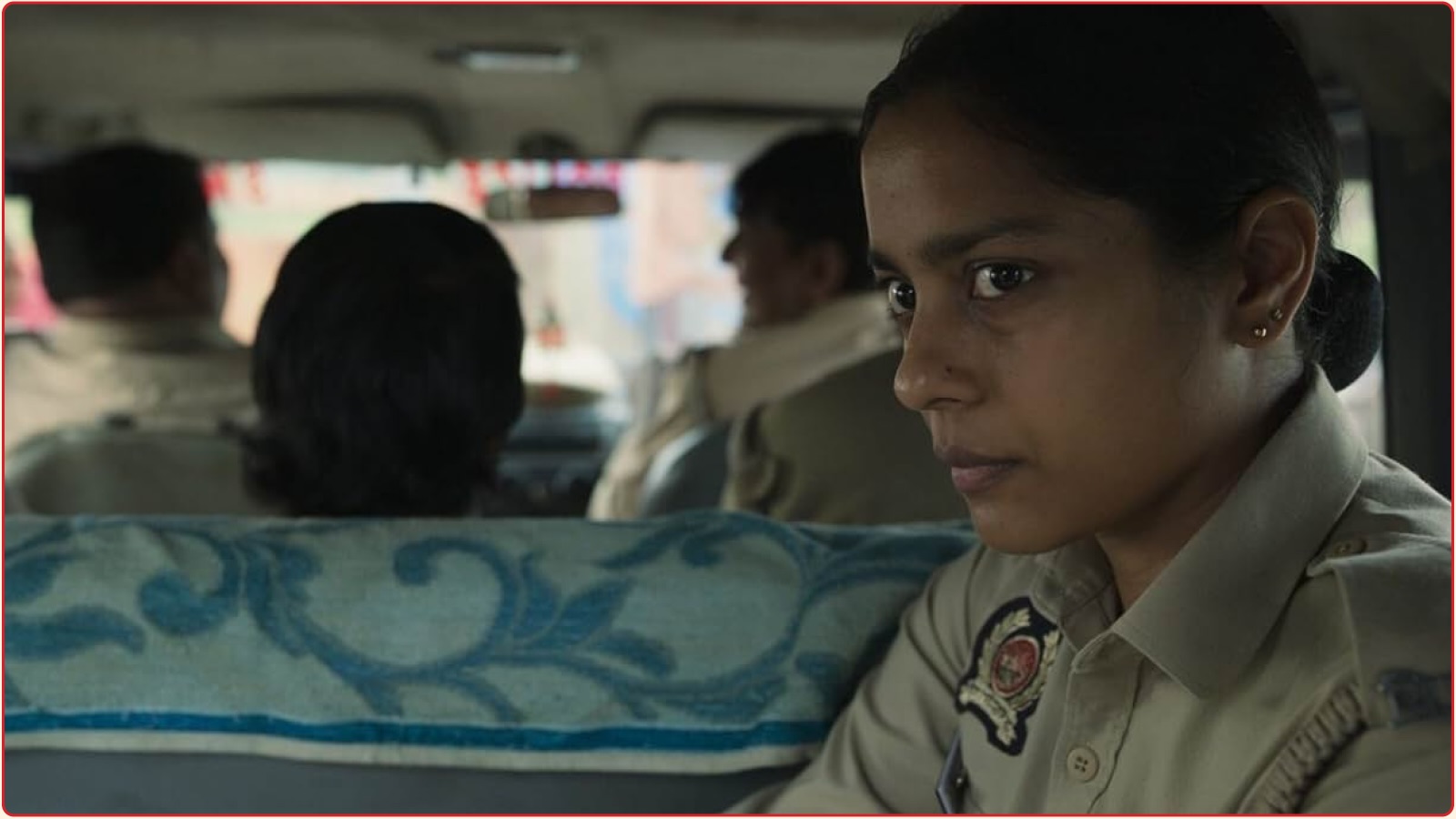
Santosh (2024)
IP: Have you had a chance to screen the film in India? And if so, what was the response like from Indian audiences?
SS: Obviously the thing I’ve been most nervous about is the response from India, but the two screenings we had in Dharamshala and Mumbai were fantastic. And I think what is being appreciated is that things are handled with a light touch, so it feels less like a finger- pointing exercise than a sort of mirror asking questions. It took 10 years to make this film, 10 years of detail and layering. As someone who travels to India all the time—I’ve traveled to more small towns in India than probably many Indians will have done—I’ve put in the time and the research and have always had that connection, so I do feel there is a clarity of the vision.
IP: Having had that 10-year process that resulted in this fiction film, do you now feel fiction is a more effective way of exploring the political?
SS: No, I think when documentaries are great there’s nothing better than them, really, but I like to work very organically and see what form fits the story I want to tell. Even regarding cinematic choices in this [film], it wasn’t about sitting down with a DP and saying, “Hey let’s just shoot with this lens or let’s only do it handheld.” It was all about what was happening scene by scene, movement by movement, within the film; if we’re moving into this thriller zone in the end, let’s lean into it naturally because the story takes the choices with it organically.
IP: The film has a strong visual identity. Were there reference points for you in terms of other films, whether Indian, British, or films from other countries?
SS: The biggest reference was real life and the locations, and keeping it feeling like those places I’d been and seen; that was number one. But filmically there was something about a sort of Sidney Lumet type—you know, gritty, corrupting, cityscape, a place you feel corruption is everywhere and there’s a certain rawness to it. Films like Dog Day Afternoon (1975), that texture, or Memories and Murder (2003); something where I feel this type of tiny shithole of a place, although those two are very different stylistically.

Santosh (2024)
IP: Were you discussing things on a large, conceptual scale with Shahana and other actors? For example, were you talking about the politics and the nature of misogyny in India, or was it more granular and about the specific characters and their choices?
SS: Always personal, always personal. Everything I have made has been about making something very intimate, which is speaking to much bigger things; every piece I’ve done has been like that and I think that’s where my skill is, to transform the big stuff into the very personal. It was always about where is Sunita now, where is Sharma now; it was always on an in-the-moment level.
IP: How did you decide upon Santosh’s trajectory? Where did you want her to end up in the film? Was that something you had a very clear sense of from the beginning?
SS: I always knew she would leave. It wasn’t going to be about a good cop in a bad system, and it wasn’t going to be about revenge, because that doesn’t feel honest. I knew that that would really be her only option. At one point, Sharma says to her, “Look, you can be a woman like me, or you can go and be this sort of person at home, who has nothing and no agency.” The end of the film is really Santosh saying, “You know what, maybe there’s a third way to be a woman,” and not knowing quite what that is, but taking that train to Mumbai and seeing that she’s a new person now. I was interested in this sort of gray-scape of moral murkiness. I wanted to explore what happens if she goes over the line. Can she come back? And then what?
IP: Given the firmness of that trajectory, would you say this is an anti-police film, or does that cross the line ideologically in terms of the message you’re trying to communicate?
SS: No, I don’t think it is [an anti-police film]. That’s why the community complaints about the police make it feel complicated, because the rot is not just with them, you know, police are just a reflection of society as a whole; they’re made of members of society. It’s just so endemic, and these really horrible themes of casteism and misogyny and violence and corruption and Islamophobia; they’re all over the film, they are the tapestry of the place, and so it’s sort of a deeper malaise.
IP: Do you have a desire for how this film will exist in the world? Do you want it to have a social message function?
SS: I mean, how can it not? The point which I think is interesting about this film is that you can really go and have a long discussion with your friends after watching it. There’s a lot coming out of it.
What’s really important for me is that it reaches its audience, and that being a “foreign film” and being subtitled isn’t some horrendous barrier that cannot be overcome because, like I said, the film is proving to be very universal. Corruption is endemic everywhere; it’s more visible in some countries than it is in others, but impunity is a major issue in your country [the US] as much as it is in India. I think the film is saying a lot about a lot of places.

Santosh (2024)
Share:
About the Contributor
Recommended
- Music Sets You Free
 An excerpt from the prodigious musician’s remarkable, newly translated autobiography.
 - Albert Serra
 From Locarno, an interview with the indefatigable Catalan filmmaker.
 - Futures and Pasts: Don’t Play with Fire
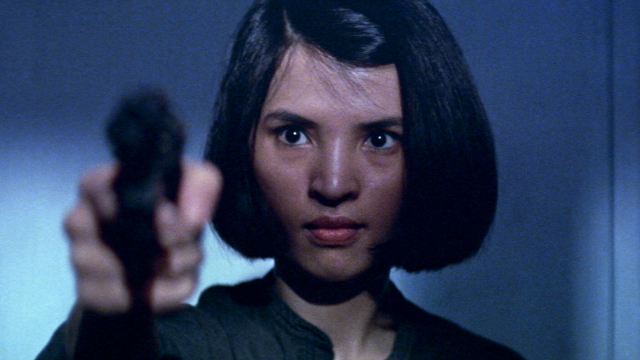 Foul times in the Fragrant Harbor, in Tsui Hark’s newly restored third feature.