
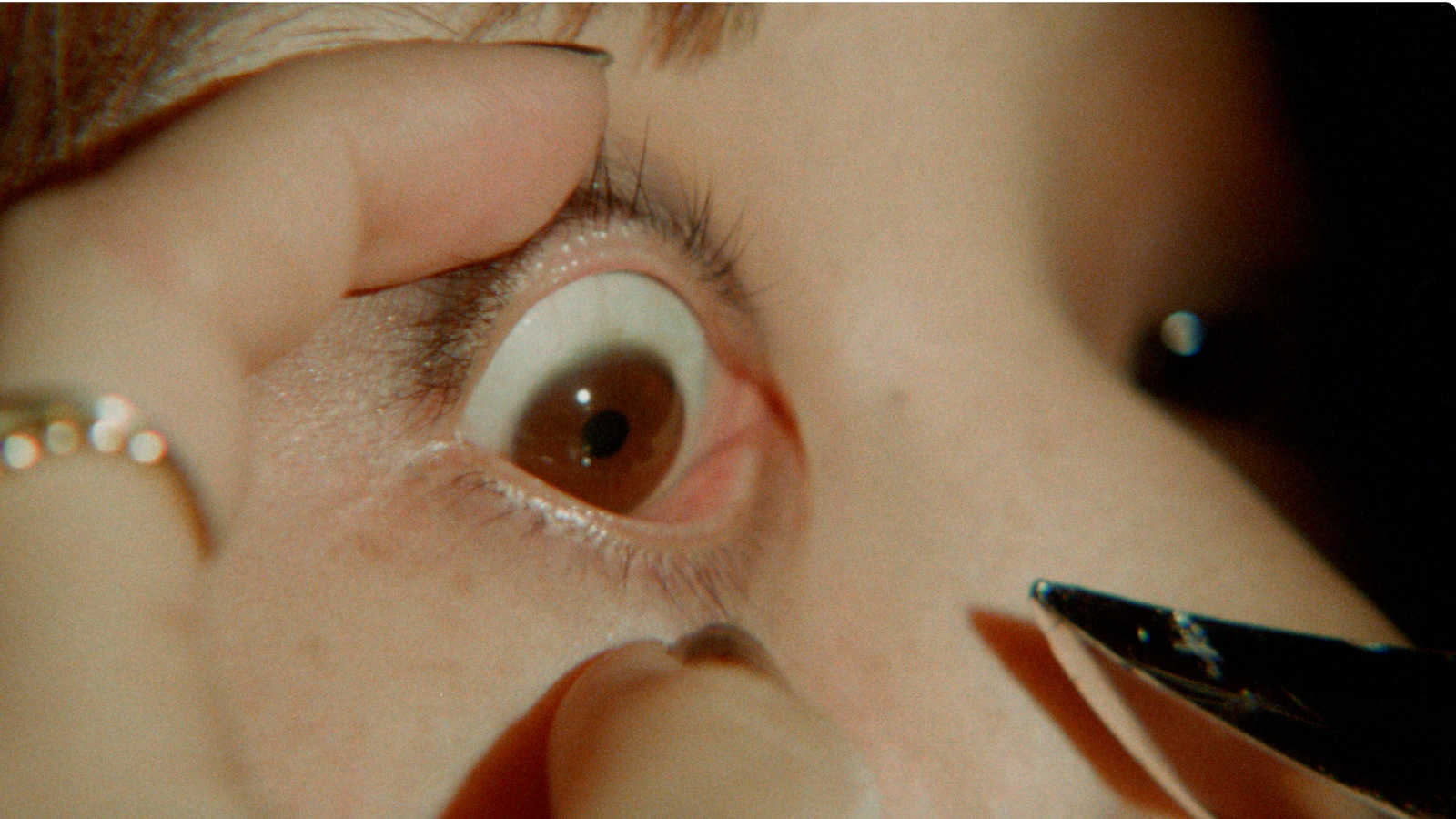
Essay
Re-Wind
On the AV dreams and celluloid nightmares of Hisayasu Satô’s Re-Wind.
Re-Wind (1988) plays at Metrograph from Friday, February 20 as part of Touch Me With Your Eyes.
Share:
A DECOMPOSING ARM CLUTCHING A VHS tape is found stuffed into a refrigerator abandoned in a Tokyo parking lot. The tape is but one of several snuff videos depicting the sexual assault and graphic dismemberment of young women, which have, seemingly intentionally, been left around the city. Their discovery by a private investigator and the janitor at a porno video arcade sends each into spirals of sexual obsession to uncover their origins. Made only a couple of years into his directorial career, Hisayasu Satô’s Re-Wind (1988) is an uneasy meditation on society’s insatiable fixation on sex and violence in the mode of Peeping Tom (1960) or Videodrome (1983), as well as a natural entry point into a filmography that’s grown to span nearly 70 features over the past 40 years.
It was a period of uncertainty and transition for the Pink Film industry when Satô first entered in 1985. Major studios and smaller indies alike had begun churning out increasingly extreme—but still firmly softcore—films, in the hopes of competing with the rising popularity of Adult Video (AV), the new genre of shot-on-video hardcore films that were flooding the home market at the beginning of the decade. The industry’s desperation allowed Satô the creative freedom to hone an aesthetic all his own and produce auteurist films that explored the dark underbelly of Japan’s Bubble Era while also testing the limits of what could conventionally be described as erotic. They’re certainly not for everyone—the salacious titles his distributors branded them with, like Lolita: Vibrator Torture (his title: Secret Garden, 1987) and Lesbian Rape: Sweet Honey Juice (his title: Silencer Made of Glass, 1991), suggest everything you need to know about their questionable taste, if little of their actual narratives—but his films have nonetheless found acclaim abroad, most notably as part of a Pink sidebar at the 1994 International Film Festival Rotterdam that featured both Ostia: Lunar Eclipse Theater (better known under its English title Muscle, 1988) and An Aria on Gazes (1992).
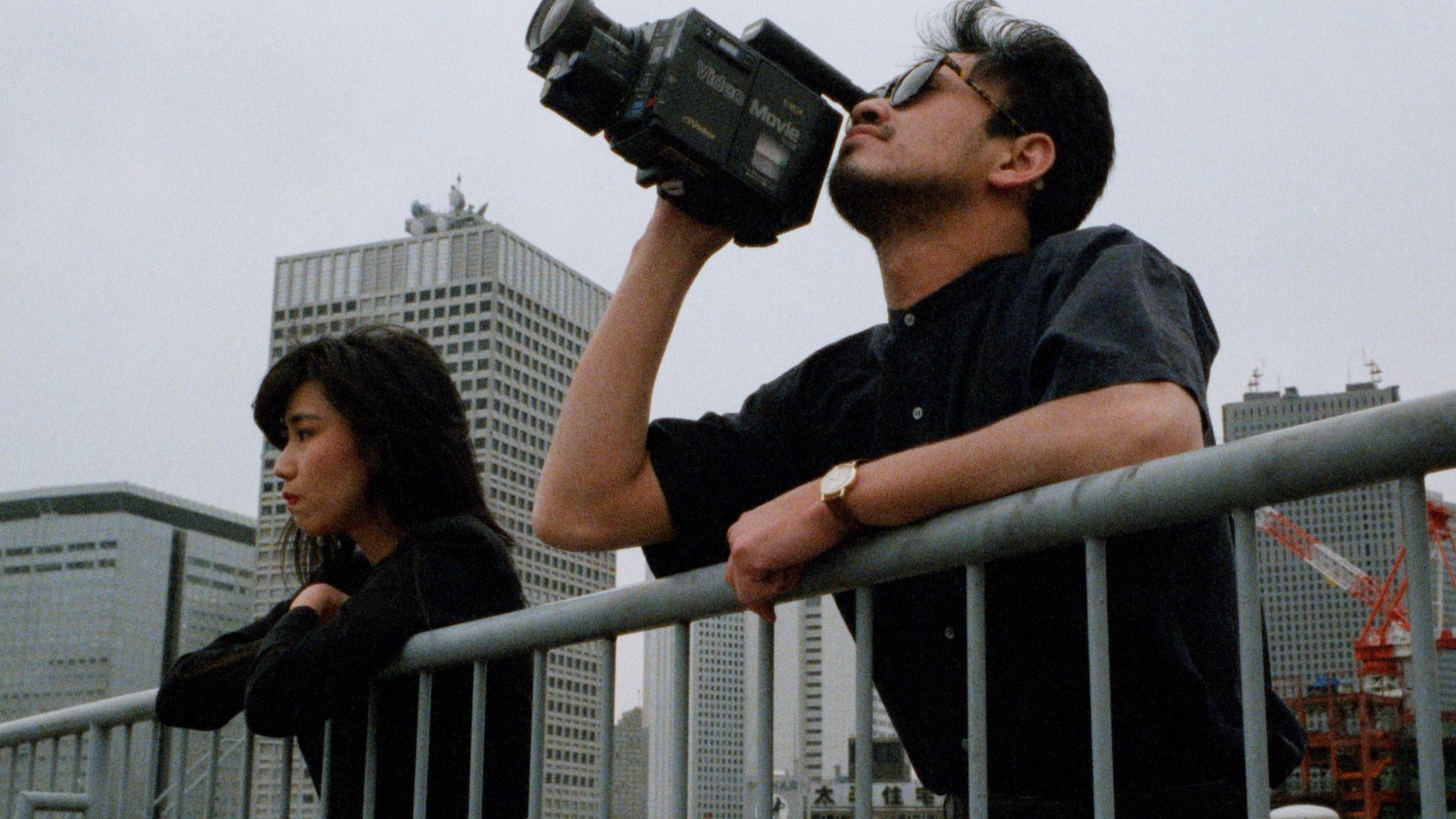
Re-Wind (1988)
As with other hyper-prolific filmmakers like Jess Franco or Rainer Werner Fassbinder, Satô’s oeuvre can be understood as a series of variations on the same set of basic themes: voyeurism, obsession, memory, urban alienation, and the ways that technology reshapes and serves as a conduit for our desires. In Satô’s cinema, characters use everything from telephone party lines (Survey Map of a Paradise Lost, 1988) and pirate radio broadcasts (Radical Hysteria Tour, 1988) to television news programs (Love Obsession, 1989), internet bulletin boards (Welcome to the Illusion, 1989), email (Psychic Rose, 1990) and even wiretapping (Kyrie Eleison, 1993), though no medium has provided a more intense focal point for Satô than video.
Consumer video was still a relatively new phenomenon when the 26-year-old began directing: the first consumer videocassette recorders hit the market in 1975, with the all-in-one portable camcorder following eight years later. At a time when the only exposure most people had to the specific look of video (flat, but fluid and “live” in a way that film isn’t) was television, there was a novelty and a thrill to suddenly being able to see forbidden material presented in a medium that seemed to actually be happening in the moment—if the sex scene or snuff video looked just like the evening news or one’s own home movies, how could it not be authentic? As the urban legend goes, even a fictional, commercially released faux snuff video like Hideshi Hino’s Guinea Pig 2: Flower of Flesh and Blood (1985) appeared so convincing that viewing it caused none other than a concerned Charlie Sheen to report it to the FBI as the real deal.
The immediacy, erotic appeal, and assumed truthfulness of video as a medium was so central to AV’s success that Nikkatsu even launched a short-lived line of shot-on-video softcore features that it transferred to 35mm for theatrical release in 1985, called Roman X (a subline of their Roman Porno series, whose higher production values and greater visibility had always distinguished them from normal Pink Films). Satô’s sole entry into the line, 1986’s Explosion… (Nikkatsu’s title: Uniform Virgin: The Prey), follows the exploits of a deranged, camcorder-wielding teenager who prowls the hallways of his high school, interviewing his female classmates and teachers under the guise of a school project before violently assaulting them on camera. Easily one of the most indefensible titles in Satô’s back catalogue, it is nevertheless one of his most prescient in its depiction of the ways technology enables us to become the worst possible versions of ourselves by creating a layer of remove from physical reality.
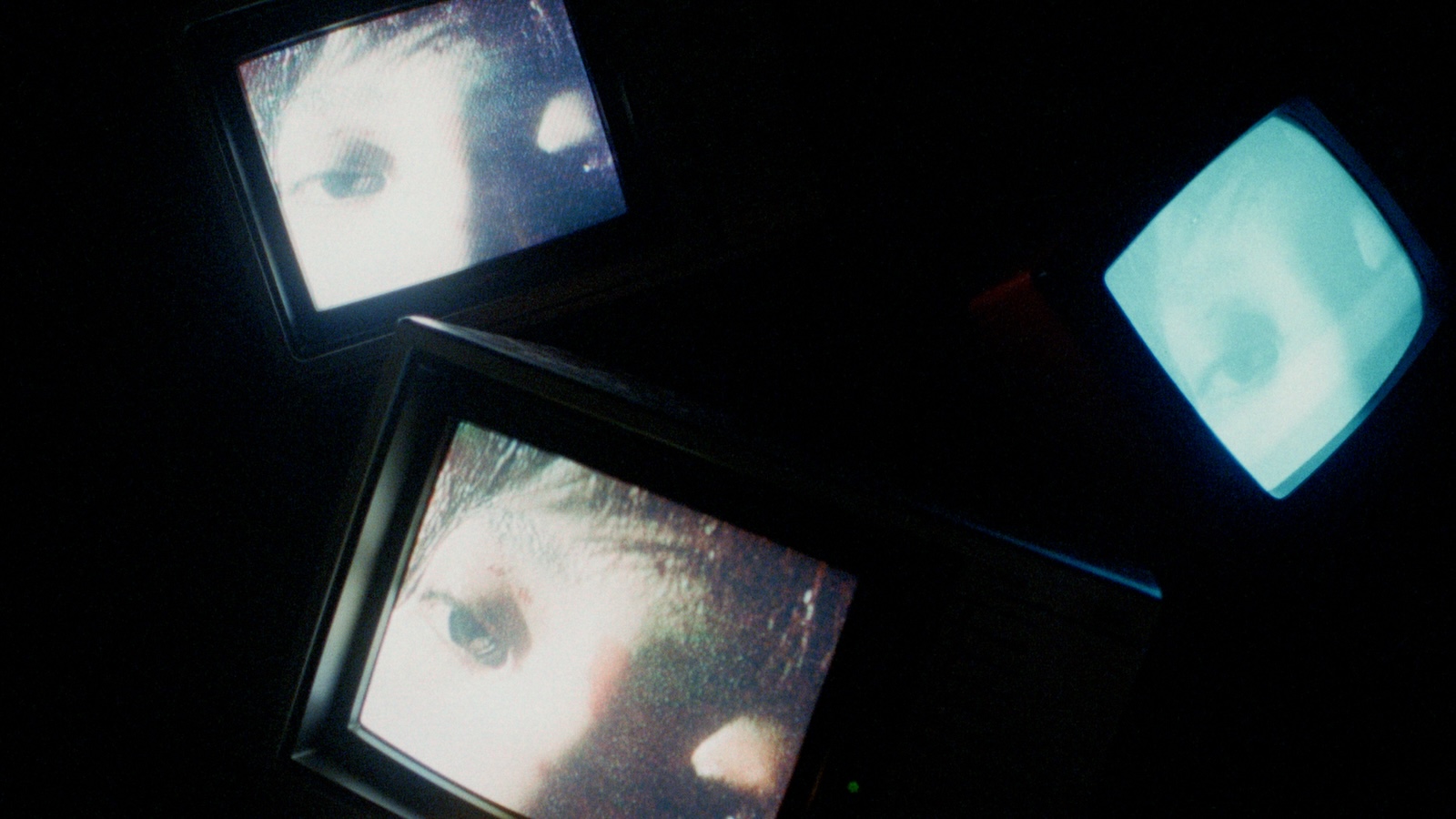
Re-Wind (1988)
In the hypersexual world of Re-Wind, conventional pornography has become so passé that its characters find themselves capable only of deriving an erotic charge from either enacting or viewing the ghastliest of acts on videotape. The janitor (Kazuhiro Sano) is so taken by the video that he finds left behind at his workplace depicting a woman’s assault that he soon spends his days glued to his television—endlessly rewinding and fast-forwarding to analyze her facial expressions, frame by glitchy frame—and his nights hitting the streets to make grisly tapes of his own. Meanwhile, the rogue investigator (Kiyomi Itō), later revealed to be herself the victim of said video, is seen casually engaging in lightly kinky sex with an off-duty cop while watching the snuff tape found in the refrigerator at the opening of the film, the latest to surface. As video becomes the medium through which these desensitized characters can express their desires, the resulting tapes act not only as the physical byproduct of an endless cycle of abuse and trauma, but also the manner in which this cycle spreads and repeats.
Like the cursed videotape at the center of Koji Suzuki’s 1991 novel Ring and its subsequent film adaptations, the tapes act almost like a virus, infecting the minds of those who view them with sexual fantasies and ideas that can’t be easily shaken. In a way, it’s like a second wave feminist’s nightmare: the dopamine hit of seeing “the real thing” is so strong that one can’t merely return to softcore sex and staged violence to get their fix. Satô shoves these videos into the audience’s face: rather than transfer the Hi8 footage to 35mm through a traditional kinescope process, he instead rephotographs them off of CRT monitors and viewfinders, alternating between shooting from the point-of-view of the characters watching them, and then in such extreme close-up that we can make out individual scanlines. The audience is implicated in the violence, and as much as we may not want to see more, we also know that, being a Pink film, Re-Wind will necessarily feature another sex scene roughly every 10 minutes. The actual erotic content in Satô’s films—which zigzags between fairly tame vanilla sex and depictions of assault, heavy kink, self-mutilation, uncommon uses for everyday objects, and a lot of oil massages and underwear licking—encourages the viewer to re-wire their brains and re-orient their tastes to derive any pleasure from it.

Re-Wind (1988)
The specificity of medium is so important to Satô’s work that it’s a shame so much of it has only ever been available outside of Japan via fan-subtitled bootlegs of varying quality. Often taken from nth-generation video sources that render his carefully composed images a murky sludge not entirely unlike that of actual snuff videos, these dodgy transfers intensified the films’ queasy effectiveness and imbued them with a sort of underground authenticity, but at the cost of the filmmaker’s original intentions. (The truly abysmal quality of the only circulating version of Satô’s 1991 horse bestiality drama WAVE makes its already disturbing content even more horrifying.) Besides 35mm and Hi8 video, Re-Wind also makes occasional use of 8mm for a series of brief flashbacks whose purpose and perspective are initially unclear. Again, rather than simply blow the footage up to 35mm, Satô rephotographs it, projected against a screen at silent speed. The mismatched frame rates—24 frames-per-second for the 35mm and 16 frames-per-second for the 8mm—introduces a flicker effect that mirrors the flash of a long-buried memory. On the bootleg version of the film that has circulated online for years (as Celluloid Nightmares, a made-up title that confusingly has also frequently been misattributed to Daisuke Yamanouchi’s 1999 V-Cinema horror Muzan-e), the fuzzy image quality erodes the intentional delineation between the different formats.
Also lost over the past several decades in the shadowy bootleg distribution of Satô’s films is their original screening context: jammed into constantly shuffling double and triple bills at Japan’s circuit of Pink Film theaters. The idea that someone expecting to see a breezy softcore sex comedy could also inadvertently be exposed to something as formally bold and transgressive as Re-Wind or, say, Horse and Woman and Dog (Satô’s title: Poaching by the Water, 1990) is one of the most subversive elements of Satô’s cinema. Watching a VHS tape, or now, a Blu-ray of these films in the privacy of your own home is one thing, but seeing them big, loud, and with a crowd is very much another. As a particularly notorious (if out-of-context) statement once made by Satô goes, “I want to make a film which has the influence to drive its audience mad, to make them commit murder.” What better way to put that to the test?

Re-Wind (1988)
Share:
Recommended
- I’m Not Everything I Want to Be
 On Libuše Jarcovjáková, the queer photographer drawn to the social fringes of Soviet Prague.
 - Letters to His Wife
 Translated into English for the first time, a selection of the esteemed Soviet filmmaker’s devastatingly honest and bittersweet letters.
 - Anocha Suwichakornpong
 The two filmmakers discuss exile, the shock of political awakening, and the filmmaking ecosystem of Southeast Asia.