
Wardrobe Dept.
Mississippi Mermaid
On Yves Saint Laurent’s striking costumes in Truffaut’s subversive neo-noir.
Mississippi Mermaid plays at Metrograph from Saturday, August 29 as part of Dressed by Yves Saint Laurent.
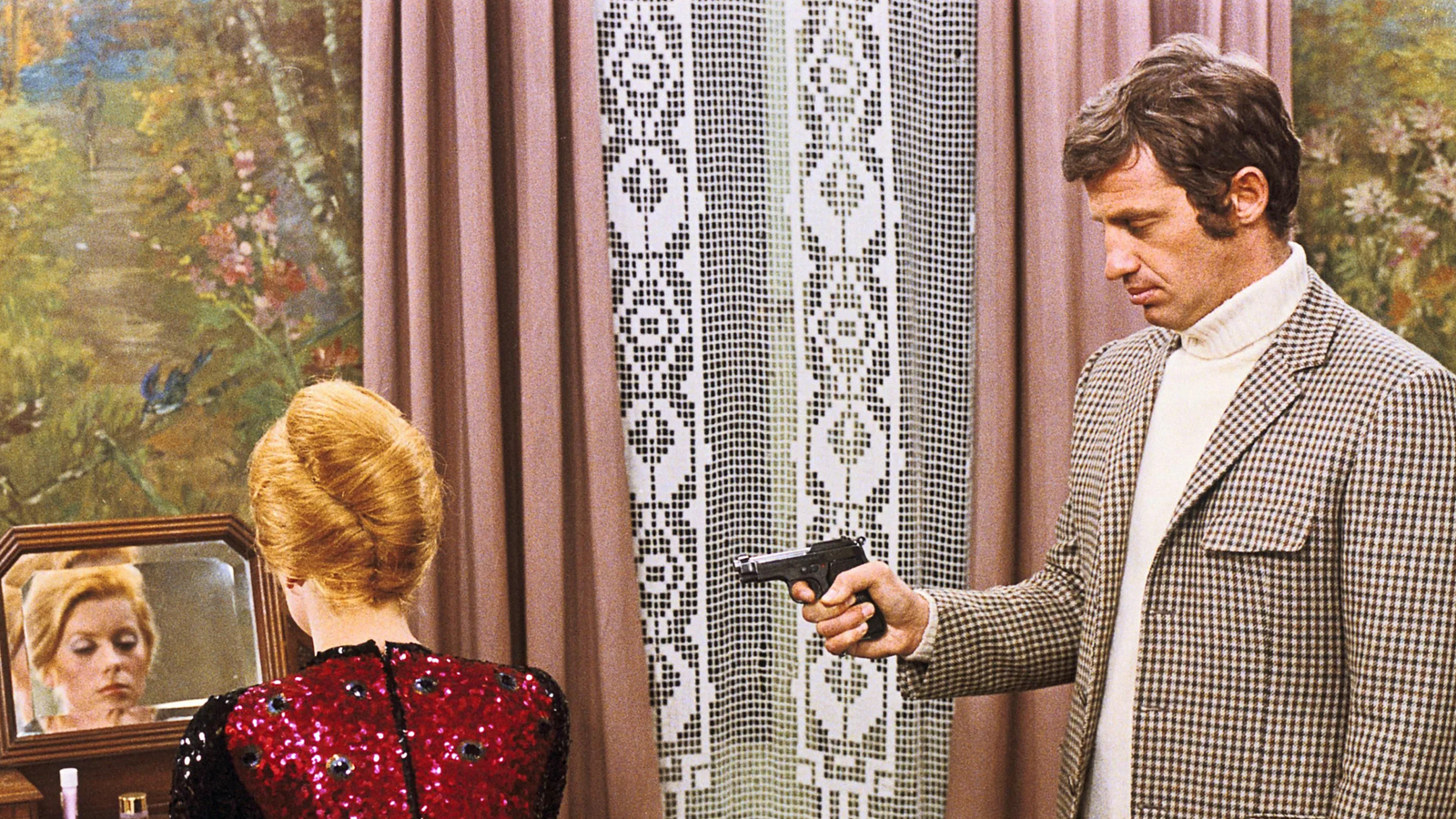
Mississippi Mermaid (1969)
Share:
EDITH HEAD RECKONED THE COSTUME designer must task herself with a certain versatility: “We ask the public to believe that every time they see a performer on the screen he’s become a different person.” Perhaps. Far be it from me to tell cinema’s most decorated wardrobe stylist her business. But at the zenith of Head’s career, mid-century Hollywood was brimming with fashion partnerships that defined its stars as much on camera as off. Where might Audrey or Marilyn be without their respective imagemakers? Hepburn went to Hubert de Givenchy’s salon seeking dresses for 1954’s Sabrina and found a 40-year friendship, carving a glittering path of iconography behind them. Monroe looms larger than life, but William Travilla helped shape the explosive portrait we have of her: namely, the floaty white halter dress in The Seven Year Itch (1955) and the strapless hot pink gown for her much recycled “Diamonds Are a Girl’s Best Friend” number. It is not quite difference these costumiers achieved, but coherence: they made each woman’s essence material.
Catherine Deneuve, née Dorléac, was 22 when she met wunderkind designer Yves Saint Laurent in 1965. The Saint Laurent house was then just four years old, but Yves, not yet 30, had already emerged as a primary architect of modern (women’s) fashion. Although she had been acting since she was a girl alongside her sisters Françoise and Sylvie, she had spent the year following her fêted breakthrough in Jacques Demy’s 1964 musical The Umbrellas of Cherbourg tapped by a veritable constellation of European luminaries—Agnès Varda, Pasquale Festa Campanile, Marcel Camus, etc.—her own stardom assured with her latest turn in Roman Polanski’s Repulsion (1965). As the story goes, not unlike the encounter that united Hepburn and Givenchy, Deneuve ventured to 30 Rue Spontini in Paris, where Saint Laurent had established his atelier, to request a dress for an upcoming reception with Queen Elizabeth II. He produced for her a custom white crepe column gown embroidered with a red bib-like panel. They were devoted to each other thereafter. When Luis Buñuel cast her in Belle de Jour (1967), Deneuve arranged for Saint Laurent to design her costumes, still perhaps the most memorable of their collaborations which bloomed to include La Chamade (1968), Mississippi Mermaid (1969), Liza and Un Flic (both 1972), and 1983’s The Hunger.
Theirs was an auspicious union in no small part because Saint Laurent was fluent in stagecraft long before he encountered Deneuve. His father owned a chain of cinemas. Yves, a precocious boy, built his miniature “Illustre Petit Théâtre” out of cardboard, using hand-painted paper dolls in elaborate puppet-style performances for his family. In between haute couture collections, he conjured dazzling vestments for several plays, ballets, and opera productions across Europe. François Truffaut, director of the oft neglected Mississippi Mermaid, recognized a consummate cinephile in the couturier, who “really understood what is necessary for [film] costumes, taking into account both movement and style.”
All three supply some of their best, if regrettably overlooked work in Truffaut’s chromatic neo-noir. The film has historically ranked among the more thankless properties in the New Wave pioneer’s corpus, but for him it was a passion project. Truffaut loved Waltz into Darkness, the 1947 crime novel by Cornell Woolrich (writing under his pseudonym William Irish) on which the film is based. To date, Woolrich’s fiction has been translated into some 40-odd films although he never quite achieved comparable name recognition. The author was a particular favorite of bold stylists drawn to the murkier dimensions of humanity: e.g. Jacques Tourneur (Leopard Man, 1943), “women’s director” Mitchell Leisen (No Man of Her Own, 1950), and Alfred Hitchcock (Rear Window, 1954), one of Truffaut’s most cherished idols. For his part, Truffaut had already adapted the author’s 1940 pulp noir The Bride Wore Black, released early in 1968, followed that same year by his 400 Blows (1959) sequel Stolen Kisses, where the filmmaker’s surrogate Antoine Doinel reads the very Woolrich novel he would convey to the screen just a year later.
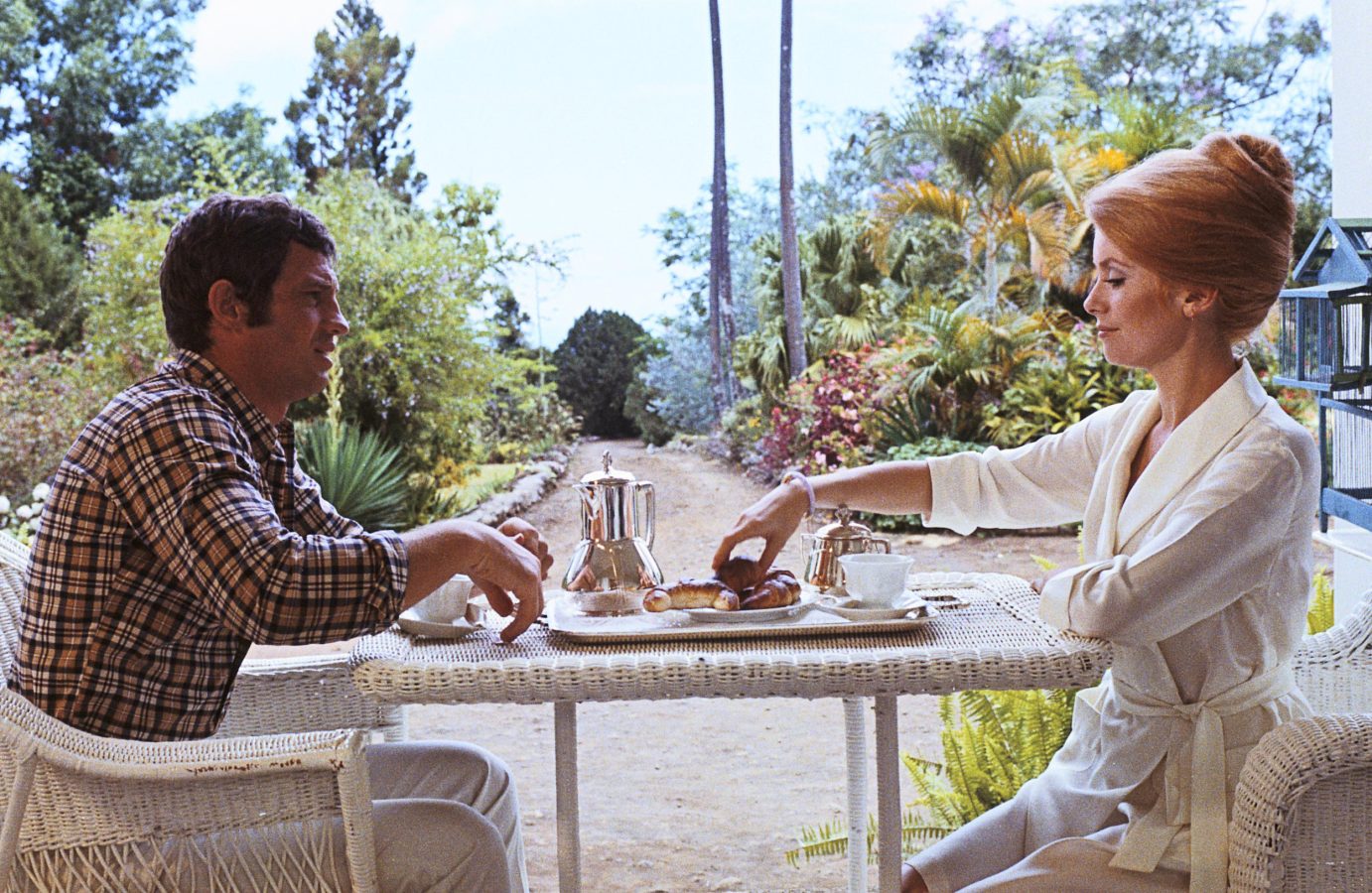
Mississippi Mermaid (1969)
Not without some trouble. Truffaut had waited since the summer of 1966 for the rights to open up, then purchased them from 20th Century Fox with the benefaction of Jeanne Moreau, Claude Lelouch, and Claude Berri. From the earliest negotiations, Truffaut exercised considerable authority over the material (it is him, after all, we have to thank for “auteur theory”): he stubbornly refused to give producers Robert and Raymond Hakim, Egyptian-born brothers, approval over the final cut and declined to cast Brigitte Bardot, the studio choice, insisting on Deneuve after seeing rushes of Belle de Jour. At eight million francs it remains his costliest production.
His preferred co-writers (Jean-Louis Richard, Suzanne Schiffman, etc.) being unavailable, Truffaut penned the screenplay alone, with one or two notable indulgences. Woolrich’s tale migrates from 1880s New Orleans to present-day Réunion Island, uninhabited before the French took possession of it and imported enslaved East Africans to harvest its sugarcane. Réunion remains an overseas department of France, while former colonies Madagascar lies to the west and Mauritius to the northeast. (The fussy 2001 remake Original Sin also skirts Louisiana, instead sprawling from Cuba to Morocco.) Truffaut buries a winking tribute, too, in the new title, La Sirène du Mississippi, so named for the vessel that delivers Deneuve’s temptress to Réunion, and a nod to her character’s American counterpart in Woolrich’s novel, who arrives by the Mississippi River.
Jean-Paul Belmondo plays tobacco plantation owner Louis Mahé, instantly besotted by Deneuve’s beautiful mail-order bride-to-be Julie Roussel. At first, the marriage seems happy, but Julie soon absconds with his fortune, left in their joint bank account. After a stint in a sanitarium, Louis chances upon her dancing at a club in Antibes. She confesses that her real name is Marion Vergano, and that she is an ex-convict enlisted by her gangster boyfriend to impersonate Julie, who was thrown overboard the Mississippi. Helplessly in love, Louis reunites with Marion, and they both become fugitives when he kills the private detective (Michel Bouquet) determined to dispense justice on behalf of the Roussels.
The noir classically boasts a surlier hero who will, sooner or later, smite the wanton femme fatale for her gender sedition. But Truffaut’s film revels in this inversion. When “Julie” first docks from Nouméa, Louis tells her, “Where you’re from is a long stretch of land, whereas Réunion is shaped like an egg.” She symbolizes the phallic while he invokes the feminine. Sex is, blessedly, the fulcrum of their relationship. By his own admission, Truffaut envisaged the hopelessly naïve Louis (“For me, [Louis] is actually a virgin!”) as the pairing’s true bride, who expects “everything from marriage.” The film owes much to the director’s peculiar diplopia, although he would later attribute its failure to casting against type. By then, Belmondo was a box-office powerhouse, a paragon of virile manhood: not too handsome like Alain Delon—in my estimation, Deneuve’s truest analogue with his glacial beauty—and not too vulnerable like (the more intuitive prospect for Louis) Jean-Louis Trintignant, who marvelously played the cuck in Roger Vadim’s 1956 masterwork And God Created Woman. Meanwhile, Truffaut saw Marion as “the tough guy, the hood who has been through hard times.” She is, admittedly, a con artist orphan-turned-sex-worker, at least twice the accomplice to murder, and a would-be murderess herself. Deneuve’s signature opacity never served her so well.

Catherine Deneuve and Yves Saint Laurent, 1966
Like Deneuve, Saint Laurent’s natural gifts made him especially disposed to the demands of Mississippi Mermaid. He was born in Oran, the seaside metropolis on the northwest coast of Algeria, to a bourgeois family. As a teenager he left for Paris, was immediately hired by Christian Dior upon their introduction, and soon anointed heir apparent. At 21, he became head of the house and the world’s youngest couturier. (The intersections between he and Deneuve persist: her sister Françoise, who died in 1967, began her career modeling for Dior.) If the designs of his mentor personified ultra-femininity and romance—cinched waists, flared skirts, Belle Époque opulence—then Saint Laurent represented democratization with the utilitarian themes that came to define his own house codes: androgyny, precise tailoring, invisible seams, leather, and masculine silhouettes. (Eventually his iconoclast impulses caught up with him; in 1960, he was ousted from Dior, the brand he’d once rescued from financial ruin, after his avant-garde beatnik collection appalled their conservative clientele.) The way Dior’s “New Look” restored an ornamental vision of traditional womanhood, capsized by wartime austerity, “Le Smoking”—the woman’s tuxedo invented by Saint Laurent in 1966—became an emblem of the “liberated” ’60s that his teacher, who died in 1957, never saw.
His boyhood in Algeria obviously guided his tastes: he reserved a fondness for earthy prints, textiles, geometric blocking, and vibrant colors. (He and his partner Pierre Bergé maintained a residence in Marrakech.) Just before Mississippi Mermaid began shooting, he released his acclaimed safari line, inspired by Occidental interlopers and the uniform of the German military force Afrika Korps. It was a commercial triumph, but the timing was infelicitous. That decade ushered in a wave of independence for African countries, among them Algeria in 1962, after a brutal and bloody war in which Saint Laurent himself was disastrously conscripted to serve. Rive Gauche, his ready-to-wear boutique (site of his most culturally vital experiments), introduced to mainstream women’s fashion a new sartorial vocabulary: jumpsuits, vests, pussy-bow blouses, trench coats, the safari jacket. But the line also betrays the more insular contours of his artistry, forged in the seat of empire. It is, to my mind (and likely, almost no one else’s given its enduring success), an unusual blunder for the designer, who otherwise rigorously championed Black models on his runways and in editorial campaigns. Almost a decade later, he would conceive his 1978 Broadway Suit collection, inspired by the all-Black opera Porgy and Bess, around Martinican model Mounia Orosemane, and in 1988, threaten to pull his label’s advertising from French Vogue unless they shot Naomi Campbell for its cover.
Of course, it is always hard to know what comes first: the influence of the trailblazing aesthete or his ability to predict the fickle tides of culture (Saint Laurent often demonstrated an uncanny ambidexterity). But the utility of Rive Gauche Spring/Summer ’68 for Mississippi Mermaid is less a consequence of his prescience than the moment he and Truffaut occasioned to collide. Student protests marked Paris and cities around the world in 1968; in solidarity Truffaut and Jean-Luc Godard famously shut down the Cannes Film Festival, storming the grand auditorium of the Palais to interrupt the screening of Carlos Saura’s Peppermint Frappé. France, and its art, was ensnared in a fraught, long simmering political reckoning.
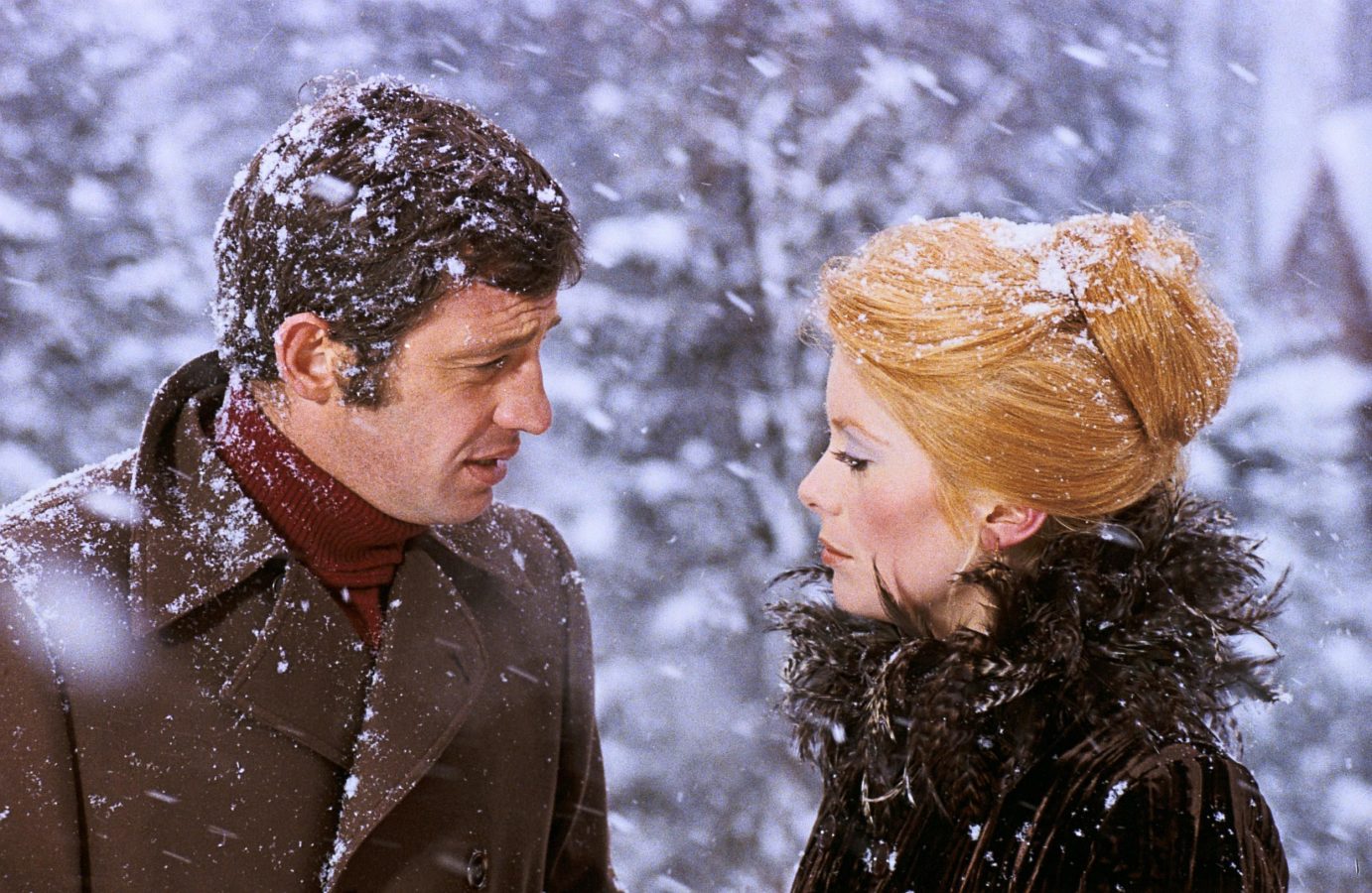
Mississippi Mermaid (1969)
Perhaps Saint Laurent imagined that he might excise bushwear from its colonialist origins, but Truffaut’s film exposes an ongoing extraction. Always musing intertextually on cinema, the filmmaker dedicates Mississippi Mermaid to Jean Renoir (his other supreme idol) and the prologue includes shots from La Marseillaise (1938), narratively transporting its troops from the French Revolution to this outpost tropical isle. In grainy sepia, a parade of soldiers roam the citadel, shrieking, “Long live France!” The newsreel footage thus recasts them, no longer liberators, but conquerors. Appareled in the finest items from this early Rive Gauche outing, Deneuve cuts an unsurprisingly glamorous figure (much to the chagrin of Jean-Louis Bory, who complained that the film was “too haute couture” in Le Nouvel Observateur). One such number was the coveted Saharienne, a khaki mini-dress, worn when she and Louis drive past a grassy knoll of Black laborers plowing the field. The camera lingers on them in wide shot, long after the newlyweds have wheeled away.
Never mind that Marion is playing a part, so is Louis, decked in an unbuttoned gingham shirt and straw hat, a working-class costume. In his letters to the real Julie Roussel, he claims to be a foreman (to test her sincerity) in the cigarette factory he actually owns. It makes little meaningful difference; it is his partner Jardine (played by producer Marcel Berbert, Truffaut’s own loyal, right-hand man) who really runs the business. Artifice characterizes the primal stages of their connection, pretense as foreplay: Louis lies again, when he tells Marion that the island was populated by women shipped from the Continent, one of them his ancestor. Only when he bitterly confronts her in Antibes does he reveal that these women were prostitutes.
Crucially, the plot relies on this constant movement between colony and imperial core. Marion and Louis depend entirely on the money generated by his business, long after he has abandoned it. She recoils when he suggests getting a job. “Work, I don’t believe in it! And besides, I hate men who work,” she tells her husband matter-of-factly. (When they finally run out, they land in the most polar realm possible: from the sweltering tropics to the snowbound Swiss mountains.) At any rate, Europe transforms Marion. Gone are the modest silk florals and pearl-white robes of her time in Réunion, replaced with the camel browns and taupes that so often anchored Saint Laurent’s collections. A fitted modern trench, cinnamon wool jumpers, and a knee-length brown wrap skirt with black pumps become her staples: the sleek, minimalist uniform of a bourgeoisie wife. But slippages prevail: Louis shoves her when she flops on the couch, legs spread open. In another scene, she stands up in their convertible and removes her blouse, tied with pussy-bow, flashing the driver in an approaching vehicle (he crashes into a tree). Marion dominates the partnership, but wields power carelessly, conveniently; her real twin appetites are money—principally for clothes—and sex.
No wonder she longs to see Paris. She desires a more cosmopolitan living than Aix-en-Provence and Lyon promise them. In another telling moment, she admires a long black coat, embellished with an ostrich feather collar, displayed in a shop window. “It’s quite a coat,” she says to Louis. “But actually, it’s really more for Paris.” He buys the pelt, but soon enough they must flee again. Fortunately, the elegant beau manteau suits the blanched highlands of Switzerland just fine. Trapped together in a remote cabin—formerly used in Truffaut’s Shoot the Piano Player (1960)—Marion dons a black knit dress and her extravagant feathered coat, finally resembling the femme fatales we had grown accustomed to, and almost as ruthless.
It did not bother Truffaut that the film was a flop; he completed production in love. Fitting, for him Mississippi Mermaid was “above all else a tale of degradation through love, of a passion.” In the climatic sequence, even selfish, fragile, inscrutable Marion tearfully concedes, “I’m learning what love is, Louis. It’s painful. It hurts me.” Truffaut and Deneuve enjoyed an intense short-lived affair, and when they split, much like Louis, he sunk into a depression that sent him to a clinic. (He had also had a romance with her sister Françoise.) By then, Deneuve had met Marcello Mastroianni.
In 2002, the actress attended an event at Centre Pompidou to commemorate the 40th anniversary of Saint Laurent’s career in haute couture and mark his official retirement. She wore a fitted black tuxedo, an updated version of Le Smoking, and serenaded him from the runway: “My most beautiful love affair is with you.”

Share:
Recommended
- Mississippi Mermaid
 On Yves Saint Laurent’s striking costumes in François Truffaut’s subversive neo-noir.
 - Lady in the Water
 On the death of the critic in M. Night Shyamalan’s watery fairy tale.
 - Der Fan
 Eckhart Schmidt’s chilling cult fable and the all-consuming side of pop fandom.