
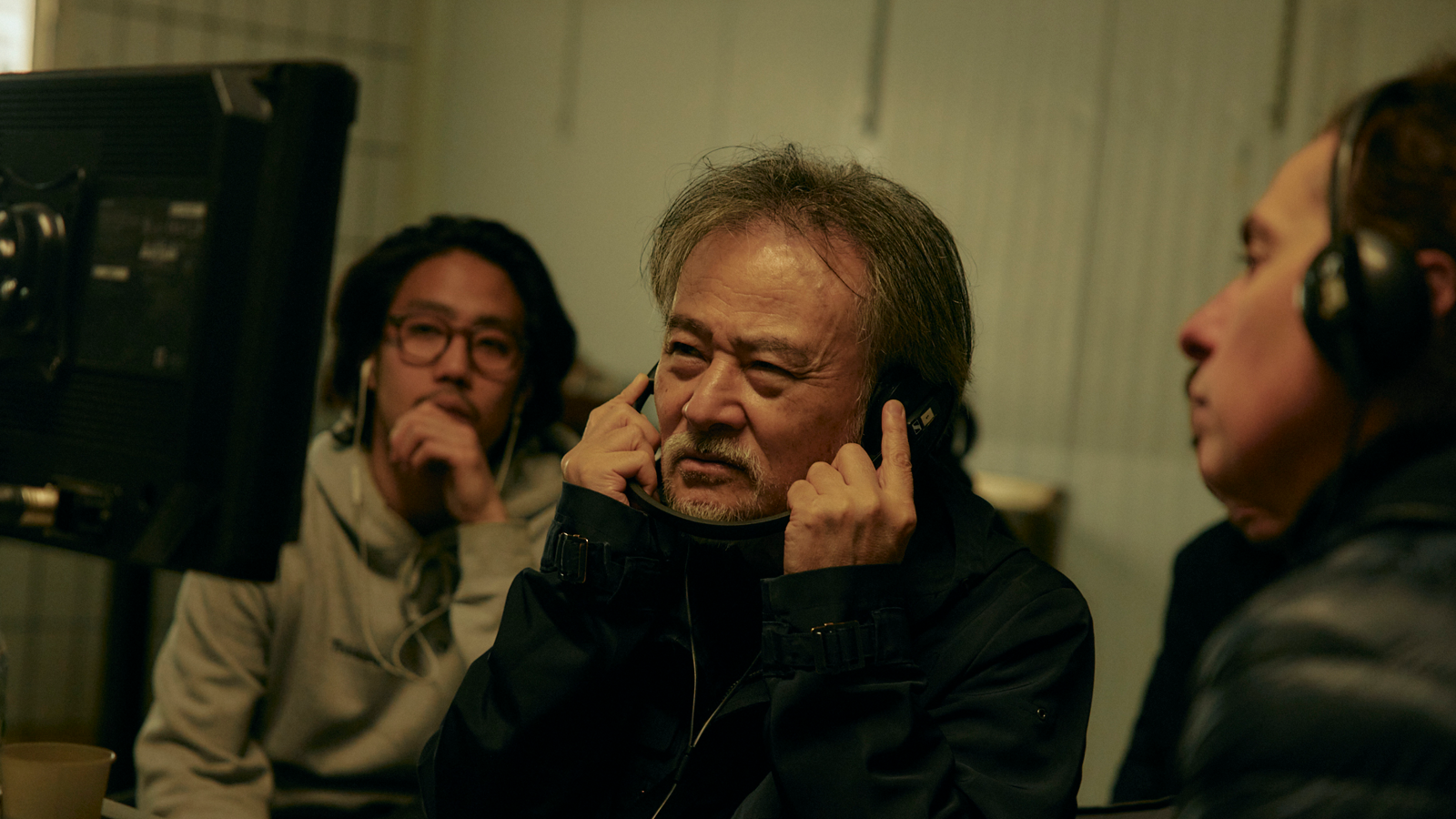
Photo of Kiyoshi Kurosawa, courtesy, 2024 Cinéfrance Studios – Kadokawa Corporation – Tarantula
Essay
Kiyoshi Kurosawa’s Haunted Japan
On the darkness and isolation that shapes the genre director’s cinema.
Directed by Kiyoshi Kurosawa is currently streaming on Metrograph At Home.
Share:
IS IT ALL ABOUT—only about—isolation? The sticking, black maw of loneliness? The inability to truly connect? The futility of hope? These are questions that follow Kiyoshi Kurosawa no matter what film he makes. At first blush, they seem to be effects of the power of his earlier films, most prominently 1997’s Cure and 2001’s Pulse, nominally horror films that are also, in their own right, dark dramas of intense human insight. It is understandable that, for many Western audiences, Kurosawa is synonymous with the macabre and supernatural. Pulse is arguably Kurosawa’s most popular film, often jumbled together with the original Ringu (1998) and Ju-On: The Grudge (2002) as riding a wave of Japanese horror films that then spawned American remakes. There’s also Kurosawa’s 2000 television film Seance, and 2005’s Loft which, along with Pulse, all present as thrilling ghost stories where human characters struggle to relate to and communicate with one another.
But there’s a lack of specificity in this slightly reductive yet pervasive interpretation of Kurosawa’s work, which spans almost five decades and includes two dozen features, music videos, and television. It is true that Kurosawa is interested in isolation, in how flawed and malleable our perceptions of one another can be, often to catastrophic and tragic ends. In short, he is continually pulled toward ghosts and what they might represent: how these revenants border not just the world of the living and the dead, but the past and present. There is the feeling of something escaping in his films, of containment breached, of chaos let loose.

Serpent’s Path (1998)
It’s with 1996’s Door III that a recurring theme of Kurosawa’s work begins to germinate. The film, the second sequel in a body horror series begun by Banmei Takahashi, follows an insurance saleswoman named Kyo (Minako Tanaka) whose encounter with a potential customer results in both bodily and psychological entanglement. Door III shares certain details with its predecessors Door and Door II, specifically the presence of a salesperson who becomes an arbiter of toxic, even murderous obsession. But what’s most resonant is Kurosawa’s budding aesthetic investigation of Japan’s Ushinawareta Jūnen, or “Lost Decade,” when the country’s then-ascendant economy entered a period of stagnation. Kurosawa’s contemporaries, too, orbited the anxiety and confusion of the ’90s, perhaps most pointedly Hideo Nakata in Ringu, his influential adaptation of the Koji Suzuki novel of the same name, where a ghostly, vengeful avatar of history invades the modern world, Trojan-horsed with new technology. Yet Kurosawa’s depictions have always been slightly more abstract, imbued with melancholy and a sense of dread that extends beyond any single sign of the times.
The year before Door III’s release, the Aum Shinrikyo cult attacked three lines of the Tokyo subway with sarin gas. In his nonfiction book Underground, Haruki Murakami follows a line of inquiry centered on the victims of the attack but also the greater psyche of Japan, interviewing ordinary people afflicted by an intense, almost parasitic malaise and dissatisfaction with daily life, with work, and their lack of connection to others. Key to Murakami’s book is an echo of Kurosawa’s project to name that which is hidden, or pushed away. Murakami writes,
I was also motivated by a strong sense of fear that we had still not begun to deal with, let alone solve, any of the fundamental issues arising from the gas attack. Specifically, for people who are outside the main system of Japanese society (the young in particular), there remains no effective alternative or safety net. As long as this crucial gap exists in our society, like a kind of black hole, even if Aum is suppressed, other magnetic force fields—“Aum-like” groups—will rise up again, and similar incidents are bound to take place.
Such a magnetic force is given enigmatic form in Cure, a film that indirectly dramatizes Murakami’s black hole and projects it onto a Japan that seems primed for unthinking violence. In the film, Tokyo detective Kenichi Takabe (played by regular Kurosawa collaborator Koji Yakusho) investigates a series of puzzling murders perpetrated seemingly at random by people who cannot explain their actions. Each of the killers has recently encountered a mysterious amnesiac drifter named Kunihiko Mamiya (Masato Hagiwara) who utilizes mesmerism and hypnosis to opaque yet nefarious ends.
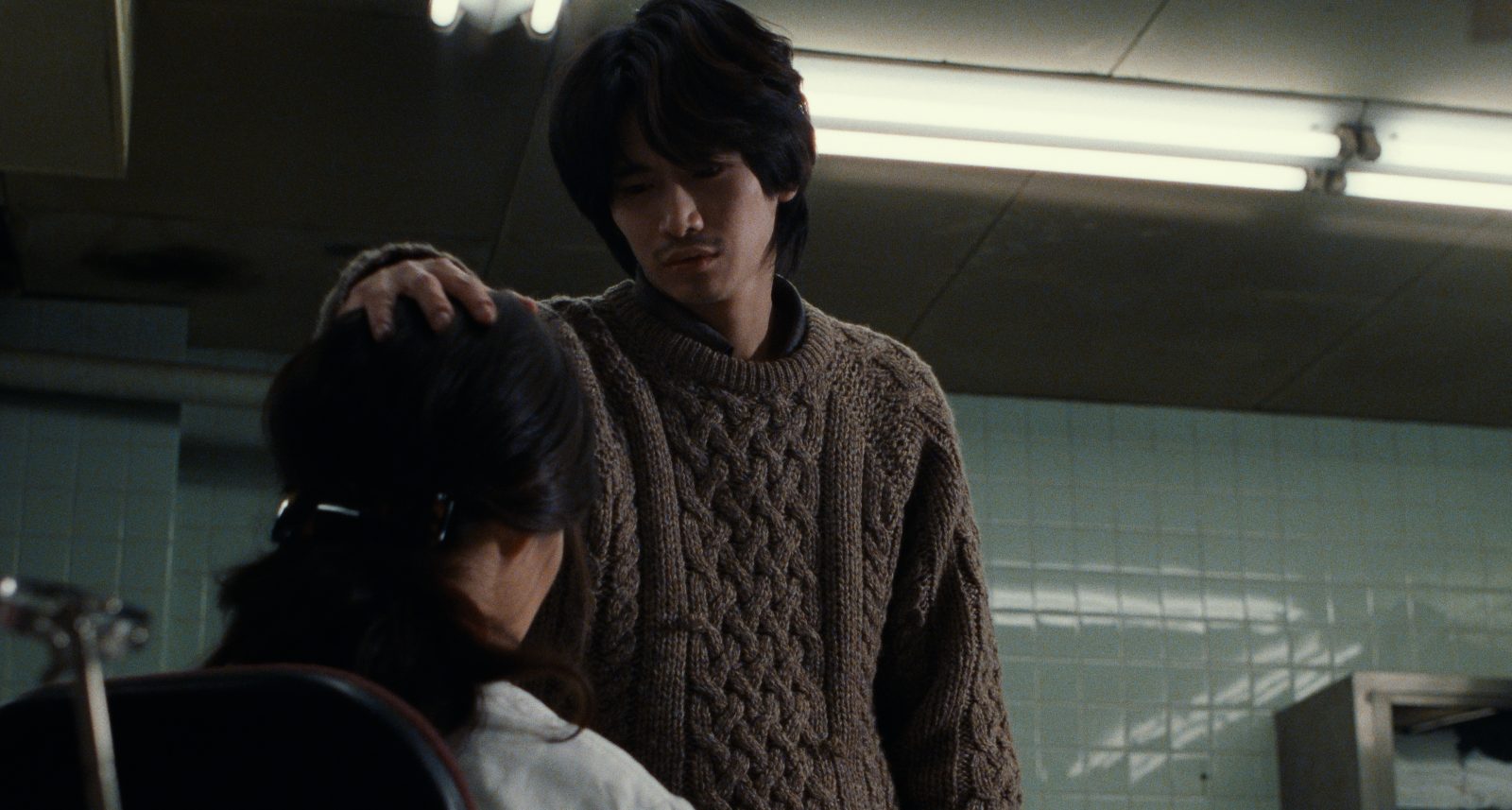
Cure (1997)
Though the commonalities between the Aum cult and Mamiya seem obvious (hypnotic suggestion which leads to shocking violence, also thematically and ideologically explored in Kurosawa’s 1999 film Charisma), Cure is as much a film about spiritual vacancies and elisions as it is a lightning rod for contemporary Japanese social ills. Implicit in both Cure and Pulse is the suggestion that, though the audience is presented with what look like clear culprits responsible for infecting others with aberrant behavior, these opaque forces merely reveal latent desires. Kurosawa doesn’t posit that what lies beneath is essentially evil or good. Particularly in the case of Detective Takabe in Cure: the law enforcement official hellbent on justice comes across as far more volatile and cruel than Mamiya, whose sinister, cryptic pronouncements take on the cadence of prophecies, a John the Baptist of already-insane times.
Over the years, Kurosawa has revisited and retooled a haunted cinema, one that follows lost souls in search of purpose or permission. Bright Future (2003) follows a factory worker named Nimura (Joe Odagiri) whose irritation with his boss leads to murder but also an inner unmooring, allegorized by jellyfish spawning in the city sewers. Retribution (2006) casts Yakusho again as a hardened detective, this time investigating mysterious serial murders that lead him to a ghostly woman in red and, in the process, becomes contaminated by the same homicidal impulse. The covered-up and expunged always find their way back in Kurosawa’s films, often in the form of insistent ghosts though not always. To the Ends of the Earth (2019) turns on a series of vignettes featuring a Japanese television reporter (Atsuko Maeda) in Uzbekistan. In one dreamlike sequence, the reporter visits the Navoi Theatre, built by Japanese POWs after World War II, history collapsing into the present, defying the idea of time as a linear and ordered phenomenon.
Indeed, it is in locations rife with unseen lineage where Kurosawa distinguishes his cinema. The filmmaker consistently demonstrates an eye for what might be called dead spaces: corporate offices, abandoned factories, bland apartment complexes, unpopulated residential streets. In one of Pulse’s most terrifying yet quiet scenes, Yabe (Masatoshi Matsuo), a young plant store worker, goes to the scene of his friend’s suicide. The bus ride preceding is shown with a beautifully grainy backdrop and when Yabe steps off, the streets are dark and deserted. Pulse is, among other things, one of Kurosawa’s most daring experiments with filmic darkness—every shadow, pupil, and charred surface rendered into an almost completely black shape on screen. Leaving his friend’s now vacant apartment, Yabe sees a door outlined in red tape, a foreboding sight that, behind it, houses a room that appears accidental, as if it was created only in that moment. Inside, Yabe encounters a slow-walking ghost of a woman in a black dress, her movements like that of a dancer or a swimmer, one iteration, perhaps, of the ghost in the red dress who appears more consequentially in Retribution. The sterile concrete of the room against the seemingly cold flesh of the ghost unsettles almost as much as the impossible darkness of the space, as if the camera itself is squinting to see better. This auxiliary room, or abandoned apartment, or defunct storage space is not some ancient place, but glaringly new, utilitarian, and yet no less haunted.
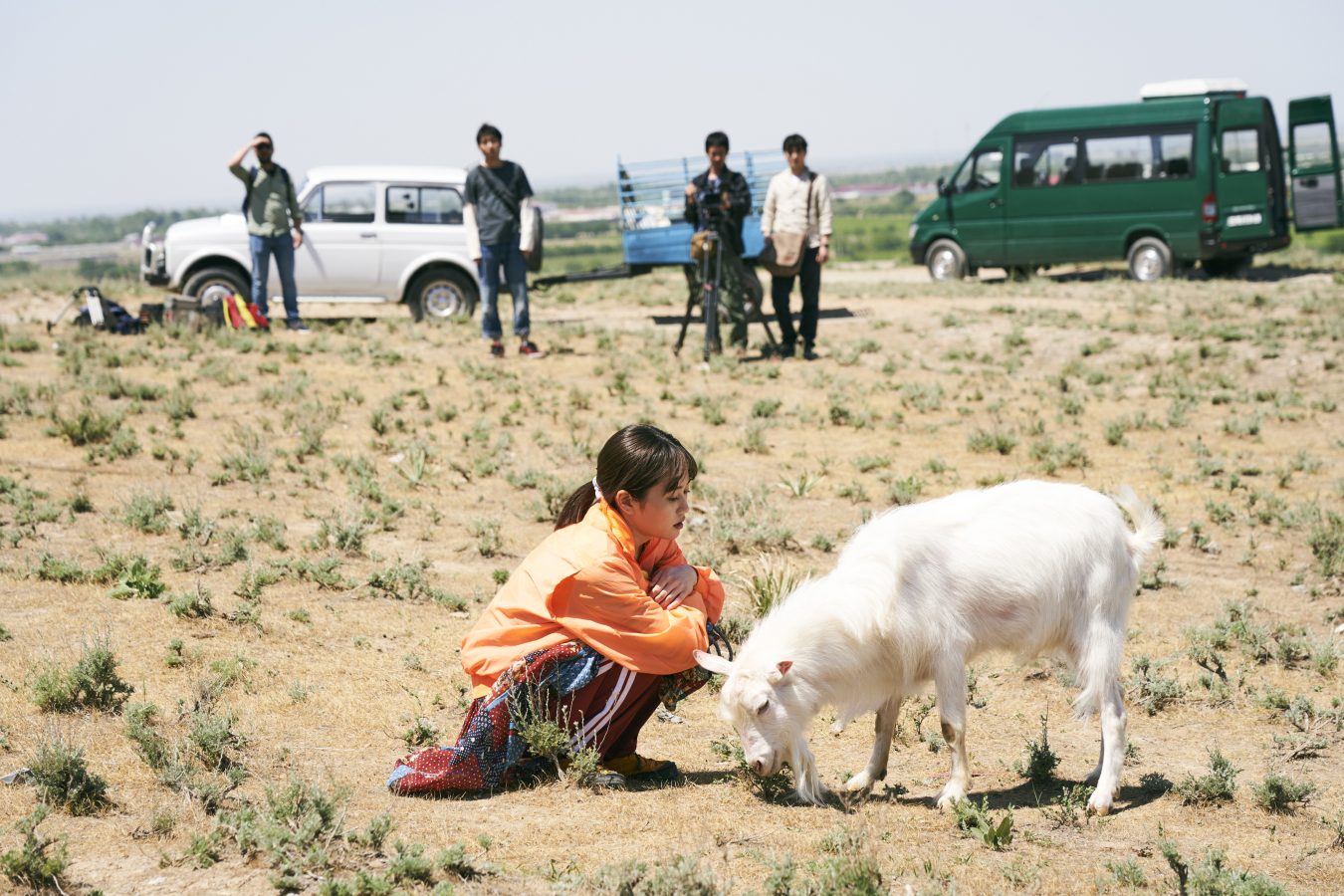
To the Ends of the Earth (2019)
In To the End of the Earth, the desert teems with forgotten or unexamined stories, but it’s the rare Kurosawa film where this setting acts as a site of potential discovery. (The film is an official co-production between Japan and Uzbekistan, and therefore also serves as a kind of diplomatic artifact.) Instead, it is in the environs of industrial decay that Kurosawa often stages standout sequences, such as the shootout in Cloud (2024) or the warehouses of Serpent’s Path, both the 1998 original and the 2024 French-language remake, which Kurosawa also wrote and directed.
These films are hulking, abandoned evidence of a not-so-distant time. Kurosawa shows that, in the tumultuous wake of World War II, Japan made ghosts of its past. This would seem to situate Kurosawa’s Japan in its buzzing, bereft multitudes as reflections of modernity in miniature. But Kurosawa is not prone to allegory or didacticism nor is he interested in diagnosing the ills of society. He takes seriously the notion of the supernatural, of a reality that is either corrupted by or simply coexistent with an ambulatory, omnipresent yesterday—one we ignore at our peril; one that, no matter how desperately we might try to contain it, always returns.

Share:
Recommended
- Kiyoshi Kurosawa’s Haunted Japan
 On the darkness and loneliness that shapes the genre director’s cinema.
- Mike Leigh
 An interview with the director about his latest and maybe last film, and the pleasures of the job.
- Gunvor Nelson
 On the exhilarating and deeply expressive work of the painter-turned-experimental filmmaker.