

Excerpt
Selected Moments: Some Recollections of Movie Time [in 1948]
An excerpt from critic Jonathan Rosenbaum’s newest collection, In Dreams Begin Responsibilities (Hat & Beard Press).
Share:
During my childhood, movies were a way of measuring time and time was a way of measuring movies, even if my easy access into most of the local theaters meant that my own time could easily and often did supersede the movie’s time. As was common for everyone during most of that period, I could go to the movies without specific schedules or timetables, sometimes entering in the middle of a feature and then staying to roughly the same point in the following screening of the same feature, or leaving temporarily in the middle of a film to buy a comic book down the street before returning. An additional privilege I had, if I wanted to use it, was glancing inside the ticket-taker’s booth in the lobby—an “insider’s” look—to read the precise menu of feature(s) and shorts to be found later in the auditorium, complete with titles and running times. In a manner of speaking, you might say I was able to be inside and outside the film experience at the same time, a privilege afforded today by digital home viewing. Back then, in a certain fashion, it made me a film critic long before I even knew what the term meant, and I even had a choice of entrances at a couple of theaters denied to ordinary patrons—staff entrances that led directly from my father and grandfather’s upstairs offices into the balcony at the largest Florence theater, the Shoals, which opened in 1948, or from their previous ground-floor offices towards the downstairs seats at the Princess.
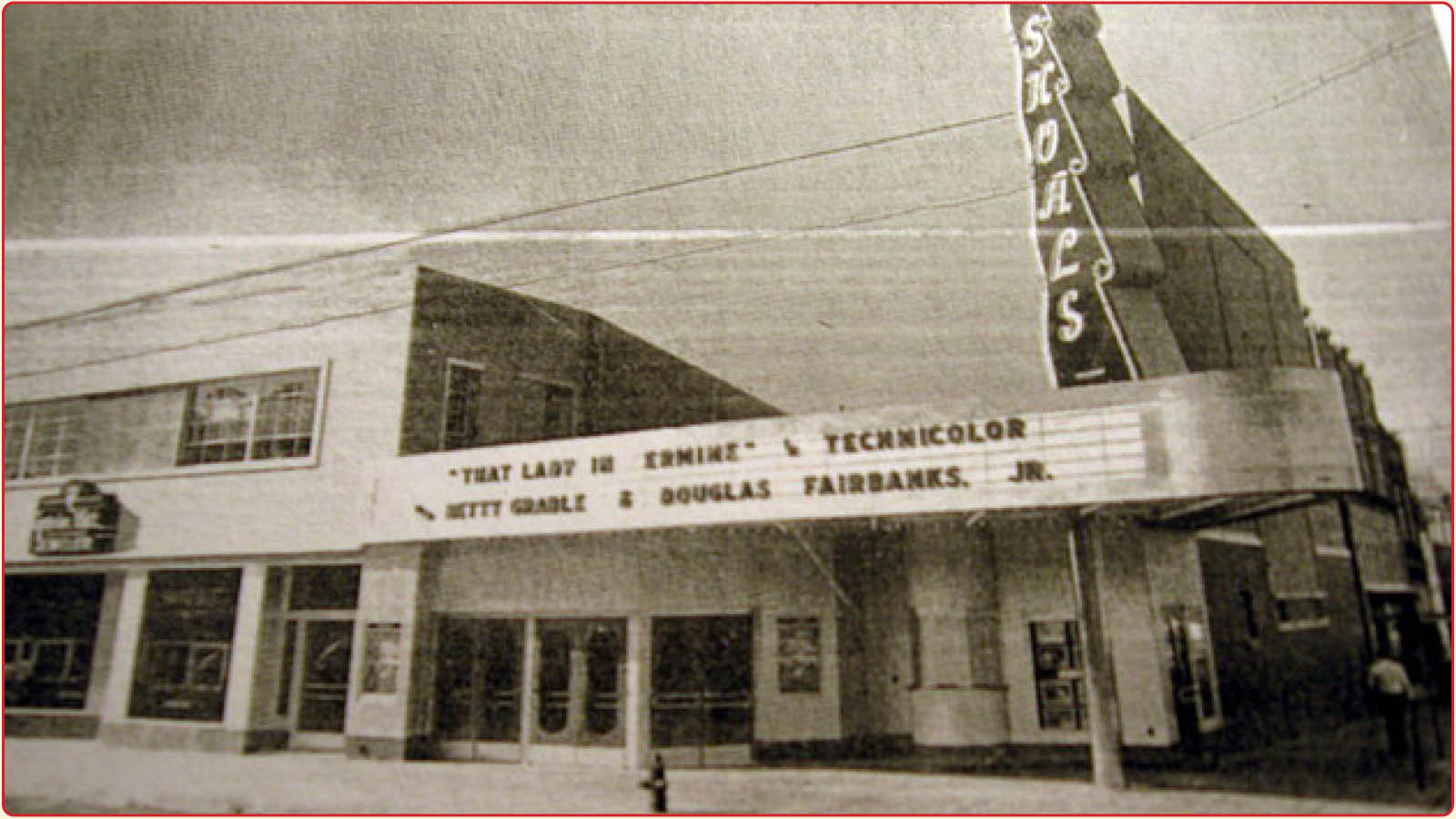
Shoals cinema, Florence, Alabama
Walking from either the street or the offices into the Princess or Shoals meant stepping from Alabama time into movie time, where Alabama time was suddenly suspended. And movie time wasn’t necessarily or invariably different from literary time: only a few counties away, in Oxford, Mississippi—a dozen years before I was born, a year before he went to work for Howard Hawks in Hollywood—William Faulkner was writing my favorite novel, Light in August, which begins in and periodically reverts to the present tense, the immediacy of movie time: “Sitting beside the road, watching the wagon mount the hill towards her, Lena thinks, ‘I have come from Alabama: a fur piece. All the way from Alabama a-walking. A fur piece.’” Faulkner clearly learned as much from movies as he did from Joseph Conrad (another cinematic writer).
This sense of cinematic literary time is no less evident in the beginning of the novel’s sixth chapter, plunging us into the consciousness and memory of the other major character, Joe Christmas, as metaphysical/expressionistic and as cluttered with debris as Lena Grove’s is physical/realistic and economically tidy: “Memory believes before knowing remembers. Believes longer than recollects, longer than knowing even wonders. Knows remembers believes a corridor in a big long garbled cold echoing building of dark red brick sootbleakened by more chimneys than its own, set in a grassless cinderstrewnpacked compound surrounded by smoking factory purlieus and enclosed by a ten foot steel-and-wire fence like a penitentiary or a zoo, where in random erratic surges, with sparrowlike childtrembling, orphans in identical and uniform blue denim in and out of remembering but in knowing constant as the bleak walls, the bleak windows where in rain soot from the yearly adjacenting chimneys streaked like black tears.” Cinematically speaking, Lena’s mind is like Rio Bravo and Joe’s is like Eraserhead. Or, in the literary terms of Erich Auerbach’s great essay (“Odysseus’ Scar” in Mimesis), Lena’s mind is Homeric and continuous (or, in Faulkner’s terms, “like something moving forever and without progress across an urn”), whereas Joe’s is as riddled with narrative gaps, unexplained motivations, and sudden leaps forward as the Old Testament.

Rio Bravo (1959)
Today, of course, digital home viewing has altered all these temporal options, so that my time now supersedes movie time. I can stop the movie and start it up again or reverse or fast-forward or freeze the flow, meanwhile altering the shape and size of the image, and Chicago time has relatively little to do with either my time or movie time—which is why I’m fond of saying that I live on the Internet, which has a time and flow of its own, and relatively speaking, only sleep and eat in Chicago.
How, then, can I explain or examine the rift between today’s home-digital movie time and my childhood’s theater-analog movie time, except to say that literary time has more to do with the latter than with the former? Today I can bookmark, scan, retrace, and even quote from my movies, as I’ve just quoted from Light in August, and furthermore feel far more qualified to call them mine because I can handle them like books—turning to favorite passages, skipping certain parts, or freezing their flow whenever I want to.
This excerpt from Jonathan Rosenbaum’s latest collection, In Dreams Begin Responsibilities, is republished here with the kind permission of the author, and publisher, Hat & Beard Press.

Eraserhead (1977)

Share:
Recommended
- The Illiac Passion
 On the most elaborate of Gregory Markopolous’s modern myths.
 - Jollof Films
 Senegalese visual artists and curators discuss the towering cinematic figures who inspire their craft.
 - Winona Ryder
 A Hollywood “It“ girl comes of age.