
Cracked Actor
Gong Li
On the enduring eloquence of the timeless actress.
Empress Li, our nine-film tribute to Gong Li, opens at Metrograph on Friday, March 27.
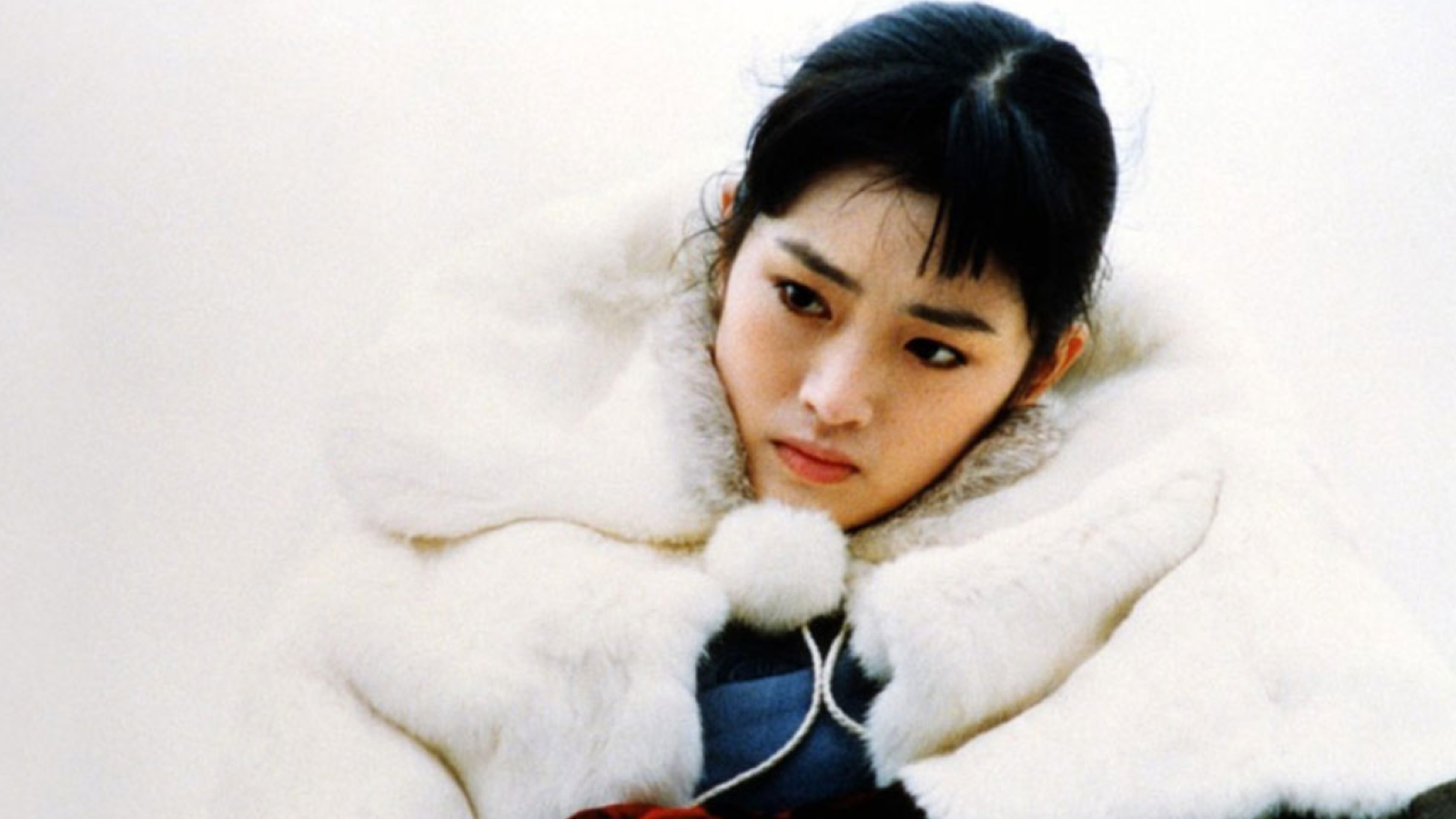
Raise the Red Lantern (1991)
Share:
Watching an actor with a long career is a peculiar thing. You witness a stranger age in motion, in color. You watch the years accumulate—on their face, in the rooms that spring up around them, in the evolving quality of the light. You feel time lurch forward where, in life, it only blurs.
But watching an actor who has, more often than not, played people from the past elicits its own special kind of disorientation. Like the immortal who dreams himself through time in Bi Gan’s Resurrection (2025)—surfacing in the silent era, in the ’70s, in the splashy neon of the 2000s—this kind of actor’s oeuvre conjures up a sense of how dense with change history really is; at the same time their constant presence makes it as though nothing has changed at all. Decades pass and they don’t. Worlds vanish and can be called back. Cinema lives in a permanent present.
The actress Gong Li started appearing in films when she was 22, but from the beginning she played characters several generations ahead of her. By 2020, when she went into de facto retirement, she had starred in 36 films; of the handful of those that are relatively realistic (not fantasies, and not Stephen Chow spoofs), three-quarters take place before her time. (Compare this to the careers of Nicole Kidman, Juliette Binoche, and Angela Bassett—in my view, the only other actresses in her generation of her caliber—where period films are peppered between modern dramas and genre movies.) In the late ’80s and early ’90s, she rose to fame through the success of her collaborations with Zhang Yimou, whose first few features are almost all depictions of earlier eras. In Red Sorghum (1988), she is a young woman living on the cusp of Japan’s occupation. In Ju Dou (1990), which takes place around a decade earlier, she is the newly-purchased wife of a dye-mill owner. Raise the Red Lantern (1991) is set in the 1920s. In 1992, she finally starred in two movies set in her own time: Zhang’s The Story of Qiu Ju, where she plays a pregnant woman from the country, and Sylvia Chang’s Mary from Beijing, where she is an aspiring migrant dating a jewelry heir. Though both films are “contemporary,” there is a sense that they unfold in different eras: in Mary, one of Yuppies and electronics; Qiu Ju, one of ration cards and work units. After Mary, it was back in time again for Gong: to Beijing in 1924 (Farewell My Concubine, 1993); Paris in the modernist midcentury (A Soul Haunted by Painting, 1994); and a small northern Chinese town in between the ’40s and the ’80s (To Live, 1994).

To Live (1994)
Throughout, Gong has been drawn to women with strong powers of sensitivity, who know the world and know themselves. Though they often undergo extremes of feeling and circumstance, she embodies them with an easy naturalism. That she has starred in so many movies set in other decades has less to do with any limitations of her technique than with the fact that she was born in 1965 and came of age in the ’80s. By the time she was an adult, the most exciting filmmakers working in China were all people who wanted to apply newly available cinematic tools to look at their country’s past.
In 1982, the Beijing Film Academy—China’s premiere school for cinema—graduated its first class of directing students since before the Cultural Revolution (1966-1976), during which almost every institution of higher education was closed. Among the graduates was a young Zhang, a savant of form and color from the inland province of Shaanxi. Zhang was 11 years old when the Cultural Revolution started; Gong was 11 when it ended. By the time she was 18, admissions proper had been reinstated, which meant that, unlike kids born only a few years ahead of her, she could go to school. To attend the entrance exam for the Central Academy of Drama, she took a night train from Jinan, where she grew up, to Shanghai, standing room only.
Zhang met Gong when she was a sophomore at the Central Academy, and cast her in his debut film, Red Sorghum, adapted from Mo Yan’s novel of the same name. The movie centers on a girl—barely a woman—who is sold off to marry the owner of a baijiu distillery, a leper. Sitting in a traditional wedding sedan carried by the distillery’s workers, she listens to them sing about his ugliness, and how selfish it is for her family to send her off to him. She looks out of the sedan’s curtain at the back of one of the men, wet from sweat, tan from sun. They exchange looks and one meaningful touch—he grasps her foot, at once firmly and delicately, moving it in behind the sedan’s curtain.
Soon, the owner of the distillery is dead. The narrator, who refers to Gong’s character as “my grandmother” and the worker who touched her foot as “my grandfather,” speculates that the latter had something to do with this, but reports that his grandfather never admitted anything. The new young wife gleefully inaugurates a regime of relative equality with the workers. Though she keeps her own room, she insists that they don’t call her boss but rather by a childhood nickname, Jiu’er, and tells one of them, “What’s mine is ours.” This near-utopian situation is abruptly curtailed with the arrival of Japanese troops, whose presence brings unspeakably sadistic violence.
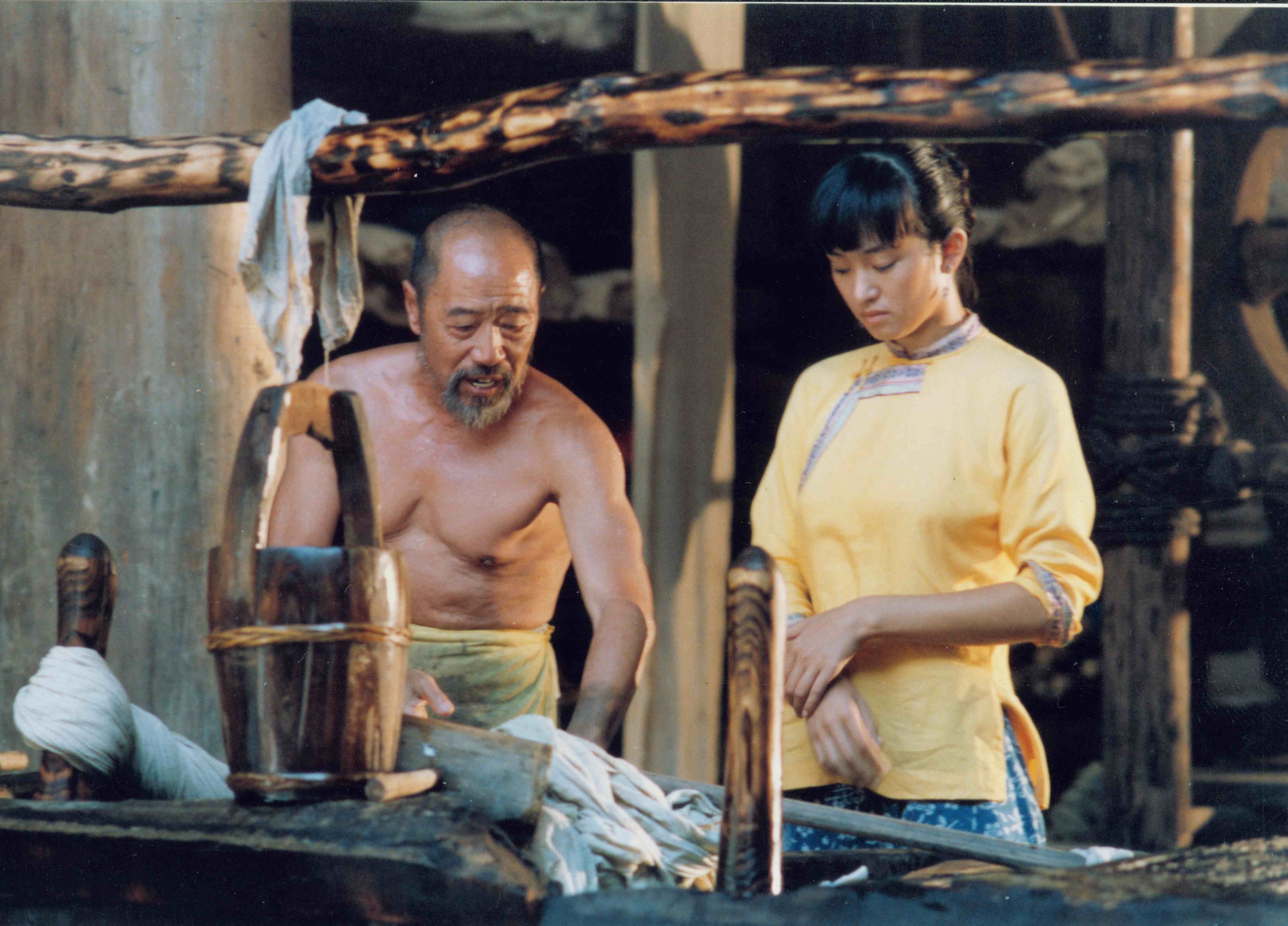
Ju Dou (1990)
The film thus encapsulates three distinct historical periods: the feudal era, the beginning of Communism, and the Second Sino-Japanese War. Arguably, the narrator adds a fourth by anchoring the story’s narrative consciousness somewhere in the ’80s. Its layering of these eras through references both literal and symbolic is emblematic of the hybrid world of Zhang’s first group of films, where he digests history in sequences of highly stylized images. Red Sorghum is stuffed with technicolor ravishments: lime-colored sorghum leaves; patterned pink wallpaper pasted onto clay walls; slick, ambiguous red forms that turn out to be a flayed cow’s bright exposed flesh. The events of the film are engrossing and ultimately devastating, but its emotional center is Gong, who is utterly persuasive using subtle expressions to convey how her character shifts from innocence to knowledge and between delight, distress, and rage. Her great gift will always be a piercing normality.
For the rest of her career, but especially in Zhang’s Red Trilogy, Gong’s heroines are subjected relentlessly to injustice, cruelty, manipulation, contempt, and—sometimes, I think this is the harshest one of all—random instances of devastation. In Ju Dou, she is once more a young woman sold off to an unattractive suitor, this one an impotent dye-mill owner who assaults his wife every night. In Raise the Red Lantern and To Live, Gong’s characters again undergo brutal experiences, and again she gives us the sense of these women surviving with some crucial share of their essence intact. Already in these films, she realizes a quality that stretches across her body of work: a serious, un-self conscious dignity. (Though when this reappears in Michael Mann’s 2006 adaptation Miami Vice, where she plays a drug lord’s wife, it can just be called gravitas.)
Her characters’ situations may be tragic—they may even have tragic flaws—but that tragedy never fully penetrates their true nature. This self-certainty takes on a comic tinge in The Story of Qiu Ju, where Zhang casts Gong as a pregnant chili farmer who seeks bureaucratic redress after her husband is kicked in the testicles by her village’s chief, going on a quest that takes her up the rungs of officialdom. The husband cautions her not to tire herself out, but she says, “If the baby’s meant to be born, it’ll be born. If I’m meant to lose it, I’ll lose it.” A casual fatalism seems to hover over Qiu Ju as she trudges to the local township through snow, then hitches a ride to the nearby city. An implacable force on a vanishingly unlikely mission, her character could have been pathetic, but instead, because of Gong—who waddles but never seems at risk of losing balance; who makes no pretensions of strength, only proves by its use that she has it—you can only admire her.
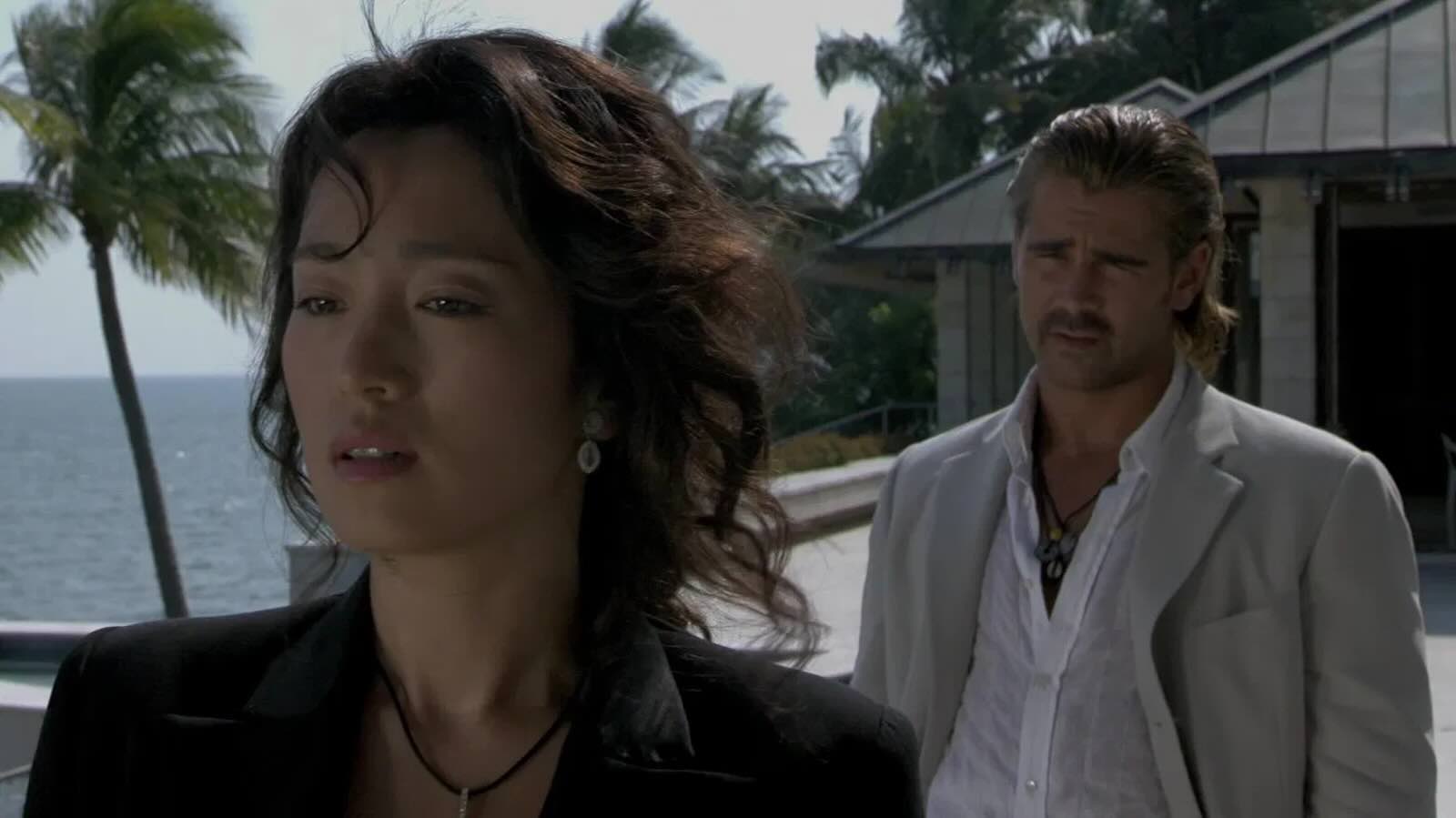
Miami Vice (2006)
Actors give and recede; they expose and conceal. We like to think we own our stars, and sometimes they even tempt us into believing it. But we never do. We can never own anyone. And yet, watching Gong act, it’s hard not to think that the self-assurance her roles telegraph corresponds to some inherent aspect of personality, as though her nature were still escaping from her characters’ skillfully stitched-up seams.
Even when Gong was working, she cherished privacy. She still doesn’t seem to have a Weibo or Instagram or Rednote account. As a 2016 article about her in NetEase’s Star Attitude, “Nobody knows what Gong Li does outside of work, what her personality is like, what her relationships are like, what her personal life is like, aside from the well-known stories of her relationships with her boyfriend Zhang Yimou or with her husband Ooi Hoe Seong. She has locked away the parts of herself outside her work as an actor… As soon as she’s done acting, ‘Gong Li’ virtually disappears.”
Until the 2000s, Gong’s public image was basically fused with Zhang. Red Sorghum was the first Chinese film to be nominated for an Oscar or to win a top award at a European film festival (in this case, the Berlinale). When Miramax distributed Ju Dou in the US in the spring of 1991, it grossed the equivalent of $4.7 million, which would still be an astronomical figure for a Chinese arthouse movie to make today. Zhang was seen around the world as China’s great auteur. And Gong became an icon largely for serving as his muse. But once the couple split in the mid-’90s, creatively and romantically, Gong began to appear in a broader range of roles. She went back to Hong Kong to star opposite Jeremy Irons in Wayne Wang’s melancholy diary of the Handover, Chinese Box (1997); she was one of Tony Leung’s fleeting romances in Wong Kar-wai’s oblique, science-fictional portrait of Hong Kong’s future, 2046 (2004); she was the villain in Rob Marshall’s campy adaptation of Arthur Golden’s Memoirs of a Geisha (2005), a film rescued by its cast—which also included Zhang Ziyi, Ken Watanabe, and Michelle Yeoh—and in which she performs a fan trick, throwing two up in the air without looking at them (Gong practiced 2,000 times a day). And she played the straight woman in What Women Want, a 2011 remake of the post-screwball comedy from 2000 with Mel Gibson and Helen Hunt.
The remake shares many elements with the original: the two leads are executives at an ad agency. They live in a thriving, cosmopolitan city: New York in the former, Beijing in the latter. In this instance, Andy Lau plays a chauvinistic ad executive passed over for a coveted promotion. The woman who gets his job is Gong’s character, Li Yilong.
Like far too few movies, What Women Want doesn’t take itself all that seriously. So even though it is not particularly brilliant, it is still delightful. (A lesson for many of us!) Lau renders Zigang with gleeful idiocy; Gong lets Yilong be strong and sweet, eager for affection yet self-sufficient, dismissive and direct and kind. Playing against Lau’s clown, her control of technique is especially apparent—just as it was in Red Sorghum, where her love interest, the shirtless distillery worker (Jiang Wen, the writer-director of 2010’s Let the Bullets Fly), turns out to be a comedian, a hothead, an honorable oaf who Jiang plays with an emphatic theatricality.
Zhang’s early movies might have been taken by Westerners as “windows” into China’s past, but they were never meant as documentaries or straight histories—reanimation was never the point. Except, perhaps, in a sidelong way, as in Qiu Ju’s integration of nonprofessional actors and of footage taken in public places with hidden cameras.
Looking across Gong’s career, though, watching works from different chapters side by side, there is a sense that these films cannot help but encapsulate the past by testifying to the radical intensity of China’s progress over the past few decades. In Qiu Ju, Gong’s character takes her husband to the doctor by pulling him on a tricycle’s bed. In What Women Want, the woman she plays takes Audis and rides elevators. The child she bears in the former would only have been twenty in the latter—she could have had parents who slept on a kang bed and then gone off to be an intern in Beijing’s newly erected Central Business District. It’s strange to imagine that only about 20 years separate these scenes, and stranger still to see the same face appear in them. So of course, it’s not true that things don’t change. Maybe instead, it’s just that actors live forever.

Share:
Recommended
- Yuliya Solntseva
 On the actress-turned-filmmaker’s unsung authorship.
 - Futures and Pasts: Socrates
 Rossellini’s one-of-a-kind approach to the costume drama, and his 1970 film on the last years of the Athenian truth-seeker.
 - The Illiac Passion
 On the most elaborate of Gregory Markopolous’s modern myths.