
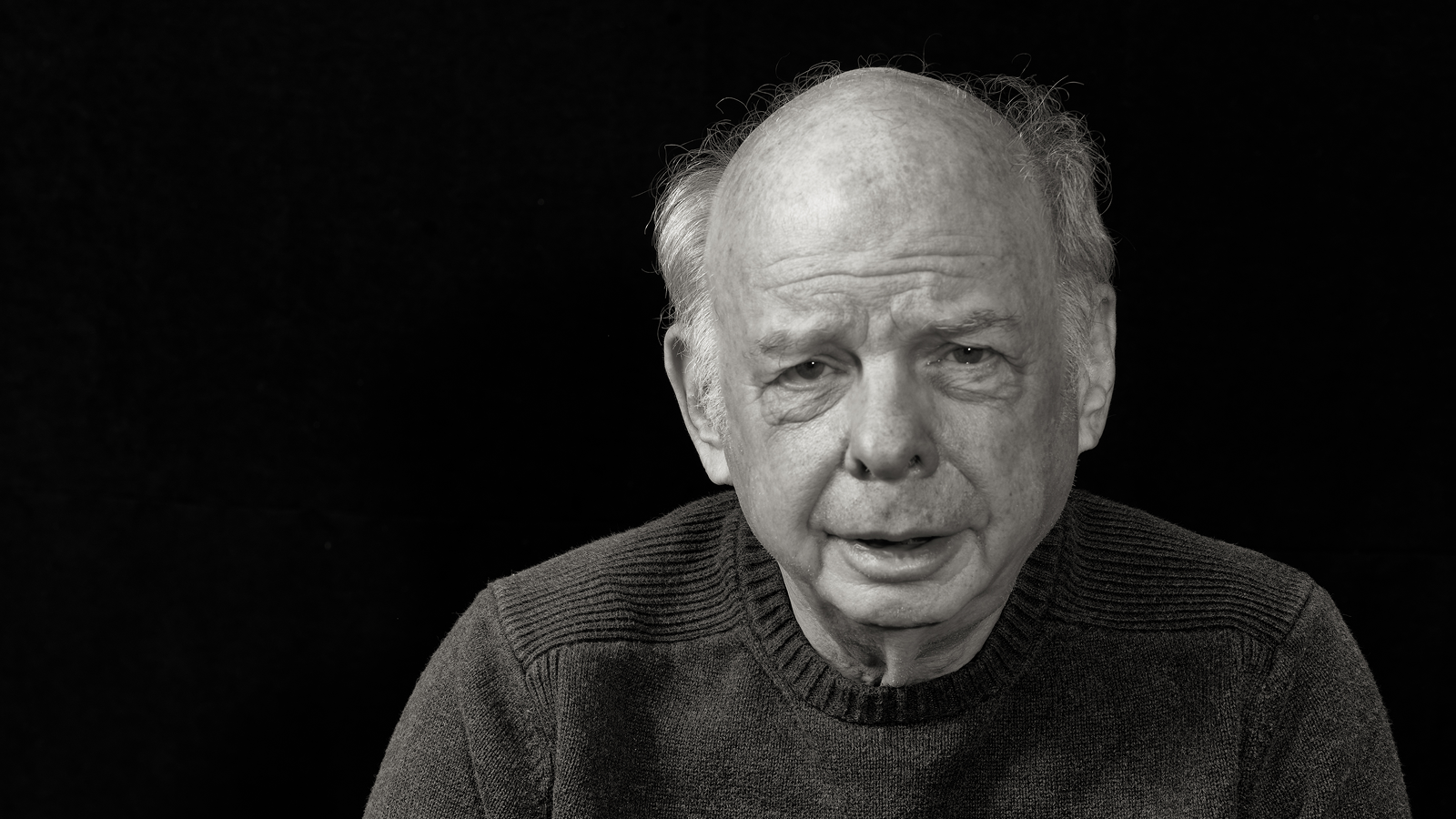
Wallace Shawn, photography by Don J. Usner
Interview
Wallace Shawn
On the fever that drives the veteran actor and playwright.
Wallace Shawn: The Master Builder plays at Metrograph from Friday, May 8.
Share:
With a nearly six-decade career behind him, Wallace Shawn remains one of the most recognizable faces in American cinema, and certainly one of its most distinct voices. In The New Yorker—the magazine once edited by his father William Shawn for 35 years—critic Vinson Cunningham recently described his “vocal presence” in varying registers: broadly speaking, he has a nasal cadence, with a treble lilt that dips into unexpected gravelly tones, so that his sentences have the effect of rolling waves. This voice has served Shawn well, a central part of his enduring charisma, which has established him as an endearing cultural figure with several landmarks of modern cinema to his name, not least among them The Princess Bride (1987), Toy Story (1995), and Clueless (1995).
That voice takes on a barbed, introspective pulse in Wallace’s plays for both the stage and the screen, charged with politically incisive commentary which frequently incited controversy. And yet Shawn boasts acclaim at home and abroad, including his Obie-winning 1975 debut, Our Late Night, directed by his friend and longtime collaborator André Gregory, with whom he stars in My Dinner with André (1981), as loose versions of themselves who meet for dinner in New York to discuss the travails of intervening years. Gregory also directs Shawn’s latest play, What We Did Before Our Moth Days, currently performed at Greenwich House Theater. Alongside Gregory, Shawn can also count other pillars of the industry among his friends and co-creators: Louis Malle, Tom Cairns, and his longtime partner Deborah Eisenberg, short story writer and actress who appears often in Shawn’s productions. (Eisenberg and Shawn had just finished a stint filling in onstage for stars Hope Davis and Maria Dizzia at the time of our conversation.) Ahead of Metrograph’s seven-film retrospective showcasing Shawn’s work as both actor and writer, I spoke with him about his literary references, working with Malle and Gregory, and the critics he’s outlived. —Kelli Weston
KELLI WESTON: This is the first time that you’ve been the subject of an actor’s retrospective. How does this feel?
WALLACE SHAWN: Well, when I began writing plays in the ’60s and ’70s, only a tiny number of people liked what I did. A great number of people really hated what I did, and critically… it was a bloodbath. There were people who thought I had absolutely nothing to offer.
KW: Your early plays were very controversial.
WS: They were controversial, and then when I started acting, I was a complete amateur. I had not been to drama school and had never dreamed of acting. So, not only did nobody else take me seriously as an actor, but I didn’t take myself seriously as an actor. And then I spent eight or nine months at the HB Studio [Herbert Berghof Studio of New York] because as a playwright, I wanted to learn about acting. Not to be an actor. But just, what is it?
Having been an actor now for, whatever, 40 years or something, I’m quite experienced and I’m no longer so embarrassed about not having gone to drama school. And having survived for so long, a lot of people who hated me have died…
KW: [Laughs]
WS: …I’m now a distinguished elder statesman!
KW: It’s hard to think of you as an amateur because your characters feel so rich and alive. For my generation, millennials specifically, you hold pretty cherished status, obviously. But you have also worked with directors like James Ivory, Rob Reiner, Mike Nichols, all of these giants. It’s a testament to your range and the scale of your craft. But there’s tension between your warm, charming presence on-screen, and your work as a playwright, which is so politically charged. Do you think there is any conversation between these two creative modes for you?
WS: I’ve learned an incredible amount about writing from being an actor. In my other play that I’m also doing at the Greenwich House Theater, called The Fever [first performed in 1990], it’s a two-hour monologue, and I do it myself. I’lI talk about Karl Marx’s Capital. Every Sunday and Monday night I say, sort of amusingly, that it begins completely incomprehensible to the ordinary person unless they’re well versed in economics. And then by the time [the audience] has gotten into, I don’t know, 50 pages, 100 pages, suddenly there’s a whole part that everybody can understand. If they get to that point. I think there was a time when I didn’t mind writing in a way that is a bit more challenging. But some of the movies and TV that I’ve done have opened my eyes to the pleasure of not doing it that way. I think it’s also great to say something and have people understand you.
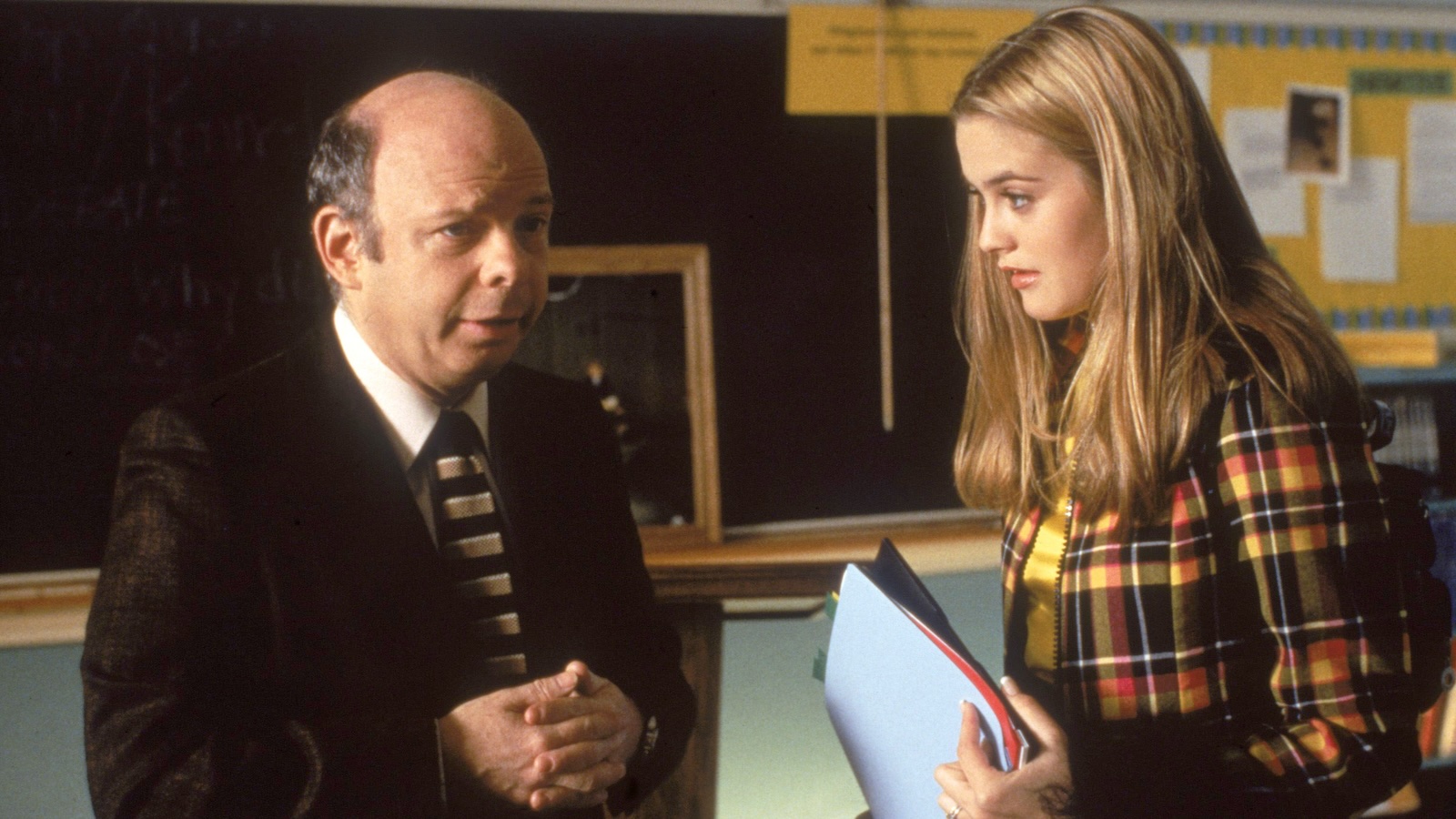
Clueless (1995)
KW: What makes your plays so interesting and meaningful, though, is that you’re not trying to comfort the audience. You ask challenging questions.
WS: Right. For me, writing is about trying to say something that the audience has not already been thinking. So that means probably removing clichés and delusions. I mean, what else would it be? Otherwise you’re just saying something everybody already knows. For me, writing is always—I mean, it sounds pretentious—but if it isn’t a quest for what is more true than what everybody else is saying, then what is it?
KW: I think this is something people really appreciate about your work and about you as a person. You’re politically outspoken, and it’s satisfying to hear someone in your position be honest and forthright about things that are going on right now. But on your writing specifically: there is something distinctly literary and almost novelistic about it. I know your dad was a longtime editor of The New Yorker, so as a kid you were surrounded by literary giants. Are there early and enduring references who have shaped the way you write?
WS: Well, let’s be blunt. I have an unbelievably vivid memory of my father working with Hannah Arendt, James Baldwin, J.D. Salinger. Obviously, Baldwin and Arendt were saying things in the magazine that were totally shocking to people, much more shocking than anything I would be able to write. And Salinger challenged Western civilization. He was a believer in the wisdom of ancient Eastern cultures. So, yes, I had models that were not just purely for amusement. I also had an opportunity to meet humorous writers and cartoonists who did write amusing things. As a child I met E.B. White, who was a very serious guy, although he also wrote charming children’s books. A lot of the models that I’ve used came from my childhood and they were serious people.
My father was a courageous editor. I mean, he was running a publication that was not merely for the bourgeoisie but was the organ of the bourgeoisie, and yet he published things that took a lot of guts to publish.
KW: You’ve done similar things as a screenwriter. Maybe this is a good place to talk about My Dinner with André, which marks one of your earliest collaborations with Gregory. You’re working with him again now on What We Did Before Our Moth Days, which he is directing, so this partnership spans nearly 50 years and counting—
WS: I think we might have broken some records, I don’t know!
KW: Yeah, longer than some marriages. I’m curious to hear how you guys were drawn to each other to begin with, and how you began the process of making My Dinner With André. Famously you’re pulling double duty; you wrote it together, and you’re playing yourselves, in a way.
WS: Well, we did a play together [in 1975] called Our Late Night—bad title, because you have to tell people how it’s spelled. So after doing that play, partly because of that play, the company busted up. André was driven to become involved in a spiritual quest, as he describes in the movie. And he did those things: he went to the Sahara Desert, and he had those experiences, and then he came to me and said, “Let’s do something together again. I’m ready to do more theater.”
I felt, well, what he had just experienced was more interesting than any play that I would write. But my reaction to it was amusing! Because he, at least temporarily, believed all sorts of things that I didn’t believe. So, wouldn’t there be something interesting and funny about some kind of a film, maybe a TV movie, in which the characters would be him and me, and he would tell about his experiences and I would react as I really do! With a mixture of skepticism and envy, let’s say. In other words, making use of my own shallowness to satirize… well, both of us as privileged people. In a way, I was trying to get rid of that side of myself in writing My Dinner with André.
So that’s how the process began, and then we got Louis Malle mixed up in it. We sent him the finished script. But then, naturally, he said first of all, we have to rehearse. Which we did for many, many months. And unusually at that time, very unusually, he wanted to rehearse on video, which we did. That was a way-out idea at that time. But also he insisted on cutting the text basically in half.
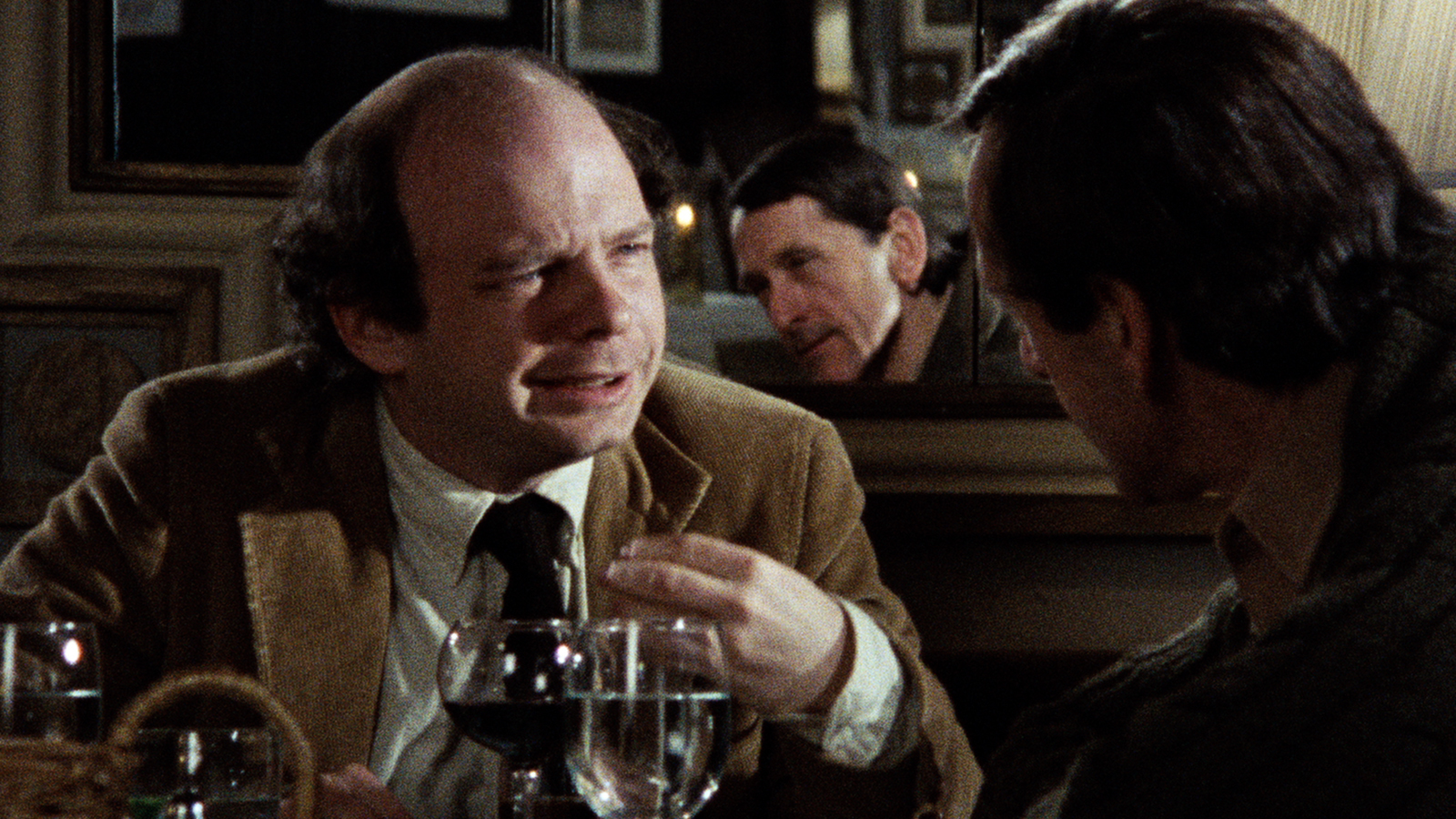
My Dinner With André (1981)
KW: What was he trying to do with those edits?
WS: I think he thought it was insanely long, for a film. And yet it was not written as a play, and it’s not a play. Although some people have done it. But it’s a crazy idea for a play, because people don’t move at all. But that process, cutting the script, Louis Malle did not enjoy, because I was so resistant. I fought him about every cut.
KW: Yeah. This is very writerly.
WS: [Laughs] So, I don’t think he was eager to work with me again. On a script! He did want to work with me as an actor.
KW: And you did. On Vanya on 42nd Street (1994).
WS: And Vanya is, I mean if you’re going to showcase my acting… I saw, for some reason—I don’t know why—30 seconds of it the other day, and I did think, “Oh… That was… I was playing a part there!”
KW: Yeah. You’re the lead!
WS: [Laughs] Yes, but I mean I wasn’t just, being me, it was acting of some description.
KW: I’m curious about the rehearsals you did with Malle, especially given the premise of Vanya, which is about actors in New York doing one long rehearsal of the play Uncle Vanya. Do you like to work that way? Do you do a lot of rehearsals?
WS: [On My Dinner With André] André was doing long rehearsals before I ever met him or Louis Malle ever met him. When I met André, he’d already done this legendary 1970 production of Alice In Wonderland with his company The Manhattan Project, which he toured to France, to Iran, to Holland; all over. There’s a book of Richard Avedon’s photographs of Alice in Wonderland with a wonderful text by Doon Arbus about the rehearsal process, and she interviewed all the actors. How did you do this scene, how did you do this scene? They all say different things, and have very different memories. But yes, André has never been part of the regular American theater, where they rehearse a play in a month. He comes from a European tradition, and he worked with Yergey Tarkovsky and hung around Brecht’s theater in East Berlin for a long time, where they rehearsed for months and months. So in a funny way Louis Malle was joining André’s process.
KW: Part of your signature on stage and in the scripts you have written is the way you have the characters in dialogue with the audience. They’re also having a kind of inner conversation; but it’s a direct confrontation or dialogue with the audience.
I know you don’t like to talk about your writing process, but when you are building a story, where do you begin? Do you start with characters and then build them out from the dialogue, which is how I think that we as an audience experience your work? Or do you have a story in mind, and then you begin to fill it out that way?
WS: Well, I’m not crazy about talking about my process, if I have one. But I would say most of my plays have begun with dialogue. And then, it’s more like, “Who said that?” In other words, I don’t think of the person first and then ask what they would say. They say something, or somebody says something, and it’s more: who would say that? And then, things grow together. I think, “Oh, or maybe it’s a play about Bob and Joe? Why would there be a play about Bob and Joe? But actually, Joe is a farmer, and Bob is his lover.” It’s a very irrational and almost inexplicable process for me, most of the time. At a later stage, my mind comes into it.

A Master Builder (2013)
KW: Many people deeply associate you with New York, given films like Manhattan (1979), Vanya, the television series Gossip Girl, and recently Marriage Story (2019). But sometimes you locate your work outside of America, for example in A Master Builder (2013). Does that open anything up for you, creatively?
WS: Well, I travelled to France for the first time when I was 15. My parents were very aware of the world outside of the United States, and had a lot of European friends. Since childhood I’ve been more influenced by European artistic things than by American things, really. And I’ve had a whole life involved with English theater. I’ve been doing plays there since the ’70s; I was tolerated more there, and accepted more there. It’s not a secret that I came from a relatively privileged background, but however much that might have blighted me, one of the benefits is that I spent time outside of America.
As an actor, I had some opportunities that did not come to fruition. But there were some European theater directors— Scott Elliott at the New Group, for example—who took me seriously as an actor in a way that American theater directors generally have not. Except for André, of course. But in general, American theater directors would not think of giving me a part like Vanya, or like Solness in A Master Builder.
KW: You do a lot when you do get those really meaty roles, but your performances are just as dynamic in smaller parts. What draws you, or has drawn you in the past, to a particular role?
WS: You know, I think, I’ve made a living as an actor. I became an actor when I was about 35. And up until that time, as a writer of strange plays, I didn’t know whether I would lead a humble life, the way an actor in the Wooster Group would, or an avant-garde playwright. Or whether I would become bourgeois again, as I had been as a child. But it turned out that, whether I’m respected as an actor or not, a lot of people gave me jobs. And the only way I’ve ever made any money is as an actor. I mean, I haven’t made money from writing strange plays. So, the main reason for taking a part is that it’s been offered!
Someone offers you a part—that’s not an everyday occurrence! I mean it is for Tom Cruise, but certainly not for me. It’s quite wonderful if someone offers me a part. And I read the script. And if it’s morally or politically nauseating to me, I turn it down. Otherwise, I do it. That’s my only criterion. And of course, somebody might say, “Wally, I think you were kidding yourself about this part, or this part; it is evil. And you convinced yourself it was not so bad because you wanted the money.” But I try not to deceive myself. I mean, I have a couple of times, and I can look back on those things and say, “I should not have ever been in that one.” But I think I’ve been accurate.
My agents, for instance, sometimes said, “Oh you’re gonna love this!” And I was nauseated. Or, “Wally, I don’t think this one is going to be for you, but take a look at it.” And I’m then delighted! I love it! I think Deborah could probably predict it. But, nobody else.
Share:
Recommended
- Christopher Doyle
 The legendary DP discusses working in different cultures, his collaborations with Wong Kar-wai, and dancing with Pina Bausch.
 - Cracked Actor: David Gulpilil
 Looking back at the inimitable Indigenous icon.
 - Spider Baby
 On Jack Hill’s classic horror-comedy, a film outside of time.