
The Taste of Tea (2004)
Essay
The Taste of Tea
On Katsuhito Ishii’s uniquely gonzo take on the Japanese shokin-geki genre.
The Taste Of Tea opens at Metrograph on Friday, May 8.
Share:
THERE’S SOMETHING, AN INVISIBLE THREAD or pulse, that keeps Katsuhito Ishii’s The Taste of Tea (2004) from collapsing into a collection of quirky incidents and manicured visual surfaces that, in different hands, it might have easily become. Not knowing quite what that is, however, is one of the film’s central pleasures—that, and the unusual emotional logic propelling the narrative.
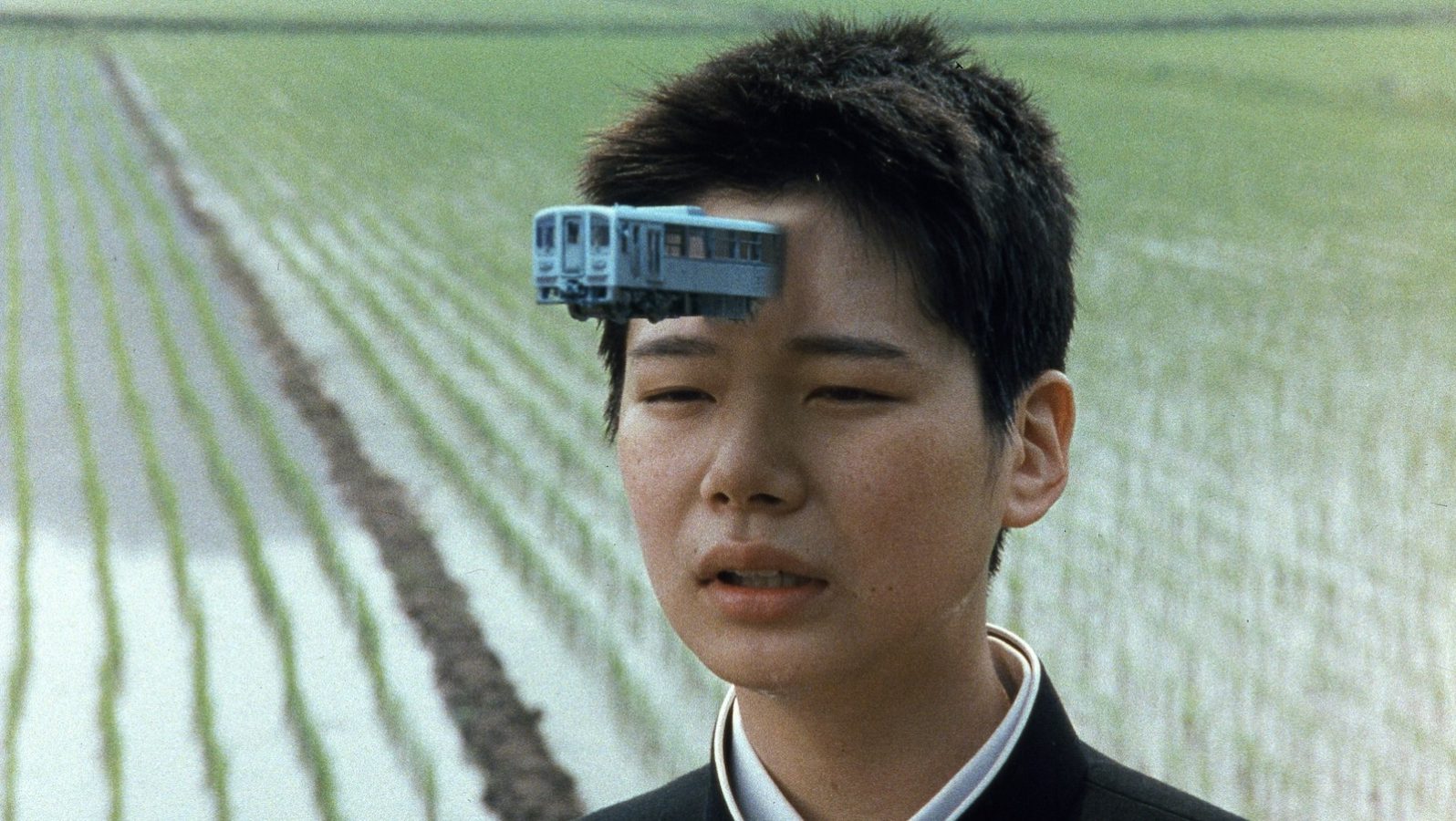
The film is marked by standout, misfit, excessive set pieces and idiosyncrasies that make no sense out of context, but taken holistically seem to promise some magical union of extraordinary contrasts. A boy taking a shit in a forest atop what he thinks to be a giant egg half-submerged in the soil (but is really a dead man’s skull); a girl haunted by a supersized version of herself that she cannot shake; an ostensibly dead and buried man (courtesy of the Yakuza) crawling out of the soil like something the ground gave birth to; the sight of a passenger train flowing out from a lovelorn teenager’s forehead as if a suddenly visible electromagnetic wave were emitting from his skull, a dream fully externalized by his longing.
The Taste of Tea (2004)
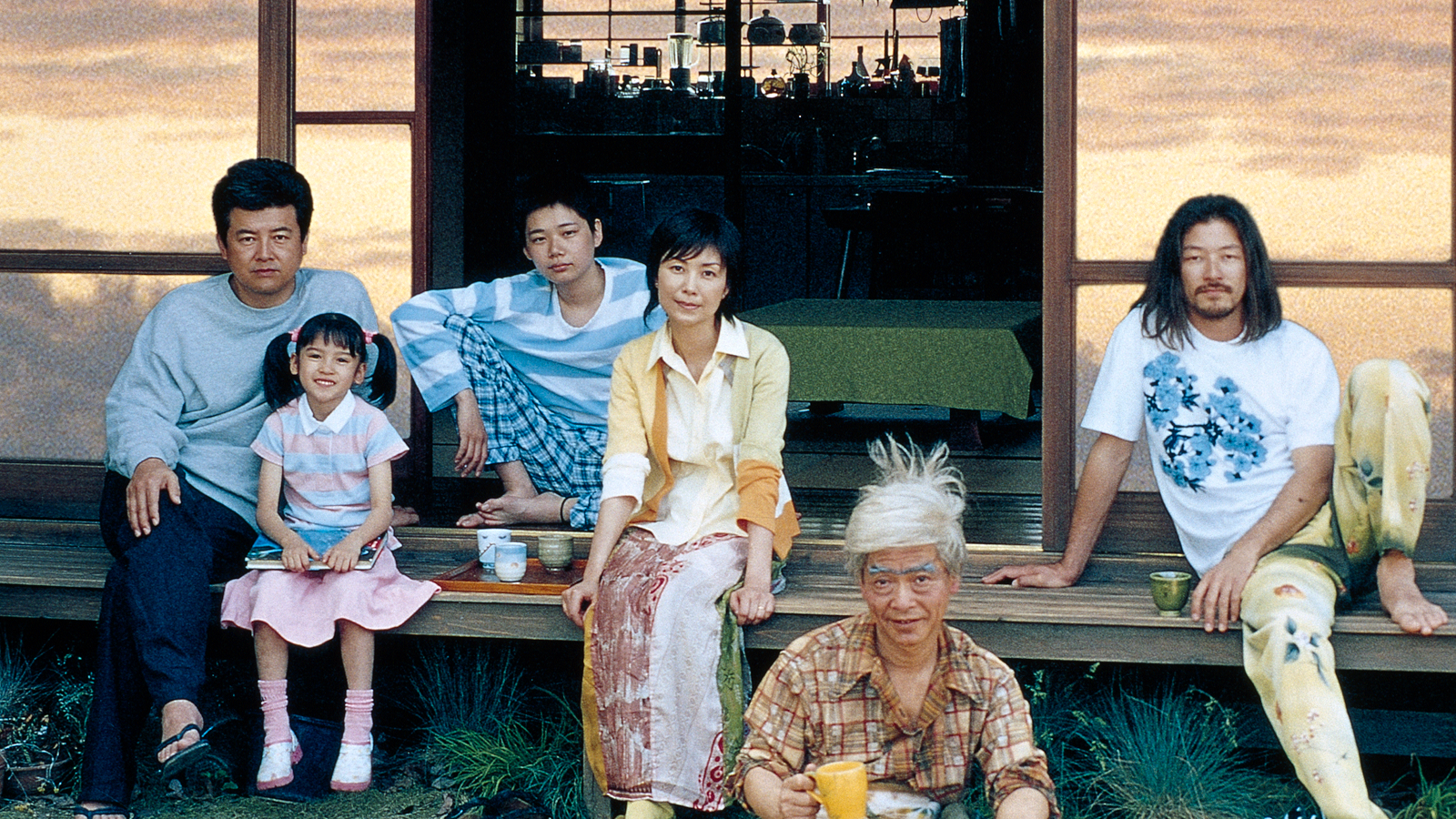
None of this quite prepares us for the almost somber purity of Ishii’s tale itself, which, for its occasional zaniness, is suffused—not unlike Ingmar Bergman’s Fanny and Alexander (1982), from which Ishii’s family-centered gravity draws inspiration—as much by domestic ennui and rural everydayness as by the gleeful poppycock of minds run amok: the latter, naturally, being what enables the former. Still it might give us a sense of the psychological terrain Ishii aims to occupy. At the center of the film is the Haruno family: son Hajime (Takahiro Sato) and daughter Sachiko (Maya Banno), parents Nobuo (Tomokazu Miura) and Yoshiko (Satomi Tezuka), grandfather Akira (Tatsuya Gashuin), and newly arrived uncle Ayano—played by Tadanobu Satō, of Ichi the Killer (2001) fame—who shows up seemingly out of nowhere to reconnect with a past love he’d abandoned years ago, teasing out, in a scene that visually dramatizes their mutual hesitancy and distance, whether he can be forgiven.
We get more than a little sense of the family as a unit, but the real engine of the film is in sequences depicting each character’s contemplative solitude. No one seems to know or care that Sachiko, the youngest member of the family, is being stalked by a double-sized version of herself that sits always at the edge of her purview, studying her, like a ruminative specter of adulthood dreamed up by someone who does not yet know what adulthood even means. Nor does the family seem to notice the full inner terrain of Hajime, who, secretive in the way that teenagers are, doesn’t share the heartbreak of a departed crush or the sudden vigor he attains at the arrival of a new one.
But we notice. And, in Ishii’s rendering, nature seems to notice, too: the hills, winding roads, and expansive fields of the landlocked, rural Tochigi Prefecture, where the film is set—all of it fecund and overwhelming—seems to dwarf and particularize each member of the family as they dream, work, lollygag through their days. It’s humbling, in a way, but also enlivening. Anything feels possible—so, Ishii gives us everything. Ishii is perhaps most famous, internationally, for his work on the anime sequences of Quentin Tarantino’s Kill Bill: Vol. 1 (2003), in which the vibrantly traumatic childhood of Lucy Liu’s O-Ren Ishii gives way to pop-infused hyperviolence. His third feature, The Taste of Tea absolutely bears the mark of a filmmaker with a boundary-less sense of reality. But emotional reality is the movie’s engine, strange as that reality is. What is most surreal, it turns out, is a consequence of other people: all the things we can only imagine about all of those feelings, needs, and lives external to our own.
Share:
Recommended
- Orian Barki & Meriem Bennani
 The multi-hyphenate collaborators discuss their anthropomorphized, experimental, animated feature debut.
 - Ira Sachs
 The filmmaker on living, and making art, without secrets.
 - Long Live the Republic!
 On a slippery, beguiling vision of war-torn Czechoslovakia seen through the eyes of a 12-year-old boy.