
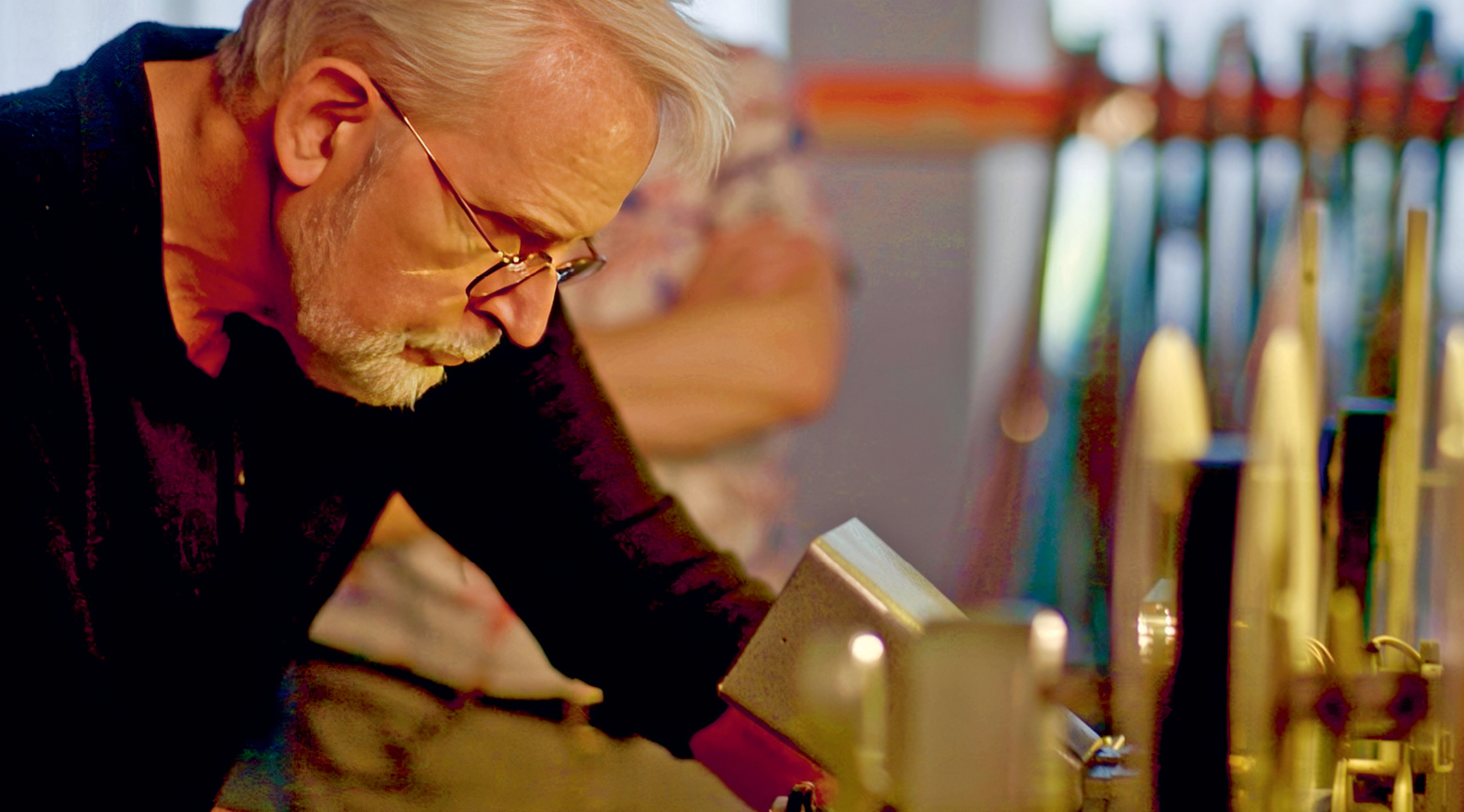
Walter Murch, courtesy of Faber & Faber
Excerpt
Your Chair Is Your Enemy
An excerpt from the legendary sound designer and editor’s latest book, Suddenly Something Clicked, which is available to purchase from the Metrograph Bookstore.
The Rule of Murch, our 11-film tribute, opens at Metrograph on Friday, September 19.
Share:
The word ‘editor’ in the job description film editor inevitably compares us to our colleagues, the editors of books, newspapers, online publications, etc. This implies that our task, like theirs, is to cut down and rearrange a work created by someone else, an author, who has submitted a manuscript to an editor, who then reads it and suggests changes. The author considers these ideas and writes a second draft, which is resubmitted to the editor for further evaluation, and so on.
In cinema, it’s the reverse: it is the editor (in Spanish, the montador, the ‘assembler’) who produces the first version, painstakingly constructing it over many weeks (or months!) from thousands of shots, guided by the screenplay and the director’s notes. This is shown to the director, who suggests changes. And then it is the film editor who makes those changes, producing a second version, which is shown to the director, who suggests further amendments, and so on.
I have simplified the process in order to make a point, which is that the editor/ director collaboration is very different from the editor/author relationship. It more closely resembles actor/director or composer/director relationships, and we film editors are, in that sense, interpretive performers, offering our version of the film for the director to evaluate. Like the work of actors or composers—and unlike the work of authors—our work is temporal: it exists in time, following a choreography of cinematic rhythms. To be modified, of course, as the actor’s or the composer’s work is modified. None of us are the final arbiters, except the director, who has ultimate responsibility for the film. 1
That distinction between text and film was brought home to me when I made the transition, in the early 1970s, from the vertical Moviola editing machine to the horizontal eight-plate KEM Universal. As I have written elsewhere, you had to be on your feet and dance with the Moviola—I would be constantly in motion, manually rewinding, swirling long trims into the bin, hitting the brake handle, going back and forth to the film racks to retrieve rolled-up shots from their cardboard boxes, wrapping up and rubber-banding the shot that I had just looked at, and so on. Under these circumstances, being on my feet was a necessity.
In contrast, although I loved the fast, silent operation of the KEM and the fact that its modular arrangement could handle ten minutes of film at a time, with three separate picture screens if needed, or three sound readers and one picture screen (or any combination thereof), and that its smooth rotating-prism action did not damage the film, I was forced to sit down at it, becoming a sedentary editor at a desk! Francis Coppola had banished the Moviola from the American Zoetrope studios because it was the past and the KEM was the future, so in 1973 I edited The Conversation sitting at a KEM.
With the KEM (and its cousin, the Steenbeck), almost all you ever needed to do was move your wrist and push a few buttons. So it was not long before I developed what I called Steenbeck neck: knotted tension in the neck and shoulders, which never happened with the Moviola because of all that dancing and those broad arm movements. In the following decade I bounced back and forth between systems. Julia was edited on a Moviola, Apocalypse Now on a KEM (although Richie Marks and Jerry Greenberg, two of my co-editors on the movie, used Moviolas). Return to Oz was a Moviola film. Finally, on The Unbearable Lightness of Being in 1986, I had a revelation: looking at the KEM one day, I realised it was simply a rewind bench, but one where the reels of film ran horizontally rather than vertically. If that’s all it is, then let’s raise it up fifteen inches to the height of a rewind bench!
Chris Boyes—later to win Oscars for sound mixing Titanic, Pearl Harbor, Lord of the Rings and King Kong— was at that time working as a young jack-of-all-trades at Fantasy Films in Berkeley, where we were editing Unbearable, and I asked him to build two heavy-duty wooden cubes out of thick plywood. Job done, four of us lifted the 600-pound KEM onto those boxes, and I was standing again. And I have been standing to edit ever since.
This excerpt from Suddenly Something Clicked: The Languages of Film Editing and Sound Design by Walter Murch is reproduced here with permission of the author and publisher, Faber & Faber. The book is available to purchase from the Metrograph Bookstore (add link).
- That is, if the director has ‘final cut’. Otherwise, the opinions of the producers and the financing studio must also be taken into account.

Walter Murch, courtesy of Faber & Faber
Share:
Recommended
- Orangey, Revisited
 A video essay ode to the inimitable feline screen star.
 - Green Snake
 On Tsui Hark’s subversive reimagining of an immortal Chinese folk tale, starring Maggie Cheung as a serpent demon.
 - Travel Companions: Bahram Beyzaie & Amir Naderi
 On two defining Iranian filmmakers, and two of their most enduring works.