

Andy Warhol, Prison [version 2], 1965. 16mm film, black-and-white, sound, 66 minutes. © The Andy Warhol Museum, Pittsburgh, PA, a museum of Carnegie Institute. All rights reserved. Film still courtesy The Andy Warhol Museum.
Excerpt
Who Are You Dorothy Dean?
An excerpt from the new bilingual edition of Who Are You Dorothy Dean?, the first book devoted to the Black writer and actress, who entered the 1960s New York underground scene and quickly became one of its key figures.
Share:
“DOROTHY DEAN, A LIFE” by Emily Wells
In Robert Mapplethorpe’s 1978 portrait of Dorothy Dean, she sits centered on a giant wooden chair, legs crossed, slight- framed, beaming widely. She is clad in a prim hat, black silk blouse, demure knee-length skirt, legs crossed at the knees. Her tidy leather clasp handbag sits on the floor. Her smile is radiant under her enormous Coke-bottle glasses. It is unsurprising that Dorothy’s sartorial enterprise has been described as “out-Wasping the Wasps.” A mammy doll sits on her lap. It was a gift from Andy Warhol, Dorothy’s close friend and Rolling Stones Sticky Fingers cover model Corey Grant Tippin tells me. “[It’s] in my home on a shelf,” he says. “I look at it daily which makes me chuckle.”
The writer and cultural critic Hilton Als has written the most comprehensive account of Dorothy’s life, in the second chapter of his three-part study The Women. Of the Mapplethorpe portrait, he remarks: “It is a measure of Dean’s social importance that Mapplethorpe photographed her at all. She was not a characteristic subject. She was not beautiful. She did not appear to be fashionable or wealthy or the creator of anything important outside herself.” Nevertheless, Dorothy was an integral, if fleeting, figure of the New York underground scene of the 1960s, and ardently empathized with White gay men, sharing in their affinity for gay-male-coded conduct like smoking, drinking, and promiscuity. She has variously been described as a Black Dorothy Parker, a Mother Superior “fag hag” to White gay New York elites—though she preferred the term “fruit fly”—and “the Warhol Factory’s most notable person of color.” She is largely omitted from the countless accounts of the Factory, despite holding a social role seldom seen for Black women of the era.
“The power she possessed [was] because of her massive intelligence and education,” Tippin tells me. “She made me laugh. She laughed with me. She loved to drink. She had mad crushes on movie stars like Clint Eastwood and Robert Mitchum. She imagined me to be in their image. She was abandoned in her willingness to get plastered—and I joined her. She was the best companion for making trouble because she could talk both of our ways out of it! She was not a person to mess with.”
Born in 1932, Dorothy grew up in White Plains, New York, in a bourgeois family. Her father was a reverend, originally from Statesville, North Carolina. She had an older sister named Carol. The family placed a strong value on academic achievement, considering it essential in the construction of a self that would not be content to simply be colored and female. They told Dorothy she was exceptional. Despite rampant racism (in her recommendation letter to Radcliffe College, her high-school English teacher mused about whether he should “encourage a brilliant… little negro girl to think of Radcliffe as a possible fairy godmother?”), she was the first Black valedictorian at White Plains High School and in 1954 she received a BA in philosophy from Radcliffe College, the female coordinate institution for Harvard College. While pursuing her master’s degree in fine art at Harvard, she became associated with a clique of White gay men known as “the Lavender Brotherhood” who drank daiquiris at the Club Casablanca on Cambridge’s Brattle Street.
For a woman principally remembered as a socialite, Dorothy’s life was actually characterized to an ample degree by work—finding work, doing work, keeping work. Compiling a biographical sketch of her life beyond that achieved by Als is a difficult task, as her output is dispersed across letters and documents distributed by mail, and through gossip and anecdotes recalled by acquaintances. There is no comprehensive register of her published work, nor is there much published work to speak of. In all of the jobs Dorothy performed, she was something of a processor, synthesizing a massive amount of artistic and cultural information, and lacked the visibility she might have enjoyed as a writer or artist. After graduate school, while living in Cambridge, Dorothy worked as a slide collections archivist at the Boston Museum of Fine Arts and Brandeis University, where she was also a temporary curator. At the Fogg Museum, she served as secretarial assistant to the Harvard Fine Arts department.
In 1963, Dorothy moved to New York without prospects, although the lack of prospects was inconsequential—it was her role as a participant within the cultural landscape which generated her ascent to social fame. Upon arriving in the city, she embarked on a career in journalism to support herself. For about a year she was a fact checker at the New Yorker, apparently the first woman in the job. After she was fired, she worked at other magazines like Vogue, Show, and Essence (from which she is rumored to have been fired after suggesting they put Andy Warhol on the cover in blackface). In her mother’s letters, we glimpse a correspondence in which Dorothy likely chronicled the struggles of finding suitable employment and enjoyable working conditions and evoked the constant threat of financial precarity that cast doubt on her pursuits. Yet she never depicted herself as a victim of discrimination or lost interest in being an active participant in her milieu. Warhol was shooting films of and for his friends at the Factory, and she starred in several of them in 1965, including: Space, a medley of conversation, food fights, and folk songs; Afternoon, an amphetamine-fueled cocktail hour at Edie Sedgwick’s apartment, in which Dorothy appears to be the most serene attendee; Restaurant, featuring a similar group of friends talking excitedly at a restaurant; and My Hustler, in which her acerbic wit is best utilized: “You are very pretty but you are not exactly literate,” she says to Warhol superstar Paul America with her characteristic mid-Atlantic affect. In 1966, Dorothy starred in Chelsea Girls, Warhol’s first major commercial success after a long line of avant-garde art films. Dorothy also appeared as “Black Barbarella” in American Cream (1971), a gay porn film directed by her friend Jean-Claude van Itallie. She was novelized by Warhol in a, A Novel (1968) as the character Dodo Mae Doom.
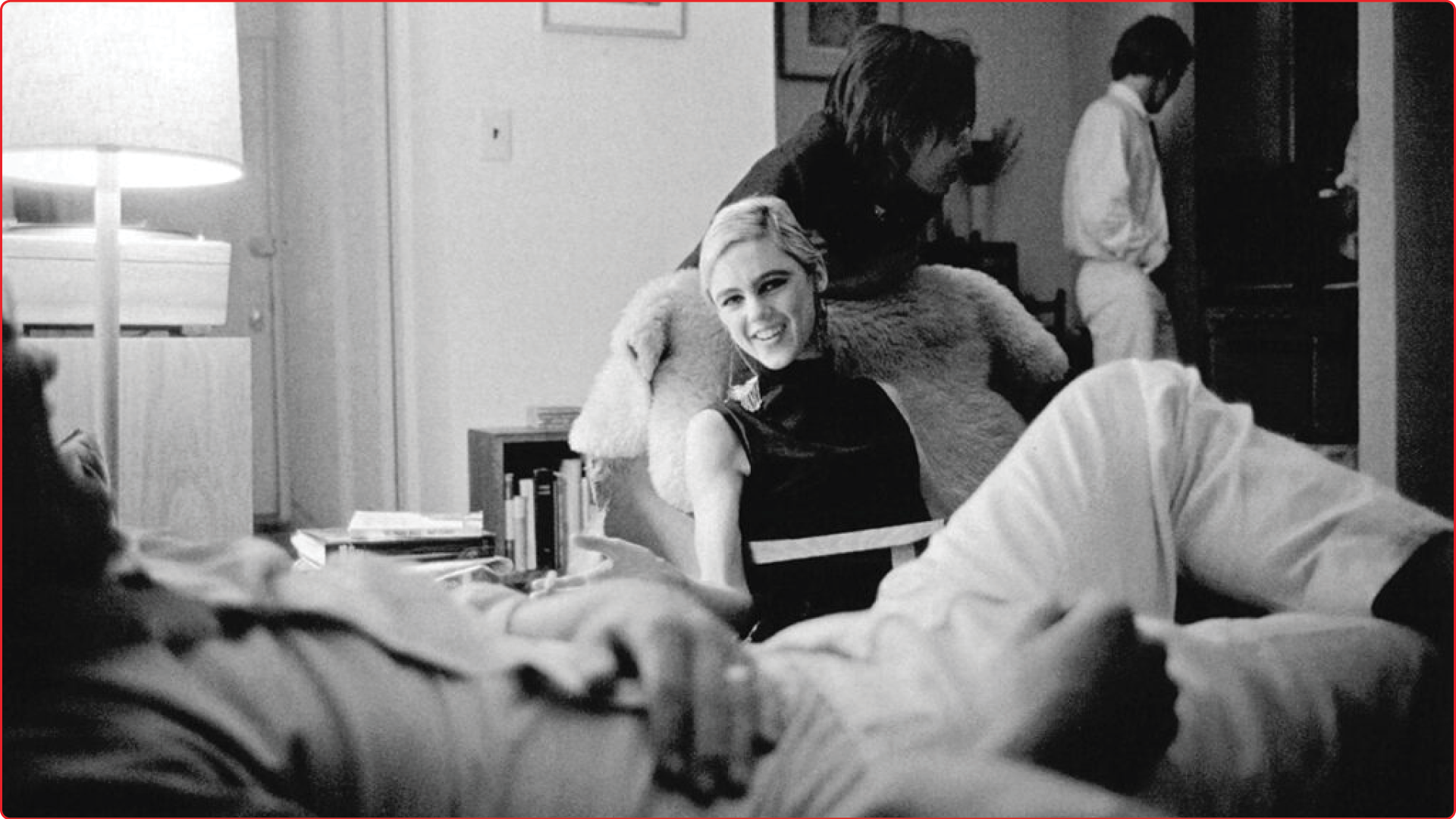
Edie Sedgwick, Dorothy Dean, and unidentified guests in Dorothy Dean’s apartment, circa 1965–67. © Stephen Shore. Courtesy of 303 Gallery, New York and Sprüth Magers.
LETTERS TO DOROTHY DEAN FROM FRIENDS: TAYLOR MEAD, EDIE SEDGWICK, AND RENE RICARD
Letter from Taylor Mead to Dorothy Dean, 1975, Brad Gooch Collection on Dorothy Dean, MSS.284; Box 2; F19; Fales Library and Special Collections, New York University Libraries.
Letter from Edie Sedgwick to Dorothy Dean, 1968, Brad Gooch Collection on Dorothy Dean, MSS.284; Box 2; F30; Fales Library and Special Collections, New York University Libraries.
Letter from Rene Ricard to Dorothy Dean, year unknown, Libby Brown Collection on Dorothy Dean, MSS.452; Box 1; F17; Fales Library and Special Collections, New York University Libraries.
Letter to Dorothy Dean, from Rene Ricard
[New York, September 11 at 12:30!]
Dorothy
What fun to get your letter. What lovely handwriting. What a cute stamp. Tell me is the Boulderado Hotel (where I stayed) still beautiful and cheap. It was $10 a night or less 4 years ago. Weekly rate negotiable with moldy overstuffed mohair furniture (bliss) they were threatening to re-decorate at that time but I’ll tell you the image of sitting on the wide velvet armchair looking out through the old fashioned lace curtains with an 18-year-old ass hole pumping on my cock is branded into my retina. Anyway it was August and therefore cheaper than Winter which is, if I’m not mistaken, the reason.
9 O’clock off to see Pasolini’s Arabian Nights. Heaven to see it.
So much has happened since I started this I think I just discovered the origin of the Polish joke. Rivarol (1753–1801) in Hamburg during the emigration: “Why do the men of Hamburg walk in fours? To catch the meaning of a joke.” Went to a millionaires’ party last night and got cornered into a talk about Rosie Blake by some thing that works in Arthur Loeb’s book shop. Alexander Bernstein (fils Leonard) hung back and couldn’t be drawn upon. A volume in silence. Some funny people there though. Remarking on Talk of the Town (Sept 8) mentioning me as “Probably the most good looking man in all of New York City… in 1966 (!)”. Peter Leeman ripped off “Praising with faint damn” “Talk of etc” and said of his brother Fred “Tall, dark and twenty-five” notice the missing adjective. What is the name of that guy I can’t remember who went to Harvard hangs out at Mickey’s has a deepish voice late 30’s friend of S. Channing and Paul Schmidt who is a comedy writer with a hunch back? Do you know who I’m talking about? Maybe Jim. Anyway I said a terrible thing to him of which I am as equally ashamed/ashammed (2 m?) as proud. He was praising my poems calling me a second Catullus (I think he was a Latin poet) and that he was going to teach me at Harvard this year (he’s artist in Res.) Innocently I asked “Why don’t you get me a reading there” His reply? “You’d faggot them out” then I said “I suppose you got in by “humping” them”. In case you haven’t got three friends reading this with you: he has a hump “humping” get it? I know this is probably heady stuff to someone breathing the thin air of Boulder so to prevent giddiness I shall, with love, ring off
Rene
This selection of correspondence and excerpt from Emily Wells’s essay “Dorothy Dean, A Life” appears in Who Are You Dorothy Dean? and is republished here with the permission of Éditions 1989.


Share:
Recommended
- Reel Politik
 A brief selection from cartoonist Nathan Gelgud’s graphic serial.
 - Ulrike Ottinger in the Mirror of Her Movies
 The figure of the artist in Ulrike Ottinger’s Paris Calligrammes (2020).
 - Your Chair Is Your Enemy
 An excerpt from the legendary sound designer and editor’s latest book, Suddenly Something Clicked.