
Interview
Vicky Krieps
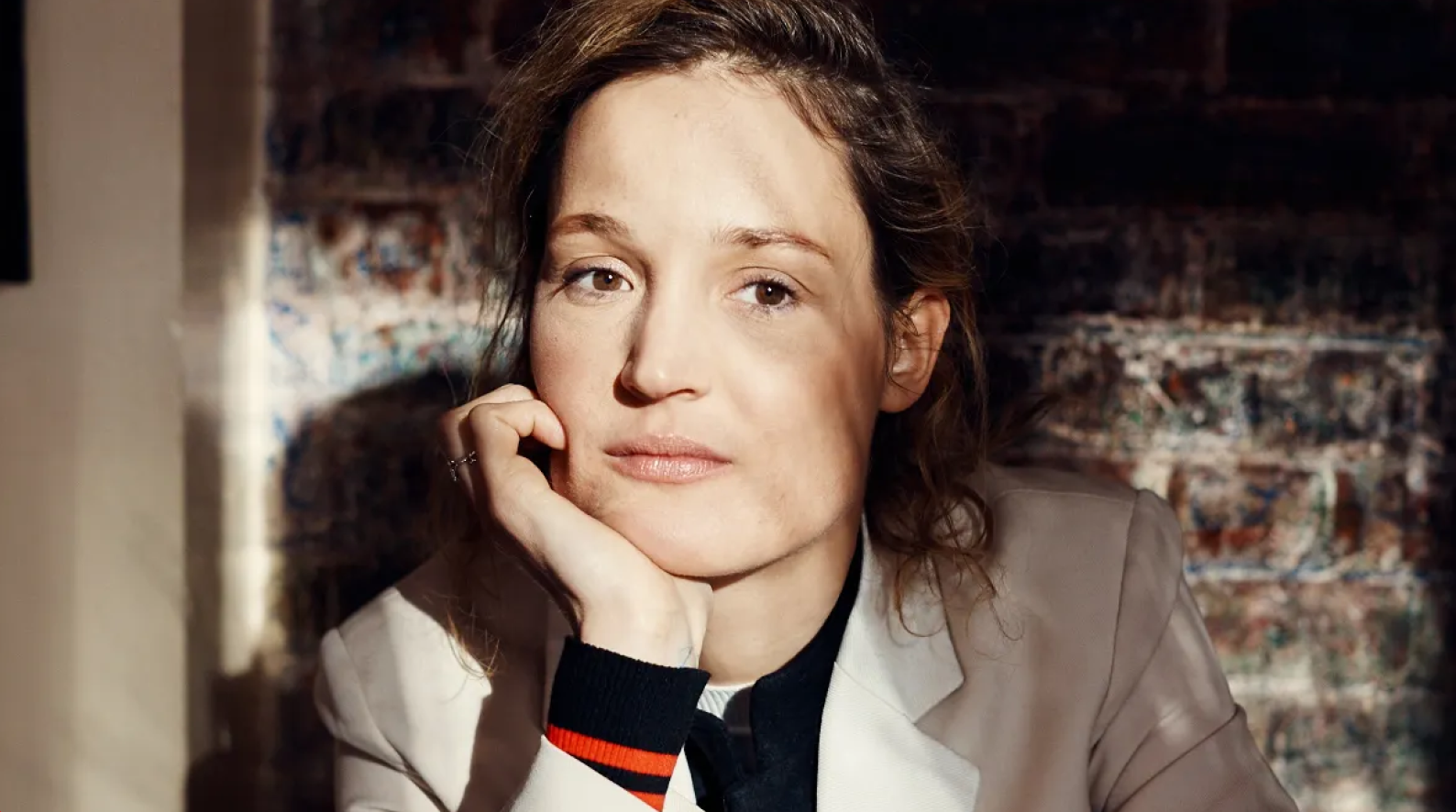
The Luxembourgish actor speaks about finding artistic freedom and escaping the Hollywood machine.
Share:
Vicky Krieps has mastered the art of portraying seemingly placid characters whose mild-mannered facades slowly erode to reveal chaos underneath. The 39-year-old actress was born and raised in Luxembourg, before studying at the Zurich University of the Arts. She cut her teeth on arthouse European films, with small roles in movies directed by Joe Wright and Anton Corbijn. It was her turn as the titular character in Ingo Haeb’s The Chambermaid Lynn (2014), in which Krieps plays a hotel maid with OCD who hides under the beds of the room she cleans to spy on guests, which led to her being cast in Paul Thomas Anderson’s Phantom Thread (2017). A new swathe of North American audiences were introduced to Krieps as Alma, a small-town waitress whom tempestuous couturier Reynolds Woodcock (Daniel Day-Lewis) adopts as his muse, only to learn that Alma is not nearly as pliant and submissive as he (and we) immediately assumed.
Following the success of Phantom Thread, Krieps became something of a media darling, a foreign-born ingénue who could hold her own and then some against one of Day-Lewis’s most ferocious roles. The attention was overwhelming. Krieps returned to her home in Berlin and kept her distance from Hollywood (with a few exceptions, including a turn as a mother trapped on a beach that forces rapid aging in M. Night Shyamalan’s 2021 supernatural thriller Old). In Mia Hansen-Løve’s Bergman Island (2021), she plays a screenwriter on a creative retreat with her director husband in Fårö, the island where Ingmar Bergman lived. While her husband’s project thrives, her own seemingly stalled work-in-progress takes on a life of its own. She acts as a wife and mother again in Hold Me Tight (2021), in which director Mathieu Amalric subverts this role, twice. At the movie’s outset, Krieps’s character, Clarisse, appears to be abandoning her family, but it quickly becomes apparent that the film’s reality is not to be believed, and that she is actually trying to outrun an unspeakable tragedy.
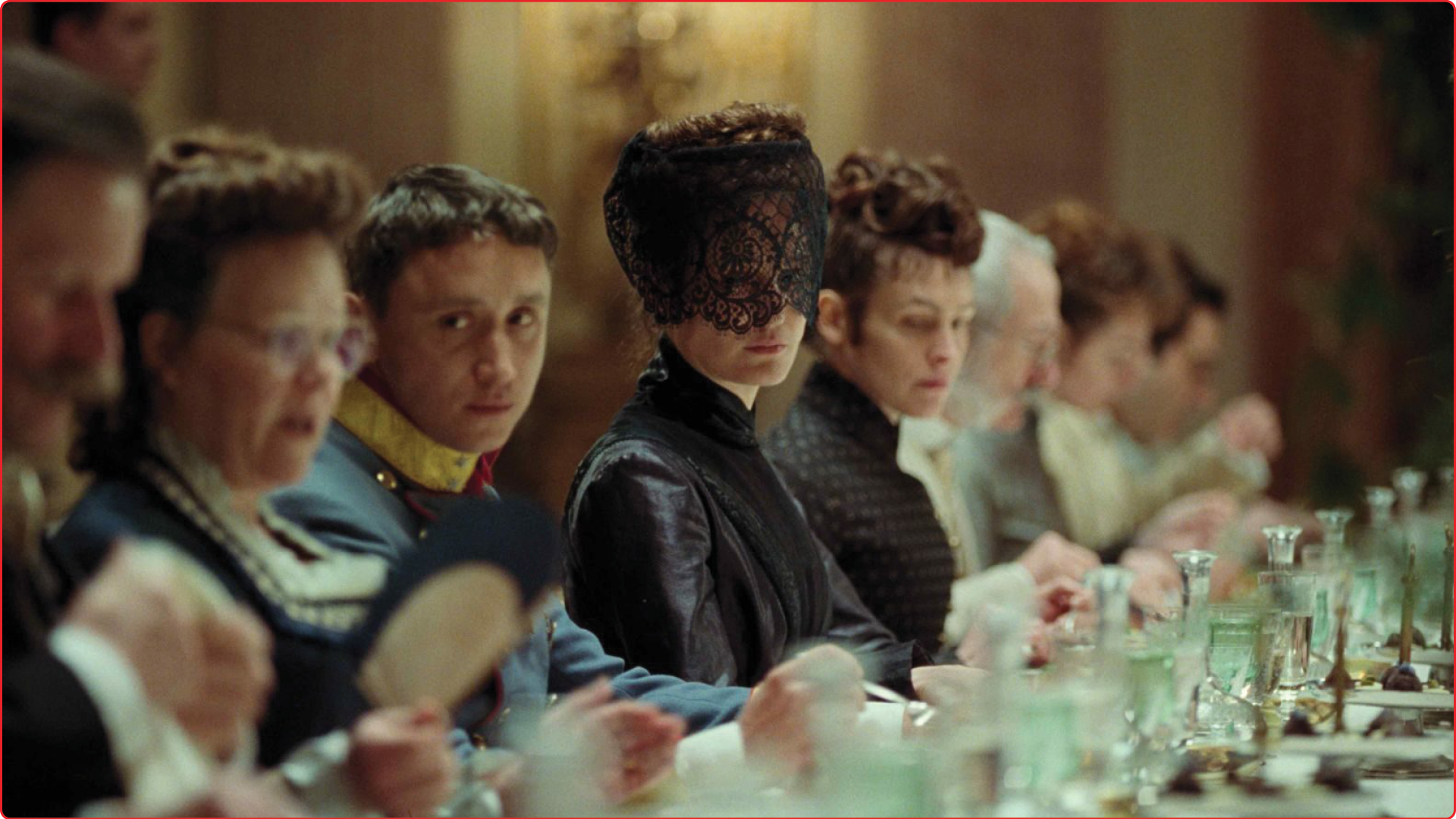
At last year’s Cannes Film Festival, Krieps had two movies premiere: first she portrayed Empress Elisabeth “Sissi” of Austria in Marie Kreutzer’s ahistorical Corsage, which imagines Sissi in her 40th year, grappling with her tenuous grasp on power. And in More Than Ever, directed by Emily Atef, she stars as a woman with a rare illness who is, to her husband’s chagrin, fed up with invasive medical procedures and prefers to live out her years on her own terms. Krieps’s characters are women forced into passive roles who assert themselves in wildly different ways, thanks in large part to the actress’s ability to capture all the subtle degrees in which a woman can find herself on the verge.
At the time of this interview, Krieps was in Greece. She was there shooting Rebecca Lenkiewicz’s adaptation of Hot Milk, Deborah Levy’s novel about a hapless woman, accompanying her controlling mother, who is bewitched by an enigmatic stranger (Krieps). Krieps Zoomed in from Athens, where she had just wrapped up filming.—Anna Fitzpatrick
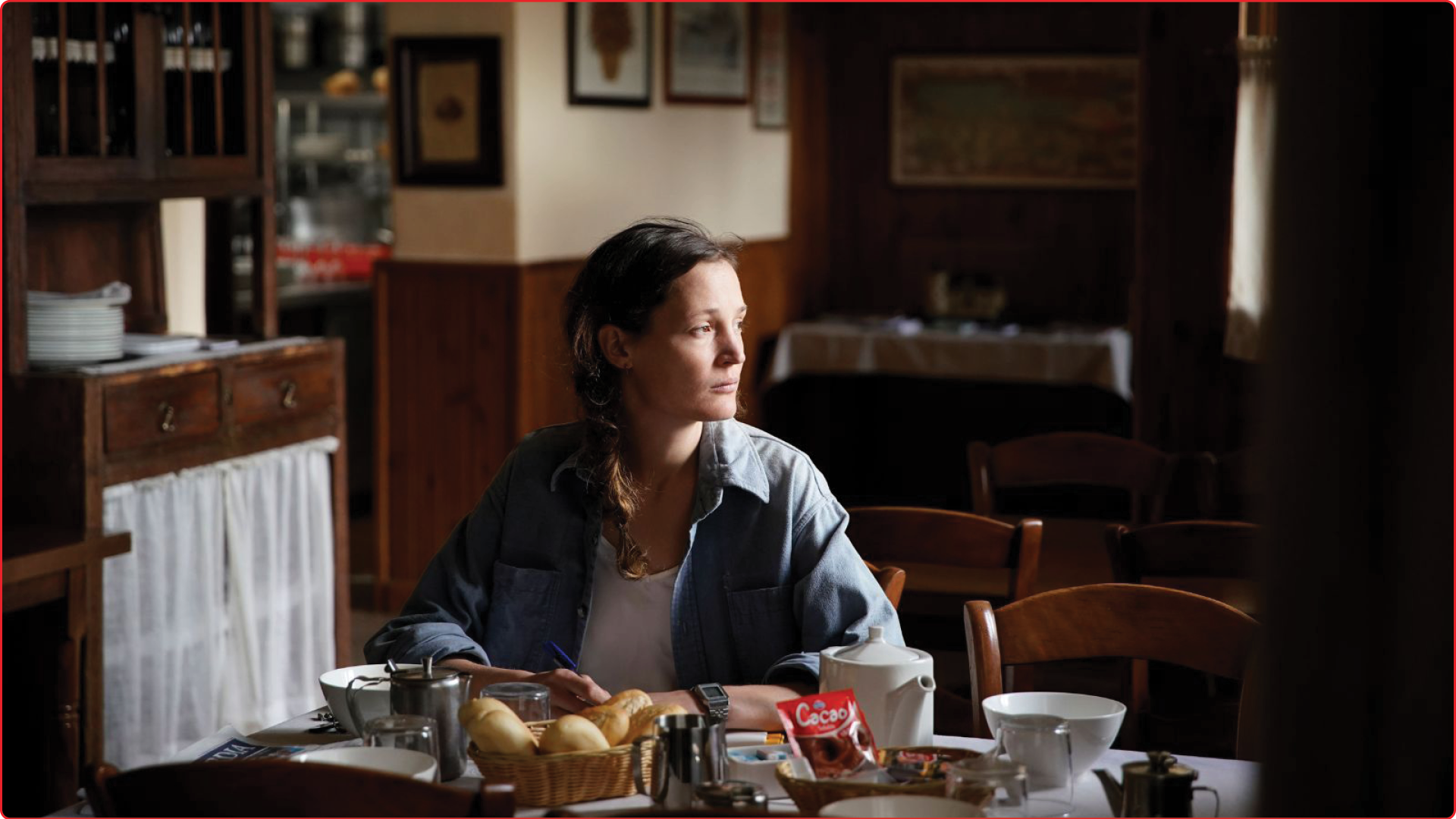
Hold Me Tight (2021)
ANNA FITZPATRICK: What was it like growing up in Luxembourg?
VICKY KRIEPS: You find it in many biographies of musicians or artists or filmmakers, that they come from a small town, or in my case, a small country. It seems to give you an extra drive to get out and find something else. [With] Making art, often you are more sensitive to things in life or to your own feelings. It drives you to put it into something, to start writing about it, or start making music. I have observed that for people who have that, you’re born with a problem, because the way our society is made, you have to function, and you’re not here to feel things.
If, on top of that you are born in a small place, you feel like you’re suffocating, which creates, I think, a huge drive that can catapult you on the moon—not on the moon, but for me, the comparison for where I come from and for where I am now in my work, that is the moon. I never thought this was possible for me at all. I didn’t know of any Luxembourg artist who had an international movie career. I really thought actors like that have to come from Paris or New York or Berlin, maybe, but not Luxembourg. [Luxembourg] has changed a lot now, but it used to be quite conservative, in the way that it’s Catholic and just small.
AF: Growing up, what role did movies and films play?
VK: My father was actually working, I can’t say in movies, but for a distribution company. To me, he was just a manager somewhere. But he would show us early movies, old black-and-white films. The one that was the first where something really happened for me was Cocteau’s Beauty and the Beast (1946). That was a revelation. I saw that and thought, “I want to be part of these people.” But I didn’t think I would be the actress; I thought of the hands that move in the wall. [During the surreal scene where Belle first enters the castle, the candelabras are held from the wall by disembodied but animated human hands.] That’s what I wanted, to create worlds.
In Luxembourg we have a really well-equipped cinematheque, with many copies of the classics. From when I was 15 to when I was 19, we would go, a bunch of friends, I don’t know how many times a week. We’d watch a film and then go talk about it after in a café next door. That awoke this hunger in me for movies, and wanting to be part of this artform.
AF: How did you realize acting was the part that you wanted to do?
VK: I think I’m still not realizing it. Just yesterday, a director asked me to give them some advice about a fellow actor; I tried to describe their way of working, and we talked about other ways of working. I suddenly came out of this like, “I just feel like I’m not an actor.” I’m not saying that to provoke. I love what I do. But for some reason, I don’t seem to have the problems most other actors have.
I still search for the answer. Am I really an actor? What am I doing? I know I’m doing something. And when I’m doing it, I’m so in it, I’m 100 percent consumed and invested. But I’m more like a scientist, you know? I’m absolutely obsessed with my research. And every movie is a new time to research. I think what I’m researching is probably the human soul, or what this place is, and what makes us who we are. One day I fell into this and I haven’t been out. I never think, “What I did, is it good? Will people like this?” I just go in, and I forget, and I’m in the jungle… and then one day, I come out.

The Chambermaid Lynn (2014)
AF: You eventually studied acting in Zurich, and started to make small movies. Do you remember how The Chambermaid Lynn came about?
VK: The connection of The Chambermaid Lynn to Phantom Thread is what I love about my own story the most, because I was one of those actors—and there are so many out there—who really believe in something: not just being famous, they really want to do art. But then, people tell you, “Ah, you’re being too demanding. You have to compromise.”
I remember this period of my life very well. I was working, I wasn’t famous, and I wasn’t making a lot of money, but it was enough to live. But I really believed in the art of cinema. So I was doing my short movies and little films; Chambermaid was one of those that I even helped finance with a tiny amount.
People around me at the time were almost laughing at me: “What are you doing? You’re believing in a Santa Claus! You’re financing these little independent films that no one will ever see.” The movie came out, and no one saw it. And in Germany, it was completely forgotten and ignored, especially by the film scene. It was painful.
I was refusing to go to these parties or premieres—people think that as an actor, you have to go and have your photo taken so you become famous, so you get the better roles. I kept thinking, “But I don’t want to be famous and then therefore get better roles, I want to do good roles, which lead to better roles.” I wanted to go through my work. But I seemed naïve, and I was very alone with this.
And then, and this was really a miracle, out of nowhere, PTA was on his iPad. He’s always looking at European films that no one saw. For a week or so, Chambermaid must’ve been on iTunes. PTA watches this film twice, because he likes it, and then calls his casting agent and says, “There’s another name. Can you please also write to her to send a tape?” Everyone thinks Phantom Thread changed my life, but actually, what changed my life was Chambermaid.
AF: I see Chambermaid as such a precursor to, obviously, Phantom Thread, but also roles you would take later, because, at its core, it’s about this unconventional relationship and this woman who seeks human connections in very unique ways. Your character, the voyeuristic Lynn, hires a dominatrix after spying on her with a hotel guest, and the two women form something of a close bond. What was it like working with Lena Lauzemis, the actress who plays Chiara, the dominatrix, and developing that relationship together?
VK: I remember the casting, it was funny, because I wasn’t famous, so [Haeb] needed to be convinced. At the audition, we were doing this scene, and I was just cleaning. That’s what did it; it was not the acting, he said, it was the way I was cleaning. He said I was so concentrated. That’s what I mean with the scientist. I completely forgot where I was, and my head came forward like this [cranes her neck forward]. Like a giraffe.
Lena was my friend. She’s still my friend. When they were doing the auditions for Chiara, I said, “Can you also look at her?” They were all, “What? Why?” They thought Chiara had to have long blonde hair, be very feminine—you know, big boobs, like the other women they were calling. I said, “Huh?” I almost had to convince the director to take her audition. Now, whenever I talk about the movie, people are obsessed with her.
AF: Your chemistry is great.
VK: We were friends, but also what I loved doing—this was the director’s idea—we worked with a dancer, finding quite exact choreographies for all the body work. We choreographed the sex scenes, everything. Because otherwise, how do you do this naturally, where it’s not natural? Also she’s my friend, it’s awkward. But it went well with my character, because she is stuck in herself. She’s stiff.

The Chambermaid Lynn (2014)
AF: So Anderson watched Chambermaid Lynn and cast you in Phantom Thread. All of a sudden, you went from these little indie movies to working on a much bigger production. Just from an acting perspective, what was that like?
VK: I can’t tell you why because they obviously had so much more money than any movie I’ve made since, but Phantom Thread felt like another independent European film. We were on location all the time. It was a small house. It took so much time to move the gear up and down the stairs. This made our time shorter, which made it feel like when I’m usually working on smaller productions, you know? You have to rush.
Also PTA was so humane and very down to earth, very un-Hollywood, actually. So it didn’t feel like a big production. That was also interesting. I think he was very intelligent about how he went about this, protecting me as much as he could, for as long as he could, from the reality of a Hollywood film. He didn’t introduce me to any people. He didn’t even tell anyone I was doing the movie, so I did the same. I found that quite relieving: okay, great, I’m not going to say anything, either. Until the movie got released, I was really in this secret chamber. I didn’t do anything except for being on set and in my little apartment.
AF: That must’ve been an even bigger shock, then, because when that movie came out, it was so explosive, and your role particularly.
VK: Yes.
AF: What were the most surreal parts?
VK: The press tour. I mean, the press tour was so shocking that it made me not go back to LA for almost two years. I’m not saying this to judge. It was just very difficult for me. If you’re a sensitive person and you go to LA, it feels like every single light in the city is cutting your skin. Everything is just [makes cutting sound], too much. And the most surreal of all was the media training.
They did it to help me—they were not like, mean, bad, horrible Hollywood people. But the training consisted in telling me not to talk of me, not to say what I think of the movie, but to talk about the landscapes and the clothes, and that I loved working with Daniel Day-Lewis, and not to move my hands or my upper body. It only lasted half an afternoon, and I was tired and jet lagged… But for an afternoon, I was walking around the street thinking, “Okay, fuck, I have to do this. I have to be this person now.”
When I look back on it, it makes so much sense with what is wrong in Hollywood. It doesn’t even stem from a bad thought, you know? I think it started in the ’50s, and it’s about trying to protect actors, when by protecting you turn them into imbeciles. This makes them weak and victims. And then they become trapped in this thing. You must’ve seen interviews like that, where they don’t move, they just repeat the same five answers. After understanding that that was not what I wanted, I decided I would never give any answer that I had said before, I would never repeat myself, I would never think of how I look or what I am wearing.
AF: Bergman Island didn’t come out until 2021, but you started filming in 2018. It’s my understanding that shooting began without the Tim Roth character being cast, and there was a long gap between the start of filming and finishing the movie.
VK: Yeah, it was exactly one year.
AF: How did that gap in filming affect your understanding of Chris, the character you plan who is herself a frustrated artist?
VK: I remember thinking, “How am I going to make this work?” And then, as always in my life, I gave myself the answer of like, “I’m just not going to even try.” There’s something great in not trying to achieve, [whispers] when secretly you are. Often, you land on your feet. I watched the movie and I couldn’t believe there were scenes where I walk out of one year into the other year—I’m walking from 2018 into 2019. And you don’t feel it.
It’s the island [Fårö], too. It’s a very special place. [Mia Hansen-Løve] really captured it. There’s this energy, and it’s definitely fueled by Bergman, but also the place itself. You go there and you’re immediately in this mindset. I made the island my ally more than anything, because I knew I wouldn’t have my husband before later. I tried to communicate more with the place.
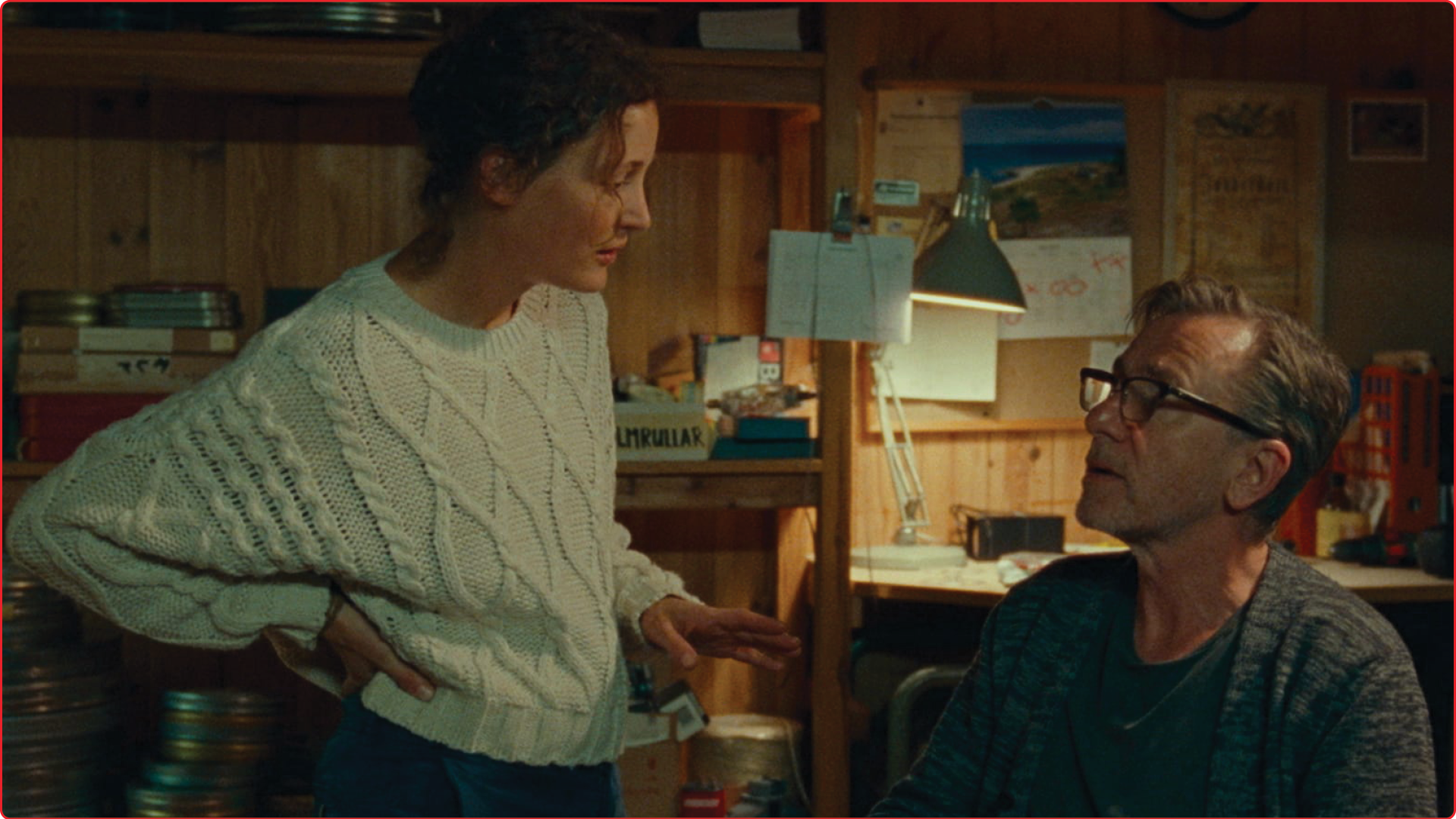
Bergman Island (2021)
AF: You credit the influence of Bergman himself, but the island as Hansen-Løve interprets it is so different to the island you see in Bergman’s movies.
VK: I think that’s partly why she wanted to do the film, because she was amusing herself. She’s having fun seeing this place for what it is, and [discussing] these male directors, who we love, but also we hate because they’re difficult, and you think everything that has to do with them has to be like, austere and dark and grrr. Then you go to the place and it’s just like, cute. The place is cute and everyone is cute and the housekeeper’s kind of grumpy, but cute. I think that was also her irony, doing that movie, you know, making fun of directors in general. What is film directing really? It’s making a movie, but it’s not changing the world.
AF: In that film, your character and Mia Wasikowska’s share very little screen time, but are kind of integral to each other. She’s playing a figment of your character’s imagination. Did you get to interact much behind the scenes?
VK: Behind the scenes, yes. She was one of those people you meet, and you’re happy they exist. You’re like: “This is one of us.” We live in a world, in a society that makes it very hard for artists, or women, or for any kind of intellectual artistic independence. So when we meet another independent artist, it’s almost comforting. It’s soothing your soul. I think we just share this happiness for one another.
AF: When working with writer-directors with such auteur-like visions, does developing the characters become collaborative?
VK: Mia Hansen-Løve is very architectural, which is fascinating. She is very close to her text, and her text is very important. I always need to feel free, somehow, but it’s a different kind. Some actors, they want to be free because they want to promote their own performance: “Let me do this because maybe I will find this awesome thing, and I will do it subtle, and everyone will applaud because I can do subtle.”
With Mia, she was really very particular about things needing to be the way she had it in mind. That was a corset for me. There, I found something that I then kept for all my roles. If I have to say what is written, but I still need to feel free as an artist, energetically speaking, maybe, then I will speak in a specific tone or voice. As I’m saying something, it’s like I’m keeping the backdoor open… and maybe it means something else? It’s almost like sending sentences out like little ships: you just send the ship out and let it go, but you don’t give it a direction.
I always need something of my own, but I don’t need it to be visible. In Corsage, I didn’t have to talk about the things I was going to do. I started poking my tongue out or doing all sorts of different things.
At the end, we knew that we were going to use one roll of film and that I was going to dance whatever way I liked, to any song. I was totally free, and you can see it and you feel it in the film. I had the idea of going to the make-up truck and asking for a beard. I stuck it to my arm here, under the sleeve. I had my back to [the crew], I remember I was so nervous because I was thinking, “What if they don’t like it?” I put it on and I turned around, and I have this beard. I do need this kind of artistic freedom. But I always find a way, you know? I like it to be more in the undertones.
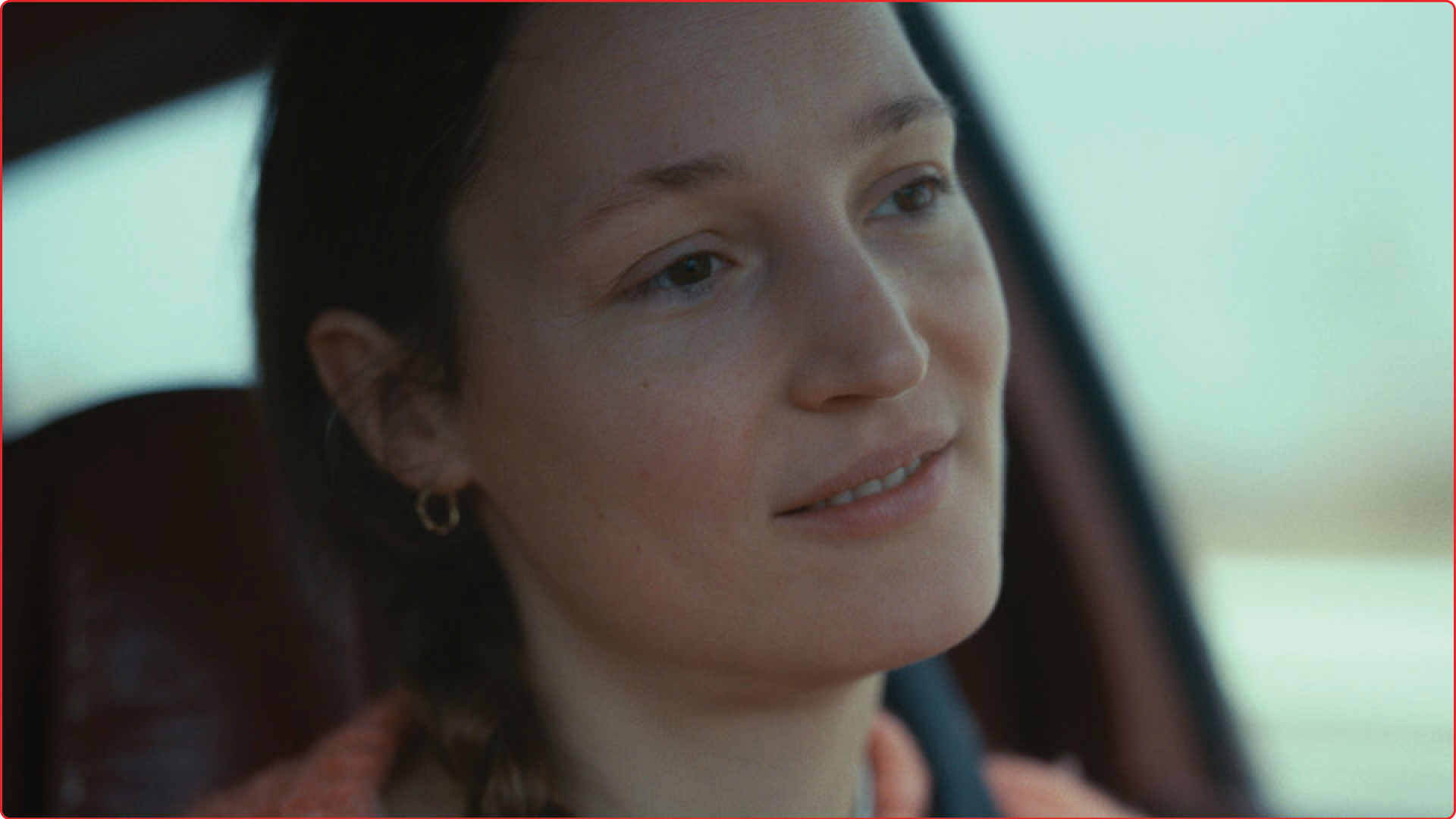
Hold Me Tight (2021)
AF: So many of your most iconic roles are about women craving agency in relationships with powerful and dominant men. In Hold Me Tight, it starts like that. We think it’s about a woman searching for independence, and then it flips the script, and challenges our perceptions of that narrative.
VK: It’s maybe my favorite film. [Amalric] called me and he said, “I would like to meet you, I have something.” You could hear in his voice there is someone truly seeking. We met in a café. He told me that was stuck in his writing process because he didn’t see [Clarisse, Krieps’s character]. He realized that for his past eight movies, he had directed his former or current lovers. This time, he was in love with someone who didn’t want this to happen. And then, I visited him; seeing me, he could finish the script.
From the moment I read it, I knew the beauty of it. Just to say, “What if someone goes insane in order to not go insane?” I found that so truthful. Also, of course, to begin with the idea that a woman is leaving her family, and we already judge her. At the same time, every woman in the room has probably secretly thought that, you know?
From the first minute to the last, it was a movie I didn’t even have to think about. We both agreed we would shoot with as few people as possible, so it’s almost like a documentary. It’s really just following this woman in her madness.
I remember the scene [where the fate of her family is revealed]. He came to me and said, “Vicky, what do you think of this scene, how do we end it?” I said, “I have no idea. You just have to let me do it, because I don’t know if I can act this.” Who am I to even dare go close to this kind of feeling of grief, when I’ve never had it, you know? He left me alone, and I was completely on my own in the house, while they were outside putting up the shot.
I remember thinking, “Thank God I’m not a Method actor, or doing the Stanislavski training,” because imagine, I would think of my own kids. It was enough to just think of them as my movie children. I stayed in that house, wandering around, wondering where they were, because before she sees them, even if it’s absurd, she’s probably thinking, “Maybe they are up there somewhere?” I’m sure someone like her would have these ideas.
The assistant director was giving me the cue. It felt like I was a skier on a ski ramp, and she was counting “One, two, three, go.” I didn’t know if I was going to jump really high, jump not at all, if I was going to be stuck on the slope, or what would happen. And then, the scene just happened like, I can’t explain. I have that sometimes in my movies that I play something, and afterwards I come back to myself and I don’t know what happened. This was like that.
All I know is that I was crying on the floor, my face was buried in the dirt. Mathieu picked me up, and we were both crying for another 10 minutes in each other’s arms. Then he said, “Okay, we won’t do it again.”
AF: With Corsage, you’ve spoken before about growing up watching the Romy Schneider Sissi movies (1955-’57). The Empress Elisabeth, Sissi, she’s so iconic in Vienna. With a person who has been depicted so many times, is there a freedom in getting to do your own version, where you know no one is going to take it to be the definitive historical text?
VK: It was the fun of it, but it was also the challenge. You know, when you’re told not to jump over the fence and then you jump because they told you not to? That’s a bit how it was. I knew I was—not destroying—but dismantling one of the most famous, beautiful, romantic princesses of our time, especially in Germany. I really wanted to get into mischief and just play with something that I’m not allowed to play with.
AF: What did you think other depictions of Sissi had been missing?
VK: They were mainly focusing on her beauty. Because even when they were trying to say, “Oh, but she also lived in nature and was barefoot,” it was all about the young, beautiful, naïve—but beautiful!— little naughty—but beautiful! You know how in old movies, every woman at some point has to be excused by being but beautiful! She takes her glasses off, and oh!
I was like, “What is this idea that a woman has to be beautiful, or that being beautiful increases her worth or agency?” I love beautiful things, but also I think that’s the main curse around Sissi, the idea of beauty.
Corsage (2022)
AF: I watched Corsage and Old back to back, and they’re wildly different movies, but they both deal with the anxiety of aging.
VK: Yes. And also, being stuck in time. Both characters are stuck in their situation, and unhappy about it, and finally have to give in. One gives in to death, and the other understands “Where was I running to, when I could’ve just sat at this fire all my life?”
AF: What was it like doing a straightforward, Hollywood thriller after so many indies?
VK: Not easy, I have to say. I mean, I enjoyed all of my colleagues, and we had a nice time. But it’s a machine—and that’s no one’s fault, you know? Because of the special effects, there’s a lot of equipment, physically there and then also digitally, what you can’t see. It creates a set that feels very technical. I have never done that before. I don’t necessarily think I am going to do it again. Not that that’s wrong and what I do is right, it’s just because I’ve learned in my life that I can only do my art this way. It’s like trying to grow a flower in Times Square. It’s just too loud and too full of people, there’s too much concrete and stuff going on.
But Old, because even though it is a thriller and it uses the tools of the machine, it is about family, and about how we all are running from time. It was in Covid that we were doing it, and I found it, philosophically speaking, super interesting.
AF: After that film, you made More Than Ever, which has a lot of parallels with Chambermaid; you’re playing a woman who has an illness, a degenerative lung disease, that controls much of her life. How did you approach embodying someone who’s physical life is so limited?
VK: I talked to people who have that [disease], so that they could try and explain it to me. But I knew I wouldn’t really be able to know how it feels. This idea of suffocating, and how this suffocating becomes generally suffocating for a person, and how everyone around you doesn’t see what you feel, doesn’t know what you feel, doesn’t get it. I was mainly focused on trying to portray this invisible pain that becomes something that alienates you from everything around you, including the person you love.
AF: Could you talk a little about working with Gaspard Ulliel? [Krieps’s onscreen husband in More Than Ever died suddenly in a skiing accident in January 2022, when the film was in post-production.]
VK: We were very close. We knew each other for a couple of years, and he was someone very important to my life, maybe because of this mutual respect we spoke about earlier. It was very strong, just knowing that the other exists. For France, he was maybe the most respected actor for this thing—to believe in something and say ‘no’ to commercial opportunities in order to say ‘yes’ to smaller artistic things.
It was such a pleasure to work with him, because we both wanted the same out of cinema, wanted the same for cinema. We had [reached] the same impasse of wanting to work when we work, and party when we don’t work. But when we work, we work. Not being on your phone, being dedicated, being very precise with the text.
It was a great tragedy in my life, actually, to lose him. I still am quite shocked by life and how it does things, that of all the movies he could’ve done, he made that one. The last shot is him on a boat leaving, not turning back, and me crying. And in life, he goes and dies and I stay behind. It’s very weird. I also feel like, and maybe it sounds presumptuous or stupid or crazy or, I don’t care, but I feel like something happened there. It’s like he gave me the baton, when you run [in a relay race]. Ever since, when I am working or presenting a movie, he’s with me. I think of him and I think of what he would’ve done, and then I have to smile.
What he taught me, and that was so important, was that it’s also okay to care. He was like, “Vicky, it’s okay to consider the camera and talk about how the camera is put and what is the better shot.” Because I was always, “I’m just going to do what I do and they’re going to film it and it’s fine.” Or let’s say when you go to a premiere, what do you wear? I would always say, “I don’t care. I’m going in my pajamas, leave me alone.” He would say that it’s okay to go and celebrate. It’s about caring and wanting it to be the best it can be, technically as well as intellectually. I met him because I apparently had to surrender to this thought that, yes, we are doing this together.
Share:
About the Contributor
Recommended
-
Susan Seidelman
 An intimate conversation with the trailblazing American filmmaker.
 -
Carol Kane
 Fifty years in 50 minutes with the irrepressible screen icon.
 -
Mark Lee Ping-bing
 The legendary cinematographer reveals his three core beliefs.