
Essay
The Cassandra Cat
On the transgressive Czechoslovak New Wave fairy tale.
The Cassandra Cat opens at Metrograph Theater on Saturday, May 17 as part of Guided by Animals.
Share:
History is rife with tales of oracular kitties, spooky housecats, and other such wizards of the whisker, variously deified and demonized as seers and sinners across art, folklore, and mythology. In Ancient Egypt, where the cat was accorded the status of the goddess Bastet, the creature’s eye was thought to symbolize the portal between worlds. Consider those cryptic peepers for a moment: under bright exposure, their pupils resemble two crescent moons converging to form parentheses, which—as noted ailurophile William S. Burroughs loved to remind us—represent the communion of past, present, and future.
The feline gaze has been cast across the Seventh Art since its inception: everything from soup-slurping silent-movie kittens and Maya Deren’s kino kindle to the cats spellbinding Jimmy Stewart in Bell, Book and Candle (1958) and shooting emerald lasers from their eyes in 1977’s House. Still, as far as cross-dimensional furballs go, the pick of the litter has to be Mourek, bespectacled star of Vojtěch Jasný’s subversive Czechoslovak New Wave parable, The Cassandra Cat (1963). Few big screen mousers have ever seemed as visionary—or as likely to play keyboards for the Pet Shop Boys.
Mourek is first spoken of by the town castellan Oliva (Jan Werich), who emerges from the tower clock-face like a human cuckoo to deliver the story’s “Once upon a time…” bookends—presumably for the benefit of the censorious communist state, for which the film served as a thinly veiled critique. (The convivial actor, who co-wrote the screenplay with Jasný and fellow filmmaker Jiří Brdečka, had recently portrayed another slippery storyteller in Karel Zeman’s 1962 adventure film The Fabulous Baron Munchausen.) Aside from the Tatra 603 that briefly rolls into frame, the events could be taking place in any number of generic, out-of-time fairytales, in a village (the filmmakers shot in picturesque Telč) whose major claim to fame is its quaint school that doubles as a museum of taxidermy. “No living animal is as much alive as a formerly living one we stuffed,” says the school caretaker (Vladimír Menšík), game-hunter and toady to the headmaster and town gauleiter (Jiří Sovák). Neither are especially fond of Oliva, whose cheerful humanism threatens their small-minded authority. The old man’s wry ability to size things up as they are—watching from his castle turret—makes a mockery of their own surveillance of the citizens.

The Cassandra Cat (1963)
Regaling a rapt class of third-graders, Oliva describes his days as a young sailor in love with a mysterious girl whose kočka wore sunglasses and possessed a peculiar gift: the ability to see humanity’s true colors. For his trouble, the cat was murdered, causing his companion to vanish. As a testament to this fanciful yarn, Oliva produces a tiny pair of old-fashioned shades—cat’s eye, of course—from his dusty pocket. As he speaks, the kids paint their impressions of the animal in a wild array of styles, effectively summoning the beast from its fabulist form and into the material world. The cat is coming to town.
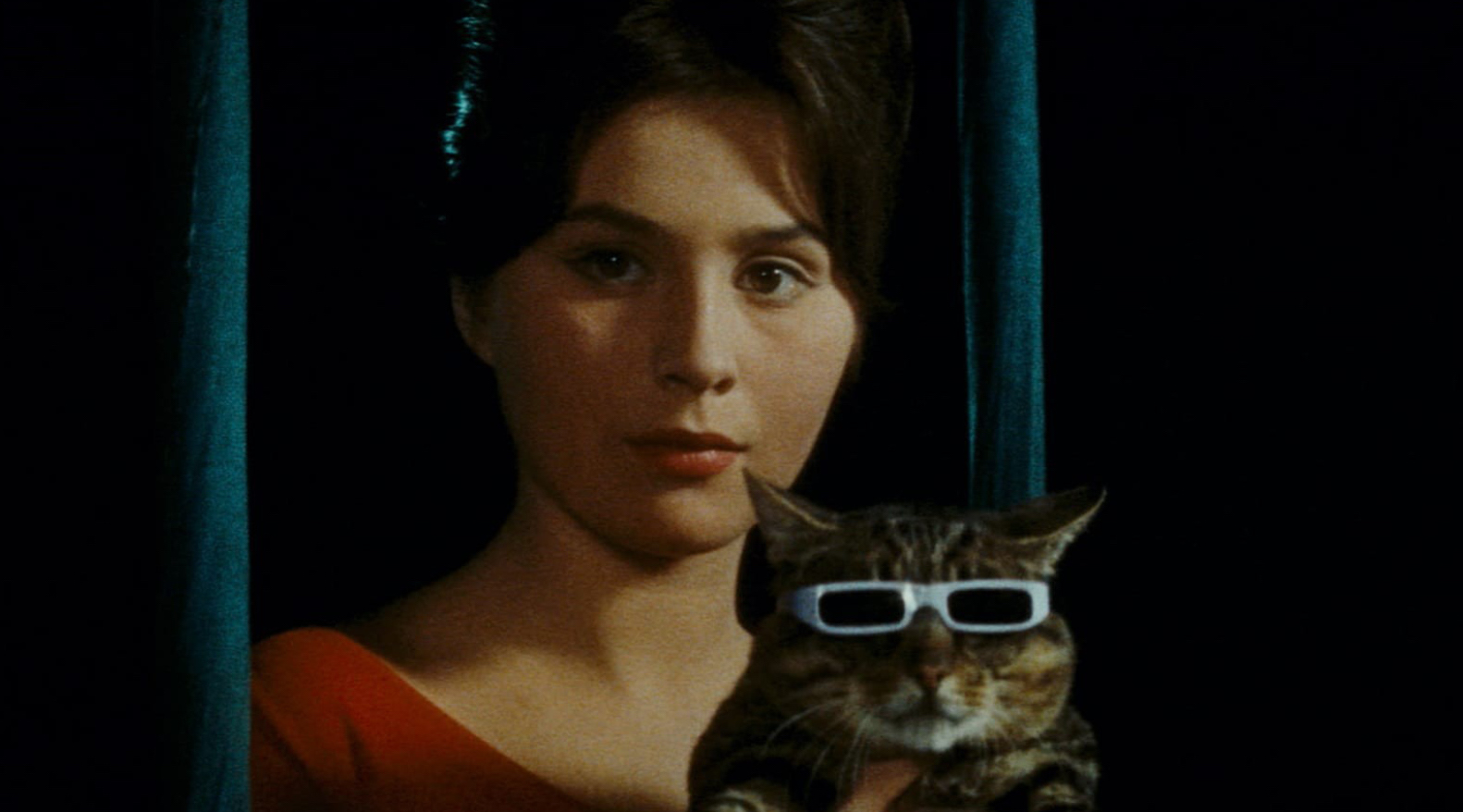
Nothing can quite prepare the adults for the arrival of Mourek, a puss in cahoots with the sylphic acrobat Diana (the great Slovak actor Emília Vášáryová) and her mystery troupe of actors, led by a top-hatted ringmaster (also Werich, playing Oliva’s doppelgänger) who sets about enchanting the village. Held aloft by his handlers, Mourek would be an otherwise unremarkable tabby were it not for the fact that his eyes are wrapped in a pair of futuristic, white-framed sunglasses.
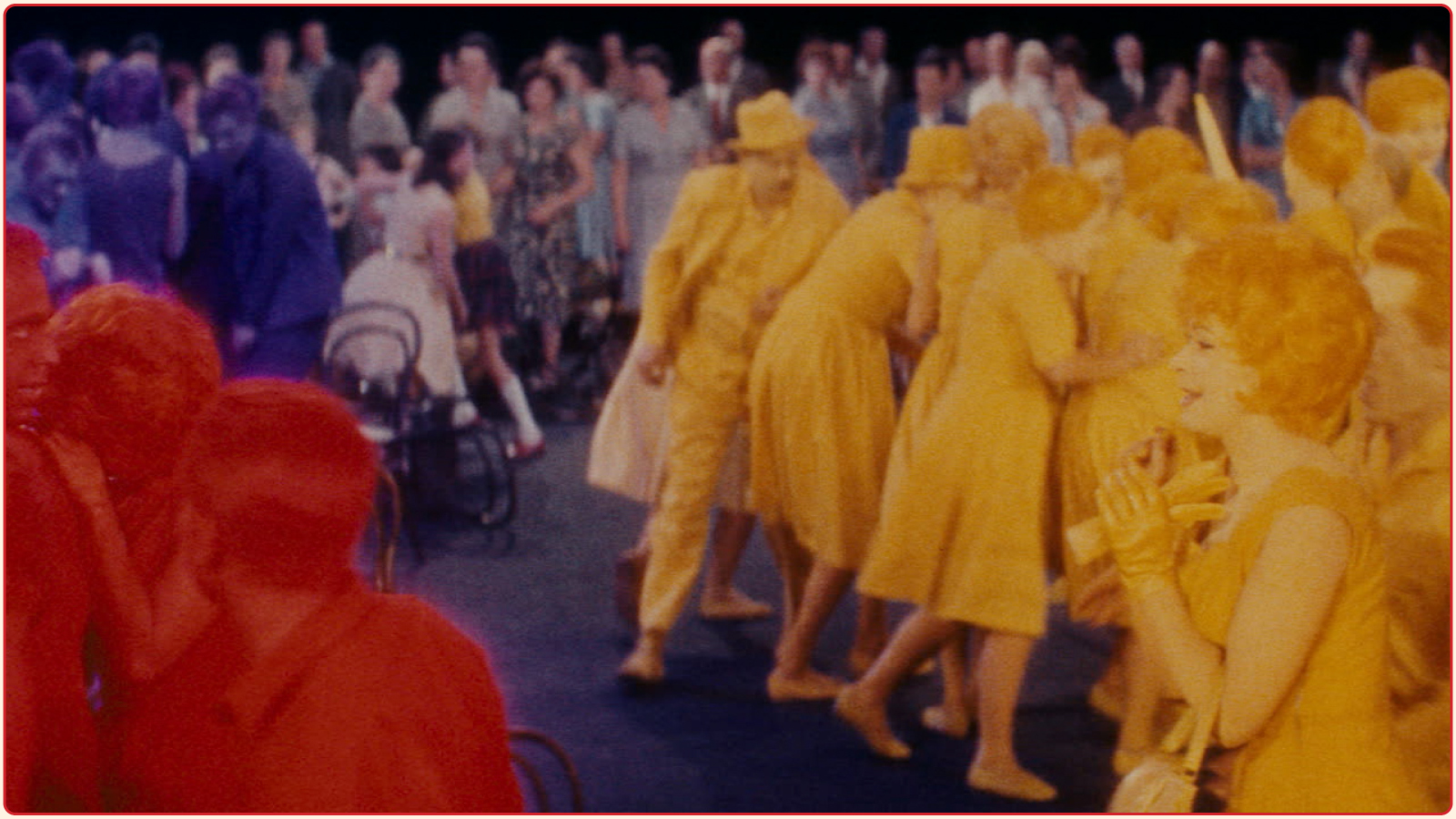
Jasný and his cinematographer Jaroslav Kučera—whose vibrant lensing electrified Věra Chytilová’s Daisies (1966), Juraj Herz’s Morgiana (1972), and Karel Kachyňa’s crystalline adaptation of The Little Mermaid (1976)—stage the ensuing chaos with a dizzy, ludic abandon. In a riot of sound and color, the secrets of the duplicitous villagers are splashed across the screen. The film’s showstopping centerpiece sees the citizens gather in the town square for a magic show put on by the visiting troupe, who needle the assembled bureaucrats with parodies of their authority and poke fun at the rampant infidelity of the adults. But it’s mere preamble to the sequence’s surrealistic climax, in which Diana, suspended on a trapeze swing with Mourek above the audience, whips off the cat’s glasses to reveal the townsfolk’s true selves. (Was John Carpenter a student of the Czech New Wave?) Suddenly the movie becomes a balletic musical erupting with giddy choreography, as dancers appear in vivid reds (representing lovers), purples (liars), yellows (the unfaithful), and ambiguous grays (thieves). (The actors’ bubblegum shades were achieved via a combination of make-up, film tinting, and old-school, in-camera lighting.) Jazzed by composer Svatopluk Havelka’s discordant score of electronic blips , and edited in a rapid-fire, kaleidoscopic montage by Jan Chaloupek, the entire sequence feels as though an avant-garde reel has been dropped into the middle of a fable.
It’s often remarked that the cat is a psychic being, able to simultaneously inhabit the physical and etheric planes—as anyone who’s seen their familiar shadowboxing in an empty corner can surely attest. Scribes in the medieval bestiaries wrote of the cat that “so acutely does she glare that her eye pierces through the shades of darkness as though with a gleam of light.” In peeling back the veil between the material and the spirit worlds, it might be said that Mourek is witnessing the townsfolk’s astral bodies, a reading given credence by the movie’s recurrent meddling in the metaphysical. “What is this, a symposium of doubles?” Oliva wonders upon encountering his magician twin. “Or is it a meeting between matter and antimatter?” Either way, the rattled villagers are soon making a beeline from the feline, who—unfazed by his supernatural mandate—appearsfar more interested in snacking on grass and chasing the local tail. That darn cat!

The Cassandra Cat (1963)
Despite its patina of storybook whimsy, The Cassandra Cat makes so little attempt to conceal its jabs at Czechoslovakia’s communist regime that its existence is something of a marvel, even allowing for the fact that it was produced during a period of relative political thaw post-Stalin. Jasný, whose father perished at Auschwitz in 1942, had welcomed the postwar Soviet dominion over his homeland, making state-approved documentaries under Stalin. But a filmmaking trip to the Soviet Union and China proved to be an eye-opening glimpse behind the propaganda—not unlike the cat removing its lenses.
“Socialist realism is a beautiful word, or two words, but in the end it was a lie,” he told The Other Europe in 1988. “You had to lie, and to show everything much more beautiful than it was.” In response, Jasný and his peers took the funding provided by the government for film production and used it for precisely the opposite intended purpose: to create art that satirized the state. “We couldn’t say things directly, so we used fairy tales, comedies and similar things to talk in allegories,” he explained. “I had to learn to be very smart then, like in the Bible: to be nice as a dove, and also as a snake.”
Once Mourek becomes public enemy number one, Jasný’s contempt for his country’s totalitarian regime is impossible to miss. The school director and his cronies lead a hunt to apprehend their tabby tormenter, sowing suspicion and mistrust among the civilians in the process. When they finally catch and cage the anarchic kitty, authorities conspire to plausibly get rid of him via natural causes, in a scene that feels inspired by the way the party would effectively disappear dissidents in real life. Jasný maintained that his friend, the Czech composer Radim Drejsl, had his wrists slashed and was tossed off a balcony by Soviet spooks, who he insists staged the murder to look like a lovelorn suicide. It was just one of many such incidents among the filmmaker’s artistic circle.
The ruling cabal are quick to dismiss and then discredit school teacher Robert (Vlastimil Brodský, something of a Czech Tom Ewell), the beloved pedagogue who serves as a clear stand-in for political free-thinking and revolutionary unrest. Robert’s sympathy for the feline fugitive is all the excuse his superiors need to remove a man whose lessons stress the importance of “friendship, honesty, and not to bend to the peoples’ rule,” and who recently branded a colleague a murderer for shooting a majestic stork out of the sky.
The Cassandra Cat (1963)
Little do the powers-that-be realize that Robert has a pee-wee army in his class of impressionable third graders, in whom he’s instilled the importance of dreaming and imagination. In one of the film’s most remarkable sequences, doubling as a kind of formal seance for the digital future, the student’s notebooks transform into film projection screens of their dreams, looking for all the world like flat-screen devices beamed in from the 21st century. It’s a striking moment; secret dreaming as resistance to the surveillance state. To these kids, Mourek is nothing short of a hero; when he’s cat-napped by town officials, they unite in solidarity with their little čiči, festooning the streets with images of the mantic moggie and slogans demanding his release. “We have been mistreated and we are leaving,” they declare, and vanish en masse as a show of support.
Jasný, too, would eventually go into exile, after his acclaimed 1968 film All My Good Countrymen drew fire in the wake of the Soviet invasion of Czechoslovakia, a maneuver designed to brutally suppress the Prague Spring. Countrymen and The Cassandra Cat quickly landed on a list of banned films, alongside the rabble-rousing likes of Daisies, Miloš Forman’s The Fireman’s Ball (1967), and Herz’s The Cremator (1969), never to be seen in the country for decades.
Or so the government thought. “All My Good Countrymen [is shown] secretly. You can have tapes in Czechoslovakia, you can see it,” Jasný said in the 1988 conversation, speaking from his adopted New York, and just a year away from the Velvet Revolution that finally dismantled Communism in his homeland. “Young people know it. It’s like a legend.”
Likewise, Mourek and his merry band of tricksters would return from the shadow realm, demonstrating—both on screen and off—the power of the imagination in standing up to oppression and groupthink. As Diana says, right before she and her crew leave town on their next mission: “Everywhere, there’s someone waiting for us.”

The Cassandra Cat (1963)
Share:
About the Contributor
Recommended
- The Maiku Hama Trilogy
 On the retro riffs and magnetic lead of Kaizo Hayashi’s newly restored cult trilogy.
 - Juliette Binoche
 On the eloquent hunger of the iconic French actress.
 - I’m Not Everything I Want to Be
 On Libuše Jarcovjáková, the queer photographer drawn to the social fringes of Soviet Prague.