
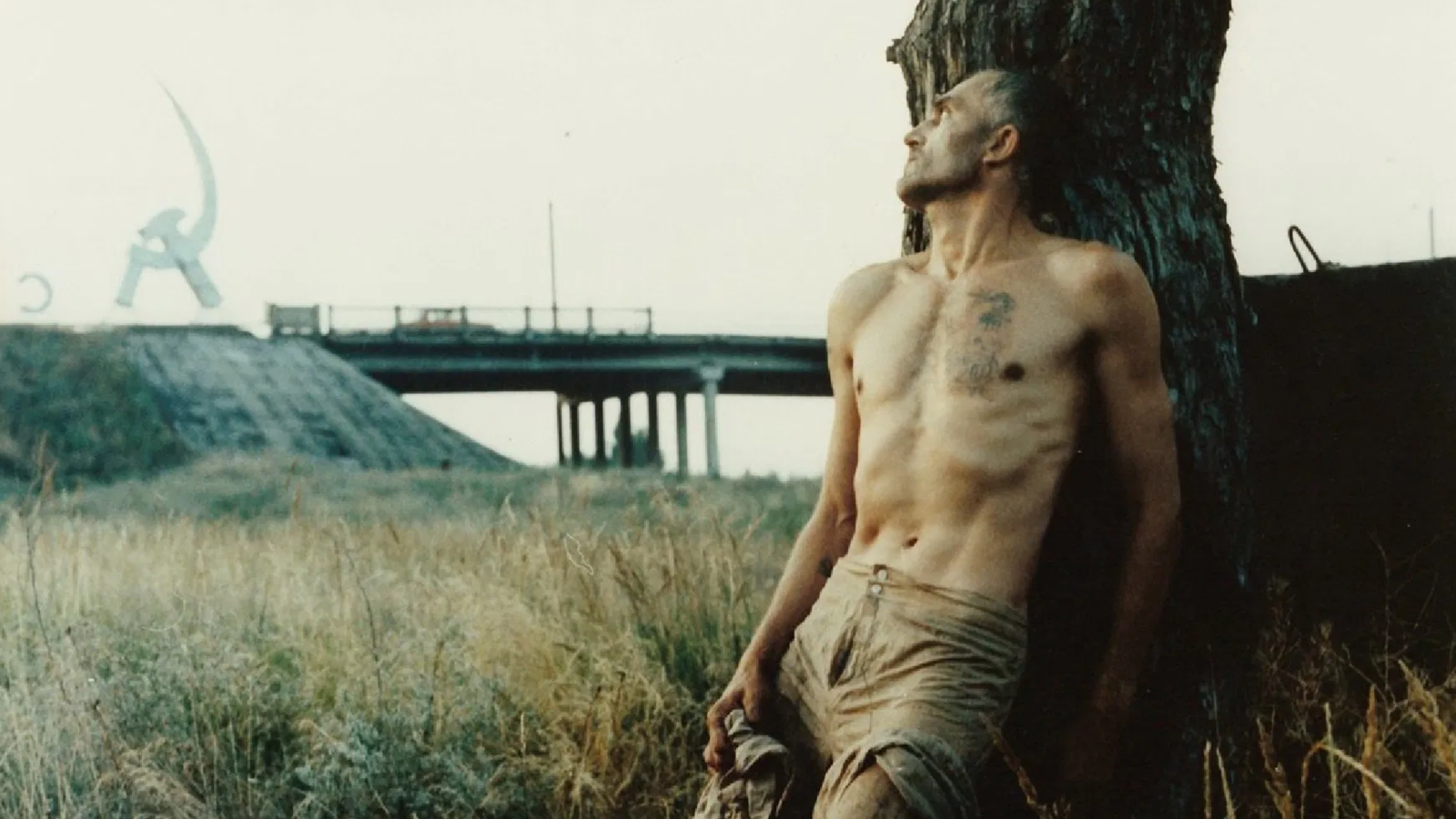
Swan Lake. The Zone (1989)
Interview
Pylyp Illienko
Yuri Illienko’s son discusses the lore behind the making of Shadows of Forgotten Ancestors (1965), the duel between his father and Parajanov that almost derailed this classic of Ukrainian Poetic Cinema, and their late career reconciliation that culminated in one of his father’s most darkly prophetic films.
Soul and Soil: Ukrainian Poetic Cinema opens at Metrograph on Friday, November 7.
Share:
American audiences still experience a very narrow exposure to cinema produced in the former Soviet Union. Andrei Tarkovsky represents the whole of it for many. And though to diminish Stalker (1979) would be foolish, there remain many more extraordinary films and talented directors who didn’t have the promotional mechanism to place them alongside the more established hits and hitmakers that make up the pantheon. Of such overlooked works, I would especially point to those that make up what is sometimes referred to as “Ukrainian Poetic Cinema.”
Thanks to the work of people like producer Pylyp Illienko, though, we have the opportunity to experience movies like Swan Lake. The Zone (1989), by Pylyp’s father Yuri Illienko, one of four features by Illienko screening at Metrograph as part of the series Soil and Soul: Ukrainian Poetic Cinema. Comparisons between Swan Lake and Tarkovsky’s famous film are unavoidable, if not intentional. Grim does not begin to describe both these visions of a future (present) devoid of hope and reason, delivered by authors overflowing with poetic sensitivity.
And yet, Illienko’s works as director have barely screened in the US, which has been a shame and a loss to us for decades. Here, he is best known as the cinematographer of Sergei Parajanov’s classic Carpathian Mountains–set folk tale of love and witchcraft, Shadows of Forgotten Ancestors (1965). If this were Illienko’s only achievement, I would still put him in the sanctum of essential image makers. Shadows, of course, announced Parajanov to the West, although it is not at all like his later films, which are made up of almost still images, whereas the physical camerawork that drives Shadows is present in all Illienko’s subsequent films—movements that are sublime, spiritual, chaotic, impossible. The unstable color film stocks used in this period of Soviet cinema are displayed at full tilt here, matched by the imaginative optical printing and strong blacks and whites.
Even more lawless with its uses of camera and boundless color is Illienko’s The Eve of Ivan Kupalo (1968). A much rarer film, Ivan should be a big discovery. Based on a Gogol short story about a young man who makes a pact with the devil, Ivan becomes more and more bonkers with each reel. If only this film had been seen by Jerry Garcia in the late ’60s, instead of The Saragossa Manuscript (1965), I believe it would be as highly regarded, at least, as the psychedelic candelabra.
Ivan Mykolaichuk and Larisa Kadochnikova, the romantic leads from Shadows, return in Illienko’s The White Bird Marked with Black (1971). Though in no way a sequel, the film does also feature stunning pastoral Ukrainian landscapes, and perhaps reveals what Shadows may have been without Parajanov pushing certain elements of his own. Some 14 years after Shadows, Mykolaichuk would direct and star in Babylon XX. It too is a truly rare and unforgettable film. (Kadochnikova, who was married to Illienko, also appears in his wonderful directorial debut, 1965’s A Spring for the Thirsty.)
Ahead of Pylyp’s visit to Metrograph, bringing with him from Kyiv some of his father’s personal 35mm prints, we spoke about these very special films. We only had 45 minutes, and I spent much of that fumbling over myself with questions I have wanted answers to for years, trying to imagine that others might as well. I am grateful for his time, and I was moved by his respect and devotion to his father’s contribution to cinema. Because of such efforts, the pantheon expands. —Sean Price Williams

Photo of Sergei Parajanov and Yuri Illienko, courtesy Straw Bells Media
SEAN PRICE WILLIAMS: Hi, Pylyp. It’s really incredible to speak to you. How are you doing in Kyiv?
PYLYP ILLIENKO: Oh, it’s been a couple of crazy nights here. But I had a fever, so you know, I wasn’t paying much attention to the air strikes. But now I’m feeling better.
SPW: Oh, geez. So you’ll have to take the train to Poland to get out, when you come to visit Metrograph? Is that your journey?
PI: It’s more complicated because I have some screenings of my own films happening. But generally, the passage is through Warsaw, Krakow, or Budapest.
SPW: I visited Ukraine a couple of times during the war, so I’ve done that train trip from Warsaw, with Abel Ferrara, the filmmaker—we were invited to work on a documentary [Turn in the Wound, 2024]. And I’d visited a few times before; my first trip was in the west, in the Carpathian Mountains. My goal was to find the house from The Shadows of Forgotten Ancestors. I saw a house that it seemed maybe was it… But it was definitely the same landscape, which I find to be the most beautiful in all of Europe.
PI: I have seen this house also, but I am not sure it is the one. Maybe it’s a local legend?
SPW: It looked similar… the windows looked right, but it didn’t seem like exactly the same house.
PI: I believe they filmed interiors in a studio in Kyiv. Because the film stock they used, 64 ISO, it has low sensitivity and so they needed a lot of light, and it would be very hard to get this amount of light in the real house.
SPW: For sure, plus the ceilings were low. It’d be a nightmare to light; the amount of light required, people would be dripping with sweat… Technically, though, the films your father worked on, for me, they expand the idea of what photography and cinema can be. There’s so many tricks, some that he would use over and over. I often have no idea what the camera is on—is it dollies, cranes, or some early form of a camera mounted on a person? For example, in Shadows, there’s a scene crossing a river, when Ivan [Ivan Mikolaichuk] finds his drowned wife [Larisa Kadochnikova]. I have no idea how this shot exists.
PI: I believe that this specific scene was done using a wide-range lens, and with a small, handheld Soviet camera, a “Konvas”, which was designed for documentary filming. My father was jumping from the raft to the rock on the river bank, and they built the motion of the actors and everything into the scene so that when the camera moves—and it’s obviously shaking—there is also an actor moving that distracts the viewer’s attention, so you don’t see the shake. It’s balanced that way.
SPW: I’d be curious to see the size of the camera. And yeah, he’s walking on unstable terrain. It’s incredible, and very effective, emotionally. That’s the thing: none of these are gimmicks.
PI: I will ask about the camera; it was a light camera for those days.
SPW: Thank you, this is exciting, truly. And then, as a child, you appeared in his film The Forest Song. Mavka (1981), right?
PI: Yeah, that was my first experience. I am one of the children of Kylyna, playing the flute, with Ivan Mykolaichuk in the end of the film.
SPW: It’s an incredible film. It has some scenes in the forest where the camera is spinning around and around, and you don’t see any [camera] tracks. You should, but you don’t. It’s an incredible way of shooting in the forest. You don’t see anyone shooting in forests the way your father does. And also, tiny lights, almost like Christmas lights, everywhere in the trees—that’s another trick that he would do. Just magical.
When you watch films like The Eve of Ivan Kupalo or Shadows, it seems that any idea that the cinematographer or director had, they would really try to do. They would pool resources, build rigs. Dangerous, impossible things seem to be happening on-screen—for example in Ivan Kupalo, the burning barrels. I really hope that film becomes better known in the West. Especially speaking as a cameraman, that film is good for opening the mind up; it’s such a psychedelic movie, such a treat.
PI: Yeah. This burning of the wheels is part of the traditional celebrations for The Eve of Ivan Kupala [also called Kapula Night], which is one of the most ancient pre-Christian holidays in Ukraine, and in Slavic countries generally. It’s still a huge holiday. It’s based on the tradition of burning fires near the banks of the river and then jumping naked across the fire, and doing some witchcraft …the main legend is about finding the fern flower that will open a treasure chest, which Gogol describes.
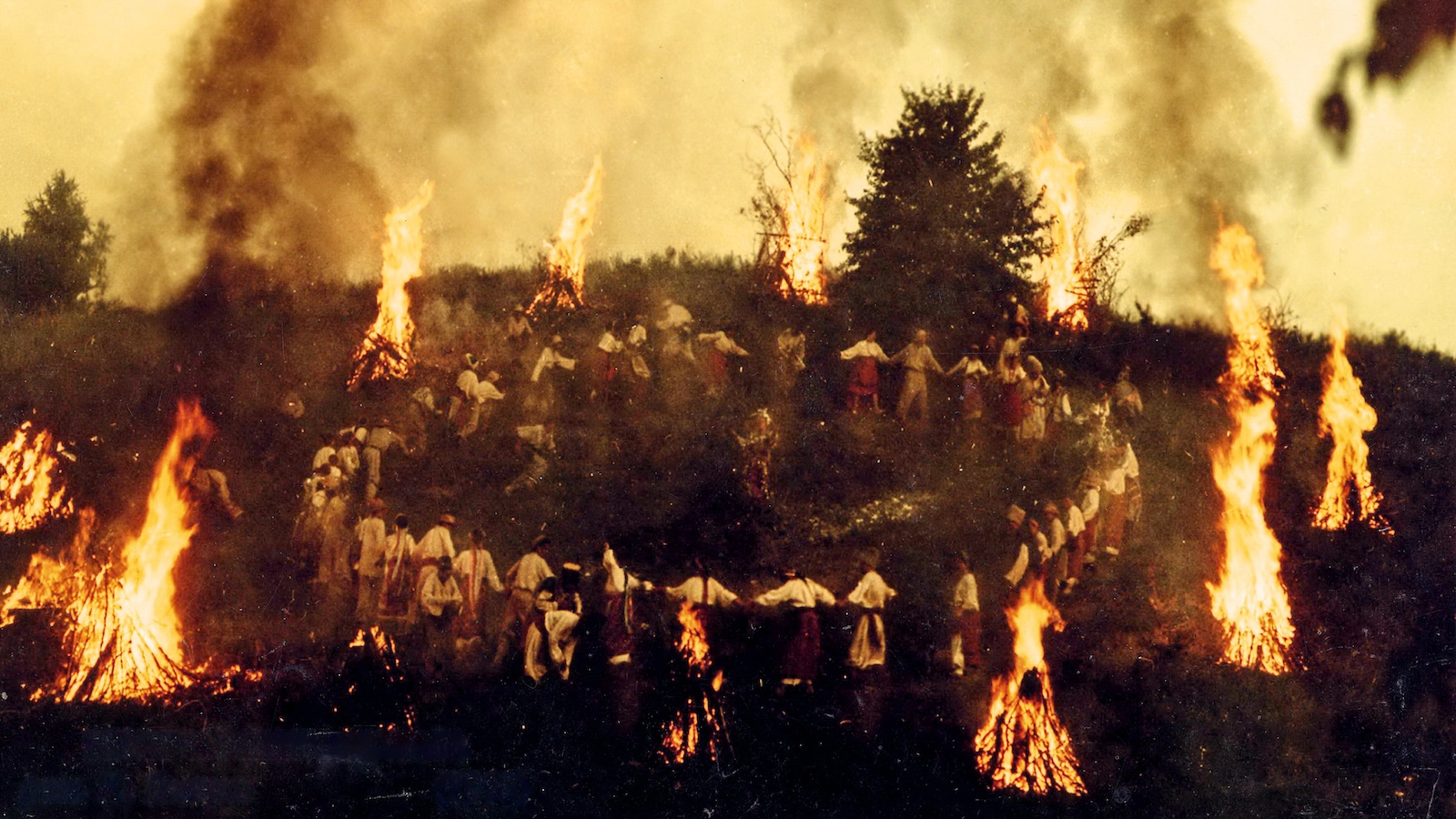
The Eve of Ivan Kupalo (1969)
SPW: This idea that a production would go as far as they could imagine to try and make something happen, it’s a quality I associate more with Ukrainian cinema than any other national film industry, at least as far as camera capabilities. I mean, there’s the famous shots everybody talks about from I Am Cuba (1964), which was shot by Sergey Urusevsky, with a Soviet crew, I expect. But I think if more people saw your father’s films, I Am Cuba would not be as popular.
PI: As a matter of fact, my father talked a lot about Urusevsky’s work as a cinematographer. He regarded his contribution to these films very highly, more than that of [director Mikhail] Kalatozov, because he liked the cinematography more than the directing in them [laughs].
SPW: Can you tell me a bit about your father’s relationship with Parajanov? How did they meet? And why did they only make the one film together?
PI: There’s a lot of stories and legends about that, in Ukraine. They met after Parajanov saw my father’s previous films as a cinematographer. His debut, Goodbye Doves (1961), directed by Yakov Segel, was very popular, made by Yalta Film Studio. My father started his career at this studio, he made his first two films there. Goodbye Doves won a prize at the Locarno Film Festival for its visual style. When Parajanov was developing Shadows, he sent a telegram to my father, inviting him. My father was in Moscow—he was born in Ukraine but grew up in Moscow and went to school there. At that time, Parajanov was not yet a very well-known director, and the Dozhenko Film Studio was known to be mostly making propaganda films, so my father was reluctant to accept the proposal. But then his mother-in-law at the time—the mother of [Ukrainian actress] Larisa Kadochnikova, to whom he was then married—she knew the novel by Mykhailo Kotsiubynsky, which is a classic of Ukrainian literature, and told him, “You must read it.” He went to a library and read the book outside on the bench, in one sitting. And he was astonished. He was born in Ukraine and raised in childhood, in Cherkasa, but he had never been to the Carpathian Mountains, it’s a totally different region. Then he went to the nearest post office, sent a telegram saying that he accepted the proposal, and came to Kyiv to meet Parajanov. And that’s how it started.
But then, in the middle of the production, they had a serious conflict. It was about artistic approach, but also because, as you mentioned, the camera movements were so complicated that Parajanov wasn’t always able to control the shot, because he wasn’t able to watch the rehearsals, and he had no access to a viewfinder, so he had no idea what was actually happening. He felt he was losing his grip on the whole production. And this conflict was growing and growing. Plus, the crew were unhappy because the production was behind schedule. In Soviet times, it was very important the crew receive the premium payment; because of the delay they were not receiving it, so they were not happy. In the end, Parajanov sent a telegram to the studio saying that Illienko was sent there to kill him, and to throw his body into the abyss of the Carpathian Mountains. Parajanov fired him, and also his wife, Kadochnikova, who was the lead actress, and Parajanov went and hired another cinematographer, Suren Shakhbazyan, with whom he would make his next film, The Color of Pomegranates (1969).
SPW: Yeah, where there is no camera movement. In fact, I think there’s barely any camera movement in the Parajanov movies after that point.
PI: Yes. And so after that, my father challenged Parajanov to a duel and told him he really would kill him. The only reason the duel didn’t happen is because they lived on the different sides of the Cheremosh River. In the night, there was a huge amount of rain; the river flooded, and the bridges were swept away. They were hanging bridges, made of rope and wood, which were rebuilt each time after a flood. And the river was a little too wide for them to shoot at each other from across the river.
SPW: A real duel with two pistols, just like that.
PI: Yeah, it was after World War II so there was no problem with [getting] weapons in the Carpathian Mountains, where the guerrilla war had ended only a few years before the beginning of the shoot.
My father already had his ticket to return home, but then the director of Dozhenko Film Studio—I consider him to be the godfather of Ukrainian Poetic Cinema, Vasyl Tsvirkunov—personally came, and he brought with him the first dailies from Kyiv, where they’d been sent for development. It was the first time anyone from the crew had seen the footage… I think three reels of dailies, so 30 minutes, arrived. Parajanov sat in the first row, right at the end of the row, and my father at the other end; in between them was the head of the studio, just to keep them from killing each other. Then when they saw the material, they simultaneously stood up, and came to each other and hugged. Shakhbazyan, the new cinematographer, he told my father, “Give me your tickets. You have to finish this film.” Which they did.
After they solved this huge conflict, Parajanov and my father started to trust each other more, so the work resumed. But after the production ended, there was a huge discussion and rumors: who really filmed The Shadows of Forgotten Ancestors? Who is the real author? One of the reasons Parajanov made the rest of his films with a static camera, I think, is to prove that he was the real author, so he could do it both ways, with a dynamic camera and static, that he has this range… Of course, no one person personally authored Shadows, the answer is much more complicated. For example, the huge influence of Georgiy Yakutovich, the production designer and main artist of the film. And the lead actor, Ivan Mikolaychuk. He was the only one who was local, he’s born in that region, so he brought this authenticity. It was his first appearance in a film and he went on to become one of the most famous Ukrainian actors ever. Maybe the most famous, and later a director, too… So that is the true story—at least, this is how I heard it from my father, and it is supported by the book by the first assistant director. There are different variations, of course, but the main story doesn’t change.
SPW: Yeah. I’m so happy that you told it because you can’t find a clear version of that story in English… To finish with Parajanov and your father, so they decided not to work together again but remained friends?
PI: I don’t think it was that easy. Afterwards, rumors were still flying around about who should take credit for Shadows, stuff like that. Their relationship was strange; they were not enemies, but they also weren’t friends—and they definitely didn’t want to work together, but only because my father didn’t want to shoot films for anyone else anymore, he wanted to make his own. And so they went in different directions. But even in small details, this competition continued. For example, when my father was completing his debut directorial feature A Spring for the Thirsty (1965), Parajanov started to come visit the editing room, and sit there for some time, to have a drink or talk… But then he started to come two, three times a week, and my father heard behind his back someone saying, “Oh okay, Parajanov is editing his new film.” So the next time that he came, my father said, “Sergei, please leave, I don’t want you in here.” Parajanov took offense, but also probably he was coming in order to… [laughs]. He was a very smart person; he knew what he was doing and how it could be treated, and the studio itself was very competitive.
So then Parajanov went on to make films in Armenia, and then was imprisoned [from 1973-1977], and it was only after he was released—he was prohibited to come back to Kyiv, he was sent to live back in his family house in Georgia, in Tblisi—that they had their reunion, in the ’80s. The time that had passed had cured all the bitter feelings, and they become friends and collaborators again. They even wanted to make a new film together! My father had even agreed to be a cinematographer again, not to be the director of the film. It was to be The Tale of Igor’s Campaign, based on the medieval manuscript about a Ukrainian prince who is held captive after losing a battle with the Polovtsians. But around the time when my father’s film Swan Lake. The Zone was being produced, Parajanov’s health was getting worse, and he died of cancer shortly after, unfortunately—quite early, because of his prison experiences, and the health problems he developed there.
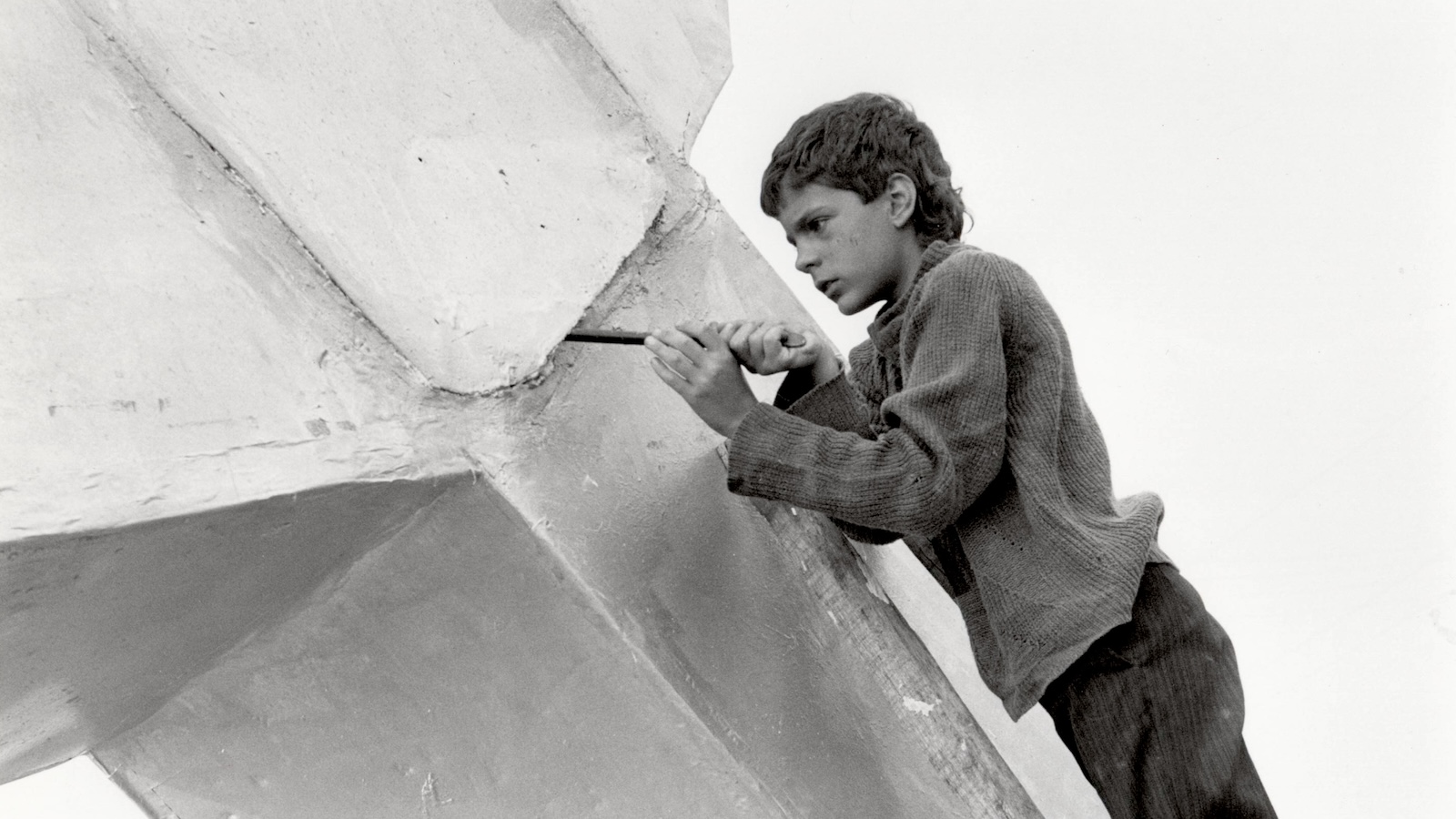
Pylyp Illienko in Swan Lake. The Zone (1989)
SPW: Swan Lake—which you also appear in—it’s really one of the most… uncompromising is an easy word, but it’s just the bleakest movie. It’s very unpleasant and it’s beautiful… it should be on my 1,000 Films list. You never forget the images of the unnamed man [Viktor Solovyov] stuck inside the hammer and sickle structure.
PI: The main Soviet propaganda symbol.
SPW: The reference is very direct. And then inside, it’s just full of trash and misery. And of course, there’s the prison. That was a connection to Parajanov, too, right? Something to do with his prison time?
PI: The film was based on stories Parajanov told my father about his prison time, a number of stories that were not directly connected to each other. But when they were talking, Parajanov told my father that he had to record them and make a film based on them, because he could not go back to that place, even to make a film about it. It would be too painful for him. So, my father wrote a script based on these stories that he was told, and he interconnected them to make a single plot. And he credited Parajanov as the co-author of the script.
Swan Lake. The Zone was filmed in real prisons. In the Soviet Union, they were not called prisons, though, they were called the camps, or the zones. The film was made at a strange time, when the Soviet system was collapsing, and absolutely unbelievable things became real. It would be impossible now to film in a real prison, but in that moment, it was not easy, but they were allowed. They filmed in a few prisons, including one where Parajanov had really spent time. There were people there—some inmates, guards—who remembered him, because not that much time had passed, and it was a strict regime zone, so convicts were sent there for decades.
SPW: These prisons were in Ukraine, or Russia?
PI: It was exactly this region that is now occupied by Russia. The prisons were near Lugansk, and the exterior, the bridge and the railway, is in Severodonetsk, the city that was occupied in spring 2022. It’s facing the river, on the other side of which is Lysychansk, which was also occupied. The fate of this region is terrible… Now, it’s totally wiped off the face of the earth… I remember when the filming took place, I was only 12 or 13. I lived in Soviet Kyiv at that time, and even then, for me it was a very strange experience, a totally different space. Some people looked dangerous. It was not comfortable to walk on the street for a teenager who was not local.
SPW: Right. And this is just a few years after Chernobyl? It’s a heavy movie, but now knowing it’s the same region that is occupied again, I feel like when I next see it it’ll be even heavier.
PI: Yeah, it’s not easy. But who said movies have to be easy? [Laughs]
SPW: Yeah. It’s unforgettable. Like all the films, there’s images you just can’t get out of your head.
PI: So my father showed Parajanov the cut of Swan Lake, the final cut in Tbilisi. The day after the screening, my father came to Parajanov’s house the with a video camera, and brought with him that day’s copy of Pravda, the main newspaper of the Soviet Union. On the front page was an article saying the first Secretary of the Ukrainian Communist Party, Volodymyr Shcherbytsky, had been fired. This was the person who destroyed the Ukrainian Poetic Cinema, who banned the films, and who was personally responsible for Parajanov’s imprisonment. And so when my father came to his house, he turned on the camera, gave him this newspaper, and recorded his reaction to the news about Shcherbytsky. You can watch it on YouTube. It’s gold. He uses a lot of obscene language… [Laughs]
SPW: Okay, it is on YouTube. Wow. Well, I guess we’re out of time but thank you so much for speaking to me, Pylyp, and have a safe trip. I want your father’s films to be distributed hugely. All of them; they’re all full of unique and special moments. Also, the other films in the series, Babylon XX (1979)—
PI: Why do all English speakers call it “X” “X”? It’s 20. It’s Babylon 20.
SPW: Ohhh… I’ve never heard anybody say it out loud, so I just don’t know that, you know?
PI: [Laughs] Trust me, trust me. Because in Cyrillic, we use Latin numbers for the centuries, so “XX” is twenty as in the 20th century.
SPW: It makes sense. Ha, I feel like an idiot right now. But thank you. I’m going to tell everybody on earth to see these films.
Share:
Recommended
- I’m Not Everything I Want to Be
 On Libuše Jarcovjáková, the queer photographer drawn to the social fringes of Soviet Prague.
 - Letters to His Wife
 Translated into English for the first time, a selection of the esteemed Soviet filmmaker’s devastatingly honest and bittersweet letters.
 - Anocha Suwichakornpong
 The two filmmakers discuss exile, the shock of political awakening, and the filmmaking ecosystem of Southeast Asia.