
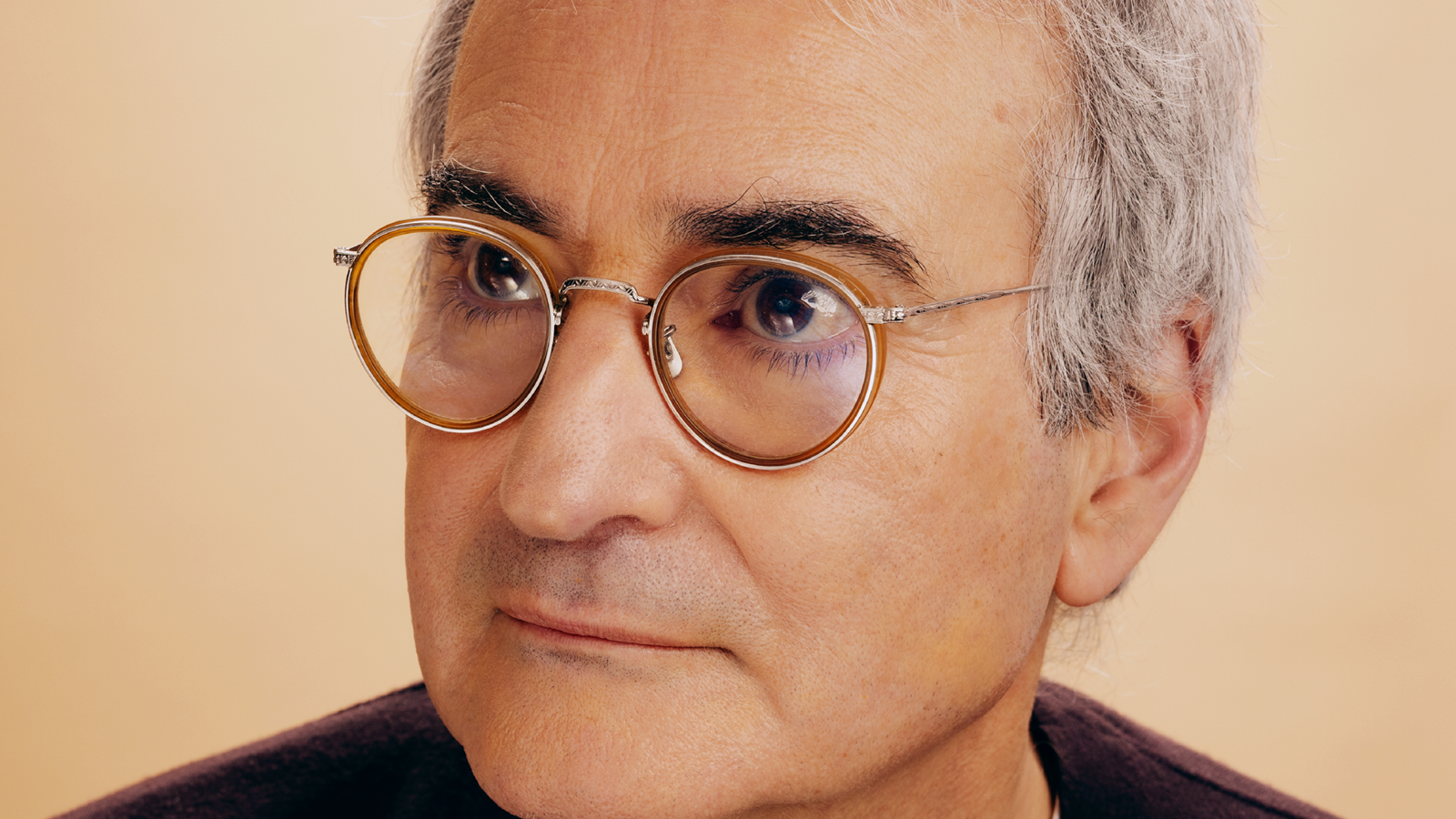
Olivier Assayas, Marie Rouge / Unifrance
Interview
Olivier Assayas
When the titan of contemporary French cinema joined Metrograph to present two films, he took time out to discuss his new, surprise box office success, The Wizard of the Kremlin, and the unpredictable lifespans of his films.
Suspended Time (2024) is currently streaming on Metrograph At Home.
Share:
RARE IS THE VOICE THAT would accuse Olivier Assayas of laziness, but even in the context of a career that has produced dozens of features, numerous documentaries, and an eight-hour HBO series—itself a brilliant rejig of his own film, which is regularly listed among supreme achievements of the 1990s—Assayas is busy. He’s just debuted The Wizard of the Kremlin (2025), which turns Giuliano Da Empoli’s best-selling book into a chronicle of Vladimir Putin’s Russia that’s both hard-edged and pranksterish—the kind of film where Jude Law can do justice to the leader’s ruthless attitude while wearing a cheap-looking wig and making zero attempt at an accent. After proving a bona fide box-office sensation in France, Wizard is expected to release stateside this summer. On the eve of its US premiere, Assayas stopped by Metrograph for a post-screening discussion of Demonlover (2002), his painfully prescient thriller that, nearly 25 years on, still sells out on a chilly Friday night.
Wizard lands shortly after Suspended Time (2024), which premiered at the 74th edition of the Berlinale and waited 18 months to receive what, even for a breezy and effectively plotless foreign-language film, would constitute a limited stateside release. This makes it closer to new-seeming than any two-year-old object in our attention-starved ecosystem, and its streaming appearance on Metrograph At Home doubly welcome. Chronicling a divorced, father-of-one director, his brother, and their girlfriends waiting out the COVID-19 pandemic in a French countryside home, Suspended Time, some may have begun to suspect, is the closest Assayas has come to cine-memoir, down to his first-person voiceover that creates a strange, stirring conflict with Vincent Macaigne’s character who, like the other directorial analogue he played in 2022’s Irma Vep update, mirrors his author’s life in just about everything but name.
Mere hours after his New York arrival, Assayas and I sat in Metrograph’s Commissary restaurant. Ever the engaged subject, jet lag or no, he hopscotched from discussing some of his oldest and rarest films to the newest of new, between which came musings on his place as a French cultural purveyor constantly trying to escape, rethink, and transcend influences. —Nick Newman
NICK NEWMAN: We’re here in the Metrograph Commissary while Demonlover is playing downstairs. And it’s a sold-out screening.
OLIVIER ASSAYAS: That’s really cool. The last time I attended a screening of Demonlover it was at BAM and it was also a full house. Movies have a life of their own. I’m always happy, it reminds me that they’re around, lingering.
NN: So many of your films have endured on home video and in the repertory world. Do you have a concern for their lifespans, or do you tend to let them go once they’re done?
OA: Oh yes! I am extremely concerned with making sure the prints stay available. I was involved in the restoration of Cold Water (1994), which had to migrate to digital. I love the process, I have to say.
Often films are owned by people who don’t care about them, so they will not be involved in the restoration. Sometimes you have to wait until they agree to let you revive the film. That happened with [producer] Bruno Pésery and a few of my early films, like Paris Awakens (1991) and A New Life (1993), movies that were completely out of reach for decades. It was really painful, because it was a struggle. I could go on and on. Bottom line: yes, I am involved in the preservation of my films. And I think that all filmmakers should be, because now everything is on shaky legal grounds: maybe they don’t have the rights to license the pop songs, or some writer’s rights have not been renewed. All of a sudden, movies get stuck in limbo.

Demonlover (2002)
NN: I actually programmed the US premieres of the Paris Awakens and A New Life restorations at BAM last year. They were the last of your films I hadn’t seen, and doing so in a theater—with people coming out in a similar interest—was such a great night.
OA: I’m very happy. I had a complex relationship with A New Life; it was 180 minutes long and I had a horrible relationship with the producer, and ultimately I had to cut the film. Even worse, when we were shooting—I will never know why—he decided we were not going to shoot the last week of the film. “What do you mean we’re not shooting the last week?” And we had pushed back all the more important, spectacular visual scenes, so there are really important elements missing.
NN: The word “elliptical” gets used a lot; I think sometimes critics say it to describe a movie where they don’t quite understand the plot. But A New Life has something that truly feels elliptical in its elisions and fades to black. It worked a spell on me.
OA: I mean, I was happy [watching the restored version] because I had forgotten about the missing scenes. It was like the first time I could watch the film in peace. I was not haunted by the missing elements; I could accept the film, and assess the film as it is…I’d never had that opportunity before. But the disappointment came from the fact that I had kept the [additional] two reels of material that we shot from the film. They were on separate reels. My editor [Luc Barnier] and I, we kept them stored in a lab knowing one day we would manage to re-edit the film and have the long version. But then, when all of a sudden the long version became possible, we didn’t have the positive print. I don’t know how, but it got lost. We didn’t find the sound, so we only have the image, and the image is not cut right, it’s not in the right order… I’ll spare you the technical process. But bottom line: we could not save it.
NN: Speaking about preserving movies, Suspended Time is a movie that also had a weird lifespan: it premiered in early 2024, came out here summer ’25, and now it’s on the Metrograph At Home streaming service. I love the film. It’s a great hangout movie. But it’s your one movie in a while that I didn’t get to see in the theater. I wonder how you feel about that scenario, experience-wise.
OA: I made the film for myself. I knew I could sell [the project] to my producer Olivier Delbosc. You know, “Okay, we’re doing The Wizard of the Kremlin, but before that, there’s this tiny project I really want to do.” And he bought it. I knew I was working within a narrow framework. It has to do with my mother; it has to do with my parents; my relationship with my brother; it has to do with memories. It connects more with my books—with A Post-May Adolescence—than with my movies. It connects also with the book I’m publishing now on my relationship to painting.
As a teenager I was a visual artist. Between the age of 15 and until I was in my mid-twenties, when I started making short films, I couldn’t imagine life without painting, but gradually it faded. I stopped painting in something like 1980. So I wrote this essay, which also has to do with my relationship with my grandfather, who was a famous Hungarian painter, and ultimately, it was more interesting than what I had imagined. It’s more diverse than I remembered—stuff that had been buried since the 1980s, which I had never really looked into since I put it in a chest of drawers and forgot about it. Suspended Time has a dialogue with that book.
NN: I’m excited to read it.
OA: And it’s a movement of trying to escape the darkness. It’s like in my movies, it’s trying to go towards the light, which, again, is something at work in Suspended Time.

Suspended Time (2024)
NN: Your brother Michka, who’s dramatized in Suspended Time [as Micha Lescot’s character Etienne], is a great rock historian. I remember you once told me that he has this theory: a good band has one song, a great band has two songs, and the best bands have three songs. And I feel like you have more than two songs, really, but Suspended Time kind of feels like you found a new song.
OA: Yeah, yeah, yeah.
NN: Like I said: it’s a hangout movie. Plus the autobiography with you giving this first-person voiceover. As a fan of yours, it’s just very exciting.
OA: To me, it’s been an important film, and I see myself potentially doing a sequel. There are movies I have been toying with the idea of expanding… I almost have a screenplay for Something in the Air 2.
NN: Really?
OA: The Punk Rock Years.
NN: Will it be the same cast?
OA: No, it can’t be because it’s too long ago. If I do make it, it won’t be my next film, it will be the one after. But I could also make Suspended Time 2.
NN: Another thing I love about Suspended Time is that everybody’s COVID experience was different, but I find that the more you talk about them, you realize so many things were shared between people.
OA: I wrote it in a week, Suspended Time. Sitting in the garden, in the house where we shot it, at the end of the lockdown, when everything was fresh. I had a clear memory about what was said, and what we did and did not do. And then when I was shooting the film, I was surprised by how much I had forgotten about the period. So I was happy I captured it; I had a trace that was true to life. And the project was to go as far as I could in the imitation of real life. Something that was important for me in the process is that I just did not want Summer Hours (2008) to be the representation of the ambience in which I grew up. Because it is not, it’s a fantasized version. Whereas Suspended Time is the real thing.
NN: Per the simulation of reality, the film was giving me strong memories of 2020. I love the detail that this character is fixated on old silent films and Sacha Guitry comedies. I know that I and a lot of others found comfort returning to specific artists at that time. It got me thinking how COVID really changed my film-viewing habits, where—I hate to say it when I’m in a movie theater—even after the theaters reopened, I just got so used to watching movies at home.
OA: Yeah. I go less to the movies, and I’ve been exploring film history more. But what really changed my viewing habits is that I had a baby after the pandemic. I have a daughter who is four and a half years old now. Before that, when my wife was pregnant, at the end of the lockdown period, I had this obsession with John Ford and I think I gathered everything that’s available by John Ford. I became completely obsessed with the genius of Ford. And it confirmed something, an idea that I have always had. I don’t know how to verbalize it well, but… something has deeply changed in American filmmaking. For a long time, the ideal of filmmaking was the work of John Ford. He was the ultimate great American filmmaker. At some point it became Alfred Hitchcock, who’s not American, but ultimately he became the reference point. And as much as I’m a Hitchcock nut, I don’t think that the substitution was a good thing for American filmmaking.
Because there is something artificial in Hitchcock. In the sense that Hitchcock is Mondrian, you know, whereas John Ford is more like Jean Renoir. On one side you have life, you have humanity, and on the other side you have something very cerebral and very technical and extremely controlled, and the warmth, the politics, also, of John Ford is something that has really been missing in American filmmaking. It’s faded because it’s not industrialized. Even if John Ford was the epitome of the industry filmmaker, he was always alien to the industry. He was an outlaw. Which is all to say yes, my viewing habits have changed because I got into this process. For the last two or three years, I have been watching much more stuff on my big screen at home.
NN: Have you ever used Plex? Do you know what that is?
OA: No.
NN: Basically it’s a way where you set up a server, or a friend of yours sets up a server, with all the films they have on their hard drive… And you can stream it straight to your own TV. That completely changed how I watch movies because suddenly it was, like, an entire history of Indian cinema is now streaming. It’s really amazing.
OA: So like, you have Guru Dutt?
NN: Yeah. And Mani Kaul, whom I know you admire.
OA: Mani Kaul… I met him, I liked him very much. I wrote about his movie Arising from the Surface (1980) after I saw it at Cannes. He’s a great filmmaker.
NN: I have Duvidha (1973) on my Sight and Sound list. That was an early COVID movie for me. That’s the kind of high that you chase as a film-viewer. That first contact with something extraterrestrial but also—like Ford—it’s earthbound, elemental. Anyway, enough about that. It’s just coming to mind.
OA: There’s a lot of stuff that I really admire in the history of Indian filmmaking. Adoor Gopalakrishnan, I like very much.
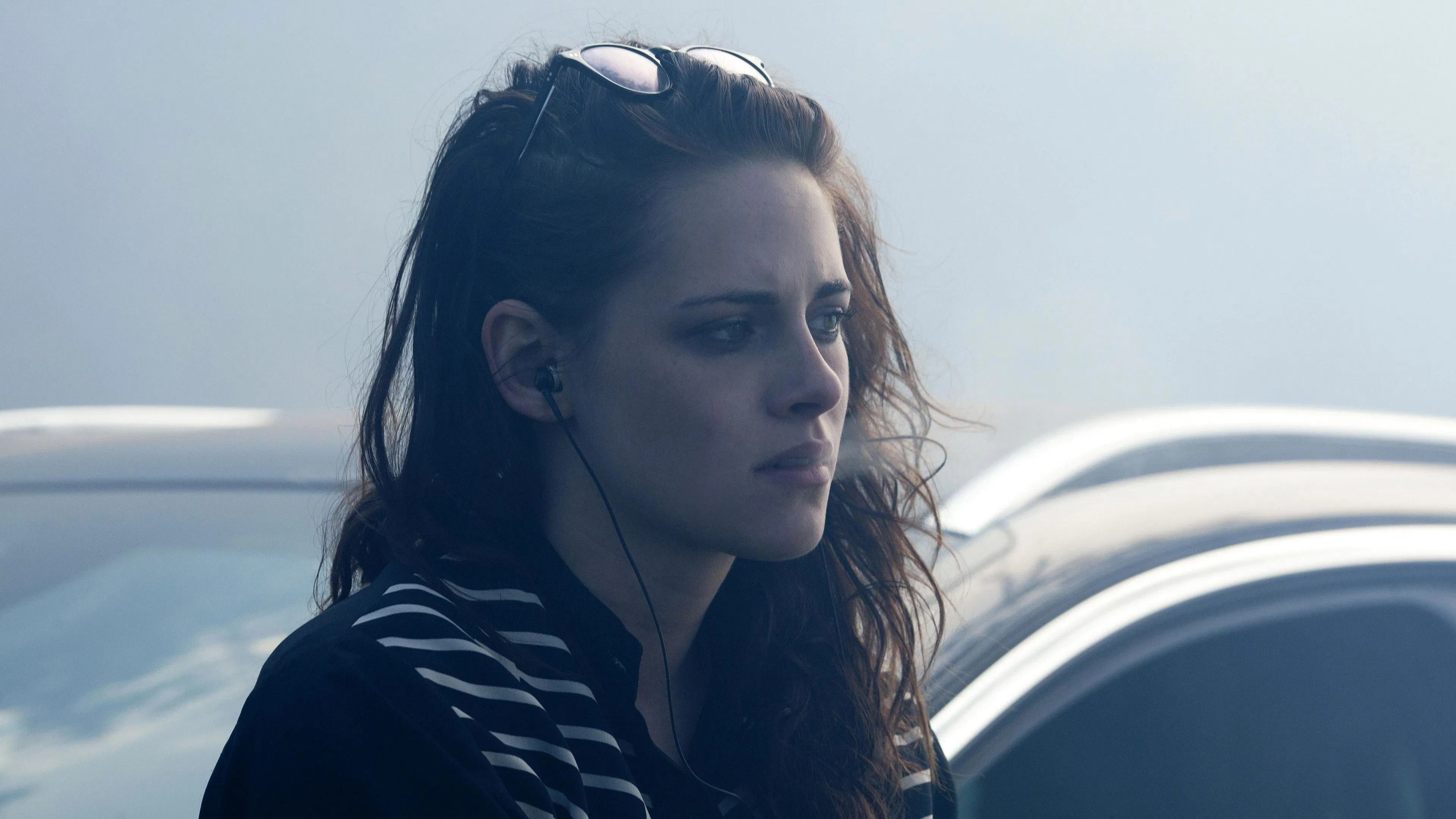
Clouds of Sils Maria (2014)
NN: Well, for me in America, you are this window into French culture, French cinema, French lifestyle. One of the things I love about Suspended Time is that I can kind of pretend to live in that house for 90 minutes in the French countryside, right? And I hold you as one of the great filmmakers in the world, but especially one of the great filmmakers of France. I wonder how you feel about the French film industry—if you feel connected to it still, or somehow outside of it?
OA: I’m completely schizophrenic. It’s complicated because my father is Jewish-Italian. Family from Thessaloniki. And my mother is Hungarian and Austrian. So there’s zero French blood. But in terms of my culture: my culture is 100% French. Even if I grew up doing everything I could to escape it. You know, I hated French pop songs. Anything that was not the British underground was despicable. The music, counterculture, free press, all that stuff was my way of escaping what was, to me, a little bit too much of a burden in my French culture… I think I’m divided. I never cracked that one. Really. Yes, I am deeply immersed in French culture; I’m defined by French culture, French Impressionist painting, medieval poetry, you name it—Balzac, Baudelaire, and of course the Nouvelle Vague—it’s the culture that made me whatever I am. But for some reason I can’t genuinely feel I’m completely part of it. I need that, but on top of it I need to have something else that is an opening onto the rest of the world. If you speak with Claire Denis, she’s a little like me in that sense; I think that it’s also one of the reasons I feel so close to her and to her work. She’s very French, but she grew up in Africa, and her sense of the world took shape in Africa more than in France, but she’s a pure product of French art and French modern culture.
NN: I feel similarly being an American: you can’t not have at least one foot in the door, but I’m also constantly trying to escape it. Your films have been a window for me in that way. While we have time, I want to ask about The Wizard of the Kremlin, which I got to see two weeks ago and had a lot of fun with. When we last spoke, you were about to premiere it and said that, like always, you were very nervous. You said, “This movie’s long, it has a lot of voiceover, I’m wondering how it’s going to go.” Now that it’s premiered: how are you feeling about the film?
OA: Well, I have a bona fide hit movie [in France]. It never happened to me before. The one [period] movie I made before, Les Destinées sentimentales (2000), did 500,000 admissions [in France], which is a lot, because it was a three-hour movie. But it was hugely, absurdly expensive, and so it wasn’t enough…. But with this one, we are in the 700,000 [admissions] range, and it cost much less than Les Destinées. Mostly because we shot within Latvia, which was a substantial savings.
It’s not like I was hugely surprised, but I never felt I was on safe ground. At the same time, I thought the film had the right energy, and the book it’s based on was extremely successful.. The film is very different from the book but there’s something in the way that the story is told, which I use, they have the core. And the core is something that, for one reason or another, has connected with audiences. Because it teaches you things, it explains in an entertaining way how the inner workings of politics function. Which is something movies don’t do that often. You have a lot of social films—cinema knows how to do that, how to produce social films. It’s a genre. Whereas making movies about politics is a completely different animal. It allowed me to try things that had never really been done or not that much.
NN: It’s also not a pedagogical film, but I feel I learned something watching it.
OA: Yeah… there’s nothing didactic about it because I wouldn’t know how to do that. But I think it shows things from a different angle. Which is an idea I’ve always been obsessed with. What excites me in filmmaking is when I feel I’m changing perspective. That’s why I make movies that are diverse, because I need to move on, to change the angle.

The Taking of Power by Louis XIV (1966)
NN: It’s funny: I wrote down the word “kitschy” to describe Paul Dano in the flashback sequences… it’s you dressing him up to look like a young man, but we also know that it’s him now. Or the Larry King sequence, which made me laugh very hard. Later, a character says that kitsch is the only language available to us if we want to communicate that to the masses. And I love that as not exactly a mission statement for the movie, because I don’t know how kitschy it’s trying to be, but trying to figure that out was fun.
OA: That comes straight from Giuliano Da Empoli’s novel. He’s explaining how the Russian state, at that point, is using the Olympic Games as a propaganda tool. And propaganda has to be kitsch. It has to do with manipulation, it has to do with things that are not new because they have always been that way. Here at Metrograph, after Demonlover tonight, I am introducing Rossellini’s The Taking of Power by Louis XIV (1966). The politics of Louis XIV, the aesthetics of Louis XIV, are nothing if not kitsch. If you want to connect with the masses, it’s not through sophisticated art. It’s through something grand, heavy-handed, flashy—which is everything, ultimately, I’ve been trying to avoid in filmmaking. It’s all that I dislike in art. But, there is some truth.
NN: Yeah. Any time the movie embraces a version of that, or exemplifies it, it’s effective. And very entertaining. I know that when The Wizard of the Kremlin premiered, it was 156 minutes; the version I watched was around 145; and in the US, the theatrical release is going to be 135 minutes. It reminds me of Wasp Network (2019), a movie you also edited after its festival premiere.
OA: The film had to be ready for Venice last year. So I really had to edit very, very fast. The deal was always: finish a version for Venice, and after Venice I would have two weeks where I could fix whatever I needed to fix. I was happy with the Venice version, but I always knew it was too long for my taste. The version released in France and all the other territories is my version. And then for some reason, the American distributor wanted a version that was 10 minutes shorter. So Gaumont sold the film to the US based on the fact that I would agree to cut 10 more minutes. I was not happy with that; I agreed, but it’s not a version I’m happy with. I think it works, but there’s stuff missing… it’s not exactly my film.
NN: Last thing I’ll ask. This restaurant has cocktails named after movies. What movie of yours would make the best cocktail, and what do you think would be in it? The Wizard of the Kremlin could be a vodka-based drink, obviously .
OA: [pause] Wasp Network Mojito.
NN: Great.
OA: I have this love-hate relationship with my art director [François-Renaud Labarthe]. He has been the set designer since my first feature, so we go way back. And I was making fun of him because I think he had a hard time functioning with the Cubans and in Cuba [during the making of Wasp Network]. But the reason was the $2 mojito. The problem started on just us, and it fucked up all the construction crew and set department. They were hooked on the $2 mojito.
NN: That’s crazy. A terrible idea. Maybe cocktails cost $20 for a reason. Anyway, thank you.
OA: Thanks to you. It was a pleasure.
Share:
Recommended
- Igor Bezinović
 The director discusses Fiume o morte!, his anachronistic recreation of the birth of Fascism.
 - Gong Li
 On the enduring eloquence of the timeless actress.
 - Allegro non troppo
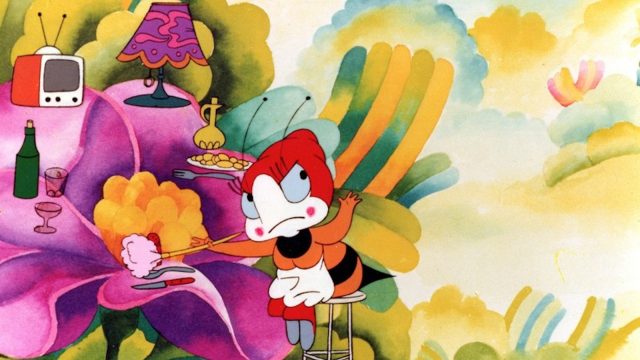 On Italy’s lurid riposte to Fantasia.