
From the Magazine
I’ll Be Your Mirror: Kim Novak
The Vertigo-like resurrection of Kim Novak as a Factory Superstar.
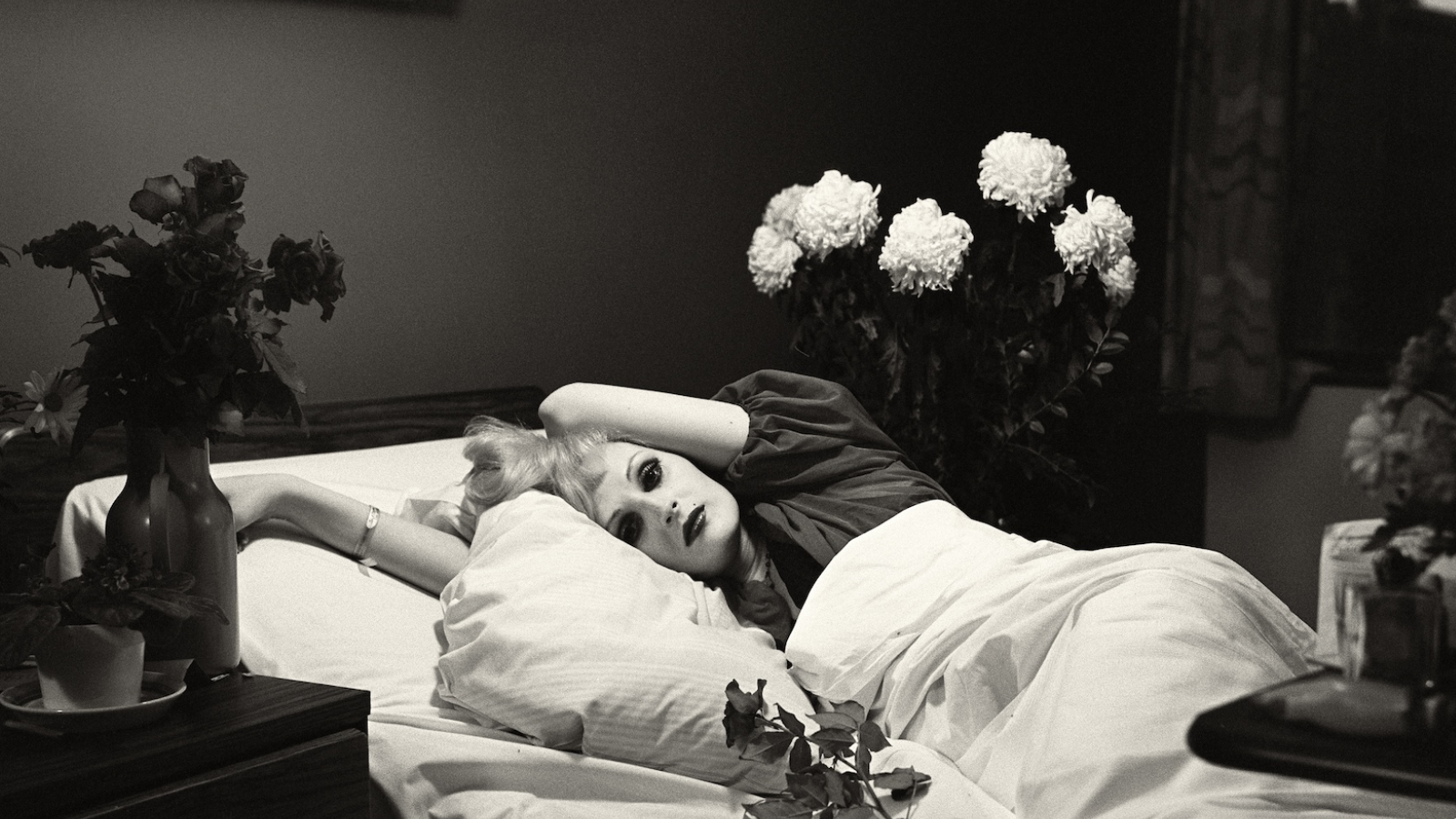
Candy Darling on her Deathbed, 1973, Peter Hujar. ©2025 The Peter Hujar Archive/Artists Rights Society (ARS), New York
Share:
This essay appears in Issue 1 of The Metrograph, our award-winning print publication. Explore more of Issue 1 and newer editions here.
IT MAKES TOTAL SENSE THAT Kim Novak was Candy Darling’s favorite actress. The Warhol superstar chose her own name—immortalized on wax by the Velvet Underground and the Rolling Stones—and by most accounts had plenty to work with as a performer during a period when Hollywood, the world she worshipped, was not open to trans brilliance. Born in Queens and raised in Massapequa Park, Long Island, Candy traipsed around the New York City of the late 1960s and early 1970s embodying the glamour of the film industry’s Golden Age. She was a beauty with teeth that needed fixing, with nothing much to smile about in her short life anyway. She attained the status of cult legend, posing for Richard Avedon and collaborating with Tennessee Williams before dying from lymphoma at the age of 29 in 1974. Though she appeared in films such as Paul Morrissey’s Flesh (1968) and Werner Schroeter’s The Death of Maria Malibran (1972), it is in still images, particularly the famous Peter Hujar photograph Candy Darling on Her Deathbed, that the underground icon remains as arresting as any great goddess of the silver screen.
Kim’s name at birth was Marilyn. In 1954, her studio Svengali, the co-founder of Columbia Pictures Harry Cohn, had her change it, then lighten her hair and go on a diet. (Four years later, Novak’s iconic role in Hitchcock’s Vertigo, that of a character who alters both her name and look, would mirror the actress’s own loss of self-identity.) In the late 1940s, Cohn had notoriously chosen not to renew the six-month Columbia contract of a certain Marilyn Monroe, née Norma Jeane Mortenson, which resulted in her signing with Fox and becoming a major star. Novak was regarded by Cohn as a potential competitor for his lost pin-up, but she obviously couldn’t keep her birth name. Incidentally, they settled on “Kim” thanks to a different Norma: Novak’s first business manager, Norma Herbert, had a son called Kim. Herbert had discovered a young Novak in an Illinois department store and sent her off to California to model refrigerators as “Miss Deepfreeze.” Maybe Candy knew this chilling factoid. According to Cynthia Carr’s excellent recent biography Candy Darling: Dreamer, Icon, Superstar, Candy said admiringly of Novak: “There was always something frozen about her. She had to squeeeeeeeze it all out. She was so scared and that’s the way I was all my life. Everyone always told me I was beautiful but I felt frozen, just like Kim. There was always something wrong with her, something… slightly… unacceptable.”
Not icy exactly but frozen—or else thawing out by a fire soaking wet, arousing a suitor and suspicion. Novak acted this precise scenario out in two films, most famously as Madeleine in Vertigo after being fished out of San Francisco Bay following an apparent suicide attempt. An infatuated newly retired detective, Scottie—played by Jimmy Stewart, Novak’s favorite co-star—dries her things and lends her his classic red robe (designed by Edith Head). She comes to, opening her piercing green eyes to the surroundings of his bachelor apartment, aware that he is decent for not taking advantage of the situation; all the while she is in control. Seemingly subdued when he leaves her by the hearth to take a call, she seizes the moment to bolt from his home. In Hitchcock/Truffaut, François Truffaut’s book-length questionnaire with Hitchcock from the ’60s, the two directors considered this fireside scene a vital element of the contemplative atmosphere that distinguishes Vertigo from Hitchcock’s other movies. Regarding Novak, about whom Hitchcock expressed doubts in this interview and elsewhere, Truffaut said, “I thought she was perfect for the picture. There was a passive, animal quality about her that was exactly right for the part. … I can assure you that those who admire Vertigo like Kim Novak in it.”
The actress would make reclining by the fire with damp hair look anything but cozy for a second time in Richard Quine’s 1962 film The Notorious Landlady, in which she plays a suspected murderess letting a room to an infatuated diplomat (Jack Lemmon). It was the last and perhaps the least successful of Novak’s collaborations with Quine, the director of her first screen test and her fiancé for a time, and she unfairly took the brunt of the criticism. Bosley Crowther of The New York Times hung the failures of the picture on her shoulders, draped as they were in gowns she’d designed herself: “If Miss Novak were something of an actress, it might be an almost ‘Hitchcock film.’” There is nothing remotely Hitchcockian about the movie. If there’s a Quine-Novak linkup worthy of the comparison, it’s Pushover, her 1954 debut, a good noir she’s good in. With its setup of a stakeout observed through city apartment windows, it echoes Rear Window, released the same year. Like Quine and Novak’s other collaborations, 1958’s occult classic Bell, Book and Candle and 1960’s suburban melodrama Strangers When We Meet, Pushover is essential to watch in order to take the full measure of her strange onscreen presence.
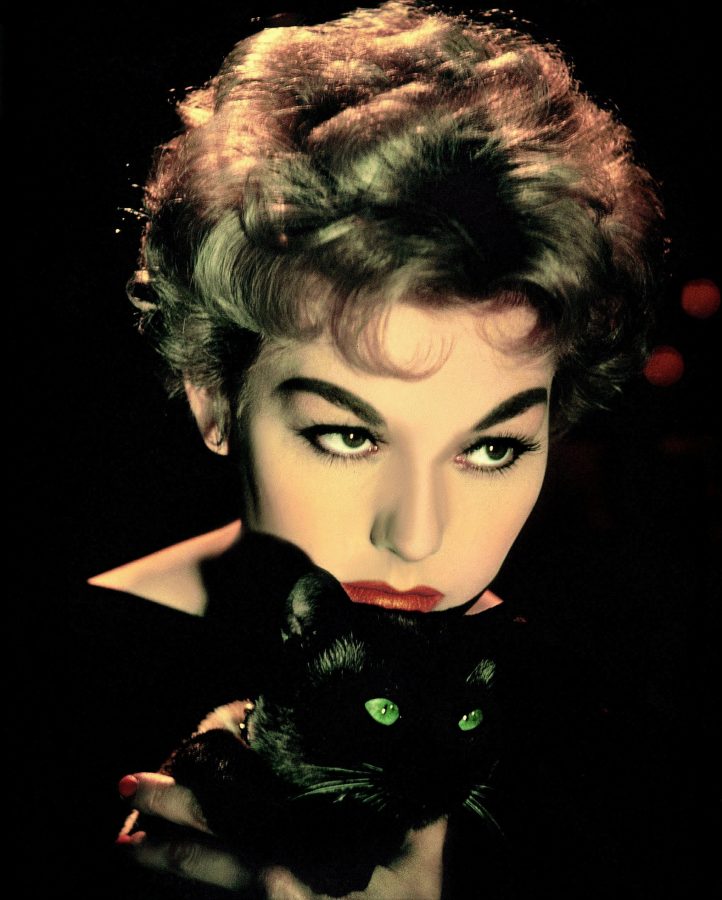
Bell, Book, and Candle (1958)
Novak also acted opposite Felicia Farr, Mrs. Jack Lemmon, in 1964’s sex comedy Kiss Me, Stupid, directed by Billy Wilder. In the film, considered unfunny at the time and littered with jokes both poorly delivered and now dated, Farr plays a jealous piano teacher’s lovely and understanding wife. Novak appears as a run-down cocktail waitress named Polly the Pistol who lives in a trailer behind the Belly Button, a joint whose roadside sign invites its denizens to “drop in and get lost.” She has no car to hitch her trailer to, no means of escape from this dusty Nevada town, whose decency-minded residents are organizing a campaign to have her workplace shuttered. (The film itself was condemned by the Roman Catholic organization the National Legion of Decency.) Joan Didion was the lone critic who saw the film’s merits at the time, writing for Vogue, “The Wilder world is one seen at dawn through a hangover, a world of cheap double entendre and stale smoke and drinks in which the ice has melted: the true country of despair. Kiss Me, Stupid is, in fact, suffused with the despair of an America many of us prefer not to know.” The problem, she insisted, was that they had played it as comedy.
Kiss Me, Stupid was a satire of the thuggery inherent to Hollywood, the American ecosystem that had made Novak into a household name during the ’50s with films such as Picnic (1955) and Jeanne Eagels (1957)—to name a couple of Candy’s favorites. She watched from home in Queens as Novak portrayed beauty queens in each of these indelible roles. In Picnic, Novak plays Madge, a pretty girl working at a dime store in small-town Jim Crow–era Kansas, encouraged by her mother to put out for her rich suitor following the Labor Day picnic. At the event, Madge gets crowned “Queen of Neewollah” (“Halloween” spelled backward) and floats down the Little Arkansas River in a swan boat while she clings to a bouquet of red roses. (The film’s director, Joshua Logan, said Novak wore her beauty “like a crown of thorns.”) In the end, Madge pledges loyalty to the proletariat in both body and soul, a move Novak performs with a dreamy innocence.
In the title role of the biopic Jeanne Eagels, Novak plays a Kansas City waitress whose sights are set much higher—a dream all the more dangerous. She ruthlessly becomes a generation-defining stage and silent-movie star with a heroin habit. We watch as she steals a script from a washed-up actress, taking the role of a prostitute in a stage production of William Somerset Maugham’s short story “Rain” for herself. (Life would imitate art: Novak went on to play a working girl in a film adaptation of Maugham’s Of Human Bondage in 1964.) What beggars belief in Jeanne Eagels is Novak as diva; there is always something guileless about her that shines through. Her 1920s-inspired looks in the second half of the film—bright blonde hair, heavy black eye makeup, super thin brows—served as clear inspiration for Candy’s final form. Here Novak, in her relatable wrongness, represents the zenith of the studio system while heralding its subversion—an idea that would manifest eventually in the shape of the future Warhol star.
One is not born, but rather becomes, a blonde bombshell. In the later 20th century, a postwar moment of Fordist consumerism coincided with the final elevation to whiteness of a number of previously white-adjacent ethnicities. Novak, born to second-generation Czech immigrants, went to California to sell fridges, the ultimate consumerist integration. Novak’s bottle-blonde hair was an accidental surrender to enduring Aryan beauty standards—Eugène Schueller, the founder of L’Oréal and the chemist responsible for synthetic hair colorant, that 20th-century invention and consumer staple, was a Nazi sympathizer. Novak’s Columbia Pictures–appointed publicist, Muriel Roberts, arranged for her to go lavender blonde to set her apart from the platinum-haired actresses the studio had worked with, including Monroe. The studio’s control over Novak’s desirability extended to determining whom she could publicly love, made apparent especially when she stumbled across the color line. Allegedly, Cohn ordered a mob hit on her paramour Sammy Davis Jr., which resulted in a huge scandal and his contractual marriage to the Black singer Loray White. Onscreen she was deemed fit to play the love object of the blue-eyed Frank Sinatra, Davis’s fellow Rat Packer, as she did in Otto Preminger’s The Man with the Golden Arm (1955) and George Sidney’s Pal Joey (1957).
In 2018, the poet and artist Claudia Rankine and the photographer John Lucas collaborated on an exhibition at Brooklyn’s Pioneer Works called Stamped, about blondeness, inspired by the lead-up to the 2016 election. The artists had observed a common trend of fair hair among women of the Republican Party and anchorwomen of major news networks at that time. For the show, photographs Rankine and Lucas had captured of blonde hairdos were adjusted to the size of postage stamps. An ad for Clairol dye was included in the exhibition’s audio track. Rankine told Vogue about vox pop interviews she and Lucas had conducted for the project: “Many people said they didn’t really think about blonde-ness connected to whiteness, which is hard to believe. They are in dialogue with a hair color that has been used by the world to suggest whiteness, to suggest privilege, to suggest desirability, beauty.” She cited, “the Doris Days and Marilyn Monroes and the Hitchcock heroines that films have presented us all along.” An ongoing dialogue with diminishing returns. In fact, a certain Hitchcock heroine was mocked by the future president Donald Trump in 2014 for her appearance at that year’s Oscars. Novak, who was 81 at the time, presented at the ceremony with her still-blonde hair cut into a bob. Subject to a deluge of internet comments on the topic of aging naturally, the star, who had recently undergone some cosmetic work, was compared with photographs of her younger, studio-primped self.
In her review of the Paddy Chayefsky–penned Network (1976), the critic Pauline Kael wrote for The New Yorker, “A beautiful woman who’s as self-conscious as Faye Dunaway has a special neurotic magnetism. (The far less proficient Kim Novak had it also.)” Novak’s talent was already being written about in the past tense, as she had all but left Hollywood, relocating to Big Sur after a mudslide wiped out her home and her life’s savings, and choosing to focus on the visual arts. Novak had starred in 1959’s Middle of the Night, also written by Chayefsky, in which she plays a callow receptionist to Fredric March’s world-weary, widowed garment businessman. Initially mounted onstage by the Picnic director Logan, with Gena Rowlands originating the role of the secretary opposite Edward G. Robinson, the Delbert Mann–directed film version is a poignant depiction of a May-September romance. On my first watch, years ago, all I could see were Novak’s crack-ups—her skittishness, how she barrels through all of her monologues, all the ways she gets in her own way. The more I rewatch her acting, though, the more I see her intelligence. By her own account, her performances are a public record of untreated manic depression. In a 2013 interview with the late Turner Classic Movies host Robert Osborne, Novak said: “I lived through the characters. And if they were fine, I was fine.”

Share:
Recommended
- Material Memories
 The ongoing effort to bring African film heritage home.
 - Minor Indignities in Moviegoing
 The two friends swap stories about their weird and wonderful experiences at the cinema.
 - Limelight: Ann Hui
 On the long, tenacious career and lyrical films of the cinematic poet laureate of Hong Kong.