
From the Magazine
RidicuLists: Bugs Bunny Paternity Test
The much-disputed question of Bugs Bunny’s true parentage.
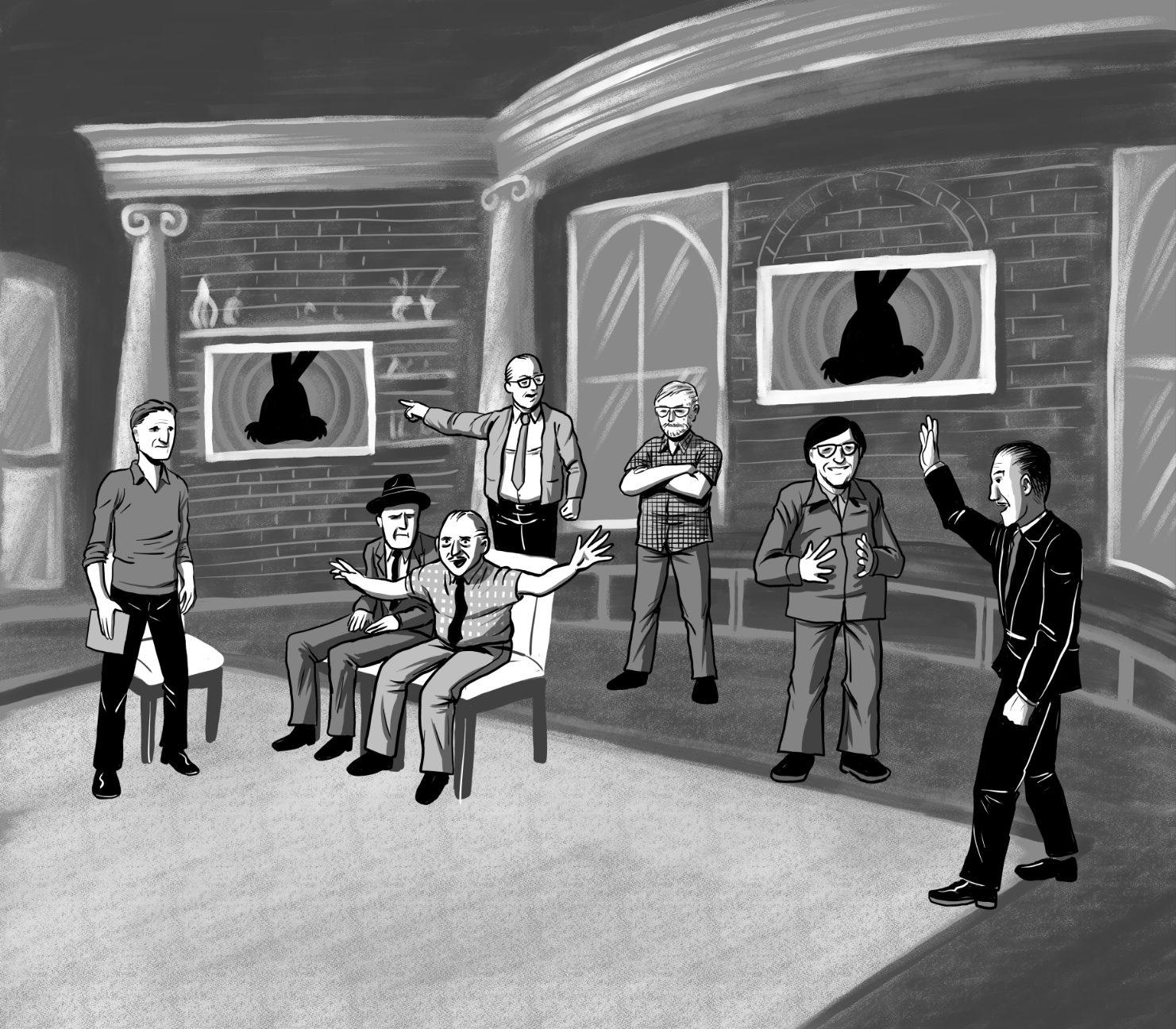
All artwork by Marc J. Palm
Share:
This essay appears in Issue 1 of The Metrograph, our award-winning print publication. Explore more of Issue 1 and newer editions here.
HERE’S WHAT WE KNOW FOR sure about the childhood of Bugs Bunny, one of Hollywood’s most enduring stars. We know his place of birth: “Termite Terrace,” the nickname given to the in-house studio at Warner Bros. Pictures that produced animated short subjects founded in 1930 (his accent suggests he might have spent some formative years in the greater New York area, but we have no official confirmation of this). We also know he claims to be 84 years old, although I’ve seen documentation to suggest he’s actually 86 (shaving off two years… typical showbiz vanity). We know his godfather was Leon Schlesinger, the head of the studio until 1944, a “hands-off” bean counter who was content to mostly stay in his office and collect Academy Award nominations.
We also know that Bugs Bunny was not born by accident. Recurring characters were the lifeblood of Hollywood cartoon studios, and after nearly a decade living in the shadow of Walt Disney and Max Fleischer, Schlesinger wanted a star of his own to compete with Mickey Mouse and Popeye. The Warner animation directors had scored modest success with Bosko, Porky Pig, and Daffy Duck, but collectively they decided their breakthrough icon would be a rabbit. Between 1938 and 1940, “several different directors took a crack at this rabbit character, and he evolved rapidly as those directors tried to figure him out,” writes Jaime Weinman in his 2021 book Anvils, Mallets & Dynamite: The Unauthorized Biography of Looney Tunes. “The result was a character much more popular and versatile than he might have been under only one director.”
So one thing we don’t know about Bugs: the identity of his father. Over the years, many have claimed paternity, but because he’s an animated character, a DNA test has always been difficult to perform. Nevertheless, after feeding some gray acrylic paint through a DNA machine, we found the names of dozens, possibly even hundreds, of animators, voice artists, directors, writers, publicists, and studio executives in Bugs Bunny’s bloodstream. Of these, six appear most prominently, all of whom can stake some claim to being Bugs Bunny’s true biological father.

Who: storyboard artist, animator, gagman, journeyman cartoon director.
The Case for Paternity: Ben Hardaway’s two-year stint as a director at Termite Terrace came when his boss Friz Freleng moved—briefly—to MGM. When Freleng reclaimed his unit, Hardaway was demoted back to writer and gagman. But don’t cry for Hardaway: between the lucky beginning and ignominious end of his directorial career, his workmanlike output included Porky’s Hare Hunt (1938), the first cartoon to feature the rabbit who would eventually become Bugs Bunny.
The protagonist is a rabbit, and he even says what would become one of his catchphrases: “Of course you know this means war!” (a reference, Weinman notes, to Groucho Marx, who utters the same line in 1935’s A Night at the Opera). A year after Porky’s Hare Hunt, Hardaway would get one more crack in Hare-um Scare-um, the first cartoon in which Bugs is depicted as gray instead of white, engages in cross-dressing, and is referred to as “Bugs Bunny” in its marketing (though not in the film itself). When another Warner artist, Charles Thorson, drew a revised version of Hardaway’s model sheet for the rabbit, he titled it “Bugs’s Bunny”—a reference to Hardaway’s nickname, “Bugs.” If that possessive credit was good enough for the animators at Termite Terrace, it should count for something in this DNA test.
The Case against Paternity: If we were to boil the previous two paragraphs down to one important word, it would be “eventually.” Porky’s Hare Hunt is a semi-sequel to Tex Avery’s Porky’s Duck Hunt (1937), the cartoon that gave the world Daffy Duck. Hardaway’s proto-Bugs is little more than Daffy in a rabbit suit; you would not recognize him on the street.
Paternity-o-Meter:

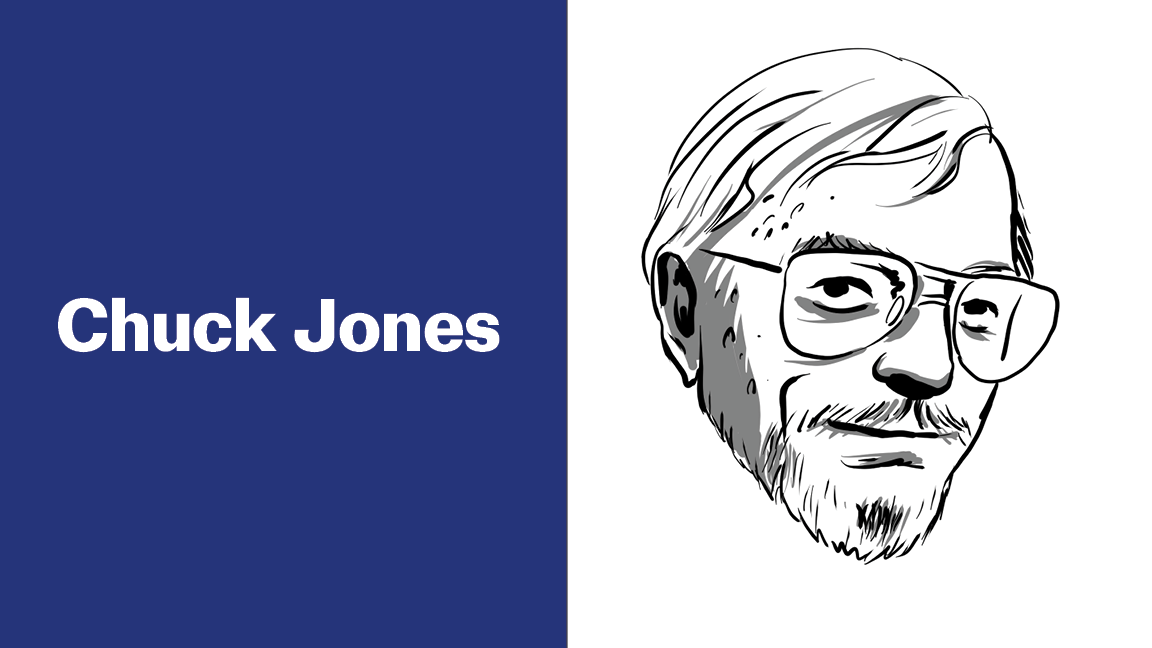
Who: the most famous animation director of all time.
The Case against Paternity: As the last survivor of Termite Terrace’s core team of directors (he died in 2002 at age 89), Chuck Jones was in a position not only to absorb all the love for the studio’s work but also to shape animation history to center his own contribution. Through the ’80s and ’90s he gave many interviews, accepted a lifetime achievement Oscar, wrote a memoir, and oversaw a cottage industry of merchandise and TV specials. The Bugs design that appears in Space Jam (1996) and TV’s Tiny Toon Adventures (1990-1992) is based on Jones’s model. In an appearance on Norm Macdonald Live in 2017, Jim Carrey told the host, “Every once in a while, somebody you really admire hates your guts,” citing Jones, “the creator of Bugs Bunny,” as a particularly wounding example. Not a bad legacy for someone who was a decidedly B-tier Termite Terrace director when Bugs was first emerging from the primordial ooze. Jones, specializing in cutesy cartoons obviously indebted to the Disney model, did not direct A Wild Hare (1940)—the cartoon most commonly cited as Bugs’s first appearance—and was far from a master of the violent, sharply funny comic style we now associate with the “Looney Tunes.”
The Case for Paternity: During Bugs’s gestation, Jones directed two cartoons pre–A Wild Hare that give him a legitimate claim to paternity: Prest-O Change-O (1939), the second Warner Bros. cartoon to feature a mischievous white rabbit (here depicted as a silent, supernatural trickster figure), and Elmer’s Candid Camera (1940), the first cartoon with a version of what would become the classic Bugs-Elmer dynamic. The latter cartoon is Jones’s strongest case—an unmistakable prototypical Bugs Bunny cartoon—but it’s still an uncanny, not-quite-there experience. Elmer is a photographer, not a hunter, and he still looks a lot like Egghead, the large-nosed hunter character he evolved from. The rabbit, meanwhile, has Daffy Duck’s voice, Woody Woodpecker’s laugh, and some small but crucial differences in his design.
Rather, Jones’s best case for fatherhood is not biological, but adoptive. The children who watched The Bugs Bunny Show in its various TV incarnations from 1960 through to the ’90s were seeing cartoons from Warner’s post-1948 library. The studio had sold its earlier cartoons to MGM, only re-acquiring them in the 1990s, which meant that cartoons by earlier Termite Terrace directors like Bob Clampett and Tex Avery were not in the same Saturday morning rotation. This left the animators Jones, Freleng, and Robert McKimson positioned as the prime creative forces behind the cartoons that generations of children watched. It was in this post-1948 period that Jones’s talent matured. In contrast to the agent of chaos pioneered by Clampett and Avery, Jones’s Bugs was cool, collected, and bound by a strict moral code—peaceful until provoked, at which point, “Of course you know this means war!” Meanwhile, Jones torqued Daffy Duck into Bugs’s jealous, conniving second banana, and if Jones didn’t pioneer the Bugs-Elmer dynamic, he made the definitive version of it with his “duck season”/“rabbit season” hunting trilogy. Close your eyes and think “Looney Tunes,” and you’ll probably think Long-Haired Hare (1949), Rabbit of Seville (1950), Rabbit Seasoning (1952), Duck Amuck (1953), Duck Dodgers in the 24½th Century (1953), One Froggy Evening (1955), What’s Opera, Doc? (1957)… all Chuck.
Paternity-o-Meter:


Who: animation director, creator of “the Tex Avery Wolf.”
The Case for Paternity: Over the decades, one cartoon has become canonized as Bugs Bunny’s official screen debut, and that cartoon is A Wild Hare. Unlike Hardaway’s and Jones’s films, this one offers no room for ambiguity. It opens with Elmer Fudd, dressed in the brown hunting outfit that would become his uniform, pacing slowly through a forest with a shotgun and whispering to the audience, “Be vewy, vewy quiet—I’m hunting wabbits.” He then leaves a carrot in front of a hole in the ground, and a gray-haired, white-gloved arm pops out and reaches for it. A moment later, the bearer of this arm sits beside his hunter, who is distractedly staring down the hole, and asks, “What’s up, Doc?”
Perhaps because of this, Avery is the director most often credited as Bugs’s biological father. Much like “the father of film” D.W. Griffith, his real legacy here is in synthesizing others’ innovations into one big-bang moment, but facts is facts: “What’s up, Doc?” was that moment. Calm when faced with danger… gleefully sadistic when given a hapless target… your Honor, the question is “Who is Bugs Bunny’s father?” In Porky’s Hare Hunt, the star is just Daffy Duck as a rabbit; after A Wild Hare, he would forever be Bugs Bunny.
The Case against Paternity: Porky’s Hare Hunt. Prest-O Change-O. Hare-um Scare-um. Elmer’s Candid Camera. You can’t claim to have completed a marathon if you started near the finish line. And say what you want about Griffith’s influence, but he didn’t really invent the close-up.
Paternity-o-Meter:

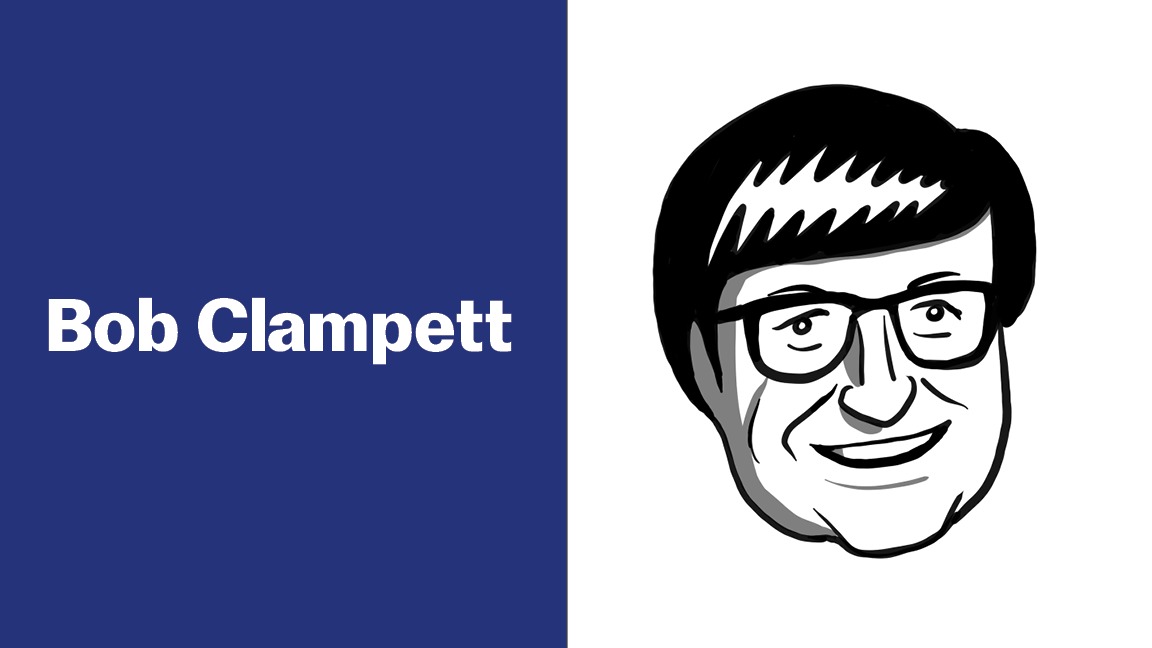
Who: animation director, jazz enthusiast, creator of Beany and Cecil (1962), hair icon.
The Case for Paternity: The rambunctious energy and always-in-motion style of Clampett’s cartoons created an atmosphere where anything could happen. More than any other director, Clampett defined the look and feel of “Looney Tunes” in its golden age. From Porky in Wackyland (1938) to Book Revue (1946), name a classic “Looney Tunes” toon from before 1948, and there’s a good chance Clampett directed it.
The Case against Paternity: He did not create Bugs Bunny.
After the sainted Manny Farber, the boomer children who watched The Bugs Bunny Show grew up to become the first critics and historians to take the “Looney Tunes” seriously as art. When young researchers began interviewing the surviving Termite Terrace directors for the first wave of books, articles, and documentaries in the 1970s, they found men who had received none of the millions of dollars of revenue their old cartoons were still generating. What these men had was their pride.
When the director Larry Jackson embarked on the documentary/compilation film Bugs Bunny Superstar (1975), he found that Clampett was the filmmaker who had kept his archives in the best shape. In exchange for his participation, Clampett insisted on serving as onscreen host, and was guaranteed approval of the final cut. The resulting film perpetuated the idea that Clampett was the author of the “Looney Tunes” and, by implication, Bugs. Though Avery and Freleng were also interviewed, their contributions were downplayed, and Jones was conspicuously absent. In 1979, Jones struck back with a compilation film of his own, The Bugs Bunny/Road Runner Movie, which combined classic Jones-directed cartoons with newly animated links. In one scene Bugs, in his mansion, wanders by portraits of his “several fathers,” whom he identifies as Avery, Freleng, McKimson, and Jones himself. The snubbing of Clampett—a greater and more consequential artist than Freleng or McKimson—was petty, but in fairness to Jones, he had a point. Bob Clampett did not create Bugs Bunny.
Paternity-o-Meter:


Who: “Man of a Thousand Voices.”
The Case against Paternity: As the voice of Bugs Bunny and most of the other best-known “Looney Tunes” characters, Blanc is the most famous voice actor of all time, and probably the single most recognizable human name associated with Warner Bros. cartoons. Nevertheless, he was a hired gun reading other people’s lines—a reality that must have needled him, since his 1988 autobiography That’s Not All Folks! is full of far-fetched stories about his role in the development of various characters. He claims that when chatting about the rabbit with Schlesinger, he offered, “Why not call him Bugs, after Ben Hardaway?” and “I suggested we make it alliterative: Bugs Bunny. ‘Like Porky Pig,’ I said, popping my Ps.” Blanc reports that Schlesinger “nodded in agreement” and the rest was history. Blanc also takes credit for ad-libbing the line “What’s up, Doc?”—which is not backed up by any of the other Warner artists.
The Case for Paternity: Still, Blanc deserves mention in this conversation because as Elmer’s Candid Camera shows, Bugs is simply not the same character without his distinctive voice. The difference between the Bugs in that cartoon and the one in A Wild Hare, beyond certain design improvements, is his smart-aleck Brooklyn attitude. The voice would become a little softer in subsequent cartoons, but the attitude remains constant. “Clarity is perhaps the most crucial element for any cartoon or radio characterization,” Blanc writes in his memoir. Not everything he said holds up to scrutiny, but this one does.
Paternity-o-Meter:

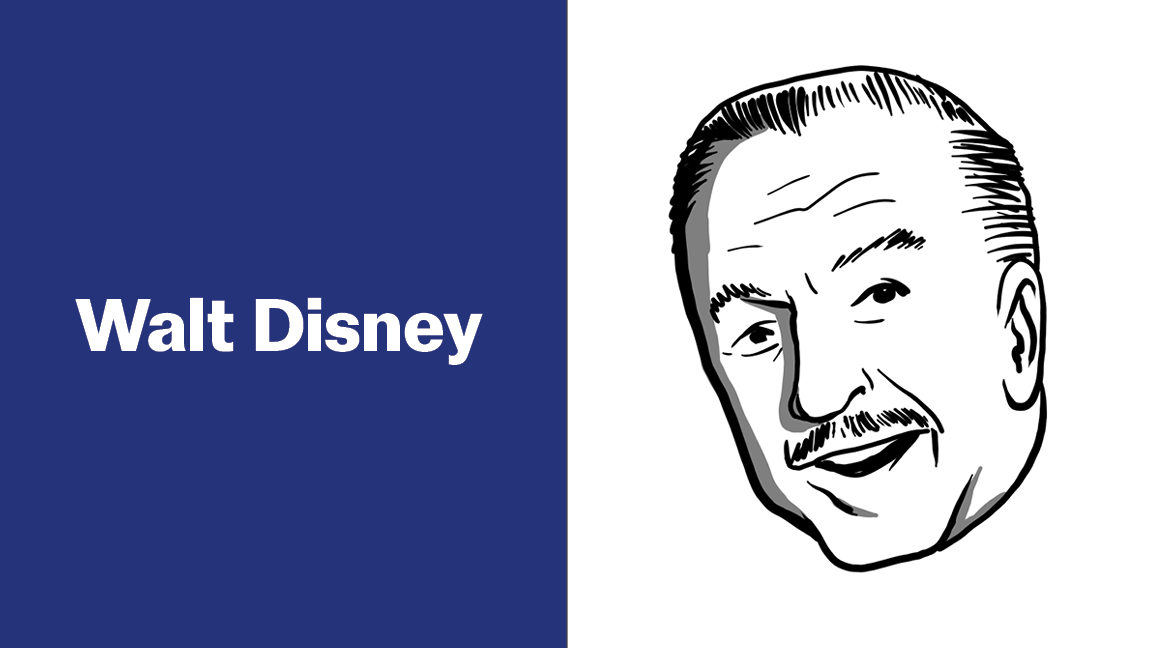
Who: producer, entrepreneur, HUAC “friendly witness,” founder of the Walt Disney Company.
The Case against Paternity: Walt Disney had no direct involvement in the creation of Bugs Bunny…
The Case for Paternity: …but much like how Charlie Chaplin created a template that dozens of silent comedians followed, the “Looney Tunes” would not exist without Disney’s “Silly Symphonies.” If we’re doing a DNA test, he is in there somewhere. Throughout the 1930s, Disney’s animation studio was the industry’s undisputed artistic and technical leader, and Termite Terrace followed his lead: Mickey Mouse was the model for Warner’s first cartoon star, Bosko—a happy-go-lucky boy who may or may not have been a minstrel stereotype (the design leaves just enough reasonable doubt for a jury to acquit). There’s a little Mickey in Bugs, but he has a lot more genetic data from the 1935 “Silly Symphonies” cartoon The Tortoise and the Hare, with its cocky, wisecracking lead character, Max Hare. “Bugs Bunny is nothing but Maxie Hare,” said the Termite Terrace veteran Frank Tashlin years later. “Mr. Disney was polite enough never to mention it, because he didn’t have to,” Avery later admitted, perhaps remembering that his follow-up to A Wild Hare was… Tortoise Beats Hare (1941).
Paternity-o-Meter:

Share:
Recommended
- Material Memories
 The ongoing effort to bring African film heritage home.
 - Minor Indignities in Moviegoing
 The two friends swap stories about their weird and wonderful experiences at the cinema.
 - Limelight: Ann Hui
 On the long, tenacious career and lyrical films of the cinematic poet laureate of Hong Kong.