

Interview
Igor Bezinović
The director discusses his anachronistic recreation of the birth of Fascism.
Fiume o morte! (2025) opens at Metrograph on Friday, April 10.
Share:
IGOR BEZINOVIĆ’S FIUME O MORTE! (2025) tells the bizarre but true story of Italian poet-turned-temporary-dictator Gabriele D’Annunzio, who in 1919, with more bravado than bullets, led a nationalist takeover of the city of Fiume on the Adriatic Coast, after it was proposed it become part of the newly formed Yugoslavia. Declaring Fiume to be an independent state, and ruling for 15 months with a proto-Fascist mix of pomp and brute force, D’Annunzio went down in the Italian history books as a national poet-hero, but Fiume—today the city of Rijeka in Croatia—does not remember him the same way, if at all.
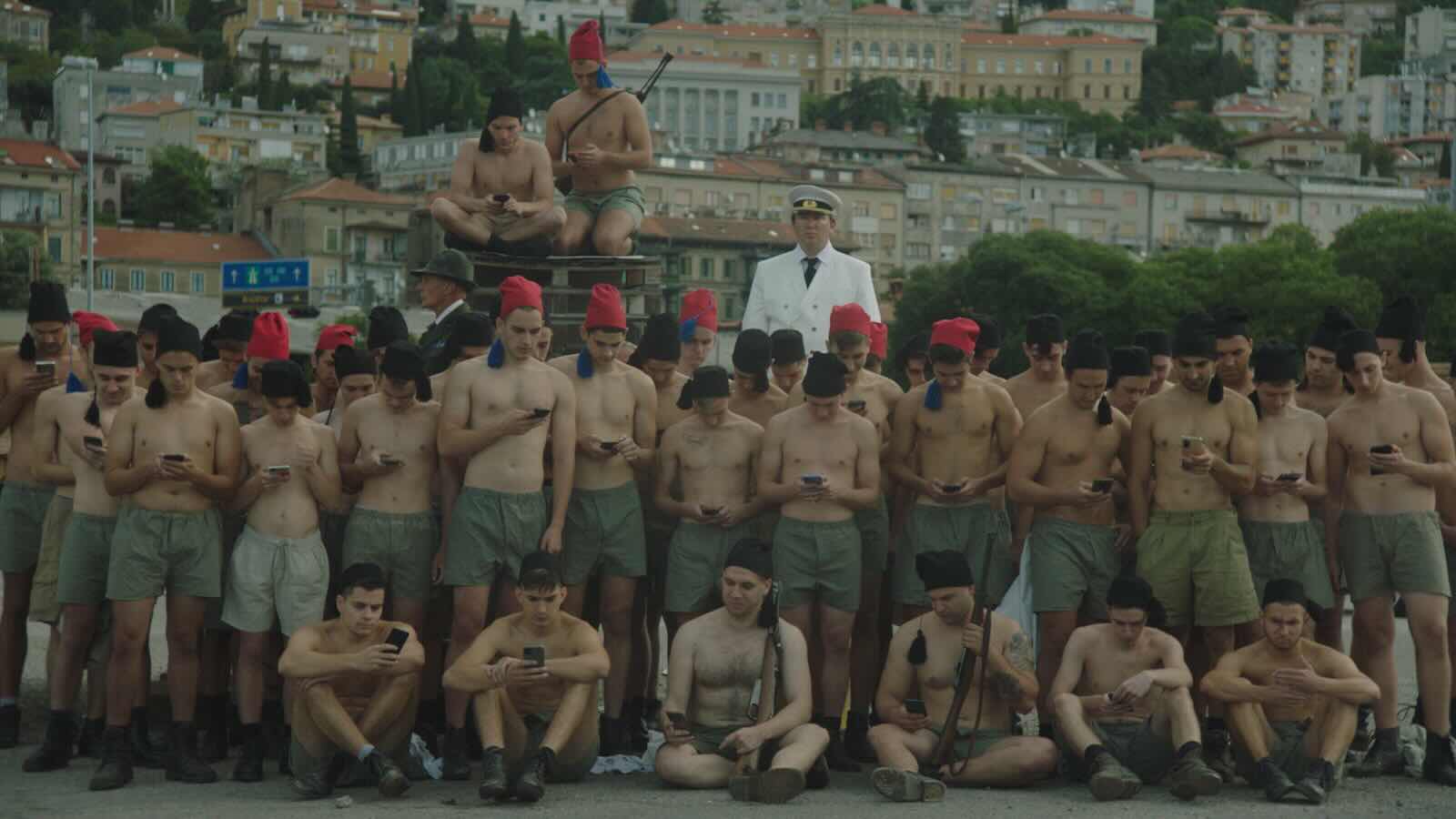
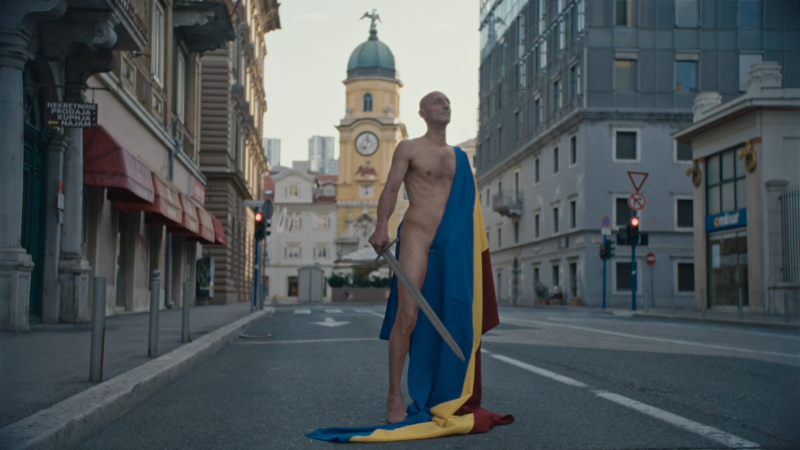
Bezinović’s hybrid approach builds up this stranger-than-fiction fact from the ground up with people-on-the-street interviews, deadpan voiceover, urban detective work, and—most prominently—glorious reenactments of episodes from the takeover and tableaux from D’Annunzio’s self-mythologizing, all performed by a cast of locals in different shades of ordinary affect. Costumes, cars, and other paraphernalia freely employ anachronism in a way that plunges us into the present of the past while also poking fun at the pretensions to D’Annunzio’s flamboyant but also genuinely destructive occupation, which ended with the Italian government’s naval bombardment of the city-state and served as a potent model for a young Benito Mussolini (who figures in the film). Rooted at all times in the historical record and sites, the depiction of D’Annunzio’s folly bops along until the inevitable blood is shed after everyone else loses patience.
None of which would, of course, happen anywhere ever! Unless… Well, Bezinović explained the possible resonance of Fiume o morte! in the era of tinpot tyrants, speaking over Zoom from his sunny hometown Rijeka, in a conversation spanning the art of reenactment and the ever-lasting importance of Mr. Watkins. —Nicolas Rapold
NICOLAS RAPOLD: Thanks for taking time to chat about Fiume o morte! Are you in the middle of preparing another movie?
IGOR BEZINOVIC: Absolutely not. [Laughs] I’m in the middle of a bunch of traveling, presenting the film. In a few days, I’m going again to Italy. I’ve already presented it there more than 20 times, but they keep inviting me. After Italy, I’ll go to the Czech Republic for a lecture, and then I am coming to New York to meet you guys!
NR: What do you think about the continued interest in this chapter of Italian history? Or the nature of this interest, I might ask.
IB: It’s a story of national relevance, and it’s the first time the story has been told from the perspective of the citizens of Rijeka, which is now in Croatia. There is this myth about D’Annunzio that is still positive for many Italians. Not all, we have to say, but many Italians consider him a hero, as you see in the film. In Italy, the film has very small distribution, a limited release in alternative cinemas. I don’t think the film will go into mainstream Italy, but I hope it will keep going because it’s something you don’t see in Italy, this kind of discourse.
Fiume o morte! (2025)
NR: I loved it, and I almost got worried about how much I was enjoying it. [Igor laughs.] But that’s the way you made it: you laugh at the outrageousness of it—then at the end, people are dying. So sometimes it’s funny, sometimes it’s grotesque, sometimes it’s scary. What did you want it to feel like?
IB: First of all, the idea behind the film is pretty rational. It’s more related to ratio [reason] than to emotions, in the sense that I wanted to openly say that we are reconstructing a story and we’re not hiding that. This was the concept. Then I was just following the different emotions I was encountering. It is basically a reproduction of my personal take on the event, which was, I think, a farce and a tragedy at the same time.
NR: In your interviews on the street, people’s reactions vary, but I was struck by who did or didn’t remember the history. Did you want to show that this is on the edge of being forgotten?
IB: For many people, it’s already forgotten. I mean, not on the other side of the border, in Italy, but the story is completely different there. On this side of the border, it’s either forgotten or seen as a proto-Fascist act. Obviously, I see it as a proto-Fascist act, and an event that determined the history of my hometown in a very bad way. But if I did the vox populi research on the streets of Trieste, which is very close, I would get completely different answers. It really depends where you’re asking the question.
NR: You’re still in Rijeka, right? Do you live near any landmarks related to these events?
IB: I can show you what I see in my window [turns laptop camera to face out window]. See the church bell up there? It was built in the early ’30s, when Fascism was already here. Rijeka was under [Mussolini’s] Fascist government for 20 years after D’Annunzio, so they decided to build a very beautiful rationalist church in a Fascist architectural style, which is still there up on the hill. Next to it is the cemetery where D’Annunzio’s legionnaires were initially buried, before they moved the bodies. Wherever you turn your head, there is something related to history and to the multicultural core of this city.
NR: But the story of D’Annunzio isn’t something you learned until university?
IB: Yeah, I didn’t learn about it in high school. I knew the name, D’Annunzio. It was mentioned—something related to Fascism. But nobody explained the history of Rijeka as a kid. I didn’t understand how the Italians were here but now the Croatians are here; the history is so complex—it would take at least five minutes to give you the basic 20th-century history, I’m not going to go there. But I knew the name D’Annunzio had a sort of negative connotation. And then in Italy, in Padua, when I was there on a student exchange program, I bought a book called At the Party of the Revolution [Alla festa della rivoluzione: Artisti e libertari con D’Annunzio a Fiume]by the Italian art historian Claudia Salaris. The whole occupation is presented as something positive and artistic, sort of like a pre-Woodstock—she literally mentions the word Woodstock. I realized that there is a huge discrepancy between the perception of the story in Italy and in Rijeka. So I started reading more.
I was really trying to find the Woodstock elements here in this occupation, but it’s not that easy. I mean, if you were one of D’Annunzio’s legionnaires or D’Annunzio personally, you had a good time: you had a playground in which you were allowed to do anything because there were no rules, and you were the ones opposing the rules that existed before you came. In Italy, it’s seen as some sort of libertarian revolution. Here, it’s mostly seen as proto-Fascism. I never say “Fascism.” I always say “proto-Fascism” to make clear it was pre-Fascism.
NR: When you describe it that way, it sounds a bit like Salò (1975).
IB: Of course, Pasolini is a big name in my formation as a film director. I presented the film in [the city of] Salò as well. The organizers weren’t allowed to play the film in the cinema so they organized a screening in a public library.
NR: It sounds like they were a little sensitive about showing it there.
IB: Not the organizers but the city council, for sure. The city of Salò after which the film Salò is named is like five minutes away from Vittoriale, [the estate containing] D’Annunzio’s villa and the D’Annunzio Foundation. When you visit Vittoriale, you can visit Salò as well.
NR: A grand tour.
IB: If you want an Italian Fascism tour, it’s the best place to be.
Fiume o morte! (2025)
NR: What do you think of D’Annunzio’s writing, his artistic output?
IB: I think it’s outdated from today’s perspective. It’s aestheticism, which people don’t really consume as literature or poetry [these days]. There are some poems I like, and I forced myself to read a couple of his novels and a few dramas, and a lot of poems. I also studied comparative literature, so I wanted to get a notion about his writing, but it’s not something I would suggest to you.
NR: Only if I’m making a movie about the man.
IB: Yeah. He’s a poet who is like a national classic, so you can’t find a city or a town without a road or a piazza dedicated to D’Annunzio. If you come to the Venice Film Festival, you’ll see on the Lido, there’s a Gabriele D’Annunzio road, and a road for Guglielmo Marconi, the guy who invented the radio and visited D’Annunzio [during the occupation of Fiume]. All the streets are named after this eastern Adriatic part, so you have Via Fiume, Via Istria, Via Dalmazia. The whole Lido has this memorialist relation to Italian irredentism. Now you won’t be able to unsee it.
NR: The role of Marconi is another important part of the film; he and all these industrialists line up to meet D’Annunzio.
IB: It’s like today. The oligarchs have their own leaders, and it’s a combination of charismatic leaders and oligarchs who are useful to each other.
NR: Let’s talk about the reenactments in your film—is that the word that you would use?
IB: Yeah.
NR: What movies inspire your use of reenactment?
IB: The films by Peter Watkins are very important. He is the legend of reconstruction or reenactment. And I am very influenced by Želimir Žilnik and Dušan Makavejev, two Yugoslav film directors of the Black Wave. And, as I said, Pasolini, who wasn’t doing reenactments but had a humorous way of dealing with politics. There’s a lot of Nanni Moretti too. These are classics for me, and it’s interesting when people see this film and say, “Oh, I’ve never seen something like this before.” I always refer them back to some part of film history, just to say I’m proud to be part of a tradition, and my work wouldn’t be like this if I didn’t know these authors.
NR: What are you bringing to the tradition that you feel is different from, say, Watkins?
IB: I think it’s much more digestible for a regular audience than Peter Watkins. I love his films, but I don’t think they were made for general audience. I didn’t really want to make a film for general audience, but it turned out that it’s the most viewed Croatian documentary of all time already. It became a crowd-pleaser and it’s showing all around the world. There’s more humor for sure. It’s like a political comedy, maybe more light-hearted than Peter Watkins. It definitely has some Peter Watkins in it, but it’s not Peter Watkins.
NR: He seemed like a serious guy.
IB: Yeah. I had a chance to organize a retrospective of his films in Zagreb, and we were exchanging a few emails. He wrote an essay for it. It was just a random Croatian retrospective of his work, and he decided to sit down and write an introductory text. Nobody paid him to do it or proposed it. He just said, “I’ll do it.” He took his work seriously, and he was dealing with serious topics, so I can understand.
NR: In terms of your reenactment, how did you direct people?
IB: I think for every film, whether it’s documentary or fiction or hybrid, casting is essential. Most of the directing is trying to understand who this person is and what he or she can do in front of the camera. Then it’s a matter of experience. I’m a documentarian, so I’ve placed a lot of people in front of the camera and observed how they behave. I’m basically asking people to do something that I already know in advance they’ll be able to. It wasn’t complicated, but I gave pretty strict directions. There were around 300 people who performed, and with each person I had a different approach, because it’s really a psychological thing.
NR: Was there anyone who you would now want to use in a fiction film?
IB: Oh, I would say all the seven guys who acted as D’Annunzio. I’m very happy with their choices. A lot of the narrators in fiumano dialect were good. Lovro Mirth, the guy who was performing “Giovinezza,” the song throughout the film [and the official hymn of the Italian National Fascist Party], is a professional jazz singer. He was the guy playing [volatile lieutenant of D’Annunzio] Guido Keller.
NR: One of the reenactments I was curious about is when people dressed all in black are throwing furniture and debris out of a building. How did this scene come together?
IB: I knew I wanted to direct a scene dedicated to these two days of people vandalizing non-Italian property in the city. Hundreds of people, both soldiers and civilians, were sacking the shops and businesses of people who were not Italian. I didn’t have the means to take 200 extras and do that, so I thought about how to represent it in a way that seemed spooky and at the same time worked as a scene [within my means]. So, as a metaphor, I took these two guys to throw things out of the shops. They had a lot of fun.
Fiume o morte! (2025)
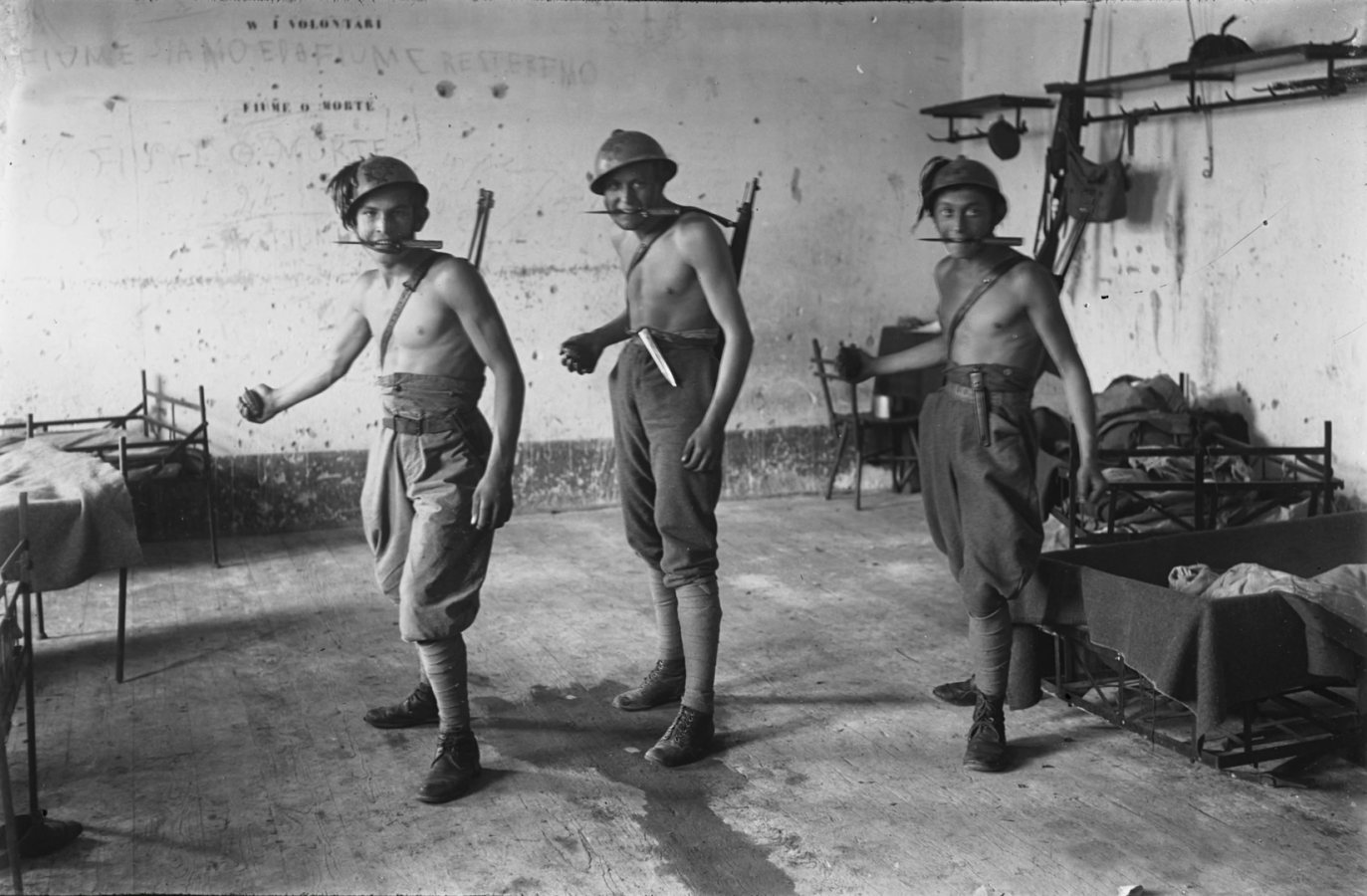
NR: When you were re-creating historical scenes or photographs, did you tell your cast to have fun with it? One might expect them to look serious or posed.
IB: I didn’t have to—they all applied to act in the film because they saw it as something fun. And they realized that we behind the camera were also people enjoying this playfulness. But it also depended on the scene. I knew that the final scene re-enacting Bloody Christmas [a series of clashes in 1920 between D’Annunzio’s legionnaires and the Royal Italian Army] would be brutal in the end, that we’d have dead soldiers. I knew it had to end in this more serious tone. The dramaturgy of this film is interesting for people because you see everybody having fun, fun, fun, fun, fun, until the end when you go out of the cinema and think, “Okay, this was the beginning of Fascism.” And that’s maybe a good thing to think about today, that sometimes we feel something is playful or harmless, but if you see the consequences, it can end as tragedy.
NR: That was one of my main thoughts about the movie: you might not recognize fascism because it looks so silly.
IB: Yeah, absolutely. Speaking of the United States of America. Dot, dot, dot…
NR: Exactly. But it’s interesting that this is all happening before a lot of modern mass media—
IB: Do you have an animal there?
NR: Yes, sorry, she is purring really loudly.
IB: She’s enjoying it. I’m saying wise things. [Laughs.]
NR: For the record, she is against fascism. Tell me about the media aspect of D’Annunzio’s occupation and its role in his rise to power.
IB: The reason I think that the situation today is so similar to the one in 1919 is that this whole event [the occupation of Fiume] was a media event. The media today is much more complex than media was back then, but I think it’s important to remind ourselves that this occupation was on the headlines of all magazines all over the world, it was huge news. It was a very clickable thing, to use today’s vocabulary: a poet occupies a city. It sounds good for a headline on The New York Times. The media was crucial for D’Annunzio’s approach, the military is crucial for him, and capitalists, oligarchs, are the ones who are financing him. So you have this combination of media, militarization, capitalism, and nationalism. All four elements are very common for many regimes in the world today: they’re enforcing military actions by combining it with capitalist investors and media. It’s scary when you think about it.
NR: The entertainment value is a major part of all this because it makes it easier for people to support him.
IB: We forget when we think about these charismatic leaders or dictators that they’re just the tip of the iceberg. That he’s just a representative of a very, very strong and rich system of people who are profiting from him.
NR: So how do we get out of this? I’ll note that your first feature, The Blockade (2012), is about a massive student protest in Croatia.
IB: Showing that you’re opposed to something publicly is very important. I think disobedience is a method that in hard times that we should apply—non-violence.
NR: Near the end, after all this, we see a clip of D’Annunzio enjoying himself, years later, entertaining people at a port. Was that a hard clip to obtain?
IB: It’s actually on YouTube, but it was hard because the rights were expensive. I’m obsessed with how commercial archives are limiting creative possibilities for making historical documentaries. It’s something we need to address: our creativity is being limited by somebody’s profit. He or she might not be the author of the video or photo but a company that is reselling you stuff. As David Lynch would say, it’s bullshit.
NR: Haile Gerima says the same thing in his new nine-hour film about the Italian Fascists invading Ethiopia: colonial legacies make it expensive to use archival materials that would tell the full story.
IB: What’s the name of the film?
NR: Black Lions—Roman Wolves (2026). How did the people who acted in the film feel about D’Annunzio and these events afterwards?
IB: They felt differently not after the shooting, but after they saw the film as a whole. We had a screening for the city—we invited everybody who appeared in front of and behind the camera. It was a huge event; people were watching as if they were at a football stadium. They were cheering, applauding, laughing, pointing at the screen. They took this whole event as something they’re proud of. They knew we had reclaimed the story, in a way, and that they were part of this reclamation.
There are two other things I’d like to briefly tell you since I’m presenting the film in New York. At the beginning of the 20th century, there was a direct ship line between Rijeka, or Fiume, and New York.
NR: For what sort of commodities?
IB: It was a big emigration port from the Austro-Hungarian Empire, so it was people moving to the US. The other trivia is that Fiorello La Guardia wanted to become the Consul General in Fiume. He lived here in 1904 until 1906. And when they refused to promote him, he moved to New York City. So he didn’t succeed in Fiume, but did in New York, which is pretty funny. There are a lot of parallels, because they were both multicultural cities at that time: this microcosmos for the Austro-Hungarian Empire, and the New York that would become, through Fiorello La Guardia, the ideal of a multicultural city.
NR: So if La Guardia had succeeded in Rijeka, we might not have had modern New York! But we also might not have had D’Annunzio in Fiume.
IB: That’s true.
NR: It’s a trade-off. I’m sorry.
IB: But good for you!

Share:
Recommended
- Genevieve Yue’s Trains
 On the offbeat pleasures of the train in Genevieve Yue’s new book.
 - Yuliya Solntseva
 On the actress-turned-filmmaker’s unsung authorship.
 - Futures and Pasts: Socrates
 Rossellini’s one-of-a-kind approach to the costume drama, and his 1970 film on the last years of the Athenian truth-seeker.